Close-Ended Questions in Sales Discovery Calls
Close-ended questions work best after you've already built context and rapport.

There's a running joke in sales training circles: open-ended questions are the answer to everything. Bad call? More open-ended questions. Prospect went cold? Should've asked more open-ended questions. Deal fell apart at the finish line? You already know.
The joke works because the advice isn't wrong. It's just incomplete.
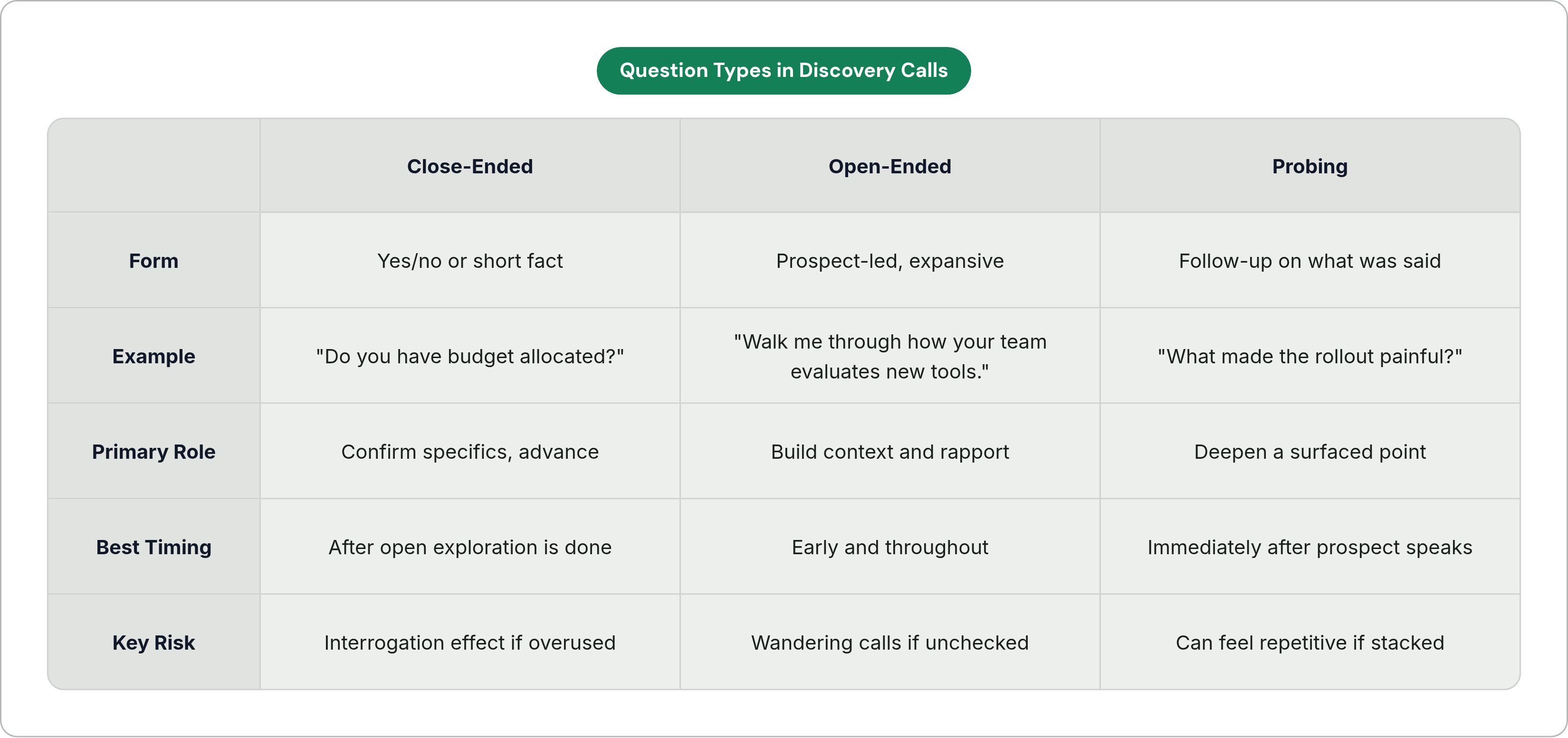
Quick definitions before we go further, because these terms get used sloppily. Close-ended questions get answered with a yes, a no, or a short fact. "Do you have budget allocated?" Close-ended. "Is she the final decision-maker?" Close-ended. Open-ended questions do the opposite. They hand the wheel to the prospect. "Walk me through how your team typically evaluates new tools." And then there are probing questions, which are follow-ups that dig into something the prospect just said. "You mentioned the rollout was painful. What made it painful?" All three belong on a discovery call. This piece is specifically about when the first type actually earns its place.
So why does discovery default so hard to open-ended questions? Because if you limit a prospect to yes/no answers, you limit the picture you can build. You get data points without context. You get facts without meaning.
Gong's analysis of over 519,000 recorded B2B sales calls put some weight behind this. Short buyer answers correlate with deals less likely to close. When buyers give more information, deals move faster. That's not just practitioner intuition built over years of getting humbled on calls. That's a pattern across hundreds of thousands of real conversations.
The talk-to-listen data lines up too. Gong's research found that successful reps land around 43% talking to 57% listening. The rep closing more is the one talking less. Open-ended questions create the conditions for that ratio to happen naturally.
None of what follows is an argument against open-ended questions. It's an argument for precision. "Open-ended questions are good" and "close-ended questions have no place" are not the same claim. The first is true. The second is worth pressure-testing.
What Actually Breaks Down When Close-Ended Questions Take Over
Picture this. You're on a discovery call. The rep fires off: "Are you the decision-maker?" Pause. "Do you have budget?" Pause. "Is this a Q3 priority?" You've answered three questions. You haven't said more than eight words. How does that feel?
Gong named this the interrogation effect. Struggling sellers fire off too many questions without building real dialogue. The prospect experiences it as extraction. There's no consultative texture. It feels like someone filling out a form with your answers, and you are the form.
There's a subtler problem too. Close-ended questions slide easily into leading questions. "So you're having trouble with X, right?" isn't really a question. It's the rep planting an answer and asking for confirmation. The prospect either agrees to move things along or pushes back, which now feels awkward. Either way, you've stopped learning what they actually think and started confirming what you already assumed. That's a bad trade.
Then there's the rhythm problem. Gong found that more back-and-forth speaker switches per call correlate with rep success. A string of closed questions collapses that rhythm into one-sided extraction. The conversation stops breathing.
But here's the thing. Too many open-ended questions in a row create their own mess. Wandering calls where neither party is sure what the point was. Prospects who feel like they're being asked to think out loud forever. The goal was never to maximize one type of question. It was to use each type at the right moment. So what does that actually look like?
The Specific Moments Where a Close-Ended Question Actually Belongs
There are four situations where a close-ended question pulls its weight.
Confirming facts before moving forward. Timeline, budget, decision-making authority. Once you've opened up the conversation and built real context, a tight binary confirmation closes the loop cleanly. "So the final call would go through your CFO, correct?" That's not a conversation-killer. It's a checkpoint before you build on top of something you haven't actually verified.
Fast qualification. Sometimes a single yes/no tells you whether to invest more call time. "Do you have budget allocated for this?" is a gate, not an exploration. Compare that to "How does your team typically fund solutions like this?" The open version surfaces procurement process, timeline, stakeholders, and urgency in one shot. Use the close-ended version after you've already done the illuminating. Not before.
Pulling focus when the call has drifted. This happens on every call without exception. The prospect goes somewhere useful but tangential. A tight closed question pulls things back without making a production of the redirect. "Are we aligned on what the main challenge is?" That's it. Shared footing restored.
Confirming the stakeholder map. Enterprise deals involve a lot of people with a lot of titles that don't always mean what you think. Once you've explored the landscape with open questions, efficiently confirming specific names and roles matters. "Is [Name] the final decision-maker?" after you've already surfaced the broader picture is useful precision. Asking it cold in the first three minutes is where it goes sideways.
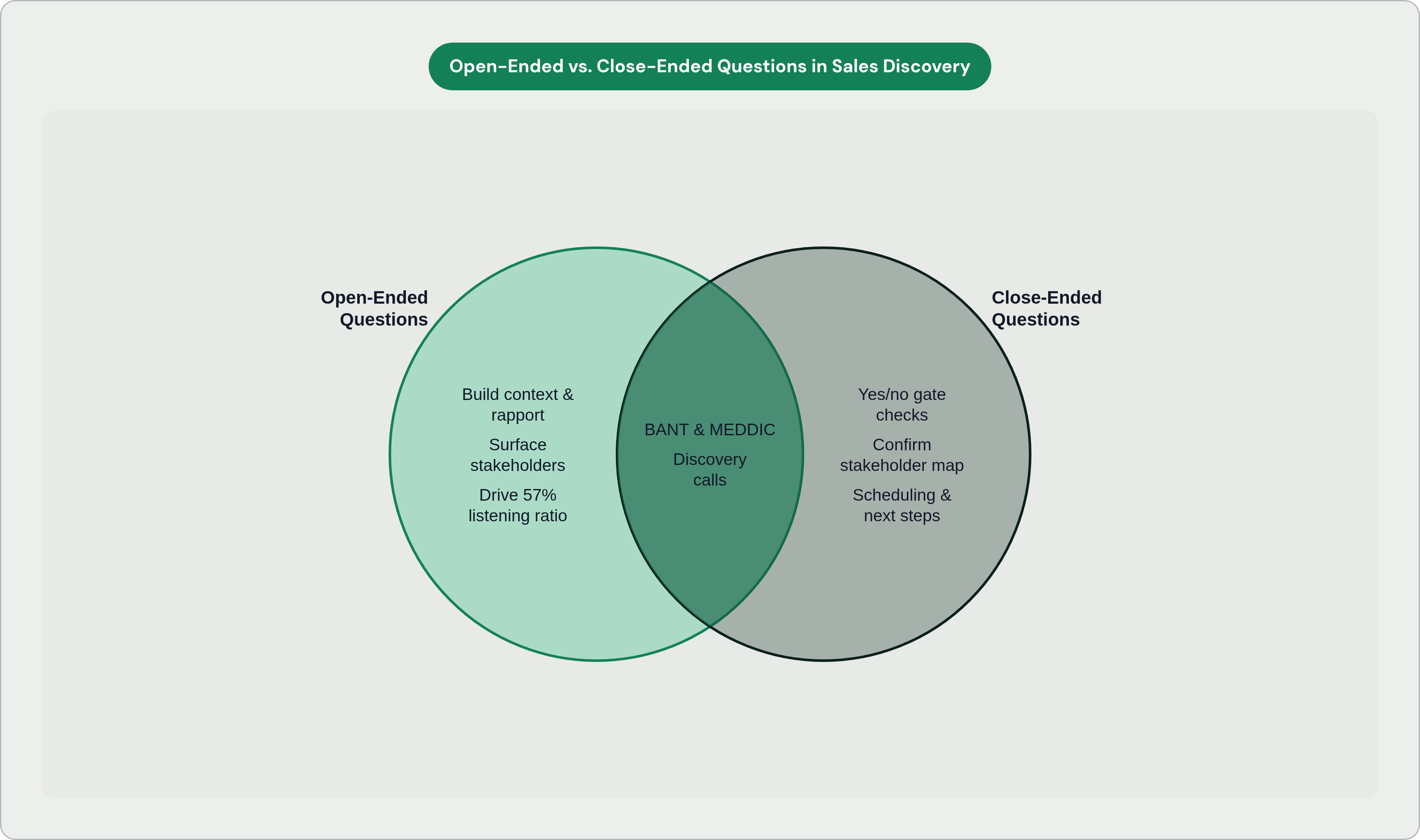
The sequencing that runs through all four of these is the same: open questions build context and rapport, close-ended questions come in later to confirm and advance. That order matters more than people realize, and inverting it is usually where calls start to feel like depositions.
SPIN Selling Made a Nuanced Point That Most People Missed
Neil Rackham spent twelve years and over 35,000 sales calls studying what actually separates top performers from average ones. The resulting framework introduced four question types: Situation, Problem, Implication, and Need-Payoff.
Rackham didn't argue that open-ended questions were the key variable. He argued that the type of question mattered more than the form. Situation questions confirm context and background, which makes them the category most analogous to conventional close-ended questions. His research found something that surprised people: top performers actually compressed their Situation questions. They asked fewer of them.
Not because Situation questions are bad. Because the best reps did the research beforehand and didn't burn call time confirming things they could have already known. There's a version of this I've seen play out a hundred times. Rep shows up on a call and spends the first ten minutes confirming the company's industry, headcount, and tech stack. All of which was on the website. The prospect is being reasonably polite but is definitely thinking about something else.
Modern reading of SPIN suggests keeping Situation questions under ten percent of call time. That frees up space for Implication questions, the ones that connect a recognized problem to its real consequences. Top performers asked roughly four times more Implication questions than average reps. That's where deals actually get made.
A tight, well-researched confirmation early in a call does two things. It signals that you've done your homework, which builds credibility fast. And it buys back fifteen minutes of call time that would otherwise get spent on basics. The real problem was never close-ended questions. It was Situation-heavy calls that burned time on context a rep should have walked in with.
BANT and MEDDIC Both Use Close-Ended Questions. Just Not Where People Assume.
BANT maps four things: Budget, Authority, Need, Timeline. IBM built it, and it's still everywhere in B2B sales.
The open version of each question produces more intelligence almost every time. "Do you have budget?" gets a yes or no. "How does your team typically fund solutions like this?" gets you procurement process, timeline visibility, who else is involved, and a read on urgency. One question, multiple answers.
But close-ended questions live inside BANT too. Just later, after the open-ended exploration has already surfaced the landscape. "So budget approval would need to go through your VP before we move forward, correct?" That's confirming something important before you proceed. Skipping that confirmation has burned deals at the end of the sales cycle when everyone thought they were aligned and weren't.
MEDDIC works the same way, and it's worth looking at because it was built for enterprise sales where the buying committee is large and the process is genuinely complex. Decision criteria and process dimensions require open-ended exploration first. Then close-ended confirmations lock in specifics. Who exactly holds final authority. Whether legal review is required. Whether the internal champion actually has executive access or just thinks they do. That last one matters more than people want to admit.
Open-ended questions build the picture. Close-ended questions confirm the details you actually need before advancing. Neither works without the other, and the order matters.
What Gong's Call Data Implies About How to Budget Your Questions
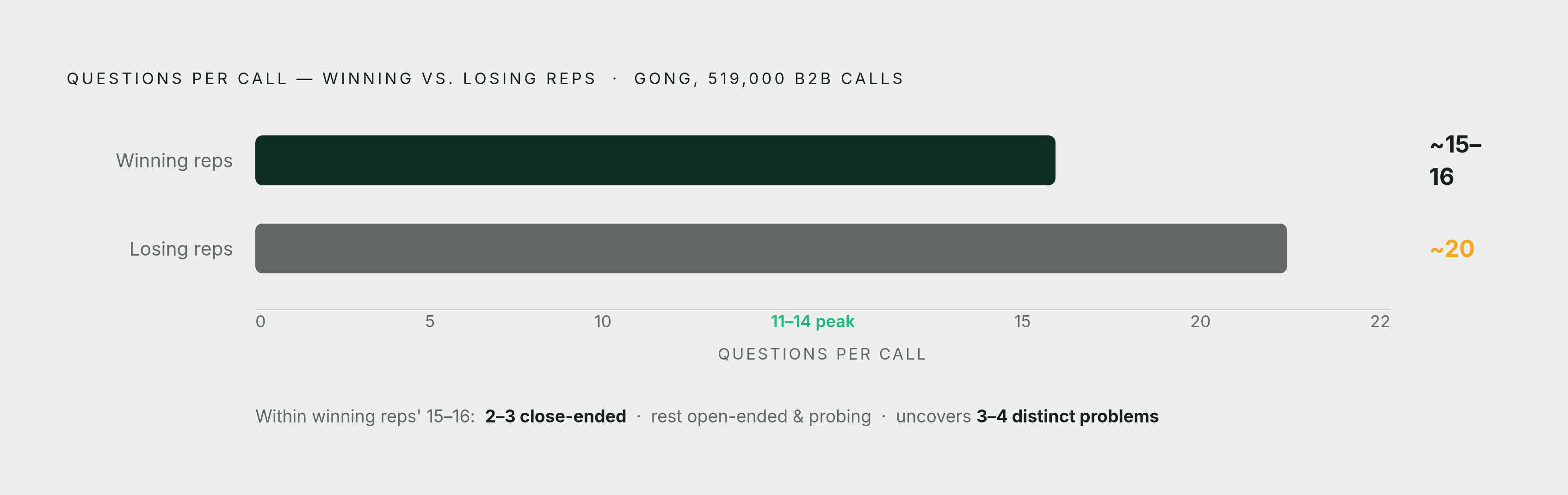
Gong's research across those 519,000 calls found something that cuts against the obvious assumption. Success peaks when reps ask eleven to fourteen targeted questions per call. Beyond that, the success rate drops back to average. More questions don't help. Targeted questions do.
Here's the part that sticks with me. Winning reps asked roughly fifteen to sixteen questions per call on average. Losing reps asked more, around twenty. The rep asking more questions is losing more deals. That should probably be a poster somewhere.
The companion finding is about depth. The most effective discovery calls uncover three to four distinct business problems. Reps who go deep on a small number of problems outperform reps who skim across many. Going wide is a way of feeling productive without actually learning anything.
So if eleven to fourteen questions is the target and three to four business problems need real depth, most of your question budget has to go to open-ended and probing questions. That's how you get the depth. Close-ended questions get a small, precise allocation. Maybe two or three woven in at the right moments. Not because they're inferior. Because the math doesn't leave room for more, and the calls that go well don't need more.

Practical Signals That Tell You a Close-Ended Question Is the Right Move
Knowing when in theory is one thing. Feeling the moment mid-call is different. Here are four signals worth watching.
You've built context and need to confirm a specific fact before advancing. The open-ended exploration is done. A binary check closes the loop before you move forward. Don't skip it just because you think you heard the answer earlier. Confirm it.
The conversation has drifted. A direct closed question restores shared footing without drama. "Are we aligned on what the core challenge is?" brings you both back without making the redirect awkward.
You're moving toward next steps. Scheduling and commitment are naturally close-ended territory. "Does Tuesday work?" is not a question that benefits from being open-ended. Nobody needs to elaborate on their availability.
You need to confirm understanding before going deeper. "So the current process is [X], right?" signals that you were listening and prevents ten minutes of exploration built on a detail you misheard thirty seconds in.
One thing to actively avoid: using a close-ended question to open new territory. That's where the conversation-killing dynamic actually lives. Open-ended questions open new ground. Close-ended questions confirm what's already been surfaced.
Watch the leading-question version too. "So you're frustrated with your current tool, right?" plants the answer. The prospect either confirms it or corrects you, and neither direction is great. Rephrase it: "What's your experience been with your current tool?" Let them name the frustration. It lands harder when they say it themselves.
And after a close-ended question gets its yes or no, follow it immediately with an open or probing question. The closed question confirmed something. The open question develops it. That pairing is where the rhythm stays alive and the call stays useful.
Close-ended questions aren't the problem. Misplaced ones are.