Inbound vs Outbound Sales Models Compared
Buyers now research independently first, forcing both models to compete in a shifted landscape.
Buyers have already made up their minds about you before you ever get the chance to pitch them.
Roughly 70% of B2B buyers complete significant research on their own before any sales contact happens. They're reading comparison guides, watching demo videos, asking peers on Slack, and forming opinions. By the time they talk to a rep, they've already narrowed the field. The self-directed buyer isn't a trend. It's just how buying works now.
Buyers spend only about 17% of their total purchasing time actually meeting with vendors. Everything else goes to internal debates, independent research, and conversations with people who are definitely not you.
A few numbers worth sitting with:
- The average B2B deal now involves 6 to 10 stakeholders. Enterprise deals can hit 17 or more.
- The average sales cycle stretched to 6.5 months in 2024, up from 4.9 months in 2019.
- A third of all B2B buyers say they'd prefer a buying process with no seller involvement whatsoever. Among millennial buyers, that number climbs to 44%.
Both inbound and outbound are competing in an environment where buyers are actively avoiding salespeople, taking longer to decide, and looping in more people before they commit. Inbound fits naturally into that self-directed research phase. Outbound has to interrupt people who weren't looking for you. Neither model gets to skip that reality.
The Inbound Model: How Leads Arrive, What They Cost, and How Long It Takes to Build
Inbound is simple in theory. Prospects find you. A blog post, a gated tool, a referral, an SEO-optimized comparison guide. You build the conditions. They initiate contact.
One well-written piece of content can generate leads for months without adding anyone to payroll. But it takes a while to spin up. A real while. I once watched a content team spend nine months publishing three articles a week, convinced the traffic was just around the corner, only to discover their domain authority was so low that Google had essentially filed their work under "maybe later." The content wasn't bad. The foundation wasn't there yet.
The cost profile
Inbound leads average around $135 per lead. For B2B SaaS specifically, customer acquisition cost runs roughly $200 on the inbound side. Both are meaningfully lower than outbound.
Lead quality is where inbound really earns its reputation. Inbound lead-to-MQL conversion rates run at 36%, compared to 14% for outbound-sourced leads. Inbound leads arrive already knowing something about you, which means the first conversation skips a few awkward steps.
The hidden vulnerability
Leads contacted within 5 minutes are 21 times more likely to qualify than leads reached after 30 minutes. The average response time across B2B teams? Forty-seven hours.
You spend months building the content program. Someone finally raises their hand. And then the internal process fumbles the handoff badly enough that the moment passes. The content gets blamed. The real problem is operational.
One signal worth watching: traffic from AI assistants like ChatGPT and Perplexity converts at around 5.8% on average, slightly above organic search at 4.9%. The theory is that the AI pre-qualifies the visitor before they click through. Whether that holds as AI traffic scales is unclear.
The real weakness
Content programs take 6 to 12 months to build consistent pipeline momentum. If your CEO wants pipeline next quarter, inbound is not the answer. And even once it's working, CAC payback for inbound runs 12 to 24 months. Lower cost per lead, yes. But the investment takes a long time to pay back.
The Outbound Model: How Pipeline Gets Created, What It Actually Costs, and Where It Breaks Down
Outbound is the model where your team goes to find the buyer. Cold email, cold calls, LinkedIn sequences. You build a list of target accounts and you start reaching out.
The big advantage is speed. Outbound can generate pipeline in weeks. And despite its reputation as the scrappy, unfashionable option, it represents roughly 55% of all B2B leads generated.
The conversion reality
The numbers here are humbling.
- Industry-wide conversion from cold calls to booked meetings averaged 2.3% across more than 200,000 calls in 2025.
- Average cold email reply rates run between 3% and 5.1%. Open rates dropped from 36% in 2023 to 27.7% in 2024, a 23% decline in a single year.
- It now takes an average of 18 touches to book one meeting. A few years ago, it was 5 to 7.
69% of B2B buyers say they're open to cold calls from new providers. And 82% have accepted a meeting from cold outreach. Buyers aren't hostile to outbound. The execution is usually just bad.
The gap between stated openness and actual conversion is an execution problem. Most outbound is generic, impersonal, and timed badly. It doesn't feel relevant because it usually isn't. Sending a cold email without context is like showing up to a first date and opening with your résumé — technically you've made contact, but you've already lost the room.
What actually works
Multichannel sequences combining email, calls, and LinkedIn increase engagement by 287% compared to email alone. Signal-led prospecting, reaching out based on actual buying signals like a recent funding round, a surge in hiring for a specific role, or a tech stack change, tends to outperform static lists. Reaching out to someone who just hired three enterprise sales reps is not the same as reaching out because their company appeared on a list someone built in 2023.
The cost structure
Outbound leads average around $346 per lead. B2B SaaS CAC runs roughly $400. Cost per qualified sales opportunity from cold outbound can run $400 to $800, and that's before SDR salaries, management overhead, and tool costs.
The structural problem is that outbound scales linearly with headcount. Want more pipeline? Hire more SDRs. The cost curve doesn't flatten.
Where the Two Models Diverge on Cost, Conversion, and Sales Cycle Length
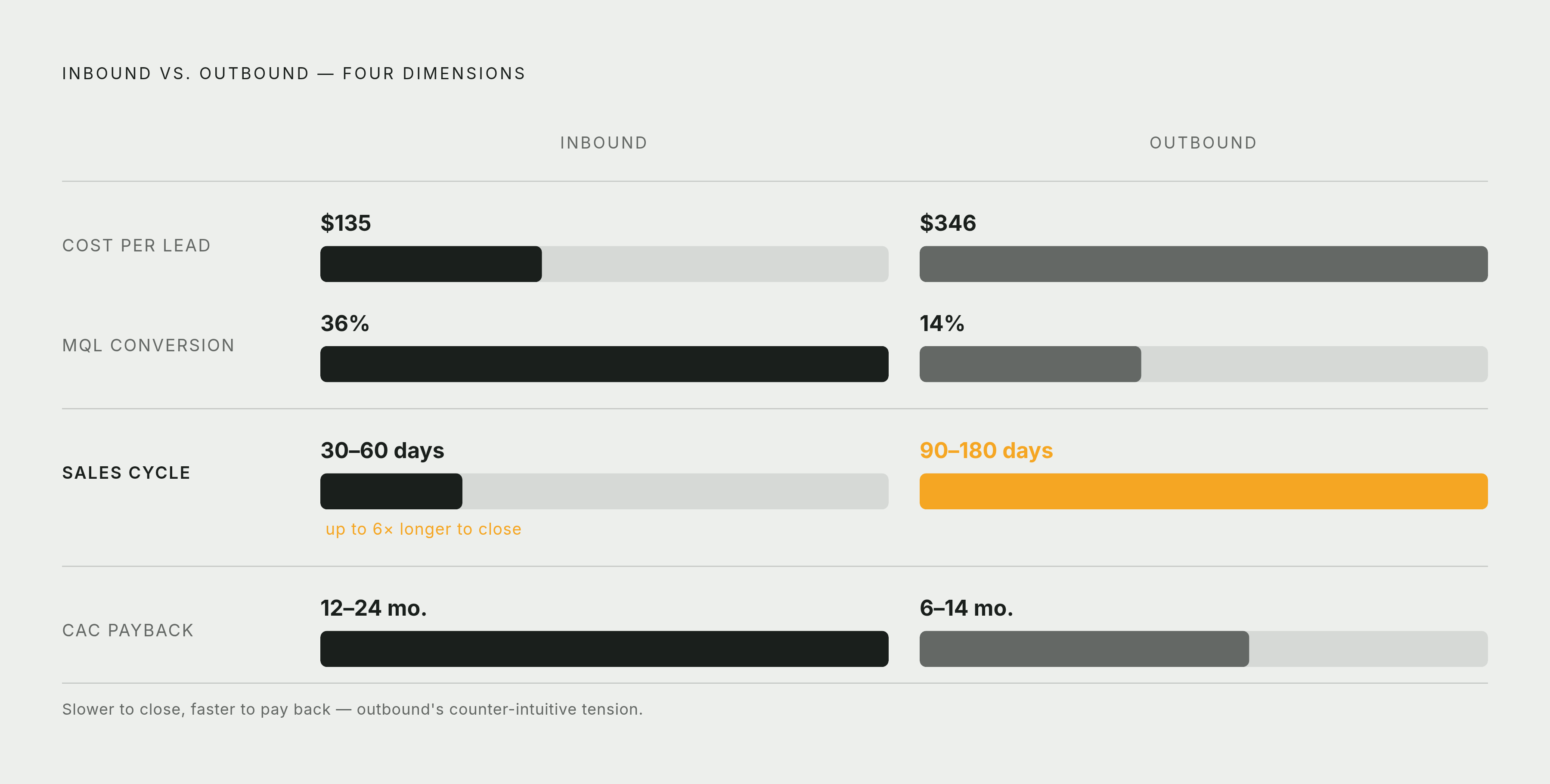
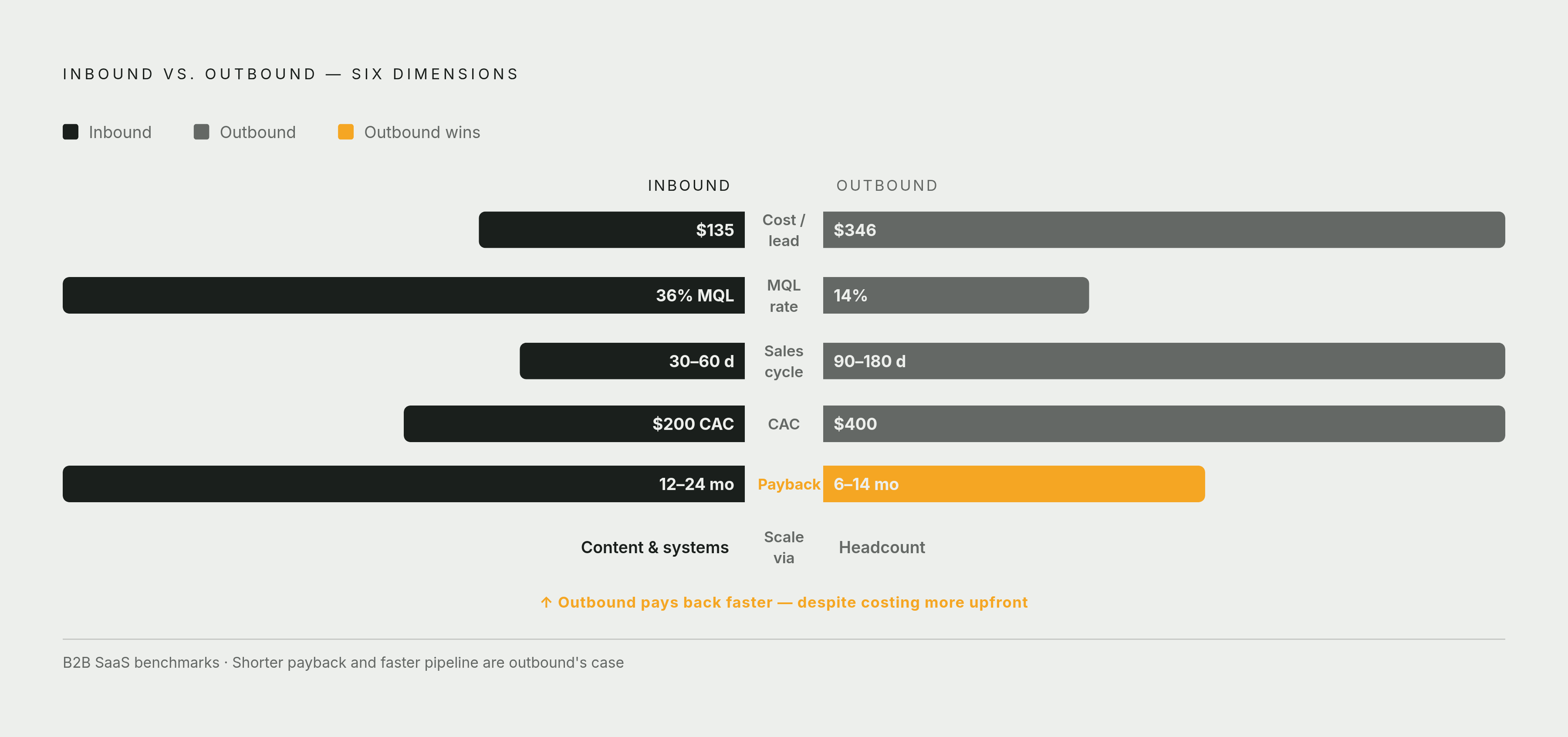
Put them side by side and here's what you're actually looking at.
Cost per lead. Around $135 for inbound, $346 for outbound. That gap has been growing as inboxes fill and spam filters get smarter.
Lead quality. Inbound leads convert to MQL at 36%. Outbound leads at 14%.
Sales cycle. Warm inbound leads typically close in 30 to 60 days. Cold outbound leads run 90 to 180 days. Warm leads convert at higher rates and close 50 to 67% faster.
CAC payback. Outbound CAC payback runs 6 to 14 months in mid-market B2B. Inbound payback runs 12 to 24 months. Outbound costs more upfront but recovers that cost faster. Inbound is cheaper per lead and converts better, but you're waiting longer to see that investment come back.
Scalability. Inbound scales with content and systems. One asset, working indefinitely, not asking for a raise. Outbound scales with people. More reps means more pipeline, but also more cost, more management, and more things that can go sideways.
Neither model dominates cleanly. Anyone telling you otherwise is selling something.
Which Conditions Favor Inbound, Which Favor Outbound, and Where the Model Choice Actually Gets Made
Doing two things halfway often produces worse results than doing one thing well.
Inbound tends to work when:
- The addressable market is broad enough that content can attract many different types of buyers.
- The team has runway to invest 6 to 12 months before consistent pipeline shows up.
- Budget favors lower cost-per-lead over speed.
- There's existing domain authority or brand presence to support SEO.
- The sales cycle is long enough that nurturing through content actually makes sense.
Outbound tends to work when:
- The target market is narrow and well-defined. You know exactly who you're going after and why.
- Pipeline is needed quickly. New product, new market segment, post-funding pressure.
- Average contract value is high enough to absorb $400 to $800 per qualified opportunity plus SDR overhead without the math falling apart.
- The team can execute real multichannel sequences with genuine personalization, not the same generic message blasted to a list of 5,000.
The stage-of-company filter
Early-stage companies often default to outbound because they need pipeline now and don't have the content infrastructure or domain authority to make inbound work yet. That's a reasonable call given the constraints. Growth-stage companies have the budget and time horizon to invest in both.
Deal size is a practical filter that often gets skipped. Low ACV products can't absorb outbound CAC without the unit economics breaking down fast. High ACV enterprise deals justify the SDR investment more easily because the math actually works.
The choice for most teams isn't binary. It's about sequencing. Which model do you lean on first, and how does the mix shift as the business matures? Most teams inherit a model rather than choose one.
How Mature B2B Teams Run Both Models Together and What That Actually Looks Like
Companies running inbound and outbound together tend to outperform companies running either one in isolation. The compounding effect of warm brand awareness plus proactive outreach shows up in the numbers.
In a large survey of GTM teams, 43% take a hybrid approach that combines inbound and outbound within a single function. Another 37% divide the two across dedicated teams.
What the mix actually looks like
A benchmark study across nearly a thousand companies found that high-performing companies run roughly 30% inbound, 25% partnerships, 20% paid ads, 15% outbound, and 10% events. Outbound as one channel among several, not the whole engine.
For mid-market SaaS companies with aggressive growth targets, the mix often flips. Something closer to 65% outbound and 35% inbound, with heavier emphasis on cold email sequences, paid ads, and content syndication.
The feedback loop nobody talks about enough
Outbound outreach drives traffic to inbound content. Inbound engagement data sharpens outbound targeting. When both models share data, each one improves. A rep sees that a prospect visited the pricing page three times before the cold outreach landed. That context changes everything about the conversation.
High-growth firms reported a significant increase in outbound activity between 2023 and 2024 while maintaining strong inbound programs. Growth pressure tends to tip the balance toward more outbound without abandoning inbound entirely.
The question isn't inbound or outbound. It's what ratio fits the business's current stage, contract value, and timeline. That ratio will change. Plan for it to change.
Where Administrative Overhead Silently Undercuts Both Models and What Removes It
Both models can be designed well and still underperform because of what happens between the strategy and the actual execution.
Reps logging calls. Drafting follow-up emails. Updating CRM records. Scheduling next steps. None of that moves a deal forward.
For inbound, that 47-hour average response time isn't purely a discipline problem. It's partly an operations problem. Slow handoffs, manual logging, disconnected tools. The content did its job. The process fumbled it.
For outbound, running multichannel sequences with 18 touches to book one meeting creates serious coordination overhead. Most of that tracking is manual, which means most of it is inconsistent.
More than half of teams are already using AI to help with personalized outbound emails. But the bigger opportunity is in the administrative layer underneath — the call logging, follow-up drafting, next-step scheduling that happens after every interaction. The tools that actually solve this problem are the ones that integrate directly with the CRM and inbox tools reps already use, without requiring new platforms or new habits. Adding a new system to reduce overhead is a move that rarely works the way anyone expects.
The model a team chooses matters. Whether reps execute it consistently depends on how much of the non-selling work gets handled without asking them to stop selling.