Sales Follow-Up Email Templates After No Response
Most replies come later in sequences, not early—stop too soon and you quit before results start.

Most sales reps send one email, wait a few days, send one more, and then quit. That's backwards: the majority of replies show up late in a sequence, not early. The rep who stops at email 2 is stopping right before the part that works.
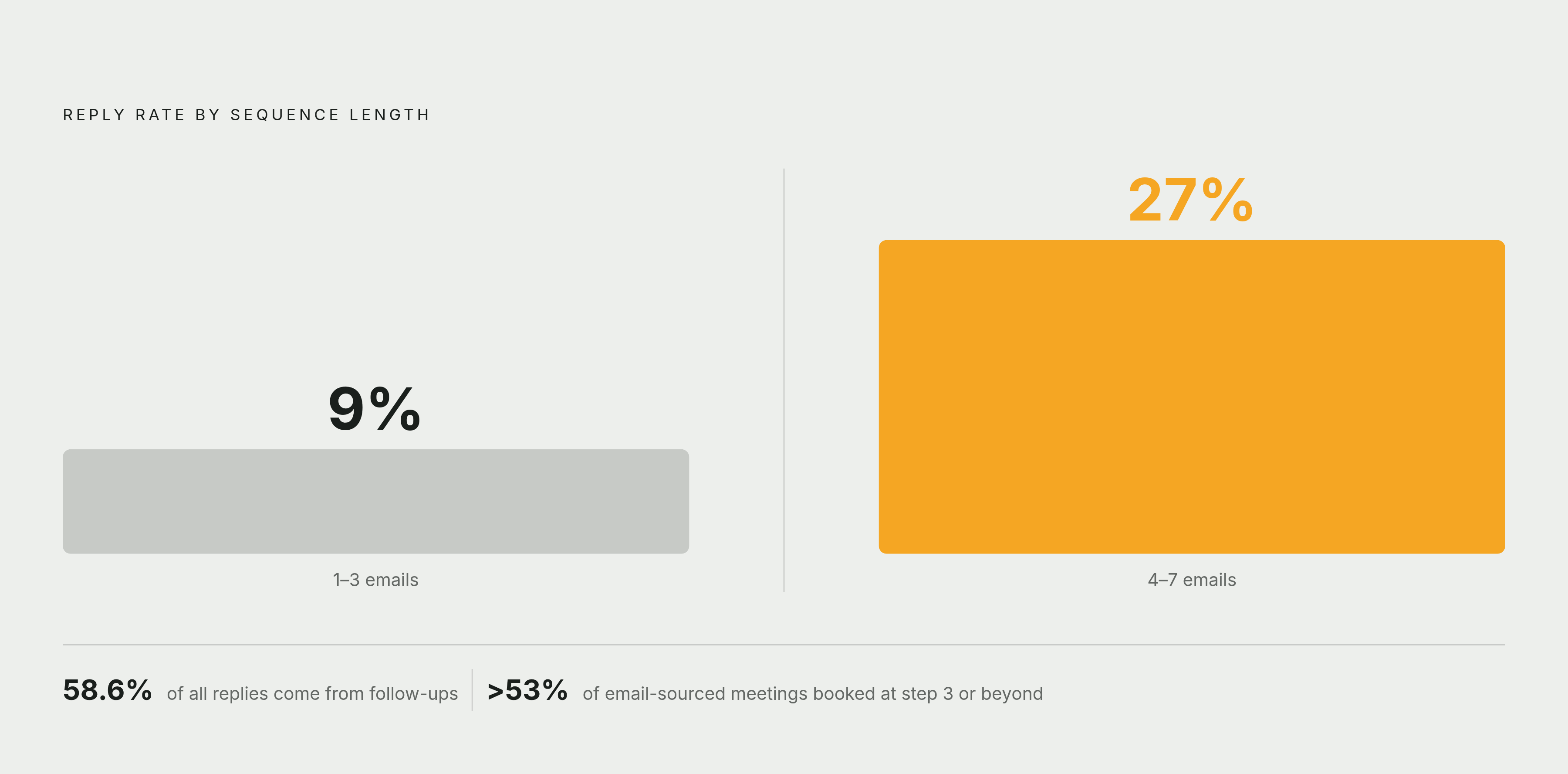
Belkins' 2025 study found follow-up emails account for 58.6% of all replies. Over 53% of email-sourced meetings come from sequence step 3 or beyond, more than steps 1 and 2 combined. If a sequence ends at email 2, the messaging probably wasn't the problem — it just never reached the step that does the heavy lifting.
That changes the question worth asking. Not "what's the best follow-up email," but "what job does this specific email have, that the last one didn't already do." Here's that broken down stage by stage.
What the data say about sequence length and spacing
Length beats cleverness. Research across over 20 million emails found four-to-seven-email campaigns get three times more responses than one-to-three-email campaigns, per Nutshell — and Woodpecker's data on those same campaigns puts the reply rates at 27% versus 9%. Anyone still running a two-email sequence is leaving most of the reply rate on the table before the test even starts.
Spacing matters just as much, and most of the instinctive choices reps make work against them:
- Skip the next-day follow-up. It reads as impatient, not diligent, and Peak Sales Recruiting found it cuts replies by 11%.
- Wait about three days for the first follow-up instead. That produces a 31% jump in replies over faster turnarounds, per the same research.
- Don't wait too long either. GrowthList's data shows delaying past five days drops response likelihood noticeably.
- Space each email a little further apart than the last one. A message every two days can feel automated rather than urgent.
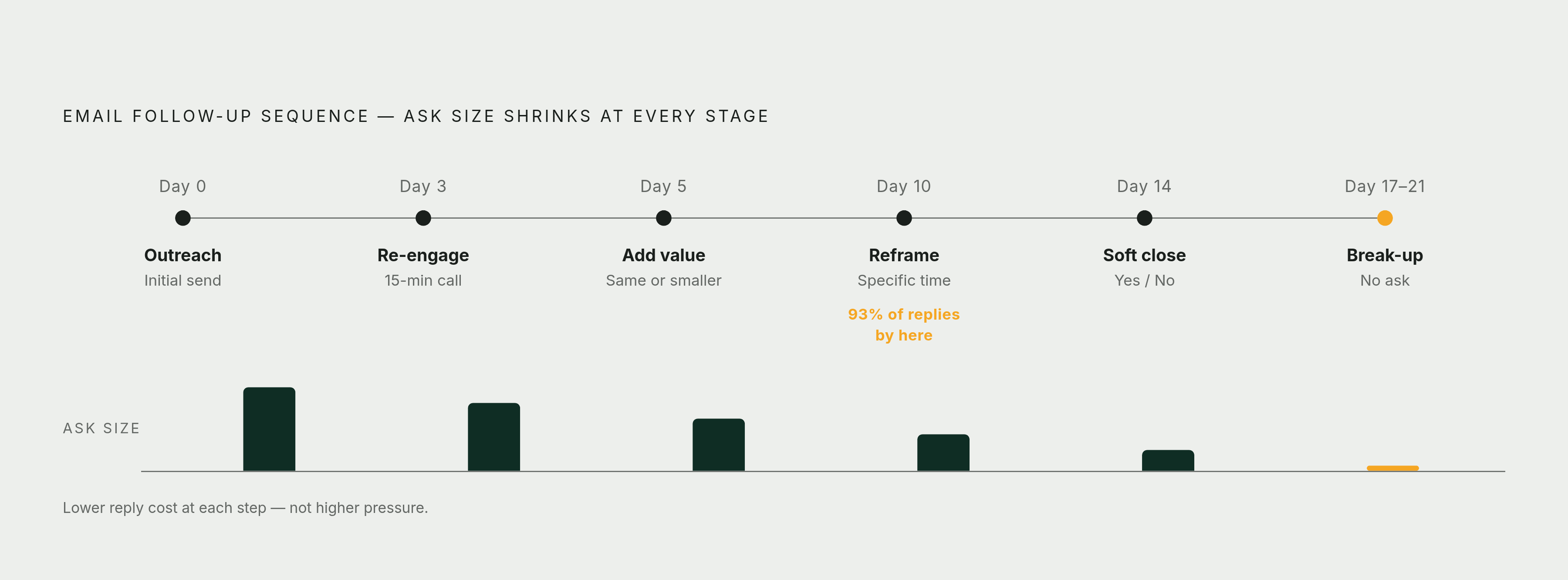
A solid default: Day 0, Day 3, Day 10, Day 17. That cadence captures 93% of total replies by Day 10, per The Digital Bloom. Cap the active sequence at four to six emails, then go quiet for a few months before trying again with a different angle.
How tone and purpose should shift across the sequence
The mistake worth naming directly: sending the same email five times with a new date stamped on it. That's a rerun, not a sequence. Each email needs its own job, and most sequences fail because nobody assigned one.
Early emails establish relevance and make one small ask. Middle emails hand over something the prospect didn't have before: a data point, a short case study, a new angle on the problem. Late emails ask for less instead of more. A meeting request shrinks into a yes/no question. The final email asks for almost nothing, just confirmation the door should close.
Email 1 asks for a meeting. Email 3 asks for a reaction. Email 5 asks for a plain yes or no. Each request works harder while asking for less.
One phrase to cut on sight: "just checking in." It describes what the rep is doing, not why the prospect should care. Every email needs a reason to exist that the prospect would recognize as relevant to them, not to the rep's pipeline.
Subject lines that earn the open at each stage
Before the body copy matters at all, the subject line has to clear two filters: is this worth opening, and is this spam. Salesso found 47% of recipients decide whether to open based on the subject line alone. Peak Sales Recruiting found 69% use it specifically to sniff out spam.
Personalization still helps, but the bar moved. First-name-only personalization barely works anymore, since many people do it now, and it can read as templated rather than personal. What actually works, per Zeliq's analysis of over 5 million B2B emails: event-triggered subject lines. Something tied to a hiring announcement, a funding round, a product launch, or a role change averages a 54.7% open rate, against 12-15% for generic subject lines. That gap is large enough to matter, and it's why "personalized" needs to mean "tied to something that just happened," not "has their first name in it."
On format, shorter tends to win. Two to four words gets the highest open rate at 46%, per Belkins. The "Re:" prefix still performs well: Email Analytics found "Re:" alone hits 92%, "Re: follow up" hits 90%, "Re: update" hits 89%.
Stage by stage, subject lines should shift with the tone:
- Early: short, direct, tied to the original thread. "Re: [original subject]."
- Middle: tied to whatever new value is inside. "One number that might change how you think about [X]," not "checking in."
- Late: quiet and low-pressure. Zeliq flags phrases like "did I miss your reply" and "one last note" as some of the strongest late-stage performers.
Email 1 of the follow-up sequence: the brief re-engagement (Day 2–3)
This goes out two to three days after the original email gets silence. The job isn't to resell anything. It's to surface the original message again, gently, and make replying take no effort.
Tone should be neutral and brief, not accusatory. Assume the email got buried under forty others, not rejected outright, since that's usually what actually happened.
A working structure:
- One line pointing back at the prior email. Not a recap, just a nudge.
- One sentence of relevance: why this prospect, specifically, right now.
- One simple ask: a short call, a quick reply, a yes/no question.
- Keep it tight. Martal's data puts 50–125 words as the range tied to the highest reply rates.
Template:
Subject: Re: [original subject] Hi [First Name], Following up on the note below in case it got lost in the shuffle. [One sentence connecting the original idea to something specific about their role, team, or company.] Worth a quick 15-minute call this week, or is [specific alternative, e.g., "next month"] better? [Sign-off]
Skip re-pasting the whole original email. Skip "just following up." And avoid quietly stacking a second ask on top of the first: this is not the email where the request gets bigger.
Emails 2–3: adding something worth reading (Days 5–10)
This is where the sequence starts earning its keep. By now the prospect has seen the rep's name twice, and familiarity alone is doing work: Peak Sales Recruiting found a first follow-up alone produces a 220% surge in reply rates. Emails 2 and 3 exist to build on that, not repeat it.
Email 2 (around Day 5): the value addition. Lead with something useful, not a repeat of the pitch. A relevant case study. A data point specific to their industry. A short insight tied to a problem they're probably already dealing with. Then tie it back to the original ask so it doesn't land as a random attachment. Keep the ask the same size as email 1, or smaller.
Subject: One thing that might be relevant to [Company] Hi [First Name], [One or two sentences on a data point, case study, or insight relevant to their industry or role.] Thought it might be useful given [specific context tied to their business]. Happy to walk through how this applies to [Company] if it's useful. Still open to that quick call? [Sign-off]
Email 3 (around Day 10): the reframe. Come at the conversation from a different angle entirely. A different pain point, a different stakeholder, a different use case than the one raised in email 1. If there's a real signal available (a funding announcement, a new hire, a product launch), this is the email that uses it: Sendspark found signal-triggered follow-ups drive three to four times higher response rates than cold, signal-free ones. Keep the ask concrete: fifteen minutes, a specific date, nothing vague.
Subject: A different angle on [topic] Hi [First Name], Noticed [specific signal, e.g., "the recent hire for X role" or "the announcement about Y"] and it made me think about [reframed problem or use case] rather than what was mentioned before. Would [specific day/time] work for a short call to see if this is relevant? [Sign-off]
Email 4: the soft close that lowers the cost of replying (Day 14)
By Day 14, the goal changes entirely. Stop selling. Make replying feel like almost no effort at all.
Shrink the ask to a binary choice: "Still relevant, or should I close this out?" No pitch, no restated features, one clean question that takes five seconds to answer.
Tone here should read curious, not annoyed. Treat the silence as a scheduling problem, not a rejection, since most of the time that's exactly what it is.
Keep it short. Two to four sentences is plenty.
Subject: Quick question Hi [First Name], Still worth a conversation, or should this drop off your radar for now? Either answer is totally fine, just want to use your time well. [Sign-off]
Even without a reply, this email does something useful: it signals the sequence has an end. That's what makes the next email, the actual break-up, feel earned instead of pushy.
The break-up email: why the last message often gets the first reply
The break-up email isn't one more pitch in disguise. Its only job is to close the loop and hand the prospect a clean, guilt-free way out.
Here's the part that sounds backwards until it doesn't: saying "this is the last one" often gets a reply where nothing else did. Every email up to this point carries a quiet obligation, the sense that a reply is owed somewhere. The break-up email cancels that debt. Once the pressure to respond on the rep's terms disappears, some prospects reply simply because they're no longer cornered into ignoring something or explaining themselves.
Tone matters more here than anywhere else in the sequence. Warm, no guilt, no passive-aggressive "since I haven't heard back." Leave the door open, but skip propping it open with another ask.
Timing is usually the last slot in a four-to-six-email sequence, around Day 17-21.
Structure:
- Acknowledge the timing might just be off right now.
- Say plainly that the sequence is ending.
- Leave one low-friction invitation, contact info, nothing more.
- Optionally, mention a check-in a few months out. That turns a permanent close into a temporary one.
Subject: One last note Hi [First Name], Haven't heard back, so assuming the timing isn't right for [topic] at the moment, and that's completely fine. Won't keep following up on this thread. If anything changes down the line, [contact info] is open. Might check back in a few months in case priorities shift. Wishing [Company] well either way. [Sign-off]
A quiet prospect after the break-up email isn't a dead one. Wait a few months, then come back with a new angle instead of resurrecting the same thread.
Making the sequence work without adding to the rep's workload
Here's the real bottleneck, and it's not creative. It's the time cost of personalizing five separate emails and logging every touchpoint across a pipeline of active prospects. That's the actual reason most reps stop at email 1 or 2: not a missing plan, but no bandwidth to run the plan they already have.
A template set solves the content half. The tracking half is untouched, and that's the half that actually kills sequences. Someone still has to know who's on step 2 versus step 4 across forty different deals, and that's where most systems quietly fall apart.
A few habits keep it from falling apart:
- Map each template to a specific CRM stage or deal status, so the next email to send is never a guessing game.
- Log every send and every reply against the contact record, not in a separate spreadsheet nobody checks.
- Fill in the bracketed fields before sending, every single time. A visible placeholder in a "personalized" email defeats the entire point of the sequence.
Some tools run alongside the CRM instead of replacing it, keeping sequence data inside Salesforce or HubSpot, wherever reps and managers already look at the pipeline. A rep with a clean template set and automatic logging can run a full five-step sequence across twenty prospects at once, without the administrative drag that makes most people quit after email 2.