Timing Outreach to Buyer Intent Signal Peaks
Stop waiting for demo requests—reach out when buyers are actively researching your solution.

Most sales teams don't have a signal problem. By then the buyer has already picked a direction.
A demo form gets filled out, a trial gets started, and the rep treats that as the starting gun. The demo request isn't the beginning of their research. Teams that wait for these inbound signals are showing up to compete for position four or five on a shortlist that's already mostly set.
Salesmotion's guide to buying signals puts a number on how bad this gets: one prospect signed with a competitor a full eight weeks before the losing rep even landed a first meeting. That's a timing failure, not a sales execution failure, and no amount of better pitching fixes it after the fact.
Most outbound lists come from firmographics, and that's the deeper issue. Firmographics describe who a company is. They say nothing about when a company is ready to buy. That gap gets outbound teams calling the right people at the wrong time, over and over.
Intent-based outreach flips that. Instead of interrupting someone with no pressing need, it reaches accounts while they're actively reading content, comparing options, and building a case internally for a purchase. That's a different kind of conversation to walk into. It's a conversation the buyer was already halfway through having, not a cold one.
None of this means collect more data and hope some of it lands. The accounts moving faster on this are not the ones gathering the biggest pile of signals, but the ones figuring out the exact moment each signal type is worth acting on, and showing up right then, before the shortlist locks in.
How intent signals differ from firmographic fit
Firmographic data answers one question: does this company look like a customer? Intent signals answer a completely different one: is this company actually shopping right now? Those are not the same question, and mixing them up is how good-fit accounts get treated like hot leads months before they're anywhere close to buying.
Think about how lead scoring usually works inside a company's own systems. Intent signals go further out. They pick up research activity on sites and platforms the company doesn't control. An account can appear in-market in that activity before it has ever landed on the company's own website.
Signals generally fall into three buckets, and each one covers different ground. Contextual signals are the public, observable changes at a company: a round of job postings, a new executive hire, a funding announcement, specific language on an earnings call. Contextual signals create a buying window even before anyone at the company starts actively researching anything, and most teams aren't tracking them closely yet.
There's also a useful split between explicit and implicit signals. One implicit signal by itself is close to meaningless. Three or four of them landing on the same account in a short stretch of time is a pattern, and that pattern often appears right before an explicit signal does.
Why each signal type has its own decay window
Every signal type has its own decay window, and treating them all the same way is close to the same as ignoring them entirely.
A signal older than thirty days isn't useless, but it's not a trigger anymore either. Launch Leads calls this out as one of the core challenges of running intent-based outreach well: an account deep in research this week might have already picked a vendor by next month. Slow follow-up doesn't just delay a conversation, it erases the entire reason the signal mattered in the first place.
The stakes here are higher than they look. Acting on a signal fast is the mechanism by which a rep becomes the first vendor in the conversation, which is most of the battle before the shortlist even forms.
Why is this pressure building now rather than five years ago? Decisions move faster, and buyers want to talk to vendors sooner. That combination rewards teams that can spot an in-market account early and punishes teams still waiting for a form fill.
The real skill is knowing that a demo request decays differently than a funding announcement, which decays differently than a hiring spike, which decays differently than a new executive hire. Each one has its own clock. The next section walks through those clocks one at a time, from the ones that close in hours to the ones that stay open for months.
The outreach timing for each signal type, ranked by how fast the window closes
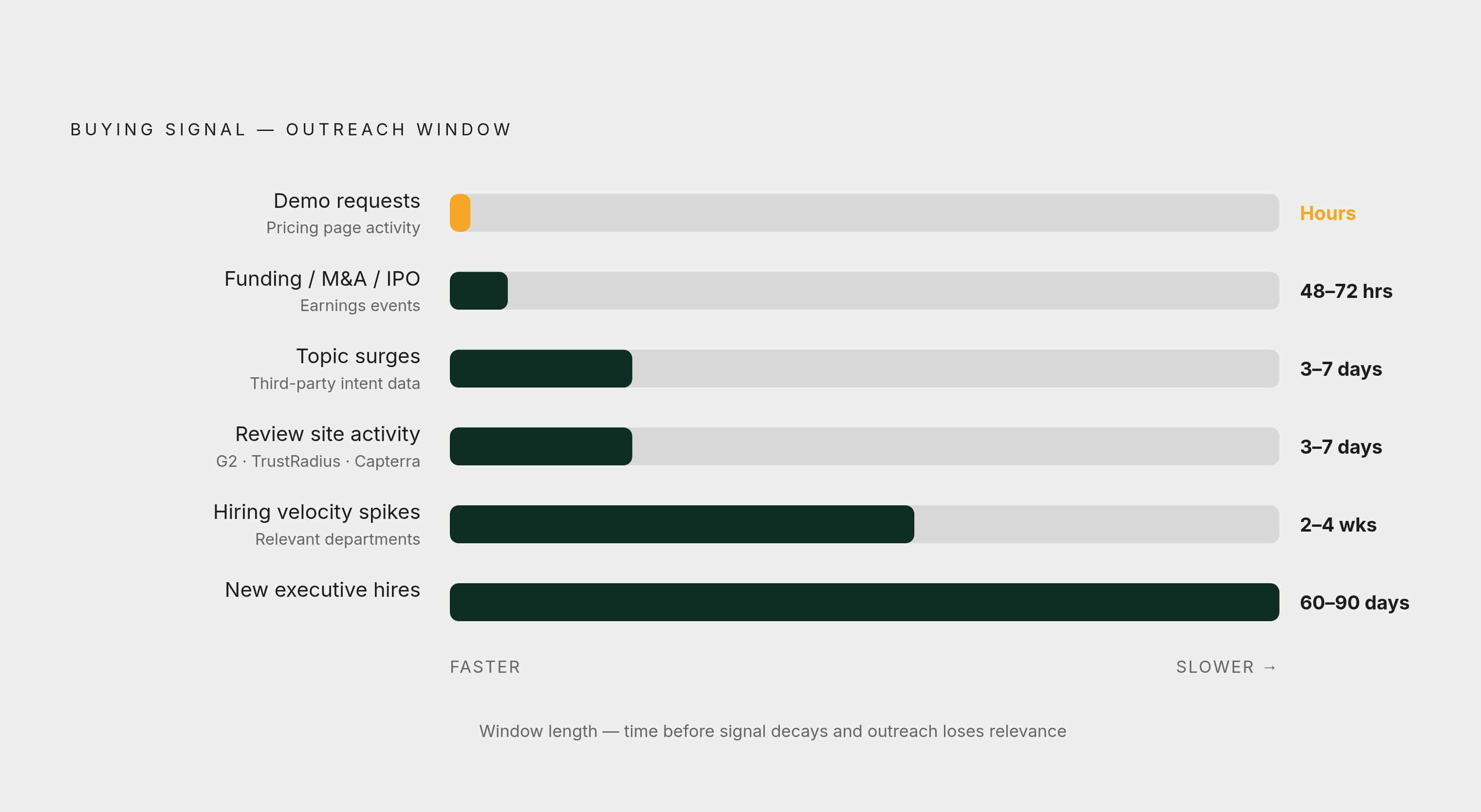
Demo requests and pricing page activity are at the fastest end of the spectrum, and the right move is to act within hours. Three visits inside a week means someone is actively building a business case and stacking a company up against alternatives. That third visit, not the first, is the moment to move. By the time a buyer is at that stage, they've already done serious homework, and a day's delay is enough time for them to book a demo somewhere else.
Funding announcements come next, with a window of roughly 48 to 72 hours. M&A activity, IPO filings, and strong earnings reports create similar bursts of buying capacity, and all of them fade the same way, once the organization settles into whatever changed, the urgency goes with it.
Topic surges picked up through third-party research tracking need action inside roughly 3 to 7 days. A surge from three weeks back could already reflect a decision that's been made and closed out. The gap between "actively researching" and "shortlist finalized" is shorter than most teams plan for. Review site activity on platforms like G2, TrustRadius, or Capterra counts as its own kind of signal here, and it's more specific and higher confidence than a general topic surge on its own.
Hiring velocity spikes in relevant departments open a longer window, somewhere around 2 to 4 weeks. When a company brings on ten new sales reps in a quarter, those roles get filled, budget gets committed, and tooling decisions tend to get made alongside those hires. Job postings for roles like VP of Sales, Head of Revenue Operations, or CRO sit a step earlier in this same category. They often come before a hiring surge and before a technology purchase, so the window stretches out a bit further, but it still rewards a prompt reach-out over a leisurely one.
New executive hires carry the longest window of the group, roughly 60 to 90 days. When a CFO tells investors the company is "investing in go-to-market efficiency" or "scaling our sales organization," that phrase maps almost directly onto the problem a given product solves. It's an earlier signal than the hire itself, but it still rewards a rep who follows up soon rather than months later.
Why more signals without signal weighting produces false confidence
More signals sound like a good problem to have, until every one of them gets treated as equally urgent, at which point the whole system starts working against itself.
The cost of that isn't just a few wasted calls. Reps who chase a handful of "hot leads" that turn out to be nothing start to tune out the system entirely. They go back to whatever worked before, cold lists and gut instinct, and the entire point of running intent-based outreach falls apart. A rep has to trust the signal before they'll act on it fast, and a few bad experiences is usually all it takes to kill that trust.
There's also an uneven distribution problem across signal types. A buyer showing up in a surge report is often getting outreach from several vendors at once off the exact same signal, which dilutes how effective any single rep's message lands.
Signal quality also depends heavily on where the data comes from in the first place. Bombora runs a cooperative drawing data from more than 4,000 premium B2B sites. The methodology behind a provider's data shapes how much it covers, how fresh it is, and how exclusive it is to that provider versus being the same surge everyone else is seeing too.
None of this means walking away from third-party signals or avoiding big data providers. It means weighting what comes in instead of treating every signal as the same size trigger. Weighting means accounting for who took the action (a CFO visiting a pricing page is not the same signal as an intern downloading a whitepaper), how recent it is (inside the decay window counts for a lot more than outside it), how deep the engagement went (three pricing page visits beats one), and whether multiple signal types are pointing at the same account at the same time. A single implicit signal sitting by itself is still just noise.
Building a signal stack that activates within the decay window
Knowing a signal exists and acting on it fast enough to matter are two different problems, and most teams solve the first one without ever solving the second. Signals get logged, reports get built, and nobody follows up before the window closes. That gap between detection and action is the thing a working signal stack is actually built to close.
When evaluating any platform or process for this, five things matter: how broad the signal coverage is, how well the data gets verified, whether it activates into a workflow or just sits in a report, whether it's scored with AI against buying stage, and whether the collection methods hold up to compliance standards.
Relying on a single intent provider also leaves blind spots, since different providers see different slices of buyer behavior. Combining sources closes more of those gaps than betting everything on one feed.
Speed of execution is where artificial intelligence is starting to change what's actually possible. AI agents built for this watch for signals, work out what the best next move is, and lay out multi-step recommendations fast enough to actually meet the tight windows that demo requests and funding announcements demand.
The workflow layer around a rep matters as much as the signal detection itself. Because a tool like this can pick up on deal context and tone without needing a rep to write out detailed prompts, it becomes possible to respond to a funding announcement or a pricing page surge within the same hour it happens, instead of losing a day to manual research or hunting for the right template.
Coordination between sales and marketing adds another layer to this. Marketing can also reinforce a signal while it's live, making sure a prospect sees consistent messaging across LinkedIn, relevant publications, and email while a sales signal is active on that account. That kind of coverage makes a timed outreach attempt land harder than it would cold.
None of this works outside the rules governing outreach, either. Treating signal-based selling as a compliance discipline, not just a growth tactic, means sticking to publicly available information: job postings on a company's own career page, technology changes visible in public vendor directories, and first-party website behavior collected with proper cookie consent.
Putting decay windows into practice: how to prioritize accounts when multiple signals appear at once
Most mornings, more than one account is going to show a signal at the same time, and the rule for sorting through that is simpler than it sounds: look at which signal decays fastest, not which account has the most signals.
An account with a demo request, measured in hours, should jump ahead of an account with a topic surge, measured in days, which should jump ahead of an account with a new executive hire, measured in weeks or months. That holds even if the slower account technically has a longer list of things going on. The constraint is time. The fastest-closing window sets the order.
That said, a cluster of signals on one account can shift the math. A strong multi-signal account at a slower decay rate can reasonably outrank a single-signal account at a faster one, because the odds of a real deal forming are so much higher.
Old signals aren't worth throwing out once they've expired as triggers. A topic surge from three weeks back won't justify jumping the queue anymore, but it's still useful for shaping the message once something fresher lands on that same account. It tells a rep what that company was looking into and gives them language to use when they finally reach out.
This logic extends past new business too. A renewal account whose team suddenly starts researching competitor products is throwing off a churn signal, and the same urgency applies: an account manager should reach out before the client brings it up, not after. Acting on that early research signal is often what keeps the account in the first place.
And not every account on a list is going to show a signal at any given moment, which doesn't mean those accounts are dead or not worth pursuing. Only a slice of the total B2B buyer pool is actively in-market at any one time, so most future customers simply aren't shopping yet. Signal-based outreach should run next to the slower relationship-building and awareness work a team does with the rest of its list, not replace it.
The practical move starting now: when signals come in, check the signal type first, check its decay window second, and let that order set who gets a call today versus next week.