When AI-Drafted Follow-Ups Outperform Rep-Written Ones
AI-edited follow-ups beat both pure AI and human-only sends.

Reply rates on cold email have dropped hard over the past several years, and they are at historic lows right now. Putting those together results in a channel that's tougher to work than it was even two or three years ago.
Anything above 5% counts as a good reply rate in 2026, and the campaigns actually winning are hitting 10% or higher. Most teams aren't close to that. They're operating well below the line that makes outbound worth doing at all.
Where does the missed opportunity actually hide? Follow-ups. A large share of reps send one email, get no response, and never follow up again. Plenty of others try one follow-up and quit. Meanwhile, HubSpot's data on closed deals shows most of them need many more touches than that. That gap, between what persistence actually requires and what reps actually do, is the specific hole this article is about.
And it's not just a volume problem. A majority of B2B decision-makers say most sales outreach feels impersonal and irrelevant, even while AI outreach volume keeps rising. More AI has made outreach feel less intelligent, not more. So the real question isn't whether to use AI. It's whether AI, used the wrong way, is part of what broke the inbox in the first place, and whether it can also be part of what fixes it.
What "human-written" and "AI-written" mean in 2026
Before getting into what actually works, a mix-up that trips up most of this conversation needs clearing up. "Human-written" in 2026 rarely means a rep sat down and typed out hundreds of individual emails from scratch. Most high-performing outbound teams already use AI to do the research and build the structure, then a person edits the draft before it goes out. So the old picture of a rep grinding out cold emails one at a time barely exists anymore, even on teams that would call themselves "human-written."
There are really three distinct setups running in 2026. The first is AI-assisted: the AI drafts, a person reviews and edits it before it sends. This mode gets the highest reply rate and tends to fit best on strategic accounts or high-value deals, where an incorrect message can cost the deal, so getting it right outweighs getting it out fast. The second is AI-automated with review triggers, where the AI drafts and sends on its own but flags anything low-confidence for a human to check. That's the middle ground, a trade-off between speed and quality. The third is fully automated: AI drafts and sends with no human touch at all. It's the fastest option at scale, but it only works if the data feeding it is tight, otherwise the output turns generic fast.
So the useful question isn't "AI or human?" It's where in the process a person needs to be involved, and where the AI can be trusted to run on its own. Everything that follows is an attempt to answer that question with actual numbers instead of guesswork.
What a controlled head-to-head test across 12,000 emails showed
One test lays this out about as cleanly as it gets.
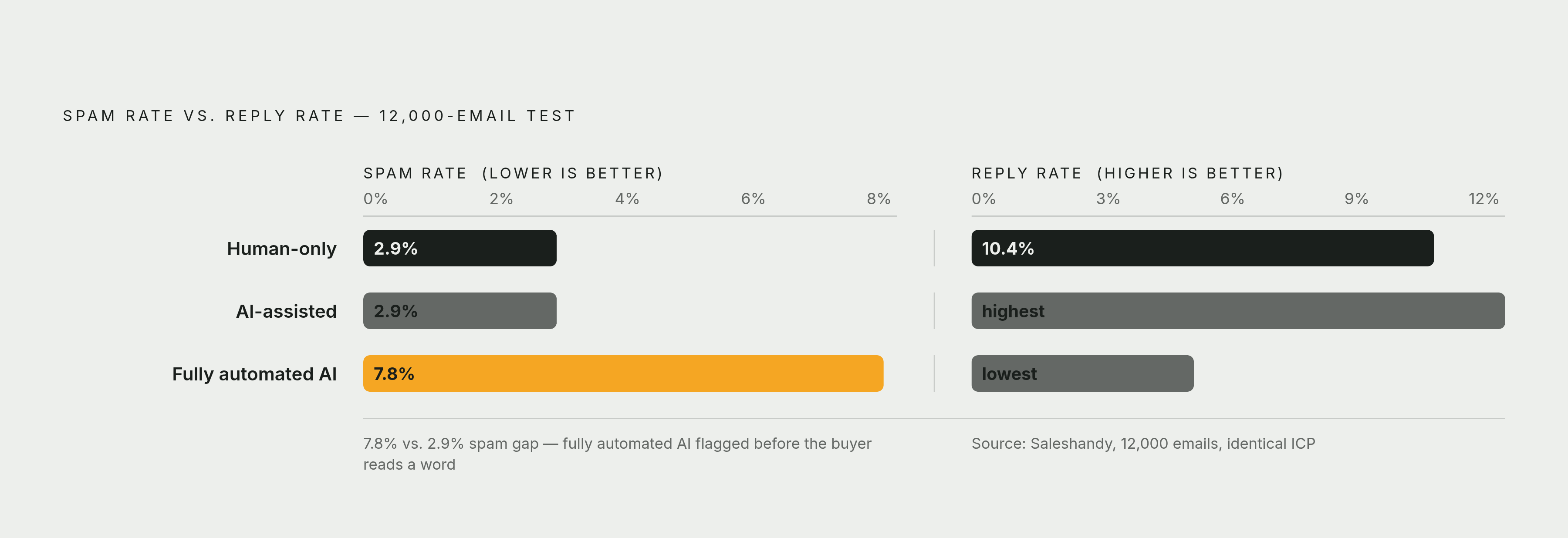
The human-only group, a smaller control group, posted a 10.4% reply rate with a 2.9% spam flag rate. That's already a solid number against the 5% "good" bar and the 10% "top-performing" bar mentioned earlier. But the hybrid group, AI drafting paired with human review, beat it. It beat the human-only group on reply rate, on positive reply rate, and on meetings booked, all while matching the human group's low spam rate. In other words, the hybrid approach didn't just avoid the downside of pure AI. It out-performed pure human writing too.
Industry complexity is a separate factor here. But where buyers respond to direct value propositions, like SaaS, AI performs close to human level. So context matters. The industry a team sells into shapes how much of the writing can safely be handed to AI alone, and how much needs a person steering. Saleshandy tested three groups simultaneously on an identical ICP (VP/Head of Sales, B2B SaaS, 50–200 employees, United States), identical sending infrastructure, identical offer (only the writing method changed).
Why fully automated AI emails underperform even when the copy looks fine
So why does the AI-only version lose, even when the sentences read fine on their own? There are three separate causes, and each one has its own fix.
First, spam filters have gotten good at fingerprinting AI text. The statistical patterns in how AI structures sentences and paces its rhythm are exactly the kind of thing filters are trained to catch, and fully automated pipelines see spam flag rates roughly double what human-edited sends get on identical infrastructure. In the Saleshandy test specifically, AI-only hit a 7.8% spam rate against 2.9% for human-written. That's not a small gap. That's the difference between landing in the inbox and getting buried before anyone sees it.
Second, buyers have learned to spot the tells. The 2024 to 2025 wave of AI cold outreach trained B2B buyers on the tells of a GPT draft, the overlong compliment, the parallel tri-colon structure, the "I noticed you're doing great work in the X space" opener. Gartner's 2026 research on B2B buyers found that most of them can identify an AI-drafted email within the first two sentences. Once a reader clocks that pattern, the email is basically dead on arrival, no matter how well-formed the copy is.
Third, and this is the subtler one: AI is genuinely good at signal-matching, pairing a message to someone's job title or a line from their company's website. What it's weaker at is the judgment call of whether this specific angle actually lands for this specific person, right now. That judgment call is the exact thing separating a middling reply rate from a strong one.
None of this means AI is bad at writing cold email. It means AI as the sole author, with nobody checking its work, is what costs the replies. The same tool that tanks a fully automated send becomes an asset the moment it's paired with a person making the final call. That's the mechanism the next section unpacks.
How the hybrid model closes the gap, and in some scenarios opens a new lead
Put a number on that hybrid effect: AI-assisted sends outperform fully automated AI sends by 15 to 30% on first-touch reply rates, according to SyncGTM's 2026 data. What's happening in that edit pass is catching tone-deaf personalization and factual hallucinations that automated quality filters miss on their own.
What exactly is the human doing in that short window before hitting send? A few concrete things. They catch hallucinations, the AI naming the wrong company, citing the wrong recent news, or misreading a trigger signal entirely. They fix tone, stripping out the patterns buyers have already learned to delete on sight. And they add judgment, deciding whether the angle the AI picked is actually the strongest one available for this account, a call the model can't reliably make on its own from structured data. None of that is vague "human touch" language.
What makes this workable at scale is how cheap that review is. SyncGTM puts human review in AI-assisted mode at 45 to 90 seconds per email, compared to 8 to 12 minutes writing the same email from scratch. So the rep is applying real judgment, but at a fraction of the time cost of drafting. That's the mechanism: a specific, identifiable time trade where seconds of review buy back most of the value of minutes of writing." It's a specific trade: seconds of review buying back most of the value of minutes of writing.
There's also a place where AI doesn't just match human writing, it structurally beats it, and that's personalization depth at scale. AI can pull and synthesize those trigger signals, funding rounds, hiring sprees, a tech stack change, a job move, at a speed and scale no rep working from memory across a full pipeline can match. And timing compounds that advantage: contacting a qualified prospect within a short window of one of those trigger events produces dramatically higher conversion than reaching out cold.
Speed adds another layer on top. Most buyers now expect a fast response once they've reached out, and leads contacted quickly are far more likely to engage than ones left waiting. AI tools process and respond to email data much faster than a manual workflow can, which gives hybrid teams a real timing edge that rep-only workflows structurally can't match.
Where AI-drafted follow-ups have the clearest edge over rep-written ones specifically
Zooming in from the general hybrid case to follow-up sequences specifically makes the advantage even sharper. Start with the persistence issue raised earlier: a large share of reps never follow up after a first email goes unanswered, and many who do follow up once simply stop there, even though most closed deals need significantly more touches than that. An AI-drafted follow-up doesn't care how the rep's week is going. It ensures the fifth touch actually goes out regardless of whether the rep had the energy to write it that day. That's a structural fix.
Follow-up sequences are also where fully automated AI, the mode that struggled as a first-touch tool, actually works best. Hallucination risk drops because there's already a real conversation thread to draw from, and the rep's voice is already on record, so the AI is maintaining continuity rather than trying to establish credibility from zero.
Speed-to-respond after a trigger event is another spot where the case for AI is close to airtight. A new hire, a funding round, a visit to the pricing page, these are moments where being fast matters more than almost anything else, and human reps are just structurally too slow to catch most of them in the window that counts. AI can detect and respond inside that window in a way manual workflows can't replicate.
Large lists are the same story from a different angle. No rep can research hundreds of prospects to real depth in the time it takes AI to do it. The quality floor AI sets across a big sequence ends up higher than the quality ceiling most reps hit when they're writing at volume. An AI-drafted email a rep reviews and lightly personalizes is the difference between outreach that happens on a system and outreach that happens whenever the rep feels up for it, and this consistency is easy to undersell. That consistency is exactly why AI agents now handle roughly 80% of the research and sequencing work at the outbound teams performing best, according to the Instantly 2026 Cold Email Benchmark Report.
The trust and disclosure question the data raises but doesn't fully resolve
What happens to trust once people suspect they're reading something AI wrote is a harder question the reply-rate numbers don't settle? Academic research from the Nuremberg Institute for Market Decisions found that simply labeling content as AI-generated reduces how sincere it seems and how likely people are to engage with it, even when the actual content is identical to a human-written version. That's a strange result to sit with. The words haven't changed. Only the label has.
A larger study backs this up. Schilke and Reimann ran 13 separate experiments in 2025 and found that disclosing AI use reliably erodes trust. The size of that hit is a fraction of a point on a 5-point scale, not a collapse. And their research found something arguably more important, getting caught hiding AI use is worse than just disclosing it upfront.
The sharpest version of this paradox appears in a blind comparison run by Bynder. Most readers, in a blind test, actually preferred the AI-written article over the alternative. But roughly half of those same readers said they'd feel less engaged with copy they suspected was AI-generated. Same readers. Opposite reactions, depending on what they thought was behind the words rather than what the words actually said. A 2026 systematic review in the American Impact Review found the same pattern across a wide range of marketing contexts, disclosure activates something researchers call persuasion knowledge, and that erodes trust-related outcomes. But the review is careful to note the effect isn't universal or uniform. Perceived authenticity is what's actually driving the reaction.
So where does that leave the hybrid model? It doesn't get to dodge this tension, but it does sit in a different spot than a straight AI disclosure debate. The trust risk isn't really a disclosure question in the hybrid setup, it's a quality question. An email a rep has actually read, edited, and approved is not the same object as an AI send nobody checked, even if a reader can't tell which is which on sight. Whether that distinction fully resolves the discomfort research keeps turning up is an open question. But it's a meaningfully different starting point than pretending the discomfort doesn't exist.
What the hybrid model requires in practice: workflow, tools, and Nextstep's role
The hybrid workflow has four functional requirements.
The first is live trigger data actually feeding the AI. A model is only as good as the context sitting in front of it, and prospect lists without enrichment, funding events, hiring activity, job changes, intent signals, produce generic output no matter how carefully the prompt is written. The second is a review step fast enough that reps actually use it. If the draft doesn't appear inside the tool a rep already lives in, and instead requires opening a separate tab or a different platform, the habit breaks and the review step quietly stops happening. The third is CRM logging that happens automatically. If a rep has to manually record every email they've reviewed and sent, the admin work AI was supposed to remove has just moved somewhere else, not disappeared. The fourth is tone and context learning: AI that studies a rep's existing sent emails and deal history produces drafts that need less editing, which cuts review time and keeps output consistent across a whole team.
Nextstep is built around that exact workflow. It runs alongside a rep's inbox, calls, and CRM, drafting replies and follow-ups automatically, logging updates, and booking next steps, without asking teams to adopt a new platform, since it works inside Salesforce, HubSpot, and the tools already in place. It learns a rep's tone and the context of each deal, so the output is relevant without anyone having to engineer a prompt to get there.
The bigger payoff isn't really the reply rate number, even though that number matters. It's what a rep does with the time that used to go into drafting and logging. Freed-up attention can go toward the relationships and the closing conversations that actually move deals forward. The metric worth watching is not just how many replies come back. It's how many deals one rep can actually run at the same time.