Intent Data Providers for Outbound Targeting
How to identify which intent signals actually drive outbound sales results.

Let's start with the uncomfortable truth about outbound sales.
For years, outbound teams built their targeting lists the same way. They'd pull a list of companies that matched a firmographic profile (right industry, right headcount, right geography), find a contact with the right job title, and start dialing. The logic was simple: if they look like a buyer, treat them like a buyer.
The problem? Looking like a buyer and actually being in the market to buy are two completely different things. And most of the time, reps were reaching people who weren't even close to a purchase decision. The buyer journey had already started, and nobody told the outbound team.
This is the gap intent data is trying to close. Research consistently shows that the majority of a B2B purchase journey happens before a buyer ever talks to a vendor. By the time they're willing to take a call, they've already read the reviews, compared options, and maybe even had an internal budget conversation. Intent data is an attempt to catch them during that research window, not after it closes.
The market momentum reflects how seriously teams are taking this. Spherical Insights pegged the B2B Buyer Intent Data Tool market at $3.20 billion in 2024, projecting growth to $17.95 billion by 2035 at a roughly 16.65% CAGR. And that's just one estimate. Virtually every credible projection in this space points to sustained 15 to 17 percent annual growth, regardless of the exact scope definition used. On top of that, third-party cookie deprecation and GDPR/CCPA compliance pressure are pushing teams away from ad-targeting workarounds and toward signal-based methodologies. Intent data stopped being an experimental budget line a while ago. It's infrastructure now.
But here's the part that gets glossed over in almost every vendor conversation: not all intent data is the same, and buying the wrong type for your outbound motion is one of the more expensive mistakes a revenue team can make.
What Intent Data Actually Measures, and Where the Signals Come From
Before evaluating any provider, it helps to understand what "intent data" is actually describing. The term gets used as if it's one thing. It isn't.
There are three meaningfully different signal types that all get bundled under the same label.
First-party intent is what you own. Website visits, content downloads, demo requests, email engagement. These signals are the highest fidelity because they're direct. Someone showed up at your front door. The limitation is reach. You're only seeing people who already found you.
Second-party intent comes from platforms with direct user relationships. Review sites like G2 and TrustRadius, publisher networks, platforms where a real person logged in and did something observable. The provider saw the behavior themselves. It's more trustworthy than aggregated data, and critically, it tends to reflect later-stage behavior. Someone on a software review site is not casually browsing. They're evaluating.
Third-party intent is aggregated behavioral data, usually from publisher co-ops. Thousands of B2B websites share anonymized content consumption data, and providers synthesize it into topic-level signals. It casts the widest net. It also catches people at the earliest stages of research, often months before a real purchase conversation.
Each type trades off breadth for specificity. Third-party signals are like casting a fishing net across an entire ocean — you'll reach the most accounts, but most of what surfaces represents the fuzziest buying stage. Second-party signals reach fewer accounts but represent buyers who are much further along. First-party signals are the most reliable but only cover people who already know you exist.
There are two more distinctions worth understanding before you talk to any vendor.
Account-level vs. contact-level signals. Most providers tell you that a company is in-market. They don't tell you which person at that company is doing the research. For an outbound SDR who needs an actual name and phone number, that gap isn't trivial. It's the difference between an actionable lead and a research project.
Topic-based intent vs. behavioral pattern intent. Generic topic buckets ("cloud security," "HR software") tell you someone is researching a category. Models calibrated to your specific product's buying signals tell you something closer to purchase intent. The precision difference matters a lot when you're deciding whether to pull a rep off another account to work this one.
The Four Dimensions That Separate Useful Intent Data from Expensive Noise
Walk into any intent data demo and everything looks impressive. The dashboards are clean, the account lists are long, the match rates sound great. The question is what happens six months after you sign.
Four things actually determine whether intent data improves your outbound results or just adds a line to your tech stack invoice.
Signal quality and freshness. How often is the data updated? Weekly, daily, near-real-time? And just as important: can the provider explain their methodology in enough detail for you to audit it? Vague answers about "proprietary models" are a flag. A weekly-updated signal is genuinely different from a daily one when a buyer's evaluation window might close in days.
Coverage and identity resolution. What percentage of your ICP does this provider actually reach? Does it resolve to accounts only, or does it also resolve to contacts? If your TAM is international, does their coverage match? 6sense claims to track intent in over 40 languages. Most providers cover far less. That gap isn't theoretical if half your addressable market is outside North America.
Precision of targeting. Generic topic categories produce high false-positive rates. A rep who follows up on ten "in-market" accounts and gets nowhere eight times stops trusting the data. The signal needs to be specific enough to actually change what reps prioritize. The question to ask every provider: what does this signal cause my team to do differently?
Workflow integration. This one ends more intent data experiments than any other factor. An intent feed that requires reps to log into a separate dashboard will be checked occasionally, usually on Fridays when there's nothing else happening. An intent signal that surfaces directly in the CRM or sequencing tool as a prioritized task will drive daily behavior. The gap between data quality in a demo and data utility in production almost always comes down to this. Forrester's 2025 Wave evaluated providers across 21 criteria, and integration and delivery were explicit scored dimensions. That's not a coincidence.
Pure-Play Third-Party Intent Providers: Broad Coverage, Best Used as a Data Layer
If you've spent any time around intent data, you've heard of Bombora. They built the defining model for this category: a co-op of over 5,000 B2B publisher websites that tracks research behavior and content engagement across that network.
Forrester named Bombora "the gold standard for account-level intent data feeds." Customers consistently describe it as the benchmark they measure other providers against. And in the 18 months leading into the 2025 Forrester Wave, Bombora expanded its co-op size by roughly 20% and topic coverage by about 13%. That's a meaningful increase in the coverage problem that has historically limited pure-play co-op data.
But the limitation that defines this category is right there in the label. Account-level. Bombora tells you a company is in-market. It does not tell you who at that company to call. Before an outbound rep can act on a Bombora signal, someone has to do the enrichment work to find an actual contact. That step takes time, and time is where signals go to die.
Pricing for the base Company Surge plan starts around $25,000 to $30,000 per year, with most real implementations landing between $50,000 and $100,000 depending on topic count and volume. Worth noting: Bombora's data is embedded in a lot of other platforms. If you're already using 6sense, Cognism, or Demandbase, you may be accessing Bombora data indirectly without realizing it.
Intentsify takes a more sophisticated approach to the same fundamental problem. Instead of operating a single co-op, Intentsify aggregates signals from multiple intent providers and applies AI to refine them. In the Q1 2025 Forrester Wave, Intentsify received the highest Current Offering score among the 15 evaluated providers, with top scores across 12 of the 21 criteria. Their Orbit identity graph, launched in 2024, adds buying-group-level attribution. That directly addresses the account-only limitation that defines this tier.
Intentsify also offers a managed-service model, meaning they can activate data through advertising and content syndication on the client's behalf. For teams without internal campaign operations resources, that's worth factoring in.
When does this category fit? When you want best-in-class data to feed into your own CRM, sequencing tool, or ABM platform, and you have the enrichment and activation capability to use it. It's a data layer, not a complete solution.
Review-Site and Second-Party Intent: Smaller Volumes, but Buyers Already in Vendor-Evaluation Mode
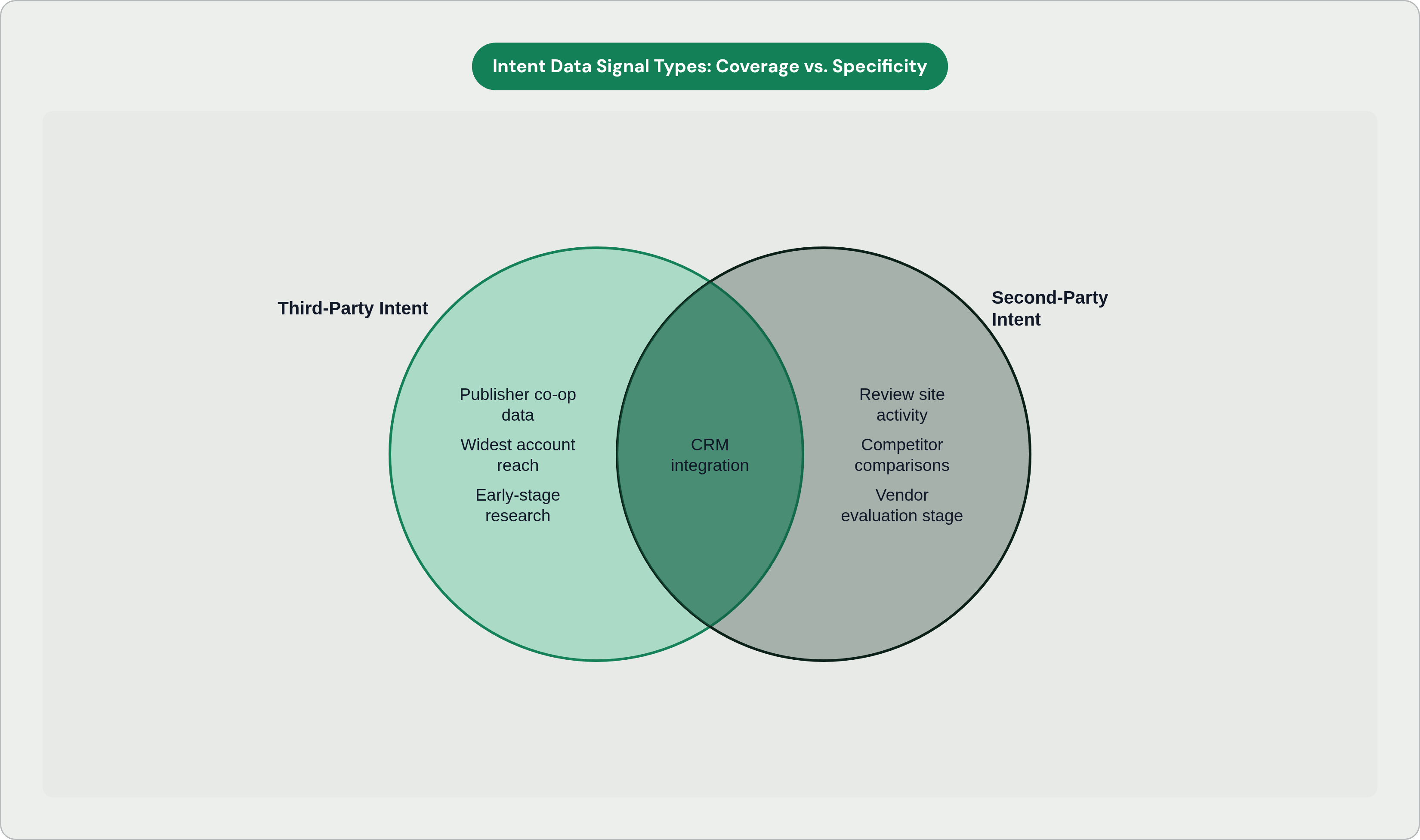
Here's what makes second-party intent different, and why it deserves its own category.
When someone is on G2 or TrustRadius, they're not casually reading an industry blog. They're on a platform specifically designed for software evaluation. They're comparing you to competitors. They may be reading reviews of your product right now. That's a fundamentally different signal than someone who read an article about "cloud security trends." If broad co-op data is a slow-burning campfire, review-site intent is a flare gun — smaller range, but you know exactly where to look.
G2 Buyer Intent draws from activity across more than 90 million annual users. It can identify companies researching your category broadly, your specific product page, or your competitors, which makes it genuinely useful for competitive displacement outbound. If a company is on your competitor's G2 page, that's a real opening.
The limitation is the same as the broader category: account-level only. G2 tells you the company is looking. It doesn't tell you who's doing the looking. Pricing lands between $10,000 and $25,000 per year, making it one of the more accessible entry points in the space.
HG Insights acquired TrustRadius in June 2025, and the combination is interesting. TrustRadius brings buyer intent signals from more than 12 million annual B2B technology evaluators. HG Insights brings technology intelligence data. The integration is designed to give outbound teams both "they're evaluating" and "here's what they already run." For technology vendors whose value proposition is dependent on stack fit, that context matters.
The practical use for outbound is signal prioritization and timing. Review-site intent shouldn't replace a broader targeting list; it should move accounts to the top of that list. Use it to trigger an immediate follow-up call from a rep who otherwise wouldn't have known the account was active. The volume will be smaller than what a broad co-op delivers. The confidence level will be higher.
Enterprise ABM and GTM Platform Providers: Intent Bundled with Orchestration
At this tier, intent signals aren't a standalone feed. They're embedded in a platform that also scores accounts, routes them, activates advertising, and sometimes personalizes the web experience. You're not buying data. You're buying a system.
6sense is the most visible player in this space. Their predictive account scoring layers on top of intent signals, and their claimed coverage advantage of 10x other B2B intent providers is a function of how broadly they track behavioral signals across the web. RevvyAI, launched at their 2025 Breakthrough conference, added pre-built AI agents for account qualification, ad optimization, and keyword recommendations. The platform is moving toward automated activation, not just signal surfacing.
The honest limitation: 6sense relies heavily on IP and cookie data for identification, and accuracy variability is a recognized issue in independent coverage. That's worth asking about directly in an evaluation. Pricing reaches $130,000 and above at the enterprise tier.
Demandbase takes a multi-source approach. It combines third-party co-op intent with first-party web engagement signals and second-party review activity from G2 and TrustRadius. The Forrester 2025 Wave highlighted "highly accurate identity resolution" and "exceptional data integration and delivery options," with customers specifically calling out ease of integration into existing processes. Forrester positioned Demandbase as a "full GTM orchestration partner" rather than a point intent solution. That framing is accurate. It's a platform, not a feed.
ZoomInfo Intent has a specific advantage worth naming. Intent signals surface directly alongside contact-level data. The enrichment step that every other account-only provider requires? ZoomInfo skips it, because the contact is already there. ZoomInfo Copilot surfaces intent-driven outreach suggestions within the existing ZoomInfo workflow. The Forrester Q1 2025 Wave credited ZoomInfo with the highest scores across 8 criteria, and it holds G2's No. 1 ranking in Buyer Intent for Summer 2025. For outbound teams that live in ZoomInfo already, the integration argument is straightforward.
The honest trade-off at this tier applies across all three platforms. Full-platform providers reduce vendor relationships and integration points. But they also require significant annual commitment, and they require teams to actually use the orchestration features to justify the cost. Teams with a mature ABM motion and dedicated operations resources get the most out of this tier. Teams still building their outbound playbook often overpay for features they're not ready to activate.
Publisher-Network and Specialist Providers: Contact-Level Intent for Specific Verticals
This is where the account-level vs. contact-level distinction really bites the broad-market providers.
Informa TechTarget's Priority Engine is one of the few providers that natively delivers contact-level intent signals. Not "a company is researching." An actual person, with a name and a role, who showed intent behavior on technology-focused publisher properties. For an outbound SDR, that's the difference between a warm lead and a research task.
The feature set includes purchase-intent scoring, confirmed-project alerts, weekly signal updates, and CRM integrations. Forrester named Informa TechTarget a Leader and Customer Favorite in the Q1 2025 Wave. The scope limitation is honest and worth stating plainly: Priority Engine is strongest for IT and technology buyer personas. If you're selling into finance, HR, or operations functions, the audience depth isn't the same.
Anteriad is worth including in any specialist-tier evaluation. Forrester named it a Strong Performer, and customers specifically cited transparency, affordability, and highly targeted execution. Anteriad received the highest possible Forrester score in future-proofing data collection, data integration and delivery, and data security and compliance. That last one matters more than it used to, as GDPR and CCPA scrutiny on data provenance has increased.
Why evaluate this tier? If your outbound team sells into a specific vertical where a publisher-network provider has genuine audience depth, the signal quality within that vertical can exceed what a broad co-op delivers. The coverage is narrower. The contacts are more actionable.
How Signal Type Maps to Outbound Motion, and Where Most Teams Go Wrong
The most common mistake isn't buying bad intent data. It's buying the right intent data for the wrong part of the funnel.
Broad co-op data (Bombora-style) is best for top-of-funnel prioritization. It answers the question: which accounts should we be targeting this quarter? It is not well-suited to triggering same-day outreach, because the signal represents early-stage research, not active vendor evaluation.
Review-site and publisher-network signals are better suited to triggering immediate action. Someone on your G2 competitor page today is in a different buying stage than someone who read an article about your category last week. The appropriate response is different too.
First-party engagement signals should always be layered in, regardless of which third-party provider a team buys. They're the highest-fidelity signals you have. Ignoring them while spending on third-party data is leaving your best information on the table.
The account-only vs. contact-level gap is where most "the data didn't work" complaints originate. When an SDR receives an account alert and has no contact to reach, the signal decays before anyone acts. Days pass. The evaluation window closes. And then someone says intent data doesn't work for their team.
Integration determines whether signals get used at all. That's not a vendor talking point; it's just how human behavior works. A separate dashboard gets checked occasionally. A prioritized task in the existing sequencing tool gets worked.
Outbound teams using AI sales tooling (platforms that log activity, surface account context, and help draft outreach automatically in the rep's existing workflow) compound the value of intent signals. The signal can trigger a contextually relevant message without requiring the rep to manually research and compose. That's where the combination gets interesting: the signal identifies the moment, the AI layer helps the rep act on it quickly enough for it to matter.
Matching a Provider to Your Outbound Setup: A Practical Decision Framework
Start with your ICP and your existing stack. Not with the provider landscape.
A few questions worth answering before talking to any vendor:
- What is your TAM geography? If most of your addressable market is outside North America, coverage in 40-plus languages is a real requirement. If your TAM is primarily domestic, it's a feature you'll never use.
- What does your CRM and sequencing setup look like? A provider with native integration into your tools is worth more than a technically superior one that delivers a CSV. Integration friction kills signal utilization.
- Do you have marketing ops capacity to activate intent data? If not, a managed-service component (like Intentsify's activation layer) isn't a nice-to-have. It's a prerequisite.
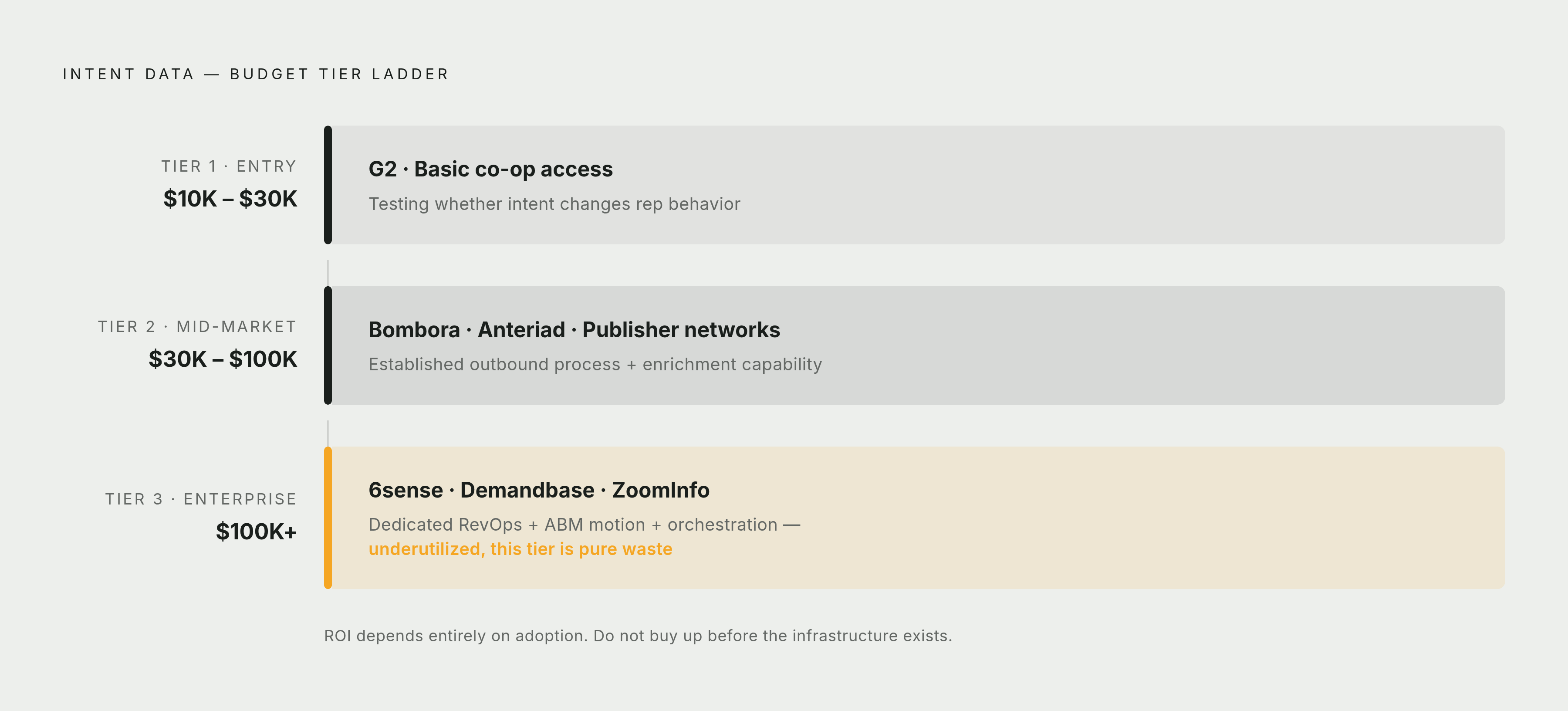
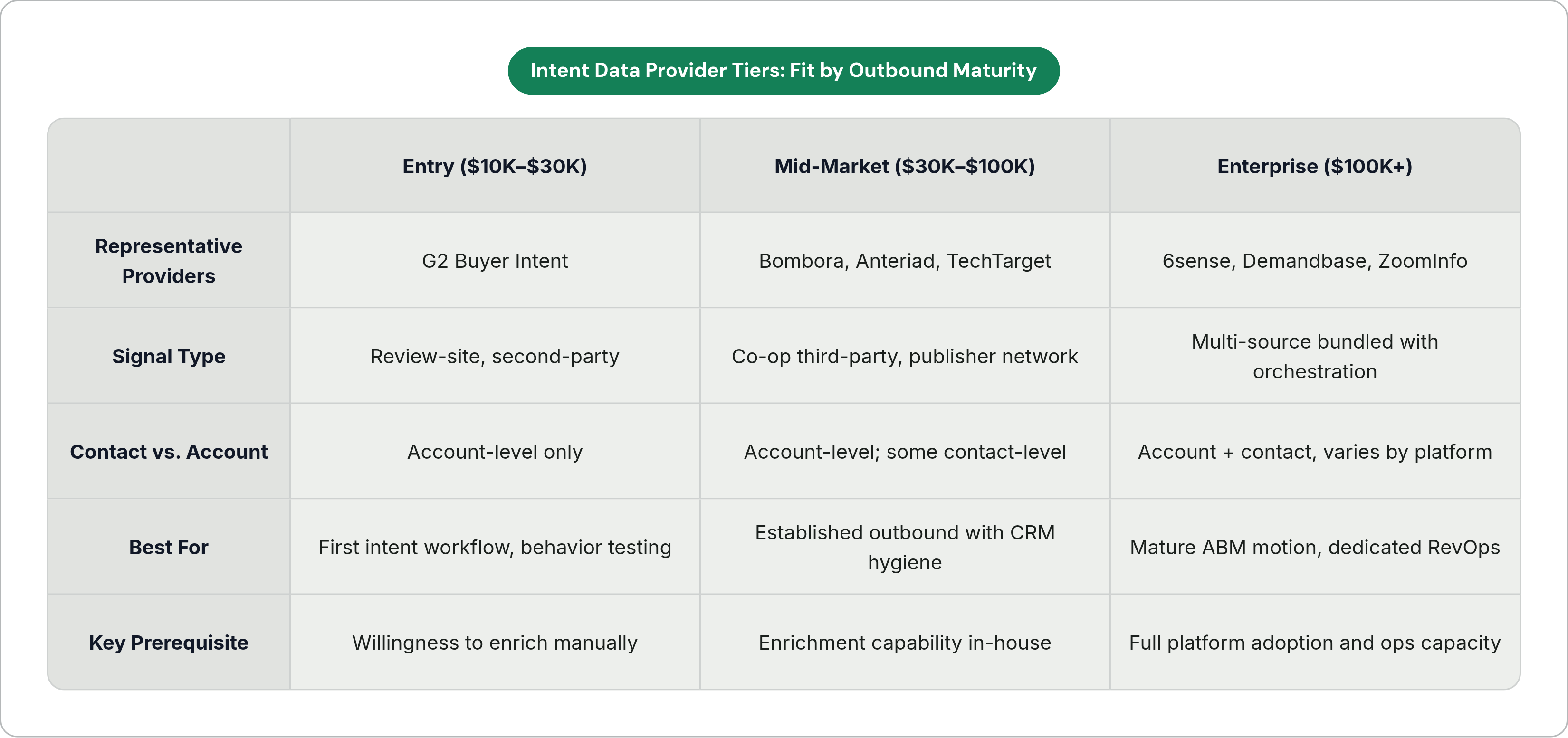
Budget tiers work as a rough sorting mechanism.
Entry tier ($10,000 to $30,000/year). Review-site signals like G2, or basic co-op data access. Appropriate for teams building their first intent workflow and testing whether the category actually changes rep behavior before committing to a larger platform.
Mid-market tier ($30,000 to $100,000/year). Bombora direct, specialist publisher networks, Anteriad. Appropriate for teams with an established outbound process, CRM hygiene, and the enrichment capability to act on account-level signals.
Enterprise tier ($100,000+/year). 6sense, Demandbase, ZoomInfo at full scale. Appropriate when you have dedicated revenue operations, a defined ABM motion, and the internal capacity to actually use orchestration features. The ROI story at this tier depends entirely on adoption. If the platform sits underutilized, you're paying for infrastructure you're not running.
One last thing worth saying plainly. The best intent data in the world doesn't close deals. It changes who your reps prioritize and when they reach out. If the rep doesn't act on the signal, or acts on it too slowly, or reaches out without any context about why the account is relevant right now, the data didn't fail. The workflow did.
That's actually useful information. Because it means the question "which provider should we buy" is downstream of a more important question: what does our team actually do with a signal when it arrives?
Answer that one first.