6sense Account Engagement Platform Review and Use Cases
The platform identifies which accounts are actively buying before competitors get there first.

6sense is a B2B platform built around one problem: most buying happens before anyone fills out a form. By the time a prospect books a demo, they've already done the research, compared vendors, and probably made half a decision. Sales teams find out about that activity late, or not at all. 6sense tries to fix that by collecting intent signals at scale and telling revenue teams which accounts are actually in-market, before a competitor gets there first.
This piece walks through how the platform's data engine works, where it delivers real results for customers, where it falls short, and who should actually buy it.
A little background first. 6sense is a subscription SaaS company that's raised $526 million, and it hit a $5.2 billion valuation back at its Series E in January 2022. According to Sacra, the company is on pace for around $265 million in ARR in 2025, growing about 8% year-over-year. That's steady, not explosive. Worth knowing if you're a buyer thinking about vendor stability over the next few years. Its customer list leans toward big, complex B2B sellers: Cisco, NetApp, Thomson Reuters. That tells you a lot about who this tool is actually built for, and we'll come back to that at the end.
The Signalverse and 6AI: how the platform's data engine actually works
Before you judge any single feature, you have to understand the data layer underneath it. 6sense calls this the Signalverse, and everything else in the platform runs on top of it.
Four streams feed in:
- Intent data: over 500 billion signals a month, pulled from B2B publisher content and review sites like G2, TrustRadius, Bombora, PeerSpot, and Gartner
- Company data: more than 25 billion signals tied to 1.1 billion company records, covering firmographics, tech stacks, and IP data
- Contact data: over 481 million B2B professional profiles
- Web de-anonymization: matching anonymous visitors on your site to real companies, using your CRM, your marketing automation platform, and live activity on your pages
All of that feeds a model called 6AI, trained on historical closed-won deals. It sorts each account into a buying stage (Awareness, Consideration, Decision, Purchase) and scores it on fit, engagement, and revenue potential.
Here's the part that actually separates 6sense from a lot of competitors: it doesn't stop at the company level. It tries to map the whole buying group; the actual humans involved in a purchase decision, through what 6sense calls the Company Graph, which the company describes as 13 years of accumulated B2B relationship data. Most tools rely on either third-party intent (what a company's doing elsewhere on the web) or first-party de-anonymization (who's visiting your site), but rarely both. 6sense runs both at once.
One honest caveat before we go further: volume isn't the same as insight. Half a trillion signals a month means nothing if the model reading them can't tell a real buying signal from noise. Keep that in the back of your mind as we go through the use cases, because it's exactly where some of the friction shows up later.
The five use cases where 6sense has the clearest impact
These aren't five separate products. Predictive scoring is the thread running through every single one of them; the account intelligence just gets applied in different directions.
1. Account-Based Marketing execution. 6sense builds and ranks target account lists by combining ICP fit with behavior data, then lets teams run plays across ads, email, web, and sales outreach from one drag-and-drop workflow canvas. Blue Yonder took 200 separate audience workflows and folded them into 60. Campaign launches got 1 to 3 days faster. They saw a 12x return. The workflow consolidation is honestly the more interesting number here; it points to less busywork, not just more pipeline.
2. Anonymous visitor identification. The platform matches anonymous site traffic back to named accounts using CRM data, marketing automation data, and real-time engagement. DealHub matched 80% of its web traffic this way. That means sales and marketing can start engaging a high-value account weeks before that account ever raises its hand.
3. Predictive lead scoring. Instead of a flat list in the CRM, reps get a ranked list based on buying stage and fit, built from patterns in past closed-won deals. Rithum saw 58% of all its opportunities come from 6sense-qualified accounts, with sales adoption tripling in 90 days. Service Express got 65% of its pipeline from accounts already in decision or purchase stage, and shaved 25% off sales velocity. The pattern across both: prioritization doesn't just change how reps work, it changes what they're working on in the first place.
4. AI Email Agents for outreach. These automate personalized sequences based on where an account sits in the buying journey. Simpro rolled this out across inbound follow-up, cold outbound, and reviving closed-lost deals: a 34% year-over-year jump in MQLs, about 2 hours saved per BDR per day, and an 80% drop in lost MQLs because follow-up got faster. 6sense also cites one customer who saved 1,098 hours with AI Email Agents; that's about seven months of BDR time. Worth flagging that most of these numbers come from 6sense's own case study library, which doesn't make them false, but it's a detail worth knowing.
5. Multi-channel orchestration and website personalization. Once intent is flagged, the platform can coordinate LinkedIn and Google ads, trigger sequences in HubSpot or Marketo, and change website content in real time, including for visitors who haven't identified themselves yet. FireMon got a 34% ad click-through rate and 50% more buyer engagement running personalized omni-channel campaigns. Qlik connected 6sense with Marketo, Salesloft, and other tools and booked 51% more meetings.
What the RevvyAI and MCP Server additions change for day-to-day users
Two additions are changing how people actually use the platform day to day.
RevvyAI launched in 2025 and went into open beta in May 2026. It's a chat-style interface: you type what you want in plain language, and it configures signals, builds audiences, launches campaigns, or pulls reports for you. No more building filters by hand or manually constructing segments. It's free for Sales Intelligence customers and in open beta for Revenue Marketing customers, which matters a lot for how fast people actually pick it up. For reps, this lowers the bar significantly: account intelligence that used to require digging through dashboards is now a question you type into a chat box.
MCP Server rolled out in July 2026, also in open beta. This one's more architectural. It takes 6sense's buying stage predictions, its 6QA qualification status, and its keyword intent data, and makes them callable by outside AI tools: Claude, ChatGPT, Writer, Agentforce. In practice, that means a team using an AI assistant to draft replies or update the CRM can now pull live 6sense data into that workflow, without ever logging into 6sense itself.
Put those two together and the direction is pretty clear: 6sense is moving from "a platform you log into" toward "a data layer other AI tools plug into." That's a meaningful thing to weigh if you're thinking about your tech stack three years out, not just today.
Where independent reviewers and customers identify friction
Every strength above comes with a corresponding catch, and it's worth being straight about them. These themes come up repeatedly across independent review sites like TrustRadius and G2; they won't apply to every deployment, but they show up often enough to matter.
Setup takes real time. Connecting your CRM and marketing automation platform, configuring your ICP, tuning intent keywords: none of this happens overnight. Teams without a dedicated RevOps or marketing ops person report a much slower ramp. This is not a tool you turn on and walk away from.
Signal volume isn't the same as signal accuracy. Half a trillion monthly signals sounds impressive, but reviewers note that intent spikes don't always line up with actual buying activity. Third-party intent data carries the same limitations as the publisher networks it's built on. Accuracy gets better when you layer in first-party signals, but it's not automatic.
Pricing isn't public. Enterprise deals get negotiated case by case, which makes early-stage budget conversations harder than they need to be. Cost scales with contact volume and feature tier, so smaller teams or lean ABM programs may struggle to justify the spend unless they have a clear line to one of the use cases above.
There's a learning curve. The platform does a lot, and reviewers say that can overwhelm new users. Dashboard setup takes training. RevvyAI's plain-language interface is 6sense's current bet on fixing this; it's still early days on whether that meaningfully shortens onboarding.
It needs sales and marketing to already be on the same page. The value compounds when both teams work from the same signals and the same definitions of a qualified account. If sales and marketing operate in silos, the realized value drops. That's not a flaw in the product. It's a condition for getting the product to work.
How 6sense compares to the main alternatives buyers evaluate alongside it
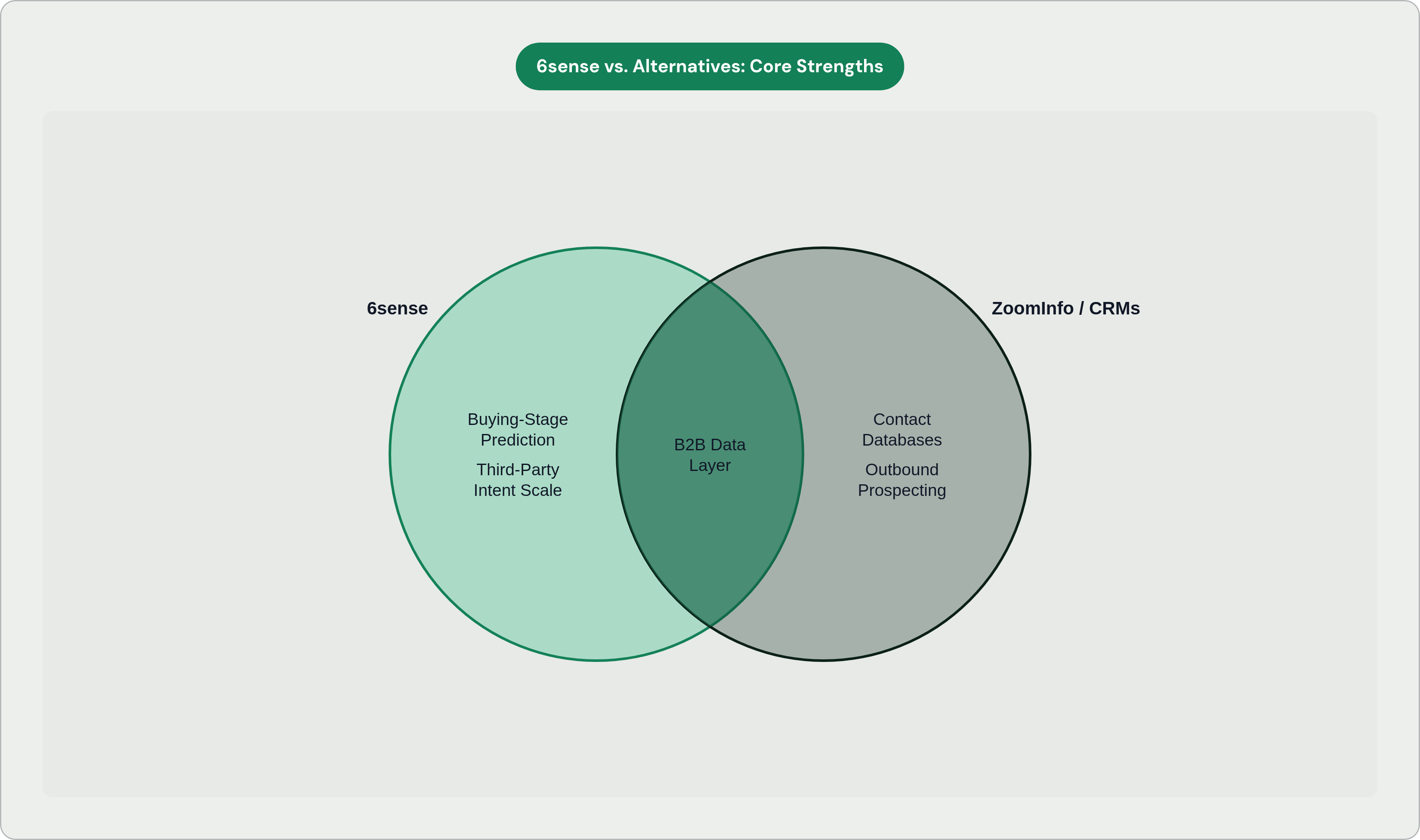
This isn't a ranked list. It's meant to help you see where the real differences actually sit.
Demandbase is the closest peer. Same category: account intelligence, intent data, ABM orchestration for B2B enterprises. Demandbase leans harder into account-level advertising and first-party data. 6sense's edge is the sheer breadth of the Signalverse's third-party intent data and its buying-stage prediction model. Both show up as Leaders in Gartner's Magic Quadrant for ABM, so if you're deciding between them, push both vendors on where their intent data actually comes from and how transparent their model is about its predictions.
ZoomInfo goes deeper on contact databases and outbound prospecting, and lighter on predictive buying-stage modeling. If your team's priority is prospecting volume, ZoomInfo may fit better. If you're running a structured ABM program, 6sense's predictive layer tends to win out.
HubSpot and Salesforce, on their native ABM features, don't have the third-party intent layer or the buying-stage prediction that make up 6sense's core strength. That's fine if your ABM needs are early-stage or simple. 6sense doesn't try to replace either CRM, by the way; it integrates with both and sits on top as an intelligence layer.
Nextstep operates in a different part of the workflow entirely. 6sense tells you which accounts to go after and when. Nextstep handles what happens after that: drafting replies, logging CRM updates, booking next steps, all inside Salesforce or HubSpot without making reps switch tools. If your real problem is administrative drag on your sales team, that's a Nextstep problem more than a 6sense problem. For teams already running 6sense, Nextstep sits downstream in the process. The two solve different failure points and can run side by side.
Which organizations are most likely to get clear value from 6sense
Good fit:
- B2B enterprise or mid-market companies with long sales cycles and multiple stakeholders in the buying decision
- Teams already running, or about to run, a real ABM program; 6sense adds the most value when there's an account list strategy to point it at
- Organizations with RevOps or marketing ops capacity to set the platform up and keep it maintained
- Sales and marketing teams that already share pipeline definitions and are willing to work off the same account signals
Socure is a good example of what this looks like when it compounds. They went from $52 million in sourced pipeline in year one to $98 million in just the first half of 2025, a 4x jump in program size, once the right pieces were in place.
Weaker fit:
- Small teams without RevOps support. The implementation burden doesn't end after onboarding, it's ongoing.
- High-velocity, transactional sales with short cycles, where account-level orchestration adds less value per dollar
- Companies where sales and marketing aren't aligned yet; that foundation needs to exist before 6sense can build on top of it
- Buyers who need clear, predictable pricing up front, since the enterprise deal model is negotiated case by case
Gartner rated 6sense highest for Ability to Execute in its 2025 ABM Magic Quadrant, and Forrester describes it as the right fit for "B2B enterprises seeking a data-rich, AI-powered platform to unify marketing and sales engagement." Both point in the same direction: this is an enterprise tool first. If you're outside that profile, that's not a dealbreaker, but it's context worth weighing honestly before you sign anything.