Revenue Intelligence Platforms for Sales Forecasting
Most sales forecasts fail because teams rely on incomplete CRM data.
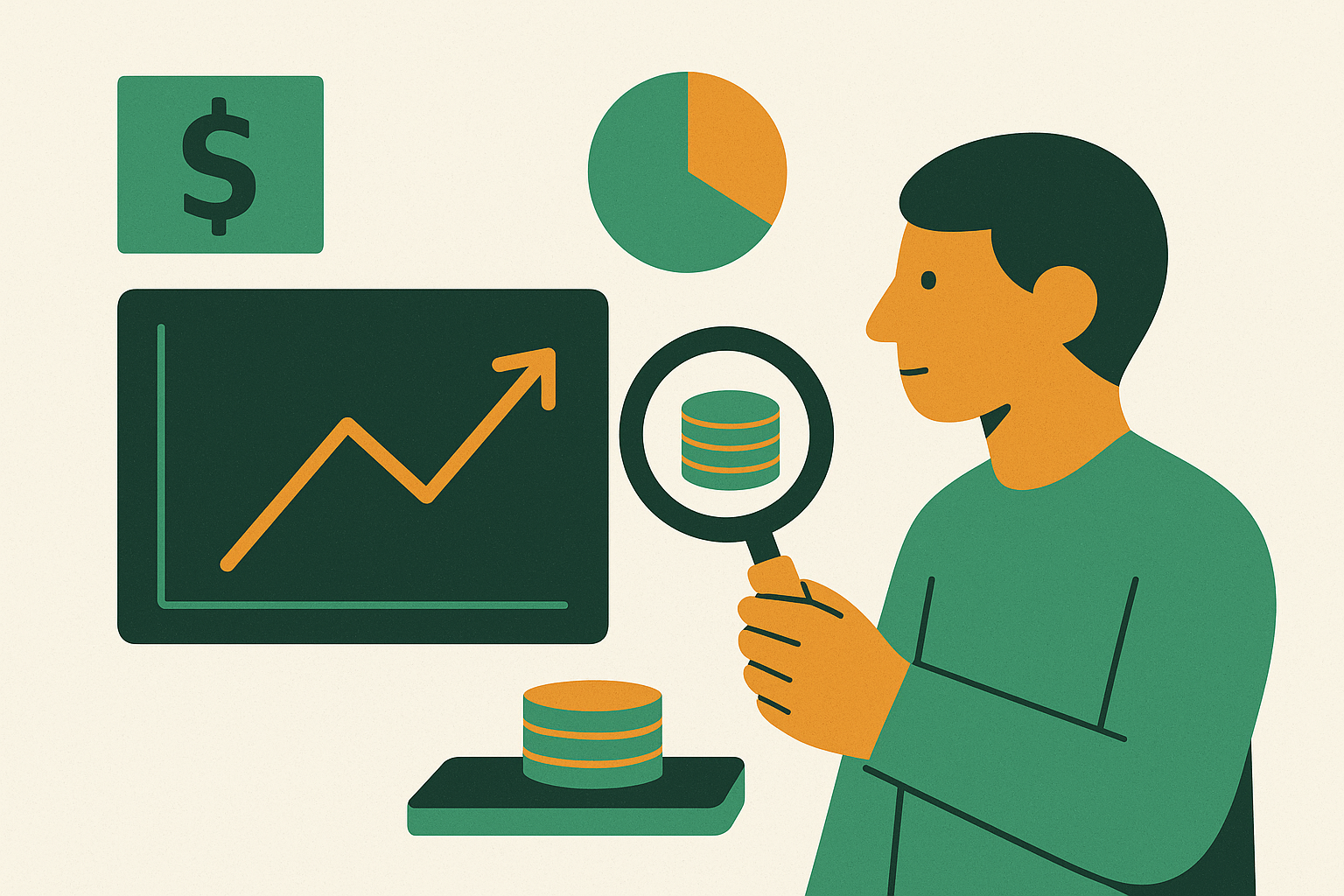
Only 7% of sales organizations hit forecast accuracy of 90% or higher. Across an entire category of highly paid professionals whose literal job is to predict revenue, almost no one is actually good at it.
Around 80% of companies have missed their revenue forecasts in the last two years. Only about 20% of sales teams can forecast with better than 75% accuracy using traditional pipeline methods.
So what's actually going wrong?
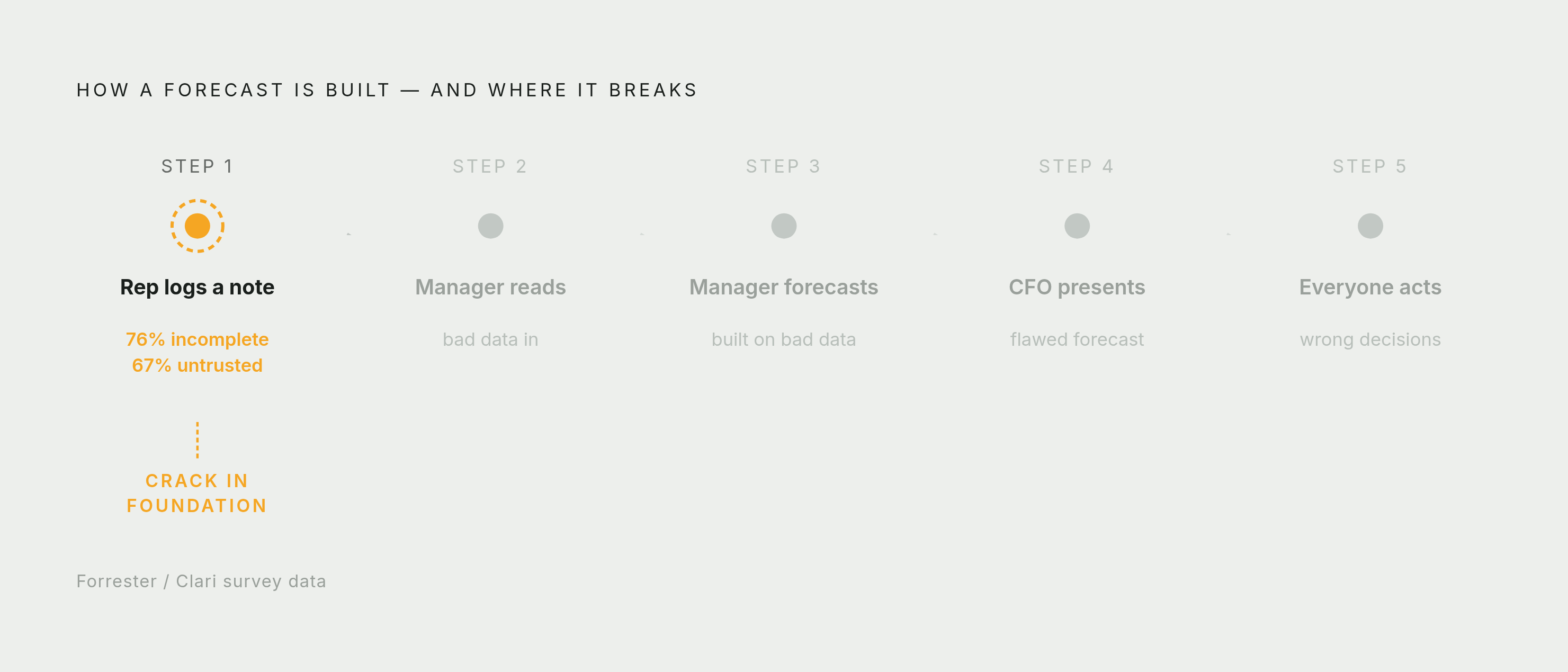
Forecasts are built on what reps tell the CRM. But roughly 67% of large enterprise revenue leaders don't trust their own CRM data. And about 76% of CRM users say less than half of their records are accurate and complete.
Here's how the broken chain works. Rep logs a note. Manager reads the note. Manager builds a forecast. CFO presents the forecast. Everyone acts on it. Except the note was optimistic, incomplete, or just never written at all. The whole downstream process is sitting on a foundation of vibes.
That problem gets worse when you factor in how complex B2B buying has become. The average buying journey now spans 8 to 12 touchpoints. Each one generates a signal. Most of those signals never touch the CRM.
Fixing CRM hygiene through rep discipline alone has a near-zero success rate. Asking people to do more administrative work, on top of actually selling, doesn't go well. The platforms in this piece take a different approach: capture the data automatically, so reps don't have to.
The data quality crisis is both the reason to buy a revenue intelligence platform and the single biggest risk to getting value from one.
How the AI Inside These Platforms Actually Generates a Forecast
There are three generations of AI working inside these tools right now, and they do meaningfully different things.
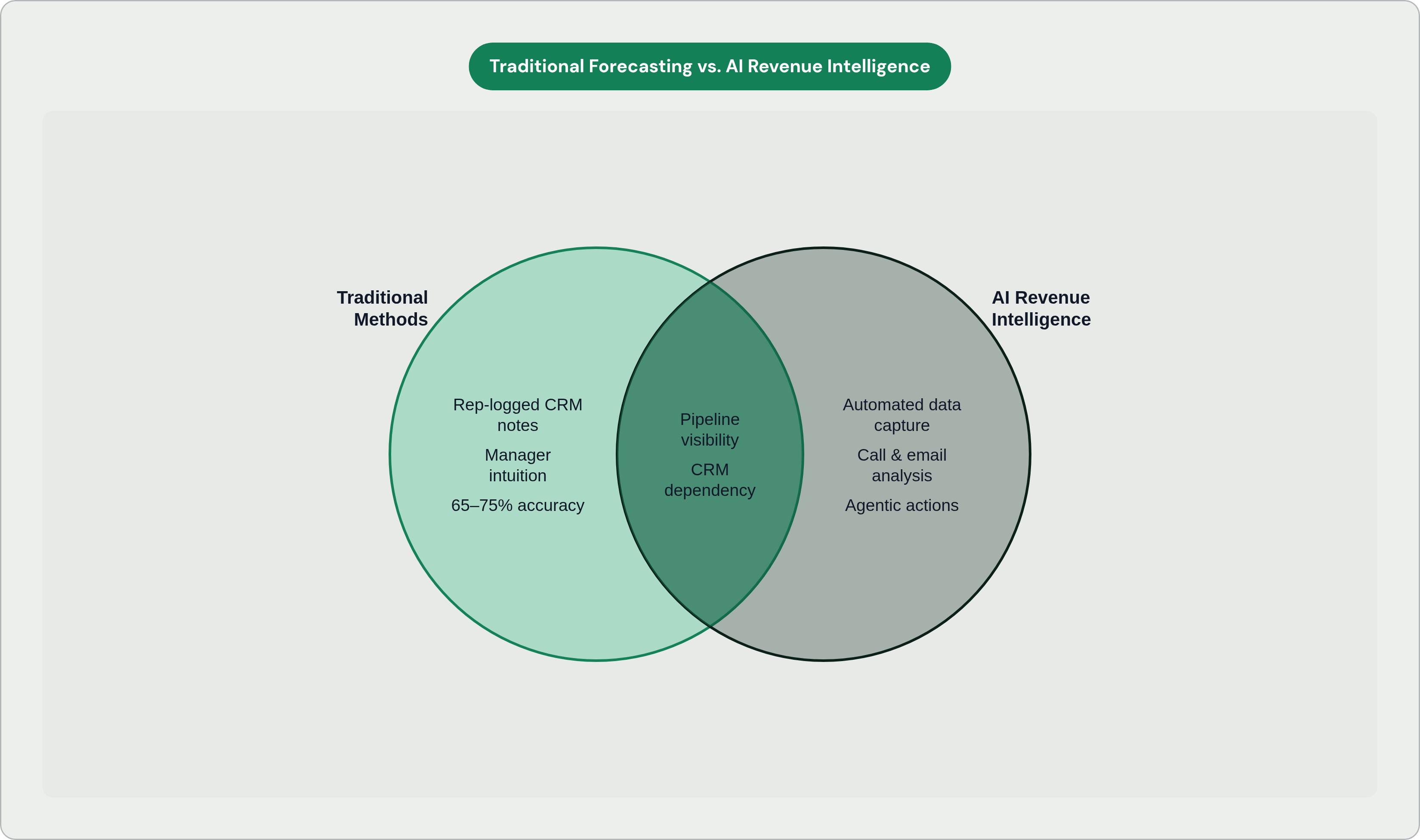
Predictive AI is the oldest layer. It trains on historical deal data, looks at deals that closed, deals that died, how long things took, and at what stage deals stalled. Then it scores your current pipeline based on those patterns. Win probability. Close date. Deal value. This is table stakes now.
Generative AI is where most investment is flowing. It processes call recordings, email threads, meeting notes, and unstructured text to pull out sentiment, urgency, objections, and buying signals. The reason this matters for forecasting is specific: a rep might mark a deal as 80% likely to close while the last three calls show the champion has gone quiet and a competitor got mentioned twice. Generative AI catches that gap.
Agentic AI is the frontier. And honestly, it deserves some skepticism before it deserves any excitement.
The idea is that the system doesn't just surface insights. It takes action. Re-routes a deal. Triggers a follow-up. Adjusts pipeline. Vendors are very excited about this framing right now. Gartner looked at thousands of vendors claiming agentic AI capability and found roughly 130 that are actually doing something substantive. They coined a term for the pattern: "agentic washing."
When a vendor demo gets to the "agentic" part, ask them to show you a specific autonomous action the system has taken, the measurable outcome it produced, and what guardrails stop it from doing something stupid. If they pivot to a slide, you're looking at a marketing label.
Under the hood, these platforms use several types of machine learning models working in combination. Classification models predict win or loss. Regression models estimate close dates and deal values. Time-series models track how deals tend to move through stages. Natural language processing extracts meaning from unstructured content like calls and emails that don't fit in a dropdown field.
Mature deployments typically achieve accuracy in the 85 to 97% range, versus 65 to 75% for traditional methods. But the high end of that range comes from vendor studies using their best implementations. Real-world results depend heavily on what data the system actually has to work with.
What the Outcomes Research Actually Shows — and Where the Numbers Should Be Read Carefully
The headline numbers are notable. Organizations with mature deployments report up to 28% improvement in forecast accuracy and roughly 19% reduction in sales cycle length. Companies using AI-driven forecasting report 15 to 20% higher accuracy, shorter sales cycles, and meaningful gains in quota attainment.
Those numbers are real. They also need context.
Most outcome figures come from vendor studies or analysts working from vendor-supplied data. McKinsey-cited benchmarks, which tend to be more conservative, point to around 15% higher sales efficiency and 20% shorter sales cycles. That's a narrower claim than some vendors will lead with, but still meaningful if you can replicate it.
Sellers currently spend only about 25% of their working hours actually selling. A meaningful share of sales professionals using AI for research report saving between one and five hours per week through automation alone. If reps spend less time on admin, they spend more time on deals. Better deal coverage means better signal. Better signal means better forecasts. The accuracy improvement and the capacity gain are connected, not separate benefits.
But there's a hard limit on all of this. If 76% of CRM records are incomplete going in, even a strong AI layer is working with weak inputs. The research describes outcomes from teams that got the data right first. If your data capture problem isn't solved at the source, you will not see those numbers.
Where the Market Stands in 2025 to 2026, and What Gartner's New Magic Quadrant Signals
The revenue intelligence market is large and growing fast, though different analysts count it differently. Estimates for current market size range from roughly a few billion dollars to several billion dollars, depending on whether a given analyst includes conversation intelligence, sales engagement, or only pure-play forecasting tools. All projections point toward a market in the tens of billions of dollars range by the early 2030s.
Use that range as a signal of momentum. Don't build a business case around any single number in it.
Enterprise adoption is well past the early adopter stage. A majority of U.S. enterprises have implemented or are actively piloting platforms. The share of companies with dedicated RevOps functions has grown substantially year over year.
The more significant market signal came in December 2025, when Gartner published its inaugural Magic Quadrant for a new category it called Revenue Action Orchestration.
The name change is the actual story. Gartner isn't just renaming revenue intelligence. They're signaling that the market has moved. Revenue Action Orchestration, as Gartner defines it, is the convergence of sales engagement and revenue intelligence into a single AI-driven system. Not just analyzing what's happening, but taking action on it.
If you buy a tool that only does the intelligence half, you may be buying into a narrower category than your problem actually demands. That's worth knowing before you sign anything.
The Leading Platforms and What Differentiates Them
Every vendor in this space will show you a forecast accuracy slide and a pipeline health dashboard. The differences are in what they're actually built to do well.
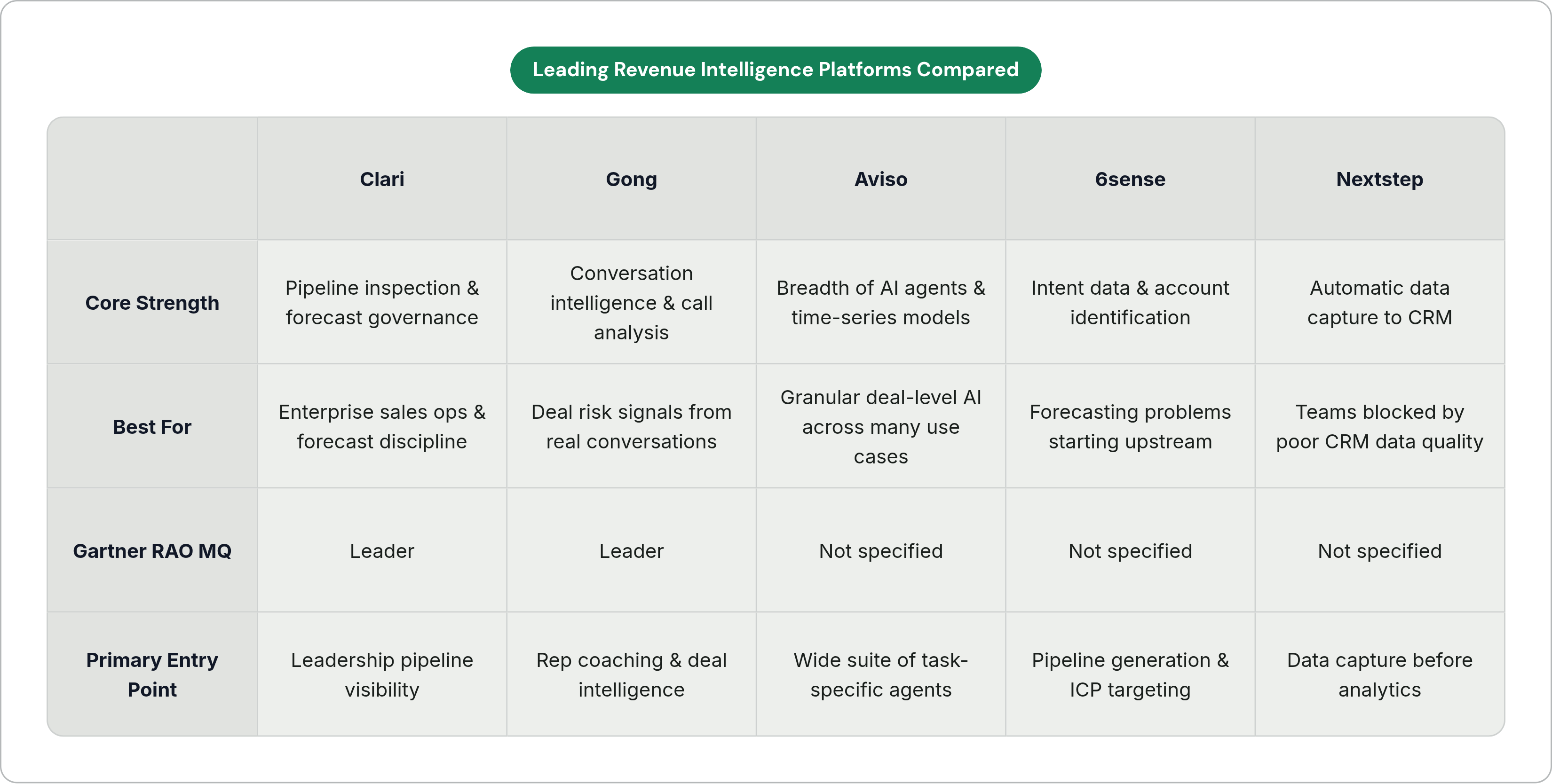
Clari started as a forecast-first platform and has stayed closest to that identity. Its strength is pipeline inspection and called-number accountability, the kind of structured discipline that enterprise sales ops teams want. It was named a Leader in Gartner's inaugural RAO Magic Quadrant. If your primary pain is forecast governance and pipeline visibility at the leadership level, Clari is purpose-built for that.
Gong started with conversation intelligence and built outward from there. Deep call and meeting analysis is still its core strength, and that matters because rep coaching and deal risk signals surfaced from actual conversations are meaningfully differentiated data. Gong also landed in the Leader quadrant of Gartner's RAO MQ. If you want to know what's actually happening in your deals based on what gets said (and not said) on calls, Gong's depth here is hard to match.
Aviso differentiates on breadth. It offers a wide suite of task-specific AI agents and is particularly strong in time-series forecasting models that track deal progression patterns over time. Teams that want granular, deal-level AI across a wide range of use cases tend to land here.
6sense plays a different game entirely. Its differentiation is on the intent data and account identification layer, which means it's most relevant for teams whose forecasting problem starts upstream, with pipeline generation rather than pipeline inspection. If you're trying to forecast accurately but you're also not confident you're talking to the right accounts in the first place, 6sense addresses that earlier part of the problem.
Nextstep takes a specific angle worth understanding on its own terms. Its design premise is that the forecasting accuracy problem is a data capture problem first. It automatically logs calls, emails, and next steps directly to Salesforce and HubSpot, learns deal context and rep communication patterns without requiring prompt engineering, and fills in the CRM data gaps that everything else depends on. It's particularly relevant for teams who have tried to improve forecast accuracy and keep hitting the same wall: the data going into the model isn't reliable enough.
Tellius and similar analytics-layer platforms position themselves as the intelligence layer on top of existing data warehouses. If you already have rich structured data but lack the analytical layer to turn it into forecasting signal, this approach lets you avoid replacing infrastructure you've already built.
The Gartner RAO Magic Quadrant changes how this comparison should be read. Vendors are now being evaluated not just on analytical depth, but on their ability to deliver autonomous guidance, consolidate revenue signals, and scale execution. That raises the bar for everyone on the list.
The Criteria That Actually Separate a Good Fit From an Expensive Mistake
Before you book a single vendor demo, answer one question honestly: how complete and accurate is your CRM data right now?
Every platform on the list amplifies the data it ingests. A strong AI layer on top of incomplete data does not produce accurate forecasts. It produces confident-looking wrong answers, which is arguably worse than the problem you started with.
A few dimensions worth weighting explicitly in any evaluation:
Data capture completeness. Does the platform automatically capture emails, calls, and meetings into the CRM, or does it depend on reps to log them manually? This is the upstream variable that determines everything downstream. If the answer is "reps log it," you haven't solved the original problem. You've just added a dashboard to it.
Integration depth. Native connectors to Salesforce, HubSpot, and communication tools matter more than they sound. API-only integrations often require IT build time that quietly stretches your time-to-value window. Also worth asking: does the platform learn from your existing deal history, or does it start cold?
Forecast model transparency. Can the model explain why a deal is scored the way it is? Black-box scoring creates the same trust problem as rep intuition. If leaders can't understand why the model is flagging a deal at risk, they won't act on it. About 67% of revenue leaders already say they don't fully trust AI-generated data. Explainability isn't a nice-to-have in that environment.
The agentic claims test. Ask for a specific autonomous action the system has taken. Ask for a measurable outcome. Ask what guardrails exist. If the answer is a demo of a recommended next step that a human still has to click, that's not agentic. That's a push notification with better branding.
Time to value. How long does it take the platform to ingest enough historical deal data to produce reliable forecasts? For teams with thin CRM history, this window is often 60 to 90 days at minimum. That timeline needs to be in your evaluation, not discovered after you've signed.
Beyond the platform, there are organizational questions that no vendor will answer for you.
Is the primary pain in pipeline visibility, rep coaching, or CRM data quality? Each maps to a different archetype on the list above. Does your team have a RevOps function to own the implementation? About 48% of companies now do. The other 52% frequently underestimate what it takes to stand up these platforms and actually see results.
And maybe the most clarifying question of all: are you trying to improve the forecast number, or improve the decisions that flow from it? That distinction separates forecast-first tools from connected revenue systems. They are not the same product.
The data quality problem has to be solved at the capture layer, not the analytics layer. You cannot model your way out of bad inputs. The teams producing the accuracy improvements the research describes fixed what was going into the system before they worried about what was coming out of it.