B2B Sales Process Fundamentals and Deal Stages
Buyers form their shortlist before your sales process even starts.
By the time a B2B buyer talks to a rep, they've already done most of their homework. Peer reviews, analyst write-ups, competitor comparisons, community threads, internal debates with their own team. The rep doesn't open the evaluation. The rep joins it, usually later than they think, and often later than is comfortable to admit.
Here's the part that should change how you think about your process: most B2B deals are won by vendors who appeared on the buyer's shortlist before the formal process started. Not the most persuasive pitch. Not the slickest demo. The vendor who was already in the consideration set before the first meeting got scheduled.
If the shortlist forms before you ever speak to anyone, your sales process isn't really the buyer's process. It runs alongside it, at best.
Then there's the committee problem. You're not selling to a person. You're selling to a group: technical evaluators, finance, procurement, legal, end users, and somewhere in the background, an executive who hasn't responded to your emails but absolutely has a vote. Millennials and Gen Z now make up the majority of B2B buying teams, and they tend to involve more stakeholders, not fewer. They've already watched three demos on your website before your first call. They've read the G2 reviews. They've asked their network.
A process built for a rep-led, education-first era keeps stalling. Not because your reps are bad. Because the buyer changed and the process didn't catch up.
Why Deal Cycles Vary So Widely and What's Actually Driving the Length
Deal cycle length isn't random, and it's not purely a reflection of rep performance. It correlates closely with deal size, stakeholder count, and industry. Knowing that is what separates realistic forecasting from explaining to your VP every quarter why that enterprise deal is still "late stage."
Deal size is the most obvious factor. Smaller contracts can move in days. Larger ones require security reviews, procurement involvement, legal sign-off, and executive approval. Each one adds weeks, and they often run in parallel in ways that are hard to predict.
Stakeholder count compounds the timeline in ways people consistently underestimate. Every additional approval layer creates coordination overhead. Regulated industries like healthcare tech and financial services carry the longest cycles by a significant margin. Compliance requirements don't accelerate because you have a quarterly number to hit. That's a lesson I've watched people learn expensively.
Channel matters more than most reps acknowledge. Inbound leads from referrals or organic search move considerably faster than comparable outbound deals. The trust is different from the start, and that difference shows up in how quickly buyers are willing to move.
One thing that cuts across all of these: multi-threading. Deals where multiple stakeholders are actively engaged close faster than single-threaded deals. This isn't a closing tactic you pull out in the final stretch. It's a process design requirement, and it has to start in discovery.
Worth noting: deal cycles have gotten longer in recent years. Tighter budgets, larger committees, more scrutiny. A process calibrated before that shift may be mistiming its own stages.
Stage One: Prospecting — Find the Accounts That Are Actually Worth Your Time
The purpose of prospecting isn't to fill the top of your funnel with as many names as possible. It's to find accounts that fit your Ideal Customer Profile. Those are different goals, and conflating them is expensive in ways that don't show up until two stages later when you're wondering why your pipeline looks full but nothing is closing.
A large share of reps cite prospecting as the hardest part of their job. That difficulty is earned. Outreach timing, ICP clarity, and signal quality all compound on each other. Get any one wrong and you generate activity that looks like progress but isn't.
What good prospecting actually looks like, in practice:
- An ICP built on firmographics, technographics, and behavioral signals. Not just industry and company size. Those last two tell you who might be a customer someday. Behavioral signals tell you who's actively looking.
- Multiple channels used together. Cold outreach, referrals, content-driven inbound, intent data. The channel should match buyer preference, not rep habit.
- Prioritization by fit and timing, not by whoever picks up the phone.
A funnel full of poor-fit accounts doesn't just underperform. It actively creates drag. Stalled deals, wasted demos, proposals that were dead before they were written. Every one of those represents time that could have gone somewhere real.
Stage Two: Lead Qualification — Deciding Which Opportunities Actually Deserve Your Time
The purpose of qualification is simple, maybe even a little brutal: decide whether a prospect has the need, authority, budget orientation, and timeline to become a real opportunity before you invest significant time in them. That's it. Everything else is downstream of that decision.
The MQL-to-SQL conversion is where most pipelines lose the most ground. It gets treated as administrative work. It isn't. It's the most strategic decision in the process, and it gets made badly because no one wants to be the person who kills a deal.
A few frameworks worth knowing:
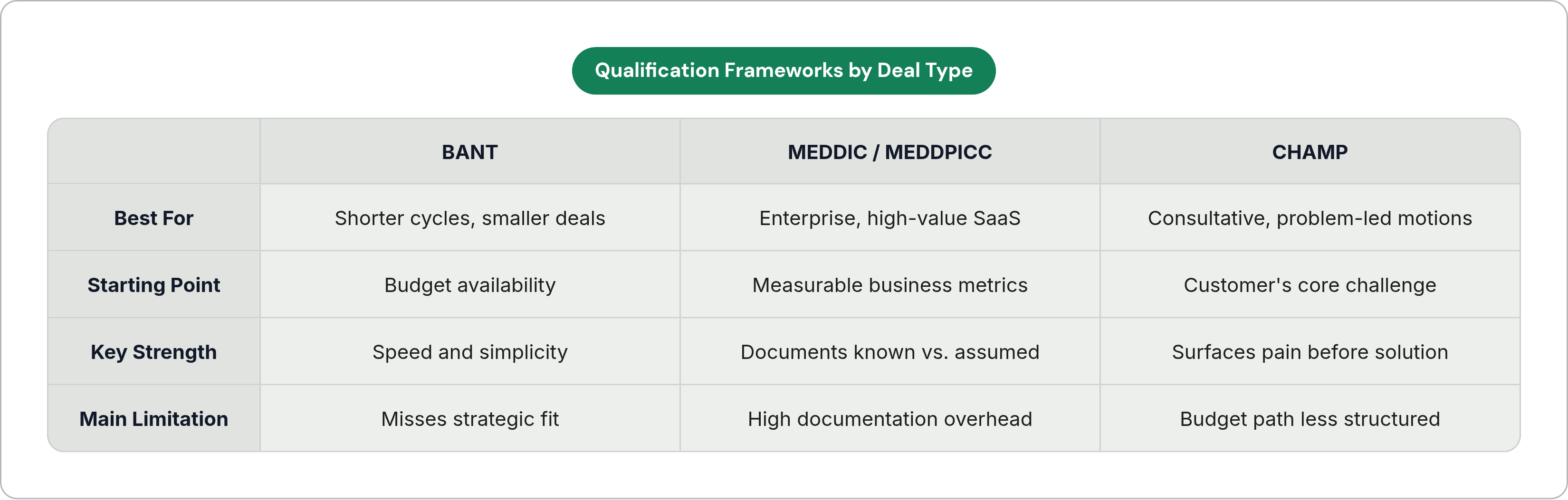
- BANT (Budget, Authority, Need, Timeline): Efficient for shorter cycles and smaller deals. Can miss strategic fit in complex sales where the budget doesn't exist yet but could.
- MEDDIC / MEDDPICC: Built for enterprise. Focuses on metrics, economic buyer, decision criteria, decision process, champion, and competition. Dominates high-value SaaS sales because it forces you to document what you actually know versus what you're assuming.
- CHAMP (Challenges, Authority, Money, Prioritization): Starts with the customer's problem rather than budget. Better suited to consultative motions where the pain is clear but the solution isn't yet.
Framework choice should match your cycle length and deal complexity. Not habit. Not what your manager used at their last company.
The thing that's consistently undervalued here is disqualification. Exiting a poor-fit lead cleanly is just as valuable as advancing a strong one. Letting bad-fit deals linger clogs your pipeline, distorts your forecast, and burns time that could go somewhere real. If "qualified" has started to feel like a formality you complete to move something to the next CRM stage, that's the leak. That's where your pipeline starts lying to you.
Stage Three: Discovery — Diagnose the Problem Before You Start Proposing Solutions
Discovery is where most reps think they're doing fine and where most proposals quietly die. The rep does the call. The notes get logged. The proposal gets written. And then nothing. Because the proposal didn't reflect what the buyer actually cared about. It reflected what the rep thought they heard, which isn't always the same thing.
The purpose of discovery is to surface the buyer's real problems, constraints, and success criteria deeply enough that your proposal addresses the actual situation. Not a generic version of it that could apply to any company in their industry.
In committee buying, a single champion's pain rarely represents the full picture. Technical stakeholders define success differently than financial ones. Executive sponsors care about things your day-to-day contact has never mentioned. Discovery has to happen across personas, not just with your initial contact, and it has to map the people who can say no but not yes before you get to proposal.
Good discovery produces specific, documented outputs:
- The buyer's current state, desired state, and the gap between them. In their words, not yours.
- Named stakeholders with their individual success criteria, because those criteria will conflict in ways you need to know about before you write the proposal.
- Known constraints: budget range, timeline, technical requirements, procurement process.
When discovery maps the full buying committee, the negotiation stage gets easier. Agreement doesn't have to be rebuilt from scratch if you built it correctly here.
Stage Four: Proposal and Presentation — Prove You Were Actually Listening
By the time a buyer receives a formal proposal, they're usually well into their evaluation. They may have already formed a preference. This stage doesn't introduce your company to them. It either confirms or undermines the position you've been building.
The largest drop in most B2B funnels happens between qualified opportunity and formal proposal. A substantial share of qualified deals simply don't advance, which means proposal quality and timing are some of the highest-leverage variables in your process. And yet the proposal review gets less attention than the demo prep.
What separates proposals that actually move things forward:
- Specificity. It references the buyer's stated problems. Not a generic feature list that could have been written before the first call.
- Stakeholder coverage. It addresses concerns across technical, financial, and executive reviewers, not just your primary contact, who may not be the person who actually kills the deal.
- Clear next steps. Ambiguity at the end of a proposal stalls deals. Every proposal needs a defined follow-up action with a date attached.
Demos that advance tend to share one characteristic: tight alignment between the problem the rep heard in discovery and what the demo actually shows. The mismatch between those two things is one of the most common reasons a promising call doesn't produce a next step, and it's almost entirely avoidable.
Stage Five: Negotiation and Objection Handling — Working Through the Resistance Before Anyone Commits
The purpose of negotiation is to address concerns around price, risk, timing, and competing priorities in a way that moves commitment forward. Not in a way that gives things away out of panic because the quarter is ending.
Budget pressure is the most common objection, and it's gotten more intense. Procurement is involved in most B2B buying cycles now. That means this stage increasingly involves working through a structured process with people whose job is specifically to reduce price and reduce risk. Not to evaluate fit. Not to decide whether your product solves the problem. To protect the company's money. Knowing that going in changes how you prepare.
If you haven't multi-threaded by now, do it anyway. A deal where only one contact is engaged is vulnerable to a stakeholder change, a budget freeze, or a champion losing internal influence. Late is better than never, but late executive involvement tends to slow deals rather than accelerate them. Fair warning.
Security review, legal review, and compliance sign-off are standard enterprise steps that people consistently underestimate for timeline purposes. The trials and proof-of-concept engagements that buyers now expect on larger contracts? Budget time for those too. These aren't surprises at this point. They're the process.
Stage Six: Closing — The Output of Everything That Came Before
Closing converts mutual agreement into a signed contract. It gets the most attention in sales culture and probably deserves less of it than qualification and discovery do. Most of what happens at this stage was determined two or three stages earlier.
The most common reason deals don't close isn't a competitor winning. Most lost deals end in no decision at all. The buyer chose to do nothing. That should change how you think about what your process is actually trying to prevent.
What distinguishes deals that do close:
- A clearly defined mutual action plan with specific dates and owners on both sides. Not "we'll follow up next week."
- Early involvement of decision-makers. Waiting until closing to engage the economic buyer extends the cycle or ends it.
- Consistent follow-through. Most B2B deals require multiple touchpoints after the proposal. A surprising number of reps drop follow-up far too early, then write the deal off as dead.
Research from Ebsta and Pavilion shows top performers closing deals substantially faster than the rest of the field, and that gap has widened in recent years. Win rates from formal proposal onward are higher than pipeline-entry win rates. That tells you something important: qualification and discovery are where most deals are actually won or lost. Closing is the ceremony.
Stage Seven: Post-Sale and Expansion — Where the Next Deal Begins
Net-new B2B sales have declined sharply, pushing many organizations to treat existing accounts as their most reliable growth source. Upsell and cross-sell carry lower acquisition cost and shorter cycles than new-logo pursuit. What's striking is how many sales processes still treat the close as the finish line, when in practice it's more like halftime.
Deals where the seller maintains an engaged relationship at the executive level show meaningfully higher upsell potential. The relationship that started in discovery pays compound returns after the close.
What good post-sale process actually looks like:
- A clean handoff from sales to customer success. No ambiguity about what was promised, what the implementation timeline is, or who owns the relationship going forward. Messy handoffs are where trust breaks.
- Defined check-ins tied to adoption and outcomes, not just renewal dates.
- Expansion conversations tied to real triggers: hitting a usage milestone, a business change, a new stakeholder appearing. Reactive upsell attempts don't work nearly as well as ones anchored to something that actually just happened.
The close is also the beginning of the data that informs your next deal. Renewal rates, expansion rates, churn patterns feed back into ICP refinement. If you're not capturing that loop, you're leaving learning on the table, and you're going to repeat the same prospecting mistakes in the next cycle.
Where the Process Breaks Down in Practice and Where to Find the Real Leak
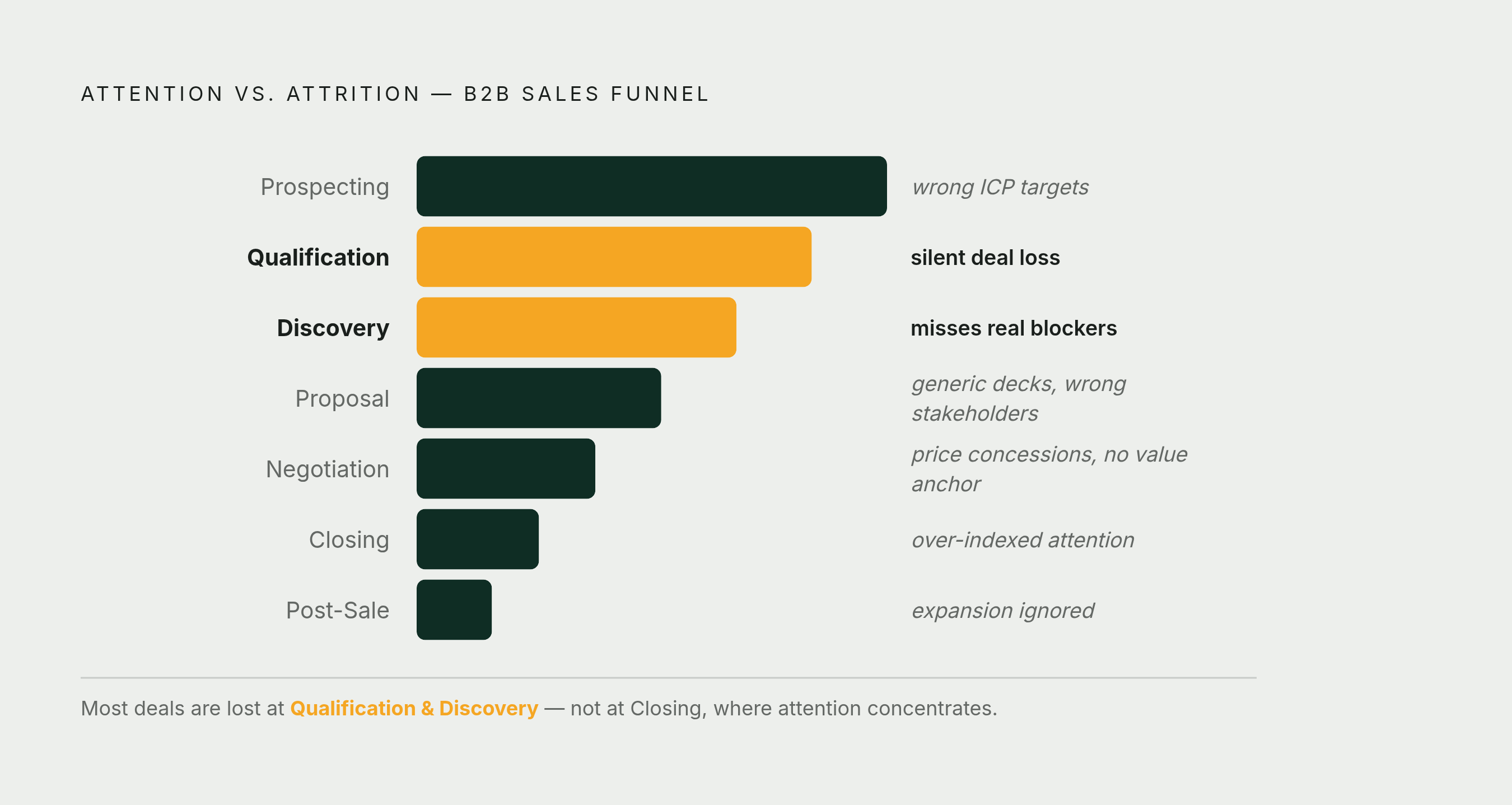
Most pipelines leak in the middle. Qualification and discovery are where the largest volume of deals is lost, often silently. Opportunities advance past prospecting, stall before proposal, and no one records a clear reason why. When the reason isn't captured, it can't be fixed.
That's not a data problem. That's a process design problem.
Here's where things actually go wrong, stage by stage, and what's usually behind it.
Prospecting. Poor ICP definition produces volume without relevance. Reps chase accounts that look right on paper but don't convert because the fit was never real. The fix isn't working harder. It's tightening ICP criteria and using behavioral signals, not just firmographics.
Qualification. Marketing and sales are operating from different definitions of a good lead. Deals that shouldn't be in the pipeline get advanced anyway to hit activity metrics. The fix is a shared, written lead definition tied to CRM data. Not a conversation. A document someone can point to when there's disagreement.
Discovery. Reps treat it as a checklist and miss the real blockers. Single-threaded discovery produces proposals that only one person feels connected to. The fix is discovery across personas, with documented outputs that actually get referenced when the proposal is being written.
Proposal. Generic decks sent to the wrong stakeholders at the wrong time. Proposals that don't reflect what was said in discovery. The fix is a review step where someone other than the rep checks whether the proposal addresses the stated problems before it goes out.
Negotiation. Single-threaded deals collapse when the champion goes quiet. Late procurement involvement adds delays that feel like surprises but aren't. The fix is mapping procurement timelines in discovery, not in the final stretch when you have no leverage to change them.
Closing. No mutual action plan. Follow-up drops after two attempts. Deals stall and get written off instead of re-engaged. The fix is a defined stall-recovery playbook and a mutual action plan that's standard for every deal above a certain size.
Post-sale. Handoffs are messy. What was promised in the sale doesn't match what customer success hears on day one. Expansion conversations happen reactively, if at all. The fix is a structured handoff document and a defined first-90-days cadence tied to outcomes.
Here's the thing about all of these: most pipeline problems get diagnosed at the wrong stage. The deal that stalls in negotiation usually broke in discovery. The proposal that lands flat usually traces back to a prospecting problem. By the time the symptom shows up, the cause is two or three stages back, and everyone is focused on the wrong thing. Which is, honestly, most of what makes sales operations so hard to improve.