Building a Multi-Channel Outbound Sequence in 2024
Each channel plays a specific role when sequences shift based on prospect behavior.
Five automated emails. Three days apart. Subject lines getting progressively more desperate until someone finally sends "Did I lose you?" The prospect didn't reply to the first four. Probably because none of them gave a reason to.
That's not a multi-channel sequence. That's a drip campaign with branding on it.
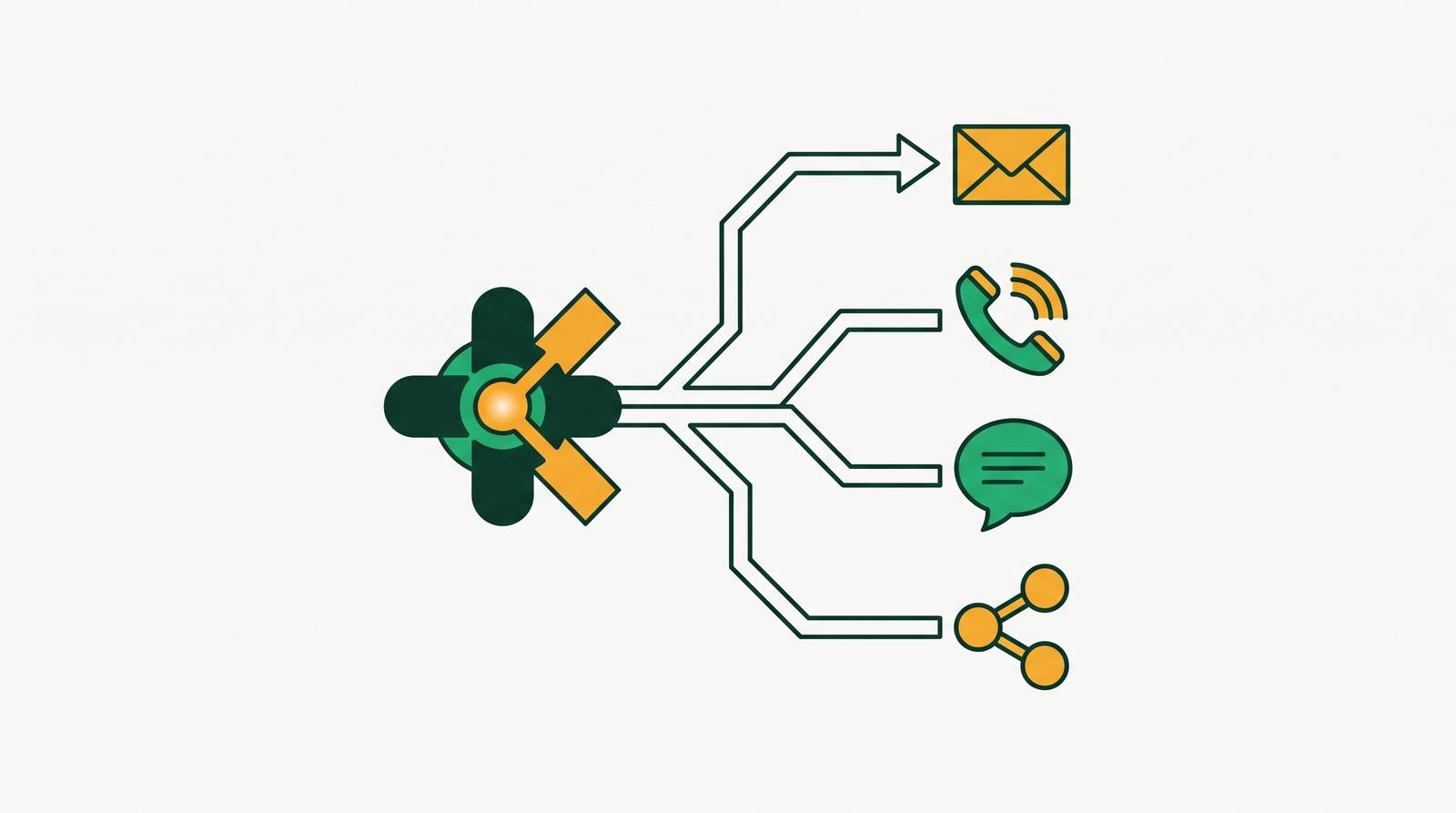
A real multi-channel sequence is a structured system where each channel has a specific job, and the whole thing shifts based on how the prospect actually behaves.
Four core channels exist right now: email, phone, LinkedIn, SMS. A fifth is gaining ground — short personalized video clips, the kind where you record a 60-second screen share with their actual website in frame. It signals effort in a way no text message ever could, and AI is starting to make it less painful to produce at scale.
What actually separates a multi-channel sequence from just "doing more stuff" is job definition. These channels aren't interchangeable slots in a calendar. Think of them less like weapons in an arsenal and more like instruments in an orchestra, each playing a different part of the same song. Email carries the content weight. LinkedIn builds familiarity before anyone picks up a phone. The phone is where actual conversations happen. SMS is a late-stage accelerant, and only after you've earned the right to be in someone's messages.
A timer sends touch five on day twelve no matter what. A sequence asks: did they open that email three times? Did they click? Did they accept the LinkedIn request? Those behaviors change what happens next. A prospect who opened your email four times and visited your pricing page is not the same as someone who never opened it. Treating them identically isn't persistence. It's just noise.
Automating follow-up timing is table stakes. What we're actually talking about is layering intent signals on top of it. Job changes. Funding rounds. Competitor evaluations. Website visits. These are sequence entry triggers, not just list additions. Someone just hired as VP of Sales at a target account is in a very different headspace than the same person nine months into the role. Your sequence should reflect that.
The goal is coordinated presence that feels intentional, not maximum volume.
What Each Channel Can and Cannot Do in 2024
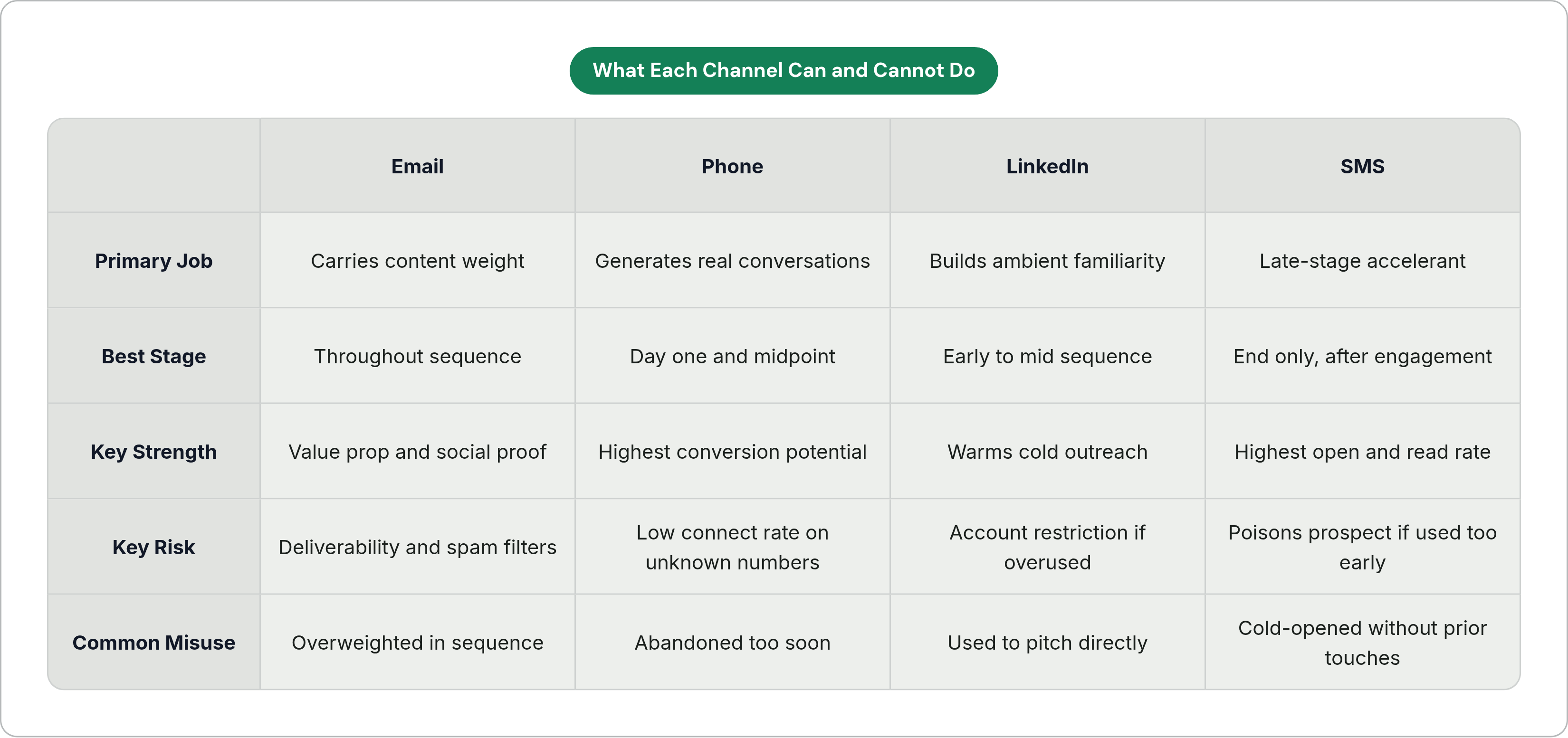
Each channel has a specific range. Using the wrong one at the wrong stage is one of the more reliable ways to burn a prospect who might have actually been interested.
Cold email reply rates average around 5% across the board. Top performers break 10%. That gap is almost entirely explained by personalization and follow-up design, not volume.
Open rates are a compromised metric right now. Apple Mail Privacy Protection auto-opens emails while scanning for malware, which inflates figures significantly for any list with heavy Apple Mail usage. The reliable signal is the reply.
Email earns its place because it carries the content weight of a sequence. It's where you lay out the value proposition, include social proof, and build a developing story across multiple touches. The ROI is real, but it can't be the whole sequence.
There's a useful framework called the 30/30/50 rule: 30% of cold email success comes from content, 30% from list quality, 50% from follow-up strategy. That last number should recalibrate where you spend your time. Most people pour effort into the first email and treat the rest as logistics.
Phone
Cold call connect rates roughly doubled in 2024, up from prior years. Part of that is simply because enough reps abandoned the phone that the ones still using it face less competition for attention.
Connect rate matters more than dial volume. Most Americans don't pick up unknown numbers. Calls after 3 PM local time outperform mid-morning, consistently. Leaving a voicemail increases connection rates on future attempts meaningfully. The voicemail isn't trying to close anything — it's making your name familiar before the next attempt.
If your ICP skews toward senior titles, weight this channel more heavily. A significant portion of C-level and VP buyers actually prefer the phone. That preference is worth building around.
InMail response rates run between 10 and 25%. Personalized connection requests reply at nearly double the rate of requests with no message. That difference compounds across a sequence.
But LinkedIn's real value isn't its direct reply rate. It's the ambient familiarity it creates before anything else happens. When a prospect sees your name in their connection requests, then in their feed, then in their inbox, and then gets a call from you, you're not a stranger anymore. The phone call lands differently.
The platform has hard limits worth respecting: 100 connection requests per week, safe practice around 15 to 20 per day. Going above that risks account restrictions, which wipes out your LinkedIn presence for weeks and takes months to recover.
One thing worth noting: AI-assisted first messages on LinkedIn outperform non-AI messages on response rate. But follow-up messages perform better without AI. The channel rewards actual human warmth at later stages. By touch three, prospects can usually tell.
SMS
SMS carries a staggeringly high open rate, and most messages are read within three minutes. It has the highest attention rate of any channel by a wide margin.
Do not cold-open with SMS. The reason SMS gets read so fast is because people treat it as a personal channel. Violating that trust on the first contact doesn't just lose the touch — it usually poisons the prospect on you entirely.
SMS belongs at the end of the sequence, once rapport exists from prior touches. It's an accelerant. The reps who use it correctly report responses from prospects who went quiet everywhere else. The reps who misuse it get angry replies and immediate blocks. The channel rewards patience and punishes eagerness.
How to Structure the Sequence: Touchpoint Count, Timing, and Channel Order
Eight to twelve touchpoints over two to four weeks. That's the range where effective B2B sequences land. It's also the range most reps never reach.
Why do people stop early? Stopping after two or three attempts feels rational because silence reads like a signal. It usually isn't. A lack of reply to a cold email is not a rejection. It's often bad timing, a crowded inbox, or a value prop that didn't land yet. Those are very different problems with very different fixes.
Email should represent 50% or fewer of your total sequence steps. If you have ten steps and eight are emails, that's not a multi-channel sequence. Heavy email weighting also hurts deliverability and signals low effort to the algorithms sorting your messages.
Here's the channel order logic that holds up in practice:
- Phone first, day one. You're capturing intent while it's fresh. It also establishes multi-channel presence from the opening move rather than as a fallback.
- Email builds the narrative thread. Each message should add something the previous one didn't. New framing, new proof, new angle.
- LinkedIn creates ambient familiarity. Not the place to pitch. The place where your name becomes a face.
- Phone again at the midpoint. By then, the prospect has seen your name across multiple channels. The call isn't cold anymore.
- SMS at the end, and only if earlier touches generated some form of engagement.
Space emails two to three days apart in the first two weeks, then stretch to four to five days for later touches. Consistent presence without saturation.
One thing worth flagging: the average B2B buying group has grown to around 22 stakeholders, according to LinkedIn's 2025 B2Believe research. A sequence targeting one person at an account is already underpowered. You need threads running across multiple contacts, each with messaging shaped to their role in the decision. That's a different operational lift than most teams are built for.
A Worked 14-Day Sequence Template, Step by Step
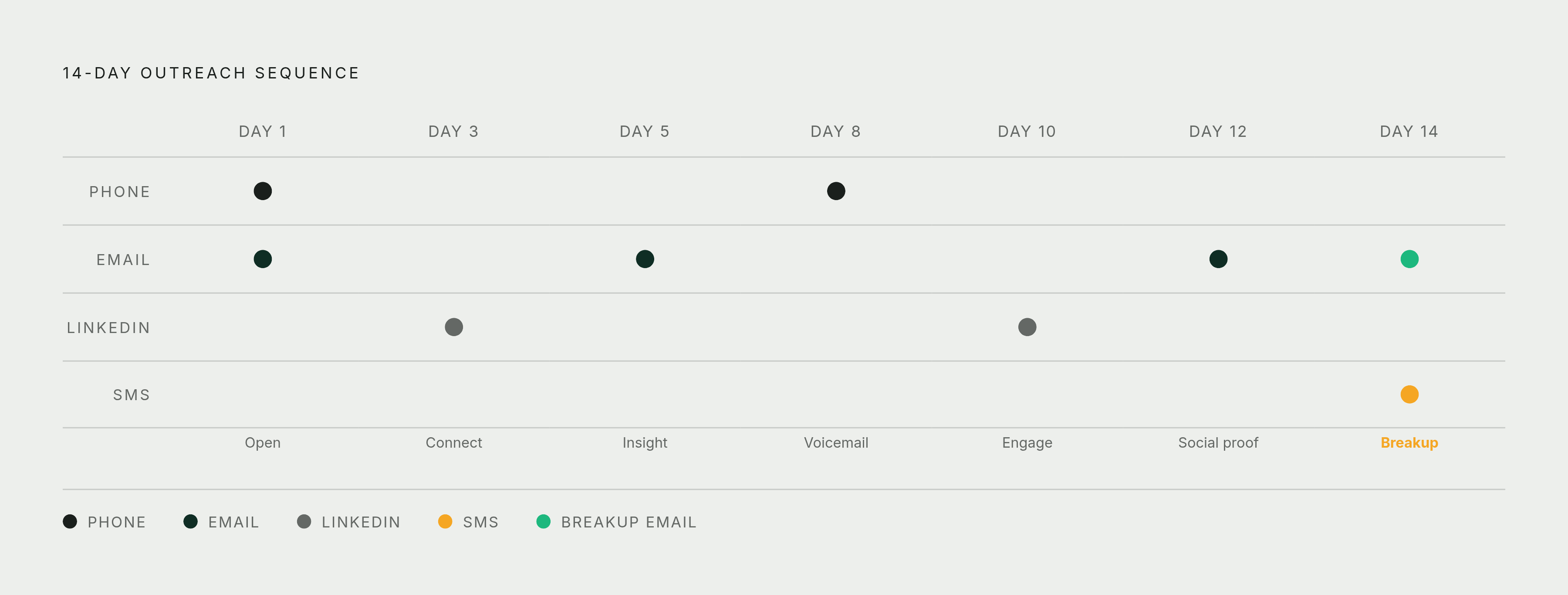
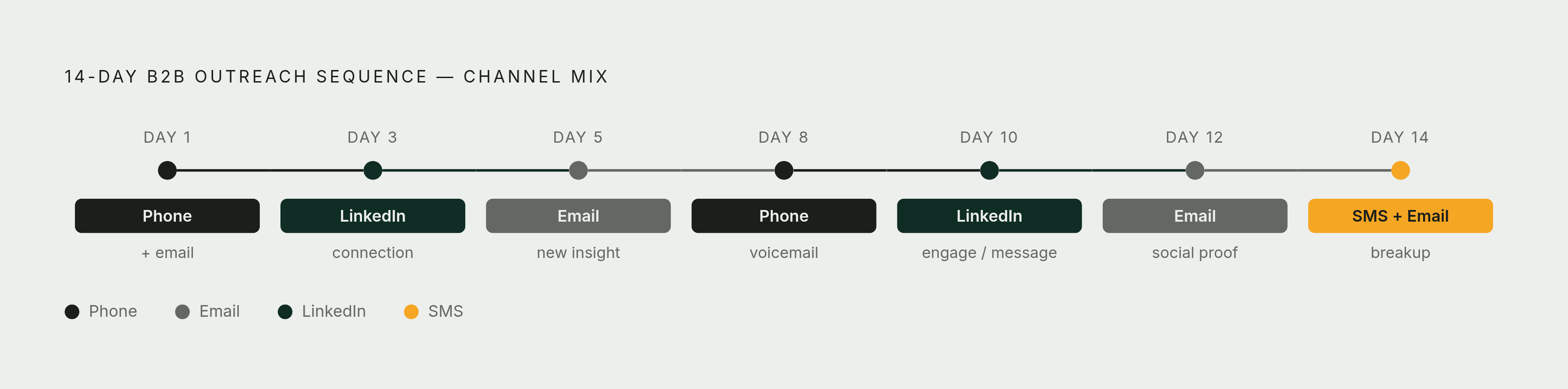
Here's what this looks like in practice. Not a framework — an actual sequence.
Day 1: Phone call, then a same-day personalized email. The call goes first. Even a voicemail establishes that the sequence opened with a real human attempt. The email that follows references something specific. A recent hire. A product launch. A piece of content they published. Not "I help companies like yours." Something you actually looked up.
Day 3: LinkedIn connection request with a personalized note. Not a pitch. Something specific. "Saw your post on [topic]" or "noticed you're building out [function]" works. The goal is connection acceptance, not a reply. You're making the name familiar.
Day 5: Follow-up email that adds something new. Not "just following up." An insight relevant to their situation. A data point. A problem framing they haven't heard before. The sequence is a developing story. This chapter needs new content, not a rephrased version of the first one.
Day 8: Phone call with voicemail. By now, the prospect has seen your name four times across three channels. The voicemail references the earlier email and the LinkedIn outreach explicitly. "I sent you a note earlier this week and connected on LinkedIn. Wanted to follow up because..." That's threading, not pestering.
Day 10: LinkedIn engagement or message. If they've posted recently, comment thoughtfully. If not, send a short message with no hard ask. Keep the channel warm.
Day 12: Email with social proof. A named customer result. A third-party review. Social proof lands differently at this stage than it would on day one. They've seen your name multiple times. Now you're giving them a reason to take the next step.
Day 14: SMS if engagement exists, plus a breakup email. The breakup email creates a low-pressure off-ramp. "I'll stop reaching out if this isn't the right time, but wanted to leave the door open." This consistently generates replies from prospects who went quiet. Not always a yes — often a "not now, try me in Q2," which is actually useful information.
What signal-responsive looks like at the individual step level: if a prospect opens the day five email three times in two days, that fires a call trigger immediately. The sequence doesn't wait for day eight. If they reply to the LinkedIn message, the automated track pauses and the rep takes over manually. The sequence is the default. Human judgment overrides it when behavior says someone is ready.
Email Deliverability as a Prerequisite, Not an Afterthought
You can build a perfect sequence and have it land in the spam folder for a meaningful chunk of your prospects. That's not a hypothetical. It's a documented baseline under typical sending conditions, and it happens quietly while you're wondering why reply rates are flat.
Since February 2024, Google and Yahoo require SPF, DKIM, and DMARC authentication for bulk senders. Microsoft followed with enforcement in May 2025. These aren't optional configurations. They're the price of inbox placement. If your sending domain is unauthenticated, a real slice of your sequence never arrives. The prospect doesn't ignore it — they never see it.
Gmail's spam complaint threshold is 0.1%. Delivery problems accelerate above 0.3%. One campaign sent to a poorly scrubbed list can push you past that threshold and damage your sender reputation for months. That's not a recoverable situation you fix with better copy.
Open rate is a compromised metric. Bot protections increasingly auto-open emails during security scanning. A 40% open rate may reflect a 10% real open rate. The reliable benchmark is a 3 to 5% positive reply rate. That's what a healthy sequence actually produces.
The practical checklist:
- Authenticate every sending domain: SPF, DKIM, DMARC
- Warm new domains before volume sending
- Keep email steps at or below 50% of total sequence steps
- Monitor reply rate and spam complaint rate, not open rate
- Scrub your lists, because bad data compounds into sender reputation damage at scale
A beautifully written, well-structured sequence built on a broken sending domain is invisible.
How Personalization and Buying Signals Change Sequence Entry and Messaging
Cold outreach reply rates average 1 to 5% across the board. Top performers hit 15 to 25%. That gap isn't explained by better copy. It's explained by better context.
Five minutes of real account research before sending increases reply rates multiple times over compared to pure template outreach. But the best sequence triggers aren't arbitrary list additions. They're buying signals — things that suggest something is probably shifting at that company right now.
- A job change, especially a new VP or director in a relevant function
- A funding round
- A competitor evaluation appearing in intent data
- A website visit from a target account
- A product launch or major hire announced publicly
Change creates buying windows. Your outreach landing during one isn't luck. It's targeting.
What signal-based personalization looks like at the message level: the opening line is specific and recent. Not "I work with companies in your space" but something that proves you actually looked. The value prop connects to the inferred business problem behind the signal. A new VP of Sales just hired implies a scaling motion — connect to that directly. Social proof is role-matched. A CFO isn't moved by a case study from a marketing team.
It's also worth considering the scale of the problem. With around 22 stakeholders in the average B2B buying group, personalization isn't a one-person problem. You need variants by persona. The economic buyer cares about ROI and risk. The technical evaluator cares about integration and implementation. The champion cares about what makes them look good internally. Same sequence structure. Different messaging running through each thread.
Gartner projects that by 2026, over 60% of B2B sales engagement will be driven by AI-personalized workflows. Whether that number lands exactly or not, the direction is clear. The question is whether you're building toward it now or catching up later.
Where AI Fits in Building and Running the Sequence
AI saves sales reps meaningful time on administrative and research tasks. HubSpot's 2024 Sales Trend Report puts the number at roughly two hours per day, and Salesforce's State of Sales research found that 83% of sales teams using AI in their processes report revenue growth.
Here's what AI actually does well in sequence execution:
- Pulls firmographic, technographic, and intent data automatically so reps open with real context instead of generic lines
- Drafts channel-appropriate variants from a single value prop: the email version, the LinkedIn message, the voicemail script
- Adjusts send timing based on engagement patterns rather than fixed-day triggers
- Flags when a lead's behavior suggests readiness, so a rep can step in before the cadence runs out
What it doesn't replace: the rep's judgment about when to go off-script. When to pause a sequence because a prospect needs a different conversation. How to handle a live phone call when someone pushes back. The phone and the actual reply still require a human on the other end.
The integration point matters more than the capability. AI that lives inside the tools reps already use gets adopted. AI that requires a separate platform, a separate login, and a workflow that runs parallel to everything else gets ignored within two weeks. The administrative load it creates has to be lower than the load it removes.
Platforms doing interesting work in this space include Apollo.io, Clay, Regie.ai, Smartlead.ai, and Persana AI. Each solves a different part of the stack, from data enrichment to copy generation to sequencing logic. The right combination depends on what's actually breaking in your current process, not which demo looked the most impressive.
Measuring Whether the Sequence Is Working and Where to Adjust It
Before you tweak anything, one question worth sitting with: are you measuring things that actually reflect sequence health?
Most teams optimize for open rate. Open rate is inflated by bot activity and Apple Mail Privacy Protection and tells you almost nothing useful about how a sequence is performing right now.
The metrics that matter:
- Positive reply rate. Three to five percent is a reasonable floor. Top performers push well above that.
- Meeting-booked rate per sequence start. This is the sequence's actual job. Everything else is a leading indicator of this number.
- Channel-level response rate. Which touchpoint is generating responses? Which one is generating nothing? That tells you where to redistribute effort.
- Spam complaint rate. This must stay below 0.1% on email, and that threshold is non-negotiable.
Treat LinkedIn connection acceptance rate skeptically. Acceptance doesn't equal engagement. Someone who accepted your request and never responded to a follow-up message isn't a warm lead.
Apollo's analysis of outbound campaigns found that adding one diversified touchpoint beyond auto-email increases meeting-booked rate meaningfully. Adding more pushes it further. That's specific, measurable lift from each additional channel.
Common failure patterns and what they actually mean:
- Reply rate collapses after touch two. The sequence isn't adding new value per touch. It's repeating the ask with different words. Rebuild the message progression.
- High open rate, near-zero replies. Two possibilities: the messaging isn't connecting, or the open rate is inflated by bots. Check both before assuming the copy is the problem.
- Good email engagement, no call connects. Usually a timing or dial data quality issue, not a sequence design problem. Check when you're calling and whether the numbers in your list are any good.
- Unsubscribes or spam complaints spiking. Targeting is off, the list is dirty, or you're hitting people too hard too fast. Slow down and scrub before scaling anything.
The sequence is a hypothesis. Every metric is data about whether that hypothesis holds. When something isn't working, the instinct is to add more volume. But more volume applied to a broken sequence just means more people ignoring you faster. Diagnose first, then adjust.