Target Audience Segmentation for Outbound Campaigns
Define which companies belong in your market before building your sales strategy around them.

Most teams skip this part. They jump straight into segmentation without first deciding what a good account actually looks like. And segmentation without an ICP is just sorting a list you haven't qualified yet. You're organizing a library before deciding which books belong in it.
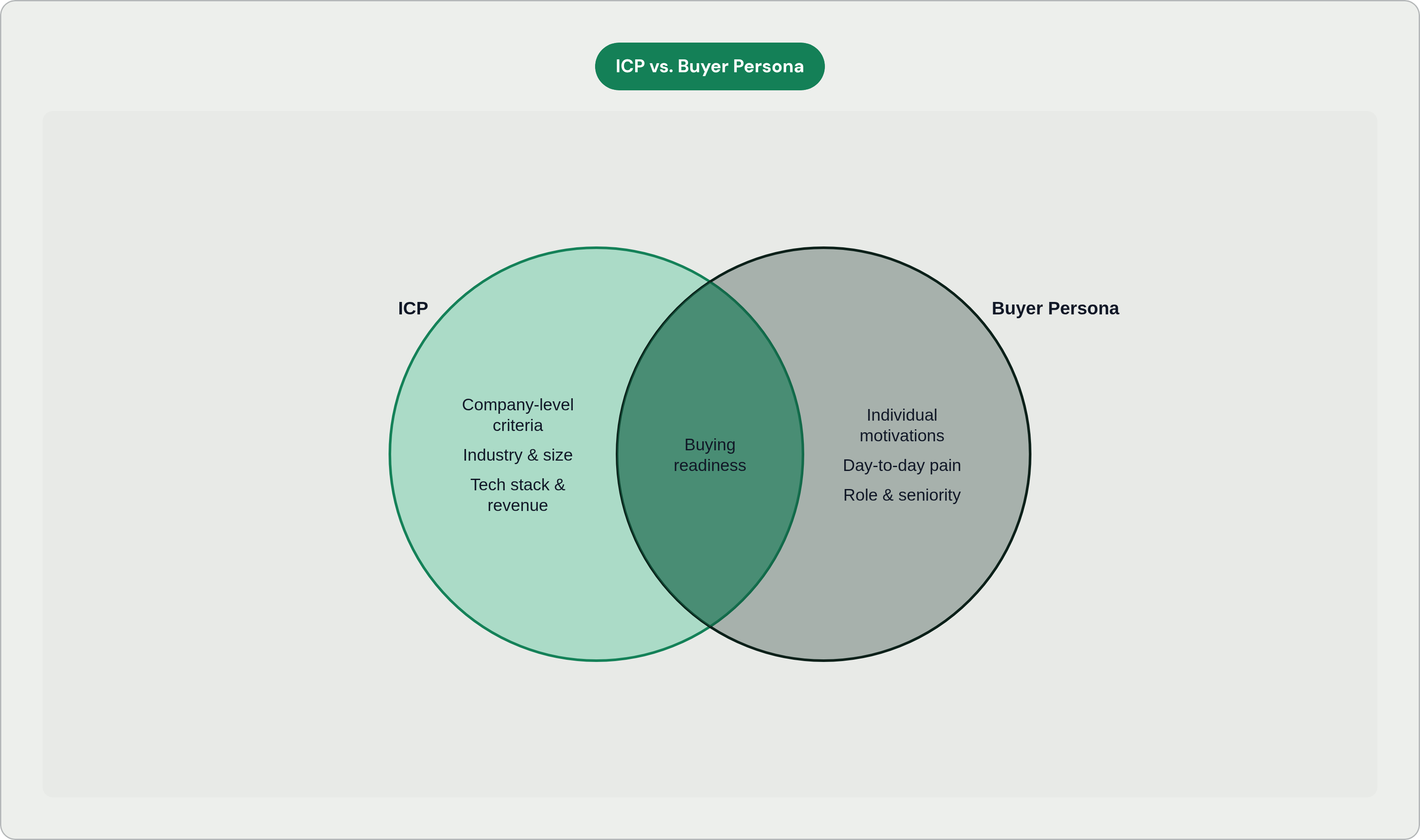
The ICP describes the organization, not the individual. That distinction matters more than most people give it credit for. It answers one question: what type of company belongs in your market at all? Industry, size, revenue band, geography, tech stack, maturity stage. The buyer persona comes after. You can't build a meaningful persona for a company that has no business buying from you.
What actually changes when you document this stuff properly? Qualification time drops. Sales cycles tighten. And the endless argument between sales and marketing about what counts as a "good lead" starts to go quiet. That fight isn't a culture problem. It's an alignment problem. A shared ICP is the fix — the Rosetta Stone that finally lets both teams read from the same definition. Lead acceptance rates tend to jump from the 40-50% range into the 70-80% range when both sides are working from the same one.
But how many ICPs should you actually maintain? For multi-product companies, two or three distinct profiles is workable. More than five usually means the segments aren't actually differentiated. Each ICP should map to a real product line or go-to-market motion, with its own scoring model. Not just a demographic slice of the same list with a different label slapped on it.
The Core Segmentation Criteria and What Each One Adds
Once you have an ICP, you start layering criteria. The key word is layering. These aren't alternative approaches you pick between. They stack on top of each other.
Firmographic segmentation is your baseline. Industry, company size, revenue, location. It defines the addressable pool. But it's necessary, not sufficient. Two companies with identical firmographics can have completely opposite buying readiness — like two books shelved side by side that couldn't be more different inside — and that's the part firmographics alone will never tell you.
Technographic segmentation is where messaging sharpens. What tools does a prospect already use? Knowing a company runs HubSpot versus Pipedrive changes what problem you lead with. It changes the whole opening line.
Need-based and psychographic segmentation is about motivation. What's actually driving a purchase? What pain are they living with day to day? Firmographics can proxy for need when you know an industry well, but need-based criteria tend to be more predictive of conversion. Know the pain, write the message.
Behavioral segmentation tracks how prospects interact with your digital properties. Content engagement, site activity, research patterns. The key feature here is that it's dynamic. Behavior changes, so segment membership changes with it. This is the layer that keeps your targeting current instead of quietly drifting stale.
Intent-based segmentation is the highest-leverage distinction in outbound. It separates "fits our ICP" from "fits our ICP and is actively looking right now." Intent data covers brand intent (they're researching you specifically), category intent (they're researching the problem you solve), and competitive intent (they're looking at your alternatives). All three are useful. Competitive intent is often the most urgent signal in the stack.
Buying stage segmentation maps to message type, not just channel. An awareness-stage account and a decision-stage account might have identical firmographics. They need completely different conversations. Sending the same sequence to both is a quiet way to burn accounts you should be closing.
Trigger and business event segmentation is timing logic. Funding rounds, leadership hires, M&A activity, product launches, geographic expansion. When a company's situation shifts, their needs shift with it. Campaigns timed to these moments consistently outperform baseline outreach.
In practice, the stack works like this: firmographic defines the pool, technographic and intent narrow it, triggers time it.
Turning Criteria Into a Tiered Outbound Target List
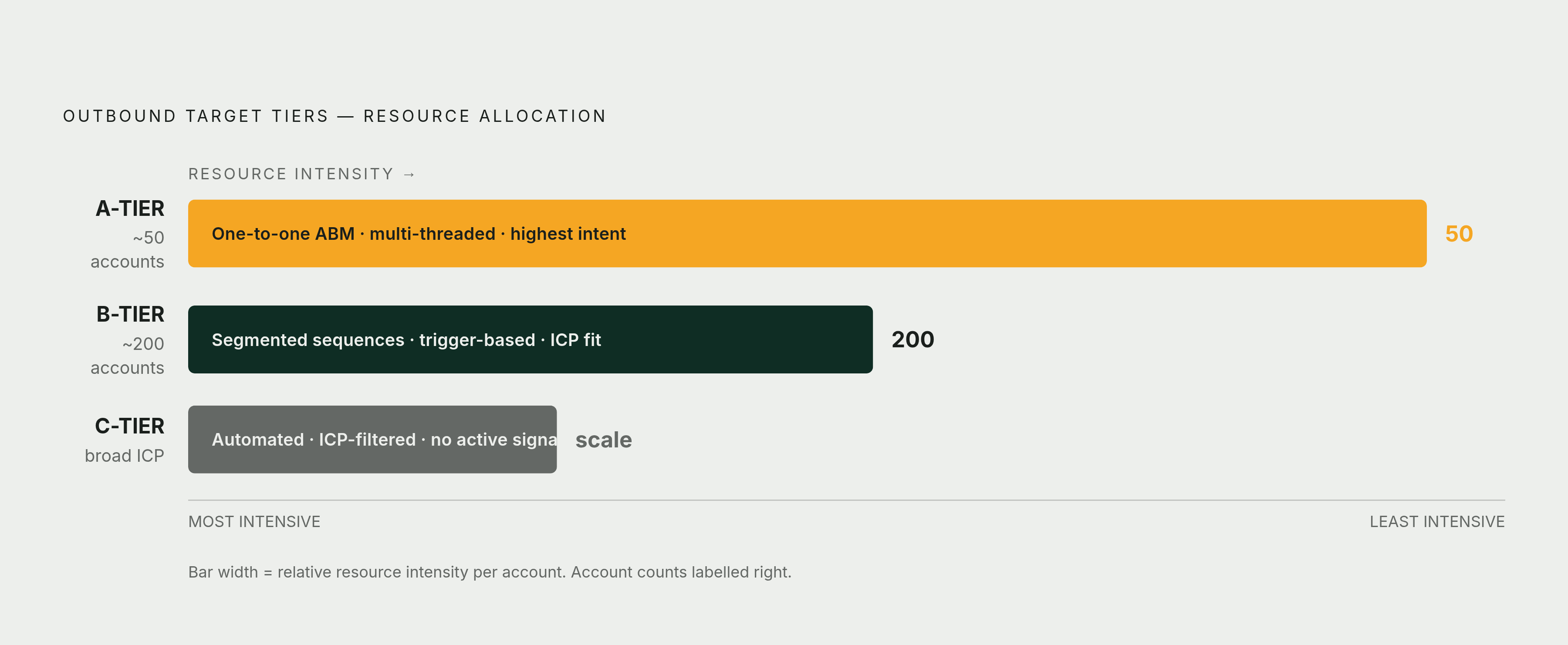
This is where the criteria actually become a campaign. The three-tier model is the simplest version that still works:
- A-tier (roughly your top 50 accounts): Full one-to-one ABM. Highest intent signals, strongest ICP fit, named accounts. These get your most customized, most resource-intensive outreach.
- B-tier (the next 200 or so): Segmented sequences. Strong ICP fit with moderate intent or a recent trigger present. Personalized at the segment level, not necessarily the account level.
- C-tier (broader ICP fit): Automated outreach at scale. These accounts meet your criteria but aren't showing active signals yet. Volume approach, but still ICP-filtered.
Tiering forces a resource allocation decision upfront. Not every segment deserves the same investment of rep time.
Your scoring model should combine ICP fit, intent signal strength, recency of the trigger event, and any existing relationship context. The output is a ranked list. The tier structure is how you act on that ranking.
One thing most teams underestimate at the A-tier level: the average B2B buying committee has grown considerably over the past five years. More decision-makers means longer sales cycles and more points of failure. A-tier accounts require multi-threading from the start. One contact per account isn't a strategy. It's a hope.
Matching Segments to Channels and Sequencing Logic
The channel question comes after the segment question. Not before. What channel you use depends on the prospect's role, seniority, industry, and tier, not on what your reps happen to be most comfortable with.
The sequencing logic that tends to work: email warms the relationship, LinkedIn builds social credibility, cold calling converts. Touches are staggered to maximize visibility without creating overlap or annoyance. And persistence within a sequence isn't optional. It is the sequence. If you're dropping off after two or three touches, you're not running a sequence. You're sending a few emails and calling it a day.
A few benchmarks worth knowing for calibration.
For cold email, reply rates vary enormously by vertical. Legal Services tends to perform near the top of the range. SaaS and Software tends to sit much lower. The same message sent to the wrong vertical underperforms structurally, not tactically. There's also a rule of thumb worth sitting with: roughly a third of cold email results come from list targeting, another third from message quality, and about half from follow-up strategy. Most teams optimize the part that drives the smallest share of results. Worth asking whether yours does too.
For cold calling, list source drives conversion more than technique. Purchased cold lists convert at a fraction of the rate that warm intros do. The data quality of your list matters more than the script you're running.
For LinkedIn, volume is lower than email, but signal quality is often higher, especially with senior buyers who don't live in their inbox.
Pick your channels based on your segment. Then build sequence depth to match the tier.
How AI Changes What's Possible in Segmentation and Personalization
The most important shift AI brings to segmentation isn't speed. It's the difference between static and dynamic.
Static segments are defined once at campaign launch and don't move. Dynamic segments update automatically as behavior changes. When intent signals shift, when a prospect moves to a different buying stage, when keyword research patterns change, segment membership updates with them. The sequence adjusts. You're not sending a "we solve X" email to someone who already requested a demo last week.
But what if personalization at scale just means better-sounding templates? That's worth asking directly. The honest answer is it depends entirely on implementation. Prospect-specific openers, company research references, and tone matching are very different from swapping in a first name and calling it personalized. AI makes the former viable across thousands of accounts. Humans can't reliably do it manually at that volume.
Where AI actually fits in the workflow: analyzing engagement signals to update segment membership, drafting contextually relevant outreach, logging responses and updating CRM records. The administrative layer shrinks. Reps focus on the conversations AI surfaces.
It's also worth sitting with the downside. Irrelevance doesn't just underperform. It actively damages a campaign. It trains prospects to ignore you. If AI-powered personalization is generating high-quality noise, you've built a faster way to burn your list.
Data Quality as the Constraint That Makes or Breaks Every Segment
You can have a clean ICP, a solid segmentation model, and a well-built multichannel sequence. If your data is stale, none of it works the way you think it does.
B2B contact data decays meaningfully every month. Across a year, a significant chunk of any list goes stale. This isn't a one-time setup problem. It's structural and ongoing, and most teams treat it like a one-time task.
Think about what data decay does to each layer of your segmentation. Wrong job titles corrupt need-based and buying-stage segments. You're selling to someone who left six months ago. Technographic data ages fast when companies switch tools, and they do switch. Segments built on an outdated tech stack misfire on messaging. Intent signals have an even shorter shelf life. Acting on three-month-old intent data treats an out-of-market account as in-market, and that's wasted rep time on accounts that have already moved on.
Practical standards worth building around: define a data refresh cadence per segment tier. A-tier accounts warrant more frequent validation than C-tier automated sequences. Flag and suppress contacts with no engagement signal after a defined window. The list is a living thing.
That cold purchased list converting at a fraction of what warm sources do? Part of that gap is because purchased data is often the least current data you'll ever use. List source quality is a proxy for data freshness.
A Sequenced Approach to Building and Running a Segmented Outbound Program
You're either managing the complexity deliberately or absorbing it as wasted rep time and missed pipeline. Segmentation doesn't add complexity. It makes the existing complexity visible enough to do something about.
Here's the sequence:
Step 1: Document the ICP. Or audit the one you have. Define the organizational criteria before you touch a list.
Step 2: Apply segmentation criteria in layers. Firmographic defines the pool. Technographic and need-based narrow it. Intent and trigger signals rank it.
Step 3: Build the tier structure. Assign accounts to A, B, or C tiers based on combined ICP fit and signal strength. Set resource allocation rules per tier before anyone starts sequencing.
Step 4: Match channels and sequence depth to tier. A-tier gets full multichannel multi-threading. C-tier gets automated outreach. B-tier sits between. Sequence depth should reflect account value, not rep preference.
Step 5: Personalize at the segment level, minimum. Use AI to close the gap between what real personalization requires and what reps can produce manually. Account-level personalization where the tier warrants it.
Step 6: Establish a data refresh cadence. Treat segments as dynamic. Don't let a campaign run for three months on data from six months ago.
Step 7: Measure at the segment level. Not just the campaign level. Reply rates, meeting rates, and conversion rates by segment tell you which criteria are actually predictive in your specific market. Not just which ones looked good on paper when you built the model.
The compounding effect is what makes this worth building. Segmentation improves with each campaign cycle because performance data refines which signals actually matter in your market. The program gets more precise, not just more scaled. Outbound that gets a little smarter every time you run it looks very different, after a year, from outbound that just keeps costing more for the same result.