Outbound Call Script Structure for Cold Outreach
A structured framework beats a memorized script when cold calling matters most.

Let's get this out of the way early, because I've watched this misconception wreck more reps than any bad opener ever could.
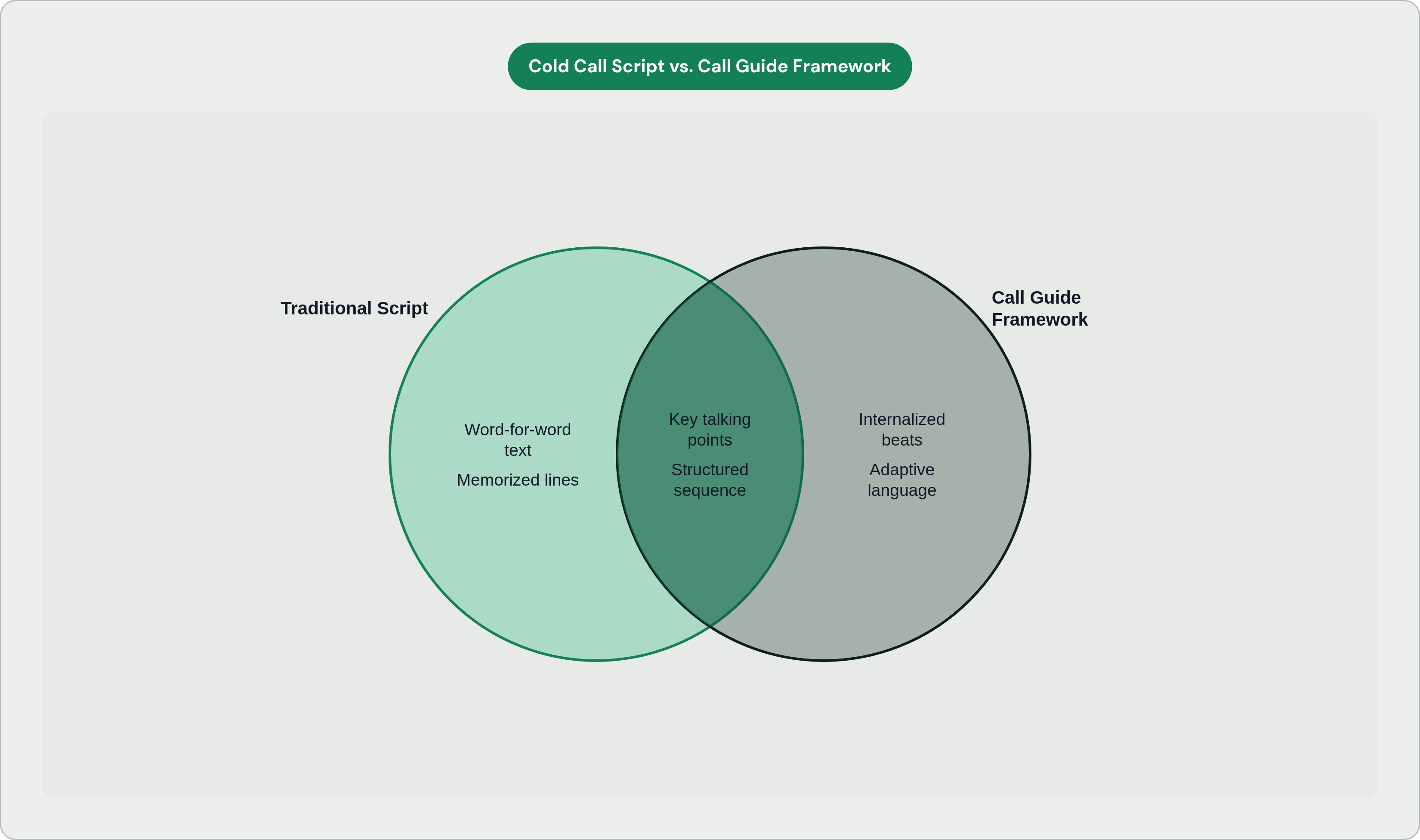
A cold call script is not a verbatim document you read into a phone.
The moment a rep tries to memorize a script word-for-word, two things happen. First, they sound like they're reading. Prospects notice immediately. Second, the moment the conversation veers somewhere unexpected, the rep freezes, flips back to line three, and the call dies in the most awkward way possible.
What a script actually is: a structured framework. Key talking points. A few qualifying questions. Your value positions. And a rough map of how to respond when the conversation forks. You internalize the shape, not the sentences. There is a real difference between those two things.
Think of a cold call script the way a jazz musician thinks of sheet music — it gives you the structure, but the performance lives in the spaces between the notes.
The five structural moves the rest of this article unpacks:
- The opener. Earns the first ten seconds.
- The hook. Earns the next thirty.
- Discovery. Earns the right to have an actual conversation.
- The value statement. Earns the right to ask for time.
- The close. Asks for the one thing a cold call should ask for.
Get those five beats in your bones and you don't need a script. You need a guide.
The opener: getting the first ten seconds right
Buyers decide in the first ten to fifteen seconds whether a call is worth their time. The opener's only job is to survive that window.
Not to impress, not to pitch — just to survive.
The best practice, backed by analysis of tens of thousands of recorded calls, is almost annoyingly simple: state your full name and company name immediately. In the first words out of your mouth after "hello." It puts you in control of the frame before the prospect defaults to "who is this and how do I get off the phone."
So what kills it? "How are you today?" sounds harmless, but it hands the prospect an off-ramp and signals, immediately, that a scripted pitch is incoming. Their brain pattern-matches to every bad cold call they've ever taken and starts scanning for the exit.
What actually works, based on large-scale call analysis:
- "How have you been?" Sounds like a continuation of a relationship, not the start of a transaction. Success rates noticeably above the baseline.
- "I know I'm catching you cold..." Disarms by owning the situation. It's hard to stay defensive toward someone who just named the awkwardness out loud.
- "Heard your name tossed around..." Borrowed credibility. Makes the call feel less random.
Lines that actively damage outcomes:
- "Did I catch you at a bad time?" Reduces meeting booking likelihood significantly.
- "Is now a bad time?" Same result. Both questions invite the prospect to say yes, and they will.
One thing reps consistently underestimate: tone of voice accounts for far more of how a message lands than the actual words do. You can have the perfect opener and flatten it with a nervous, rushed, monotone delivery. The words matter. The delivery matters more.
Micro-personalization also punches above its weight here. Mentioning a shared LinkedIn group or a specific connection, when it feels natural, can meaningfully boost your odds of staying on the call. The key is authenticity. If it feels forced, the prospect feels it too.
The hook: giving the prospect a reason to keep listening
Here's something that sounds obvious but took me real reps to actually believe: people need a reason to keep doing something, even if the reason is small. A clear reason for the call, stated in the first thirty seconds, more than doubles successful outcomes. That is not a rounding error.
But the hook is not the pitch. This distinction matters more than most reps realize. The hook answers the prospect's unspoken question, which is "why should this be my problem right now?" If you can't answer that in one or two sentences, the call is already in trouble.
Two hook types that hold up well in practice:
The trigger-event hook. You reference something specific and recent: a funding round, a hiring surge, a product launch, a leadership change. It proves the call isn't random. It shows you did at least a minimum of homework, which already separates you from the majority of cold calls out there. Even sixty seconds of LinkedIn or news scanning before a call is usually enough to surface something usable.
The problem-agitation hook. You name a pain point common to their role or industry, let it land, then gesture toward a path forward. This one doesn't require a trigger event. It works at scale because the pain you're naming is real enough to resonate without being specific to their exact company.
Either way, the hook should be one to two sentences. Not a pitch. Not a feature list. Just enough to move the prospect from "who is this?" to "okay, I'm listening." That is the only permission the hook is buying. Nothing more.
Discovery: asking the question that keeps the conversation human
Most reps rush this part, and that is the mistake.
The goal of discovery is not to explain your product. It is to surface a pain point. One open-ended qualifying question does more work than three closed questions stacked back to back.
Something like: "How are you currently handling outbound?" Qualifies the prospect and keeps them talking at the same time. Or: "What's the biggest blocker when it comes to booking meetings?" Or: "Is your team mostly inbound or outbound focused right now?"
Notice what those questions have in common. None of them are yes/no. They require the prospect to think for a moment. And when a prospect thinks, they talk. When they talk, you learn something you couldn't have scripted around.
The talk-to-listen ratio matters here more than anywhere else in the call. Winning cold calls have reps speaking the majority of the time, but not by a wide margin, with the prospect carrying a meaningful share of the conversation. Losing calls flip further toward the rep doing most of the talking. It sounds counterintuitive, because you're the one selling. But the call succeeds when the prospect feels heard, not when they feel pitched at.
Once a pain point or blocker surfaces, that is your window to add value. Not before. If you pivot to your value statement before they've told you something real, you're guessing. And prospects can tell when they're being responded to versus when they're being processed.
Handling early objections so the call can reach the value statement
Most early cold call objections are reflexive, not considered rejection. "We're all set." "Send me an email." "Not a priority right now." These show up in the first fifteen to sixty seconds, before the prospect has heard enough to have an actual informed opinion.
I once watched a rep freeze the moment a prospect said "we're all set" — thirty seconds into the call. He laughed nervously, apologized, and hung up. Afterward he said, "I just didn't know what to do with that." He had a script. What he didn't have was a map for the moment the call went somewhere the script didn't cover. That's the difference between memorizing lines and understanding beats.
If someone says "not interested" thirty seconds into a call, they are rejecting the interruption, not your product. That distinction matters for how you respond.
The LAER framework is a clean way to think about this:
- Listen without interrupting.
- Acknowledge with empathy, not a pivot.
- Explore what's actually behind the objection with one question.
- Respond with a relevant answer or an alternative path.
Another approach: validate the objection, name what you think is underneath it ("It sounds like timing is the real issue here"), and redirect toward what they're actually focused on right now. Naming it works because it makes the prospect feel heard. And when someone feels heard, their guard drops a little.
What common objections actually signal:
- "Not interested" usually means the hook didn't land. They haven't heard why this is relevant to them yet.
- "We already have a solution" is an opening. Ask what's working. Ask what isn't.
- "No budget" is often a proxy for "I don't see enough value yet." That's not a budget problem. That's a positioning problem.
The goal is not to win the argument. The goal is to keep the call alive long enough to reach the discovery beat and then the value statement.
The value statement: connecting what you heard to what you do
This is the part most reps get backwards.
The value statement comes after discovery, not before. It is a direct response to what the prospect said. Not a pre-loaded pitch you were going to deliver regardless of what they told you.
The structure is simple:
- Name the problem back to them.
- Connect it to a specific outcome your solution produces.
- Keep it to two or three sentences.
No feature lists. What earns attention is the implication: what changes for them if this problem goes away? Features are how something works. Outcomes are why anyone cares. And those are not the same conversation.
One thing that separates good value statements from forgettable ones: reflect the prospect's actual language back at them. If they said "we're drowning in manual follow-up," that phrase belongs in your value statement. Not a polished, sanitized version of it. Their words carry more weight than yours, because they know they said them.
After a strong value statement, the prospect should be able to make a clear decision about whether they want a next step. That is the moment the close becomes appropriate. Not before.
The close: asking for a specific next step, not a commitment to buy
Cold calls do not close deals. They qualify prospects and book conversations. If your close is trying to do anything more than that, it's trying to do too much.
The ask is narrow: you are asking for fifteen to thirty minutes of scheduled time, and nothing more.
A transition that works well sounds something like: "This actually sounds like a good fit for what we do. Rather than try to explain everything over the phone, can we grab 15 minutes next week so I can show you exactly how this would work for your team?"
Why it works:
- It signals the conversation has been productive.
- It respects their time by not trying to do everything in one call.
- It's a clear, binary ask. Yes or no.
The CTA needs to be specific. A time range, a duration, a format. "Let's find some time to connect" is not a close. It's a suggestion that dissolves the second the call ends.
What makes the close land is that it flows directly from the value statement. The prospect should feel like the meeting is the logical next step, not a sales maneuver. If it feels like a sudden pivot, something earlier in the call didn't land cleanly.
And one more thing worth saying plainly: a significant share of prospects say no multiple times before eventually saying yes. "Not now" is not "no." Persistence and follow-up cadence matter as much as the close itself. The close opens a door. Your cadence keeps you in the frame.
Putting the sequence together as a working call guide
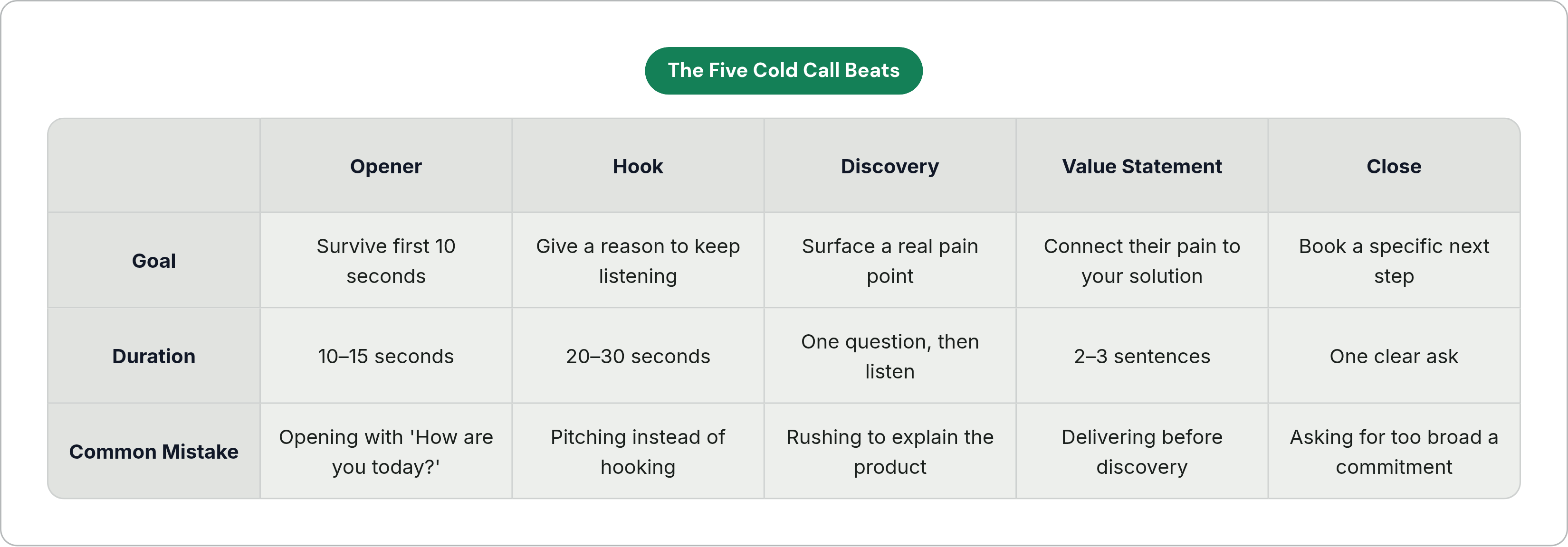
Here is the full sequence, in order:
Opener → Hook → Discovery → Objection handling (if needed) → Value statement → Close
A productive qualifying cold call runs somewhere between three and eight minutes. The sequence above maps to that window when each element is tight. Tight doesn't mean rushed. It means purposeful.
What each beat looks like in practice:
- Opener. Ten to fifteen seconds. Your name, your company, one warm line.
- Hook. Twenty to thirty seconds. One trigger event or problem reference. A clear reason for the call.
- Discovery. One open question, then listen. This is where most reps rush and would benefit from slowing down.
- Value statement. Two to three sentences tied directly to what the prospect said.
- Close. One specific ask. Time, duration, format.
The guide is not a cage. Internalize the beats. Adapt the language. What stays fixed is the sequence and the purpose of each step.
Personalization belongs in the hook and the value statement. Those are the two moments where generic language does the most damage, because they're exactly when the prospect is deciding whether this call is actually relevant to them.
The best calls feel like conversations. They feel that way because the rep stops talking when the prospect starts. The structure enables that by front-loading the rep's words early and creating space in the middle for the prospect to fill.
When the call ends, the sequence isn't over. Log what was said, what pain surfaced, and what was agreed. The follow-up should continue where the call left off, not restart it from scratch.