Value Proposition Design for B2B Sales Teams
Inertia kills more deals than competitors—fix your value prop to show why staying put costs more.

There is a strange thing happening in B2B sales right now. Revenue is up at the team level for many organizations; and yet, according to Salesforce's State of Sales (2024), up to 70% of individual reps missed quota last year. Average attainment sat around 43%. Read that again; nearly half the quota, on average.
Win rates are not helping. HubSpot's 2024 Sales Trends Report puts the average B2B win rate somewhere around 20 to 21%; that means four out of every five qualified opportunities either go to a competitor or go nowhere at all.
And that last option. "Go nowhere." That is the one nobody talks about enough.
Inertia. "Do nothing." According to research cited by Prospeo.io, it kills 40 to 60% of qualified pipeline; more than any single competitor. The buyer looked at your product, understood it reasonably well, and decided the pain of staying put was less than the pain of changing. That is not a market condition. That is a messaging failure.
So what does a bad value proposition actually look like in practice? It looks like this:
- "We offer 47 integrations and a drag-and-drop interface."
- "Our platform is built on best-in-class infrastructure with enterprise-grade security."
- "We're the only solution that combines X, Y, and Z in a single pane of glass."
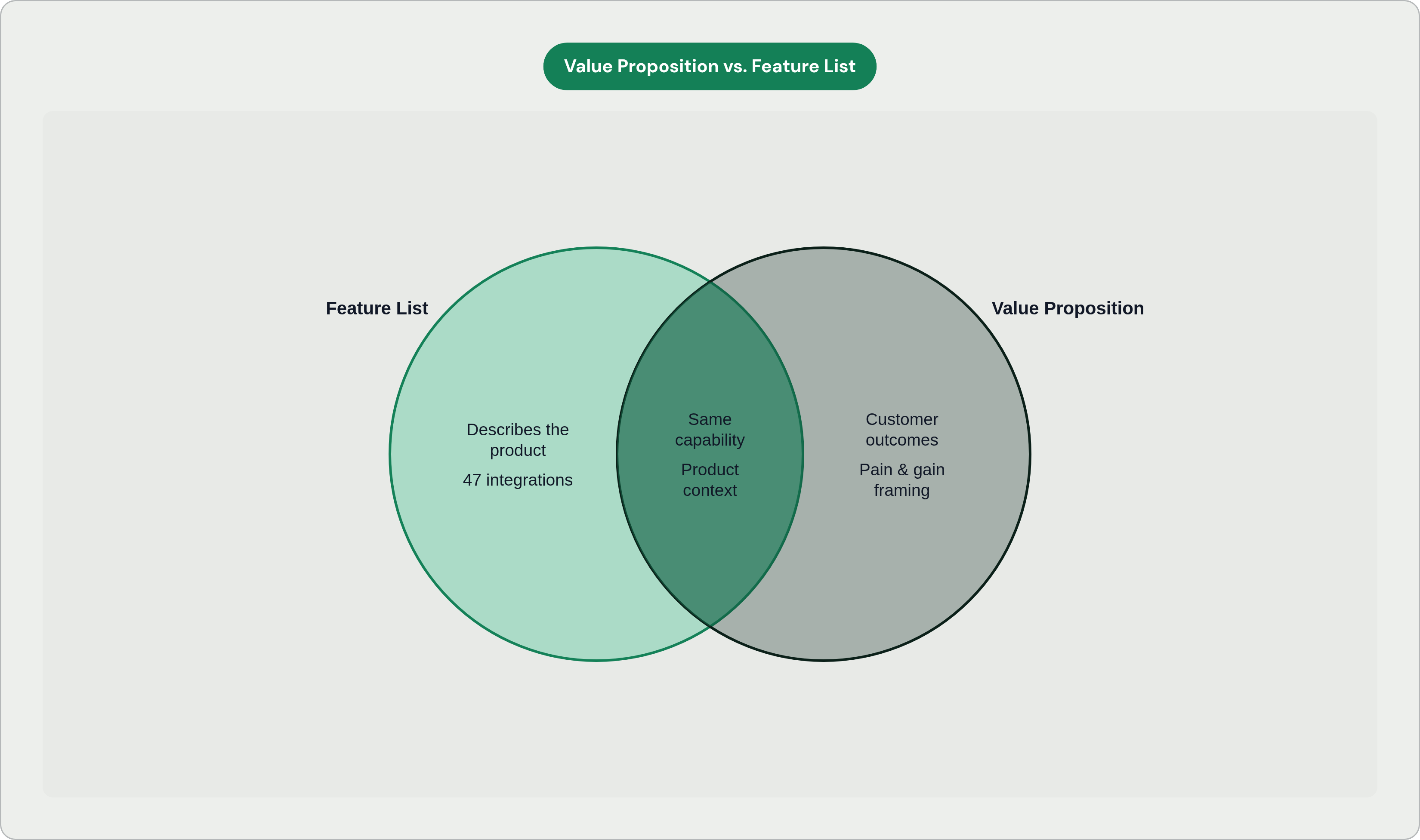
These sound polished. They feel complete. But they are feature lists wearing a value proposition's clothes. They describe the product. They do not describe what the customer walks away with.
The consequence is not just lost deals. It is funnels that leak everywhere. Outreach gets ignored. Campaigns land flat. Demos fizzle because the rep is narrating a product tour instead of solving a recognized problem. The reps are often working hard; the structure they are working from is just broken.
That is what this piece is actually about. Not hustle. Not mindset. Structure.
What a Value Proposition Is — and the Imposters We Keep Mistaking It For
Here is the clearest line I know: a feature is what your product does. A value proposition is what your customer gets.
"Drag-and-drop interface" is a feature; "you can get your team onboarded in a day without involving IT" is a value proposition. Same underlying capability. Completely different frame. One describes the tool. One describes the outcome for a specific person with a specific problem.
There is a second confusion worth naming. A slogan and a value proposition are not the same thing. A slogan exists to be remembered; a value proposition exists to be believed. Those are different jobs, and designing for one will not automatically give you the other.
So what does a working B2B value proposition actually look like? Something like this: a clear, customer-first statement of why your product solves a high-priority problem better than any available alternative, speaking to a specific problem experienced by a specific buyer, with enough relevance to create urgency now.
Notice what that definition requires. Specificity. Priority. A comparison point. A reason to move.
One more thing worth sitting with. Research cited by ValueSelling Associates puts customer-centric companies at 60% more profitable than their counterparts; a strong value proposition is the most visible expression of customer-centricity. It is not a marketing deliverable. It is a strategic one.
But here is the hard part. You cannot write your way to a strong value proposition. You have to build it from the outside in, starting with what customers actually say, want, and struggle with. Which means we need a structure for doing that.
The Value Proposition Canvas: Two Sides That Have to Lock Together
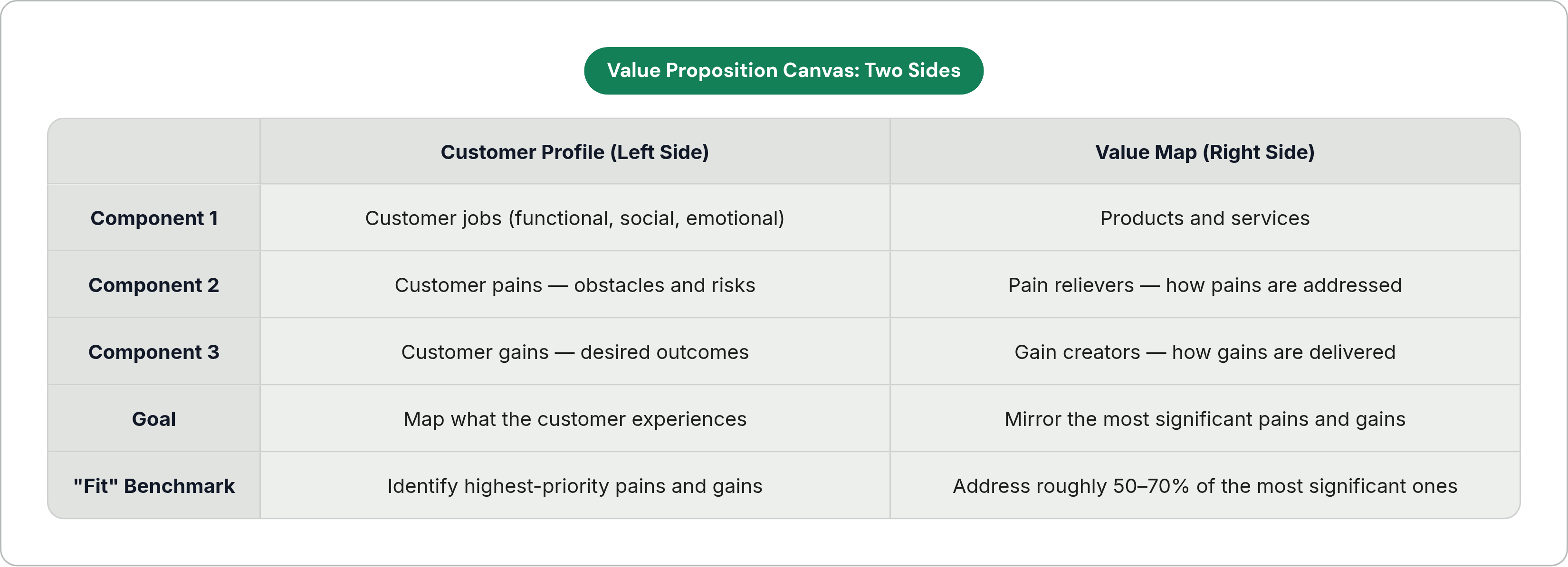
The Value Proposition Canvas, developed by Strategyzer, is the most useful tool I have found for making "fit" visible. Not because it is complicated; because it forces a discipline most teams skip entirely.
The canvas has two sides.
The Customer Profile (left side):
- Customer jobs. What is the customer actually trying to get done? This breaks into three types. Functional jobs are the practical tasks. Social jobs are about how they want to be perceived by others. Emotional jobs are about how they want to feel.
- Customer pains. The negative experiences, risks, and obstacles that show up when they try to do those jobs.
- Customer gains. The positive outcomes and benefits they are hoping for, expecting, or would be delighted by.
The Value Map (right side):
- Products and services. The offering itself.
- Pain relievers. How the offering specifically addresses those customer pains.
- Gain creators. How the offering delivers those customer gains.
"Fit" happens when the right side directly addresses the pains and gains that matter most on the left side. Strategyzer benchmarks strong fit at addressing roughly 50 to 70% of a customer's most significant pains and gains. Not all of them. The most significant ones.
That distinction matters. The temptation is to map everything; the discipline is to figure out what the customer actually cares most about, and then address that. Trying to address everything dilutes everything.
One more thing about how to use the canvas well. It works best as a cross-functional workshop. Product, sales, marketing, and customer success each see the customer through a different lens. Product knows the capability. Sales knows the objections. Customer success knows what breaks down post-sale. Marketing knows the category language. The tension between those views produces better outputs than any one team working alone.
Why B2B Means Building a Separate Canvas for Every Person in the Room
Here is where most B2B value proposition work quietly falls apart.
Gartner's 2024 research on B2B buying puts the average enterprise buying group at 11 stakeholders. Complex purchases reach 20; that is a 57% increase from the 7-person committees Gartner documented in 2017. And each additional stakeholder, per research cited by The Starr Conspiracy, reduces the probability of purchase by roughly 10 percentage points.
The strategic error is treating "the enterprise" as a single customer. It is not; it is multiple distinct customer segments inside one account, each with different jobs, pains, and gains.
Strategyzer's Michelin fleet management example is one of the clearest illustrations I know. One offering. Three completely different canvases.
- CEOs. Jobs around capital efficiency and financial risk.
- Fleet managers. Jobs around operational reliability and uptime.
- Truck drivers. Jobs around safety and daily experience.
Same product. Completely different value propositions. If you walk into a fleet manager conversation talking about capital efficiency, you have already lost the room.
The standard stakeholder map in B2B typically includes users, influencers, economic buyers, decision-makers, and potential saboteurs. Each of those roles has a distinct set of jobs, pains, and gains. Each requires a tailored canvas.
Why does this matter operationally? Research cited by Instantly.ai shows multi-threaded outreach reaching five or more stakeholders closes at 30%, compared to 5% for single-threaded deals; a 6x difference in win rate. But multi-threading only works if the rep actually has something distinct to say to each stakeholder they reach. Sending the same message to five people in different roles is not multi-threading. It is spam with good targeting.
There is also a committee dynamics angle worth understanding. Gartner's 2025 research found that 74% of buying teams experience unhealthy internal conflict; but when committees do reach consensus, they are 2.5x more likely to call it a high-quality decision. The value proposition work that helps different stakeholders align internally is the work that actually closes deals.
Discovery First. Messaging Second. Always.
No shortcut here. The customer jobs, pains, and gains on the left side of the canvas cannot be inferred from product specs or internal brainstorming; they require direct customer inquiry.
The most important questions to ask existing customers are deceptively simple. Why did you choose us? What were you trying to get done? What challenges were you trying to overcome? That conversation is where the real value proposition lives. Not in the pitch deck. Not in the product roadmap.
The iterative discovery loop that successful B2B companies use follows a recognizable pattern:
- Draft a hypothesis based on current understanding.
- Test it with customers through structured interviews.
- Analyze for patterns and priorities.
- Refine using the customer's actual language.
Strategyzer makes a point that stings a little if you have been in this long enough. Established companies with existing products often discover their messaging does not resonate because they have never systematically tested it with real customers; they built it inside-out and never checked.
Discovery also surfaces something less obvious: switching triggers. Research from Inbox Insight and The Insight Collective (2025) found that 51% of decision-makers cited poor integration with existing tech as a reason to explore new vendors; another 51% said they start researching when current technology cannot solve a business pain. Notice what those triggers are. Unmet functional jobs. Not feature gaps. Not price points. Jobs that are not getting done.
Discovery also gives you something invaluable: the customer's language. Internally invented terminology almost never maps onto how buyers describe their own problems. If customers keep saying "we're flying blind on X" and your messaging says "enhanced visibility," you are translating when you should be listening.
One more thing Strategyzer flags that is worth taking seriously. In multi-stakeholder accounts, the critical early decision is which stakeholder to start discovery with. Many B2B companies fail because they perfect their solution for end users who have zero purchasing influence; understanding the job is not enough. You also need to understand who controls the budget.
Building the Value Map: From What You Heard to What You Offer
The value map is where you translate discovery into something actionable. But there is a discipline to it that most teams miss.
The goal is not to list every capability; the goal is to select the pain relievers and gain creators that correspond directly to the pains and gains that matter most to this specific stakeholder. Every word on the value map should trace back to something a real customer told you.
Pain relievers and gain creators are different in kind, not just degree. Pain relievers eliminate or reduce specific negative experiences. Gain creators produce outcomes customers actively want. One removes friction. The other adds something. Both matter, but they are not interchangeable.
Slack is a useful example here. When Strategyzer examined Slack's value map, the company had anchored it in customer outcomes rather than technical capabilities. "Find answers faster." "Instantly summarize conversations." Each claim backed by specific metrics, including an average of 97 minutes saved per week. The technology was secondary; the outcome was the headline.
Schneider Electric's reframe is an equally instructive case. The company repositioned its energy management offering as "Microgrid as a Service." The underlying technology did not change; but the value map shifted entirely. From product features to financial and operational outcomes. From capital expenditure to access. That is a value proposition redesign disguised as a pricing change.
But what if, at this stage, the team reverts to inside-out thinking? It happens constantly. The value map ends up describing the technology, the team's credentials, the integration library. None of which tells a buyer what they walk away with. That is the failure mode to watch for.
The final discipline: rank, do not list. The value map should prioritize the two or three pain relievers and gain creators that address the customer's highest-ranked concerns. Attempting to address everything signals that nothing is truly important. And when product, sales, and marketing each maintain slightly different versions of the value map, buyers feel the inconsistency across touchpoints. CXL makes the point clearly; internal misalignment erodes trust. The value map has to be shared infrastructure, not a departmental asset.
Making the Economic Case: From Canvas to Number
Why does quantification matter so much right now? A few reasons converging at once.
Buyers are more risk-averse. Finance teams are scrutinizing technology spend more carefully; and according to research from Genius Drive, 61% of potential deals fall through without any action. The status quo wins when the economic case is vague. Inertia needs a reason to move, and "this will be great for your team" is not a reason. A number is.
Research in Industrial Marketing Management (2025) defines value-based selling as the persuasive demonstration of the seller's contribution to customer growth and profitability, justified by rational, solid arguments. The instruments named: ROI calculations, total cost of ownership studies, lifecycle analyses, and reference-customer evidence.
Genius Drive's research with over 100 B2B technology companies found that using Value Automation Platforms increases win rates by up to 52%, dramatically outperforming spreadsheet-based ROI tools. The method matters, not just the intent.
The bridge from canvas to number is more mechanical than it sounds. Each pain reliever and gain creator on the value map should have a corresponding economic proxy.
- Time saved.
- Cost avoided.
- Revenue enabled.
- Risk reduced.
Then, when it comes to structuring the ROI story to survive a finance review:
- Use the customer's own baseline data wherever possible; borrowed assumptions are the first thing procurement challenges.
- Separate quick wins from longer-horizon gains; give buyers something to anchor near-term approval on.
- Make the true cost of the status quo explicit; the cost of inaction is often the most compelling number in the room.
One more context shift worth acknowledging. Research from Forrester's 2023 Buyers' Journey Survey found that buyers complete roughly 67% of their buying process before engaging a sales rep; that means the economic argument needs to live in content, tools, and digital touchpoints. Not just in a rep's back pocket. By the time a rep gets a meeting, the buyer may already have a position.
Stage-Specific Guides: Getting the Work Off the Slide Deck
Here is the failure mode nobody likes to admit. You do all of this work. You build the canvases, you run discovery, you build the value map, you quantify the economic case; and then it all lives in a slide deck that reps are expected to internalize under call pressure.
It does not work. Reps need stage-specific guidance; the same underlying value proposition surfaces differently depending on where the buyer is in the process.
- Prospecting and cold outreach. Lead with the pain or job the customer recognizes, not your solution; connect to a trigger or context before making any value claim.
- Discovery calls. Use the customer-jobs language from the canvas to reframe the conversation around what the buyer is trying to accomplish. Not what your product does.
- Demo and evaluation. Link every capability shown to a specific pain reliever or gain creator from the relevant stakeholder's canvas; never demo a feature without a prior-agreed customer problem it addresses.
- Proposal and business case. Lead with quantified impact; the economic argument from the previous step becomes the proposal's opening, not an appendix.
- Late-stage and multi-stakeholder alignment. Deploy stakeholder-specific versions of the canvas; what the economic buyer needs to hear is different from what the end user needs to hear.
There is also a generational shift reshaping how value needs to land. Research from Sopro (March 2026) found that millennial B2B decision-makers make purchasing decisions 41% faster than their Baby Boomer counterparts, and rely less on traditional sales processes like cold calling; digital-first value communication — content, tools, chatbots — needs to carry the proposition as effectively as a rep conversation.
It is also worth considering the administrative load reps carry. A rep spending time on data entry, logging updates, and drafting follow-up emails between calls is not spending that time on the relationship and discovery work the canvas depends on; the value proposition design work creates leverage only when reps have the time and headspace to use it.
Alignment: One Value Proposition, Every Team That Touches the Buyer
The final failure mode is organizational, and it is the most common one at scale.
Product describes the solution one way. Marketing messages it another way. Sales pitches it a third way. Customer success onboards around a fourth set of priorities. The buyer moves through all of those touchpoints; they feel the inconsistency. CXL is direct about this. Internal misalignment erodes buyer trust.
A unified value proposition structure needs to be embedded across:
- Sales onboarding and rep certification.
- Enablement materials and playbooks.
- Marketing campaign briefs and content briefs.
- Internal documentation so every team is drawing from the same customer-jobs language.
That last point is more important than it sounds. When teams each have their own vocabulary for what the product does and who it serves, the drift is inevitable; a shared customer-jobs language is the connective tissue.
Strategyzer makes a point here that is aimed at industrial and technology companies, but applies more broadly. Most of these organizations are excellent at traditional R&D. Building technically feasible solutions at scale. What they often lack is what Strategyzer calls "business R&D"; the systematic testing of customer desirability and viability. Alignment work closes the gap between what the product team believes is valuable and what buyers actually say they value.
That gap is where most B2B value propositions go to die. Not in a competitive loss. Not in a pricing negotiation; in the quiet distance between an internal assumption and an external reality that nobody ever went out to check.
The canvas, done well, is how you close that distance. Not once. Continuously.