SDR Role Definition and Responsibilities in B2B
How SDRs bridge marketing and sales by turning prospects into qualified meetings.

An SDR takes a name on a list and turns it into a calendar invite for an Account Executive. That's the whole job.
Sounds reductive, right? But think about where that sits in the larger picture. Marketing is upstream. They run ads, generate demand, pull in interest. Account Executives are downstream. They run demos, negotiate, close. The SDR lives in the gap between those two worlds — exactly where revenue either gets built or gets lost.
The job runs in three stages:
- Research. Who fits the ideal customer profile? What do we already know about them? What problem might they have that you can actually solve?
- Outreach. Email, phone, LinkedIn. Multiple touches, consistent follow-up, until someone responds or asks you to stop.
- Qualification. Is this a real opportunity, or just a friendly conversation that goes nowhere?
CRM hygiene and pipeline tracking sit underneath all of this. They're not the job itself. They're how the job stays honest. Without them, the SDR can't tell what's working, the manager can't coach, and the AE walks into a first meeting completely blind.
SDRs are frequently the first human interaction a prospect has with an entire company. One clumsy cold email can close a door that marketing spent months pushing open.
The four responsibilities in detail and how they connect
Prospect research
Research is where the quality of everything downstream gets decided. Bad list, bad outreach. Irrelevant outreach, no meeting. No meeting, no pipeline.
SDRs use LinkedIn, CRM databases, and sales intelligence platforms to build contact lists that actually fit the ideal customer profile. The output isn't a spreadsheet full of names. It's a reasoned target: a specific person, at a specific company, who has a plausible reason to care about what you're selling.
The better the research, the more relevant the message. The less obvious part? Most SDRs underinvest here because the activity metrics they're measured on reward outreach volume, not list quality. That tension is real and it never fully goes away.
Multi-channel outreach
One email is not a campaign. One call is not a follow-up strategy.
A standard SDR outreach sequence uses email, phone calls, LinkedIn, and increasingly video messages, spread across multiple touches before expecting anything back. Cold B2B email reply rates hover around 5%. Cold call success rates sit around 2%. Neither number is exciting on its own, but organizations running multi-channel outreach consistently book meetings at higher rates than those relying on a single channel — because the math works.
Lead qualification
The qualifying conversation is not just a gate protecting the AE's calendar. It's the first real sales interaction a prospect has with your company.
The SDR's job is to ask enough of the right questions to figure out whether this lead has a real need, the right authority, and enough urgency to be worth an AE's time. The tricky part: being thorough enough to protect that calendar without being so aggressive that you disqualify accounts that just need a little more time. It's a judgment call more than a formula. Most SDRs get burned in both directions before they find any kind of balance.
Handoff and CRM hygiene
Booking the meeting is not the finish line.
What the AE receives on the other side of the handoff determines how the deal actually starts. What problem did the prospect mention? What did they push back on? What's their timeline? A calendar invite with no notes is a missed opportunity. A warm handoff with a clear summary of the qualifying conversation gives the AE something real to work with from minute one.
CRM logging is the discipline that makes all of this visible — the data layer that lets the team figure out which sequences convert, which segments are responding, and where leads are falling out of the process.
Where the SDR's job ends and the AE's begins
The AE owns everything after a qualified meeting is booked. Demos, discovery, negotiation, closing. That's their territory.
The SDR's job ends at the handoff: a qualified contact, a confirmed pain point, a meeting on the calendar with enough context for the AE to actually hit the ground running.
SDRs who get pulled into running demos, managing renewals, or closing small deals don't get better at either job. Prospecting volume drops because they're stuck managing deals. Closing quality suffers because they haven't been trained or compensated for it. And the original problem Aaron Ross's model was built to solve — the one generalist rep splitting attention between cold outreach and active pipeline — comes right back.
Role clarity isn't administrative housekeeping. It's how the whole structural bet pays off.
What if you're at a company too small to enforce that boundary cleanly? Plenty of early-stage startups have their SDRs doing everything, and that's fine for a season. The problem is when it becomes permanent, when the role calcifies into a hybrid that does neither function well. That's where pipeline quietly starts to leak.
SDR vs. BDR: what the distinction means and when it matters
This is where the terminology starts working against you. So it helps to just name what's actually going on.
The dominant industry convention breaks it down like this:
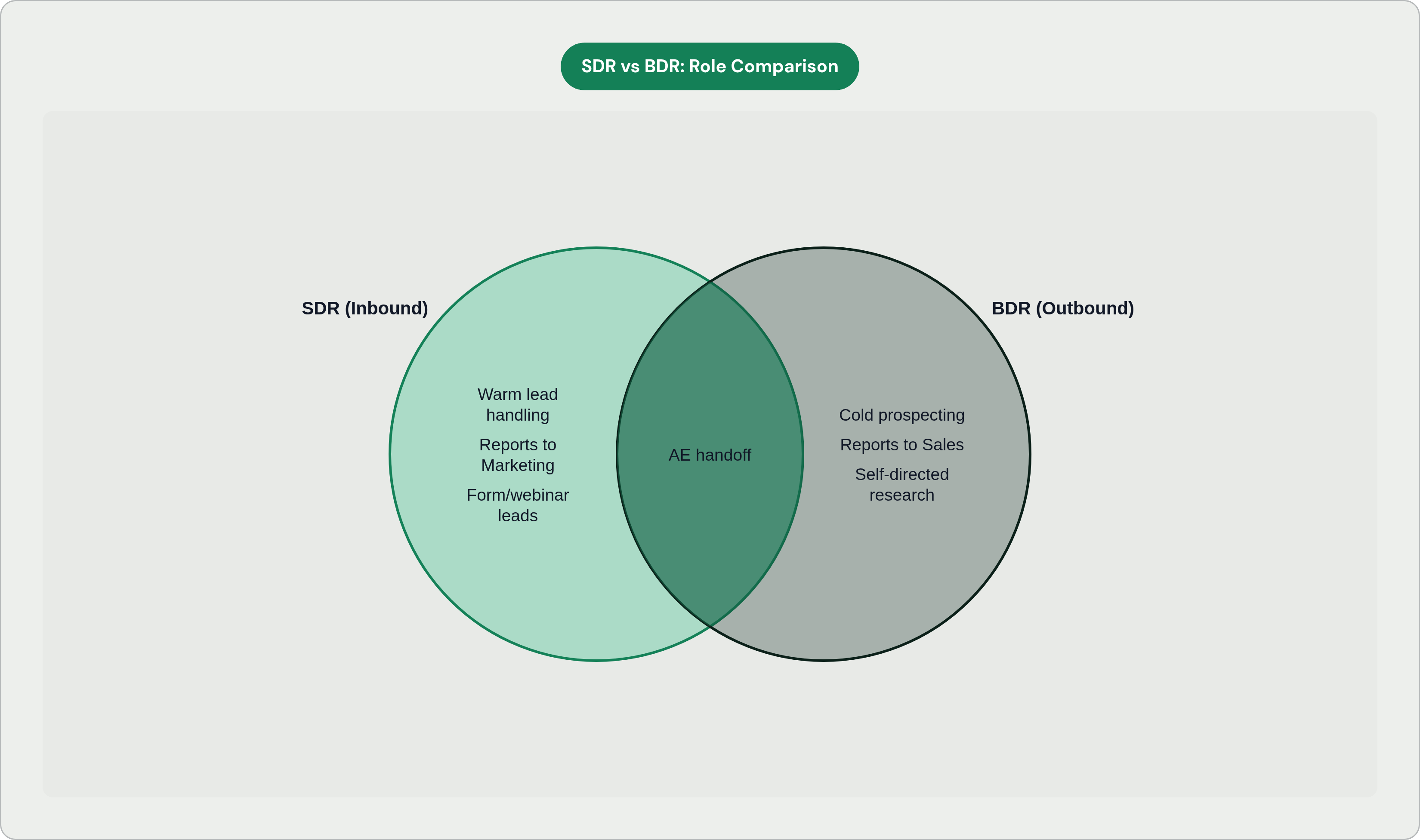
- SDR (Sales Development Rep) handles the inbound motion. Leads who've already shown interest, filled out a form, downloaded something, attended a webinar. The SDR qualifies them before passing to an AE. SDRs in this model often report to Marketing.
- BDR (Business Development Rep) handles the outbound motion. Cold accounts, self-directed prospecting, no prior contact. BDRs typically report to Sales.
Plenty of organizations flip these definitions entirely. The same title can mean opposite things depending on where you work. There's no industry-wide standard, which creates real confusion when you're evaluating a job posting. I've seen BDR job descriptions that are clearly inbound SDR roles, and vice versa. You have to read the actual responsibilities, not just the title.
Below roughly $50M ARR, SDR and BDR are usually the same role under different names. The distinction starts to matter once an organization is large enough to run dedicated inbound and outbound motions simultaneously, with separate teams and separate reporting lines.
When does this actually affect hiring and org design?
- Enterprise deals with long sales cycles and high deal values tend to benefit from BDR-style outbound, where research and personalization matter more than speed.
- Shorter, transactional cycles get more value from SDRs moving volume quickly through inbound leads.
- If marketing is already generating strong demand, an SDR ensures leads don't fall through the cracks. If marketing is thin or early-stage, a BDR creates opportunity without waiting for marketing to deliver it.
The reporting line follows the motion, not the title. Inbound answers to Marketing. Outbound answers to Sales. Everything else is a naming convention people argue about in LinkedIn comments.
How SDRs qualify leads: BANT for triage, MEDDIC for complex deals
BANT
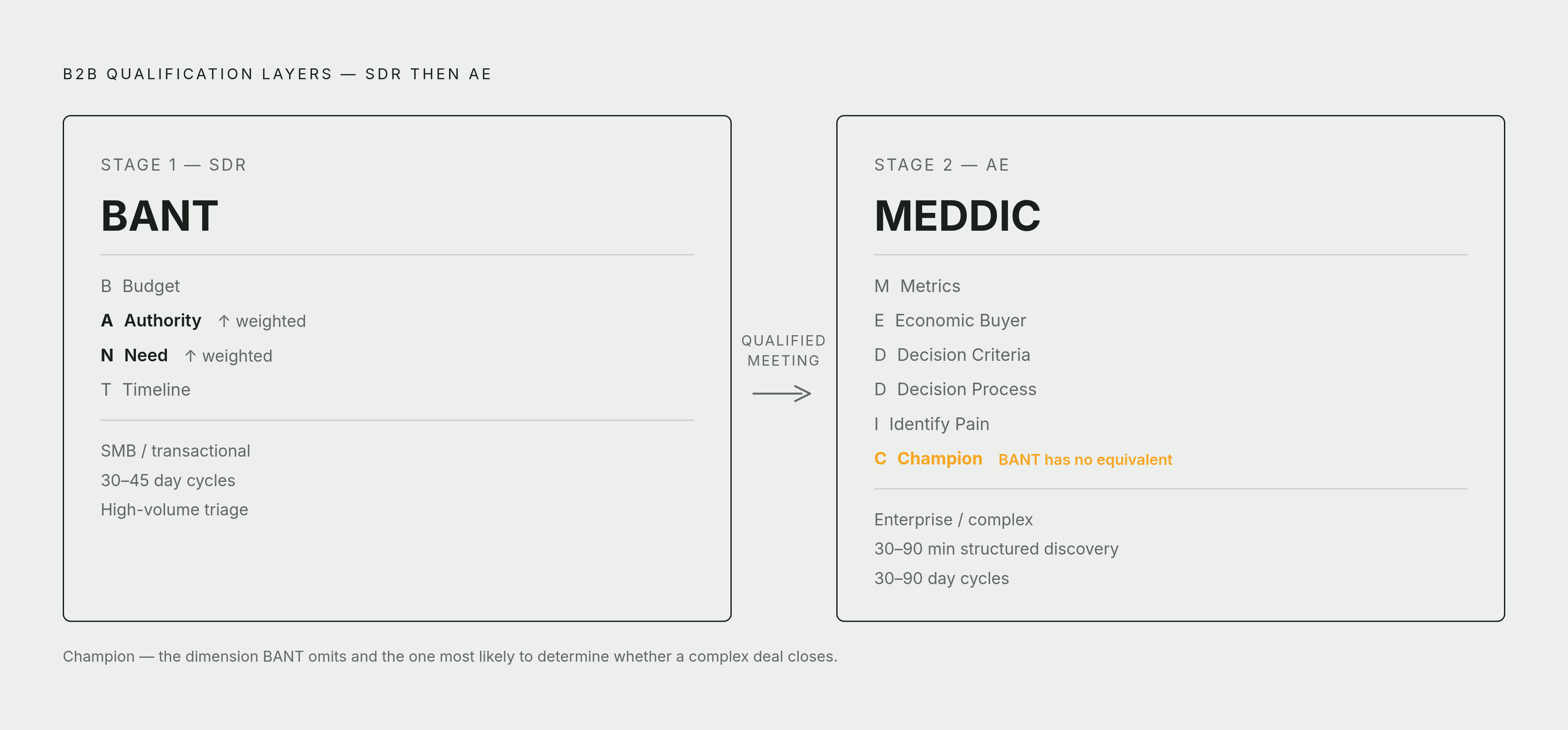
BANT stands for Budget, Authority, Need, Timeline. Four dimensions. You can run through them in a few minutes on a cold call.
It's the right tool for high-volume triage: SMB deals, transactional cycles, lower deal values, sales cycles in the 30 to 45-day range. A new SDR can learn the framework in an afternoon, and that accessibility is a feature at the triage stage, not a weakness.
One practical note: disqualifying on budget too early kills accounts that would have converted with time. At first touch, weight BANT toward Need and Authority. Whether they can actually pay is a conversation for later. Whether they have a real problem and someone who cares about solving it is what you need to know right now.
MEDDIC
MEDDIC stands for Metrics, Economic Buyer, Decision Criteria, Decision Process, Identify Pain, Champion. Six dimensions, typically covered across 30 to 90 minutes of structured discovery.
This is not an SDR triage tool. It's an AE-layer framework for complex enterprise deals, and it produces meaningfully better close rates and more accurate forecasting than BANT in those contexts.
Most of that comes down to one dimension BANT doesn't capture at all: Champion. A champion is the person inside the prospect organization who wants you to win the deal and will advocate for you when you're not in the room. In a complex enterprise sale, finding and developing that person is often the whole game.
How they work together
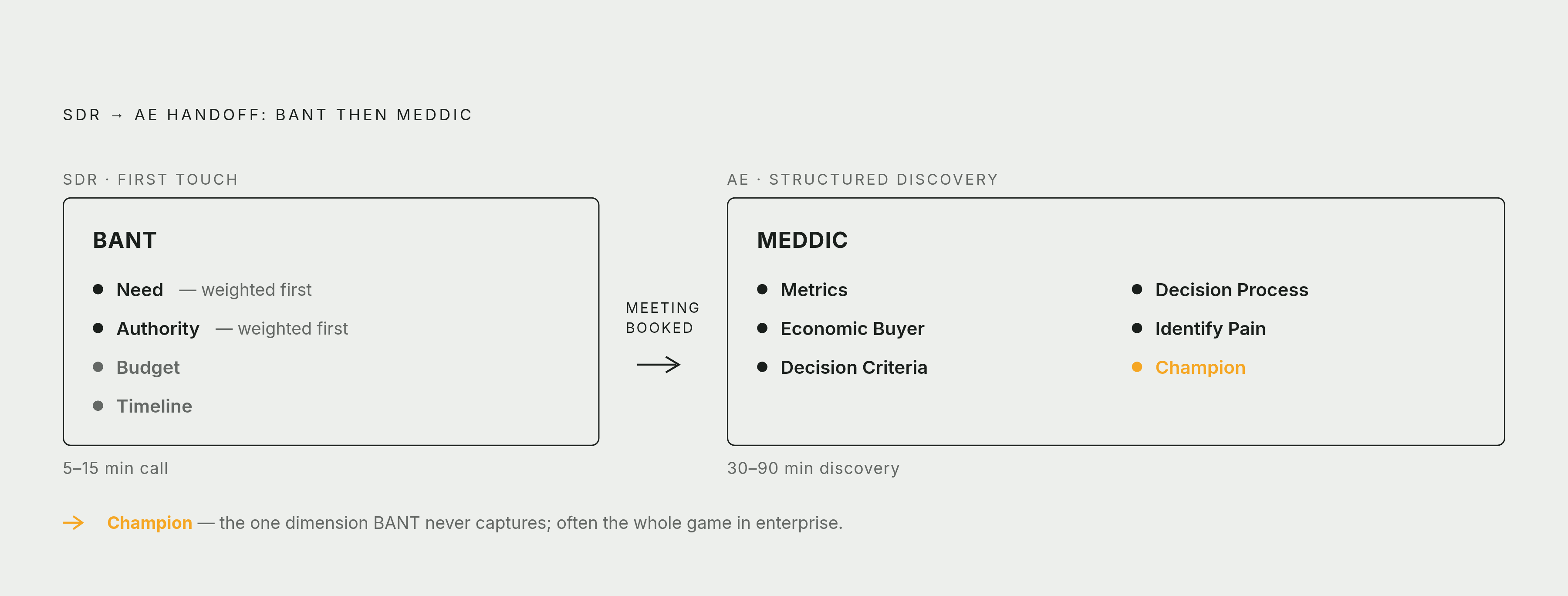
The real operating model in most high-ACV B2B SaaS organizations isn't BANT versus MEDDIC. It's BANT first, then MEDDIC.
The SDR runs a stripped-down version of BANT, weighted toward Need and Authority, before booking the meeting. The AE runs full MEDDIC in discovery after the handoff. Sequential layers, not competing alternatives.
For enterprise teams dealing with complex procurement and crowded competitive landscapes, there's also MEDDPICC, which adds Paper Process (legal and administrative hurdles) and Competition to the standard MEDDIC. The acronym is terrible. The additions are useful.
The metrics that show whether an SDR function is working
Only around 57% of SDRs nationally hit or exceed quota in a given year. That means the benchmarks below are meaningful targets, not comfortable floors.
Meeting benchmarks
- Outbound B2B SaaS: 12 to 15 meetings per month for an average SDR, 20 to 25 for a top performer
- Inbound SDRs working warm leads: 25 to 40 per month
- Enterprise or ABM-focused roles: 5 to 10 per month, with significantly higher deal value per meeting
Activity benchmarks in context
Dials and emails are useful for coaching. They're poor measures of success on their own.
A 2% cold call success rate means 98 out of 100 contacts don't convert. Volume at those rates can generate meetings. But volume as a primary metric rewards behavior — sending more emails, making more calls — rather than outcomes. A rep who sends 200 mediocre emails is not twice as good as one who sends 100 well-researched ones. Anyone who has managed an SDR team for more than a quarter learns this. Usually the hard way.
The lagging metrics that actually predict revenue
- Qualified meetings held (not just booked, but actually happened)
- Show rate (target: 80%+)
- Meeting-to-opportunity conversion (target: 58%+)
- Pipeline created
Speed-to-lead
Research from MIT and InsideSales.com found that responding to an inbound lead within five minutes makes a rep dramatically more likely to qualify that lead than waiting even 30 minutes. After five minutes, the odds drop sharply.
Slow CRM updates, manual logging, delayed follow-up don't just create paperwork problems. They kill deals before they start.
How SDR teams are structured and what one rep is actually expected to generate
The anchor number, per Bridge Group's 2026 data: the median US B2B SaaS SDR generates $3 million of pipeline per year. Top 10% generate $5 to $8 million.
The standard SDR-to-AE ratio sits around 1:2.4. One SDR feeding roughly two and a half closers. That ratio has held steady since 2018, which is worth noting given how much the tooling around the role has changed in that time.
About 60% of sales development groups report to Sales leadership. Inbound-heavy teams often report to Marketing. Same principle as the title question: the reporting line follows the motion.
The more recent trend is fewer reps doing more work, augmented by AI-assisted research, automated CRM logging, and better data. Reps are being asked to work more targeted lists with better personalization rather than scaling through raw headcount. Whether that's a long-term structural shift or a cost-cutting move dressed up in productivity language is still genuinely unclear.
SDRs account for 30 to 45% of pipeline revenue in high-performing B2B companies. That context makes the contraction SaaStr documented more legible: 36% of B2B companies cut or restructured sales development teams in 2025. That isn't a signal the role is disappearing. It's a signal that teams running high-volume, low-quality SDR motions are getting trimmed, while teams built around quality and better tooling are holding.
Compensation, career path, and what the role demands from the people doing it
The 2026 US compensation ranges:
- Entry-level (0 to 1 year): $50 to $70K base, $60 to $80K OTE
- Mid-level (1 to 3 years): $60 to $80K base, $75 to $100K OTE
- Average OTE across the role: $70 to $90K, with top performers and tech-hub reps clearing $100K+
Research from Salesforce found that administrative tasks consume roughly 41% of the average rep's day. SDRs average just two hours per day actually selling. That's the gap where AI drafting tools, automated CRM updates, and better sequencing platforms are making a real difference — by giving reps more of their day back.
The career path is fairly direct. SDR is the standard entry point into B2B sales. The skills you build here — prospecting, qualification, CRM discipline, pipeline management — are exactly what AE work requires. Most AEs sat in this seat first.
What does the job actually ask of the people doing it?
- High activity tolerance. Forty to eighty outbound touches per day is normal. Most produce nothing.
- Resilience at scale. A 2% cold call success rate means rejection isn't occasional. It's just the daily reality of the job.
- Process discipline. List quality, CRM hygiene, and follow-up consistency matter more than charisma at this stage. The reps who last are the ones who treat the process as the product.
Reps who go straight into closing roles often spend their first year as an AE relearning qualification basics from scratch, this time with revenue targets attached. The SDR seat teaches you what a real opportunity looks like before you're on the hook for closing one.