Sales Intelligence Platforms Compared for B2B Prospecting
Six dimensions separate the platforms that actually work from expensive mismatches.

Before you compare platforms, you need to know what you're actually comparing. The sales intelligence category has fractured into distinct tool types: contact databases, account intelligence platforms, ABM and intent platforms, enrichment workflows, relationship selling tools, and revenue intelligence platforms. A tool that dominates one category might be weak in another. That's not a marketing problem. It's a category problem, and it becomes your problem the moment you sign a contract without accounting for it.
Six dimensions come up again and again when this decision gets made well.
Data coverage and accuracy. How much of your total addressable market does the database actually touch? And how reliable are those contacts when you go to use them? A platform can have massive coverage and still deliver emails that bounce straight back and phone numbers that ring out to nothing. Coverage and accuracy aren't the same thing — like a map that shows every road but gets you lost on half of them — and vendors don't always make that distinction easy to see. Ask them to separate the two numbers and watch what happens.
Intent signal types. First-party intent comes from your own site. Third-party cooperative intent comes from behavioral signals pooled across B2B media networks. Predictive AI scoring models buying likelihood from patterns across both. Each tells a different story about where a prospect actually is in their decision process. Knowing which type you're getting matters more than vendors let on, and most vendors are happy to let you conflate them.
Trigger events. Funding rounds. Leadership changes. Hiring surges. Technology shifts. These signal that a window has opened. The best platforms surface them in real time. The rest make you go digging yourself.
CRM and tool integration. Does the platform embed into Salesforce or HubSpot without disrupting your existing workflow? Or does it require a parallel process your reps will quietly abandon after two weeks? Both outcomes are common. Only one is in the brochure.
Compliance posture. Data provenance, consent frameworks, and DNC screening used to be nice-to-haves. In regulated markets and across Europe, they're hard requirements. A platform that retrofitted compliance after the fact will eventually show the seams, usually at the worst possible moment.
Total cost of ownership. List price is rarely what a realistically sized team actually pays. Auto-renewal terms, seat minimums, and add-on features can turn a seemingly affordable platform into a significant locked-in commitment. Read the contract before you're in love with the demo.
Vendor-reported accuracy figures are measured under favorable conditions. Independent tests consistently show that single-source data stacks deliver meaningfully lower coverage than the headline claims. The gap between what's on the pricing page and what lands in your inbox is real and well-documented by anyone who's actually had to live with these tools long enough to measure them.
The direction the category is moving to address this is multi-source waterfall architecture. A platform queries multiple data providers in sequence, each one filling gaps left by the last. Salesforce's State of Sales research backs this up: top-performing sales teams already pull from multiple data sources, and the minority relying on a single vendor report lower confidence in the data they're acting on. That number tells you something.
ZoomInfo: what the largest all-in-one platform actually delivers and where it struggles
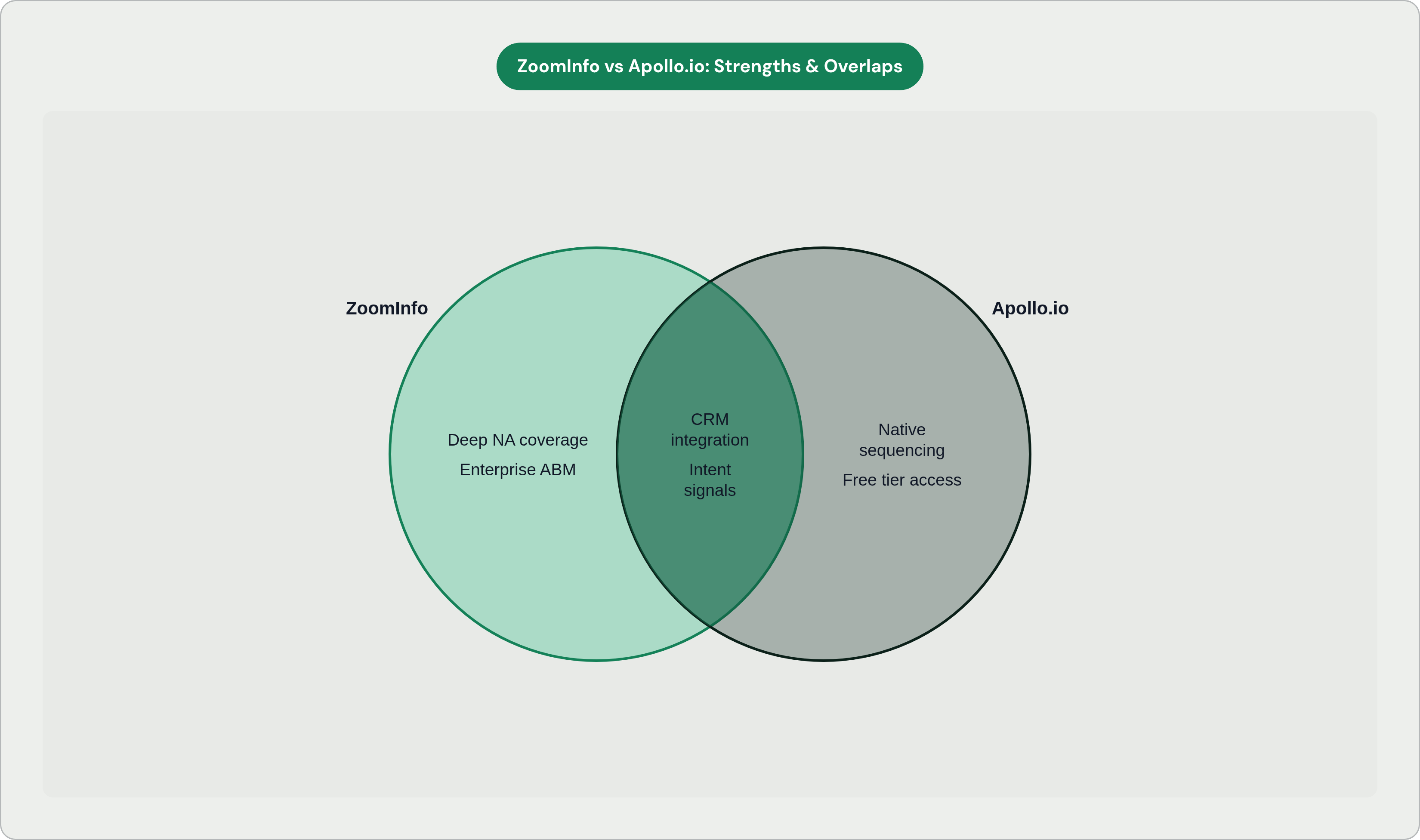
If you've spent more than five minutes in B2B sales, you've heard of ZoomInfo. The reputation is earned in the right places. Contact and company database breadth is largely unmatched in North America. Firmographic and technographic attributes go deep. Forrester and Gartner have both recognized it as a category leader. Intent data combines proprietary signals with third-party coverage across a very large topic set. And it integrates with a wide range of CRMs without requiring you to rebuild your workflow around it.
But here's where I'd push back on the default assumption that biggest means best fit.
International coverage lags considerably behind its North American depth, particularly in APAC and LATAM. If your TAM extends meaningfully beyond the US and Canada, you will feel this gap in your results before your contract is up. Not as an abstract concern. As actual pipeline you can't build.
Independent accuracy tests place real-world email deliverability and phone connect rates below what the vendor claims. The platform remains usable. But it does mean you should calibrate your expectations before you're six months in wondering why your numbers don't match the sales pitch.
And then there's the contract structure. Annual lock-ins, aggressive auto-renewals, and minimum commitments show up repeatedly in buyer complaints. The entry price point puts ZoomInfo out of reach for most growth-stage companies, and mid-market deployments often land at multiples of the stated minimum once seats and features are stacked. That's not hidden, exactly. But it's not front and center either.
So who is it actually for? Enterprise B2B teams with large North American TAMs, established ABM motions, dedicated RevOps resources, and budgets that can absorb a significant annual commitment. If your TAM is primarily international, if you're early-stage without the pipeline to justify the investment, or if you need real flexibility in contract terms, the value proposition narrows considerably. And narrowing is fine. Every platform should narrow. The question is whether it narrows toward you.
Apollo.io: all-in-one prospecting for teams that can't afford to silo data from outreach
Apollo's pitch is straightforward: a large contact database, native email sequencing, a dialer, and CRM sync in one place. No stitching together separate prospecting and engagement tools. No managing two vendors who don't talk to each other cleanly and then blaming each other when something breaks.
The price gap with ZoomInfo is substantial at every tier. Apollo also offers a usable free plan with no credit card required. For teams piloting sales intelligence for the first time, or trying to build an internal case for budget, that free tier removes a real barrier that most platforms keep firmly in place. That matters more than it sounds if you've ever had to justify a five-figure purchase to a skeptical finance team with no live data to show them.
Independent tests show Apollo's US accuracy trails ZoomInfo's. But by less than the price difference would predict. And for global coverage outside North America, Apollo holds up comparatively well in areas where ZoomInfo doesn't. That's a trade-off worth understanding rather than dismissing.
The G2 review volume tells you something the feature comparison charts don't: teams are actually using this and renewing it. A lot of platforms review well in theory. Apollo is one that growth-stage and mid-market teams are running daily, which is a different kind of signal.
Multi-source verification depth, the kind ZoomInfo achieves through its human research layer and data-stack breadth, is not replicated at Apollo's price point. That's a real trade-off. Enterprise ABM orchestration with deep firmographic layering isn't Apollo's primary offering, and you shouldn't expect it to be. Expecting a platform to be something it was never designed for is how you end up blaming the tool for a mismatch you created.
If your team is running high-velocity outbound and needs prospecting and outreach in one place at a cost that scales with headcount rather than requiring a large upfront commitment, Apollo is where I'd start.
LinkedIn Sales Navigator: when relationship context matters more than contact data
What if the most valuable piece of data isn't someone's email address? What if it's knowing that the person you're trying to reach just changed jobs three weeks ago and hasn't settled into their new budget cycle yet? That reframes the entire premise of what a prospecting tool should actually give you.
That's the terrain LinkedIn Sales Navigator operates in. And it's terrain no other platform in this comparison can replicate, because it's built on a network effect no vendor can buy their way into.
Members update their own profiles. Title changes and role shifts surface in near real time without waiting for a vendor refresh cycle. That's a fundamentally different data model than any database platform uses. Account IQ, rolled out broadly in late 2025, adds generative AI summaries of accounts, decision-maker mapping, and warm intro paths. This meaningfully closed the account intelligence gap that used to be a notable weakness. InMail response rates run materially higher than cold email benchmarks, partly because the medium carries a legitimacy signal that raw outbound volume can't manufacture.
Sales Navigator doesn't provide verified email addresses or direct-dial phone numbers. It surfaces LinkedIn profiles and InMail access. It also doesn't deliver account-level buying signals: no funding round alerts, no earnings call monitoring, no technographic changes, no third-party intent data. It sees LinkedIn activity — not the broader web. That's a real constraint, and worth naming plainly rather than burying in a footnote.
That scope limitation should drive how you deploy it, rather than disqualify it.
The pattern that actually works is pairing Sales Navigator with a contact database like Apollo, ZoomInfo, or Cognism rather than using it instead of one. It handles the relationship layer. The database handles the contact layer. Trying to force it to do both is where teams get frustrated, and the frustration is usually directed at the wrong thing.
Cognism: the case for compliance-first data in European and regulated markets
Most US-centric sales intelligence platforms treat compliance as something they retrofit after the fact. Cognism built around it from the start — and that's not just good legal hygiene, it's the difference between a foundation and a patch job. I've seen what that architectural difference looks like in practice, and it shows up in the places that matter most, usually right when you can least afford a problem.
The core differentiation is phone-verified mobile numbers at a depth no other provider in this comparison matches, combined with GDPR-first data practices and DNC screening across more countries than ZoomInfo covers. For director-level and above contacts in Europe, Cognism's independent accuracy results lead the cohort, including ahead of ZoomInfo on EMEA email validity and phone connect confidence.
As AI-driven outbound scales and European regulators increase scrutiny, data provenance and consent records become operational risks, not just legal ones. A platform retrofitted for compliance will eventually show the seams at exactly the wrong moment. And when that moment arrives, the question of whether your data vendor had the right consent architecture is not an abstract one.
Intent data via a Bombora partnership covers a broader topic set than ZoomInfo's proprietary intent layer, which is a meaningful advantage for teams running content-driven ABM plays in EMEA.
US contact accuracy trails ZoomInfo's on independent tests. Teams with primarily North American TAMs would be trading meaningful data quality for compliance infrastructure they likely don't need. Pricing is flat and predictable, which helps budget planning, but that structure limits on-demand flexibility at lower volumes compared to credit-based models. Know what you're optimizing for before you choose.
If you're running outbound into European markets, operating in a regulated industry where consent records are auditable, or managing a global team that needs real EMEA depth, Cognism is the clearest choice in this comparison. Not the flashiest. The clearest.
6sense and Bombora: intent data as a layer versus intent data as a platform
These two are worth looking at together because they're frequently confused, and the distinction matters when you're planning your stack. Buying the wrong one for your situation is an expensive lesson.
Bombora runs a cooperative network of B2B media and content sites that share anonymized consumption data. It covers a very large topic set. It measures sustained intent elevation over recent weeks against a longer baseline, surfacing accounts that are actively researching rather than ones that clicked something once. That distinction between sustained research behavior and a single page view is more operationally important than it sounds. It's the difference between a company that's in-market and one that accidentally landed on a blog post.
Bombora's signal is already embedded in Apollo, Cognism, 6sense, and several other platforms in this comparison. You may already be consuming Bombora data without having bought it directly. That's worth checking before you go write another check.
Bombora makes sense as a standalone when you have an existing data stack and CRM workflow you want to enrich with a specialized intent layer, without paying for orchestration, scoring, or campaign management you already have elsewhere. Buy the ingredient, not the platform, when you already have the kitchen.
6sense is the full platform. It combines Bombora Company Surge signals with proprietary first-party intent, website visitor identification, and AI-driven buying stage predictions. It doesn't just tell you which accounts are consuming relevant content. It models which ones are likely to convert and roughly when. That reframes prioritization in a way that matters for long sales cycles, where timing is often the difference between a deal and a missed quarter.
But here's the thing most vendors won't tell you upfront: 6sense demands significant annual investment, months to implement properly, and dedicated RevOps ownership. It is not a self-serve tool. Teams that lack the infrastructure to act on its signals will watch it underperform and wonder what went wrong. The platform isn't broken. The fit is.
6sense makes the most sense for enterprise organizations with established ABM programs, long and complex sales cycles, real marketing-sales alignment, and the budget and headcount to manage a platform of this complexity. If that's not your situation yet, Bombora as a layer into tools you already have will get you further, faster, and without the implementation debt.
Where AI-assisted workflow automation fits into the prospecting stack
Even with the right intelligence platform, reps are still spending significant time logging activity, drafting follow-up, and updating CRM records after every prospecting action. The data problem gets addressed. The workflow problem doesn't. And that's a gap worth naming clearly, because the two are often conflated in vendor pitches.
Intelligence tells you who to call. Workflow automation determines whether your rep actually has time to call them.
Salesforce's State of Sales research shows that sellers already expect AI tools to meaningfully cut prospect-research time and email drafting time. The gap is in tools that act on enriched data rather than just surfacing it. Surfacing is the easy part. Acting is where the time actually goes.
What does AI workflow automation actually add on top of a sales intelligence platform?
- Automatic CRM logging after calls, emails, and meetings. The manual update loop that pulls reps out of selling mode, gone.
- Context-aware reply drafting that uses deal history, CRM data, and prior conversation to generate relevant outreach. Not generic templates that need heavy editing before they're usable.
- Next-step suggestions and meeting booking that keep deals moving without rep-initiated admin holding things up.
The honest version of this is that most reps are spending somewhere between a third and half their day on tasks that have nothing to do with selling. That's a tooling problem, not a motivation problem. Intelligence platforms, for all their power, don't solve it. They surface the opportunity and then hand the administrative burden straight back to the rep.
The layer that addresses this sits between your intelligence platform and your CRM. It absorbs the logging, the drafting, the follow-up scheduling. It integrates where reps already work rather than requiring a new tab or a new habit. That's the gap worth evaluating separately from your data stack decision, because the same tool is not doing both.
Matching platform to prospecting motion: a practical decision map
The starting question isn't "which platform is best." It's "what does our prospecting motion actually require?" Those are different questions, and conflating them is how teams end up with expensive tools they use at 30 percent of capacity.
Sales cycle length, geographic coverage, team size, and existing stack all change the answer.
Enterprise North American TAM, ABM motion, dedicated RevOps. ZoomInfo or 6sense, depending on whether the priority is data depth or predictive account prioritization. Be clear about which problem you're trying to solve first. Trying to solve both at once with a single platform is often how you end up solving neither.
Growth-stage or mid-market team, high-velocity outbound, limited budget. Apollo as an all-in-one starting point. Prospecting and engagement in one platform, room to layer in enrichment as the team scales. Avoid overbuilding the stack before you've validated the motion. More tools do not fix an unvalidated motion.
Primarily EMEA TAM or regulatory environment where consent records are auditable. Cognism. The compliance infrastructure and phone verification depth justify the investment. Forcing a US-centric database into European compliance requirements is a losing game, and it's a game that tends to end badly right when you're most exposed.
Relationship-driven motion, complex multi-stakeholder deals, executive-level selling. LinkedIn Sales Navigator as the relationship layer, paired with a contact database for email and phone coverage it doesn't provide. Using it alone won't fill your pipeline. It will give you a very rich view of a pipeline you can't fully reach.
Teams with a functioning ABM stack that need a specialized intent layer without rebuilding around a new platform. Bombora as a feed into existing tools. Buy the ingredient, not the platform, when you already have the kitchen.
Enterprise ABM at scale with the budget and RevOps maturity to use predictive scoring. 6sense as the orchestration layer. Only if you have the infrastructure to act on what it tells you. The platform is only as useful as the team and process behind it.
Most B2B teams running serious prospecting programs combine more than one tool. Which means the real question is usually "what do we add to what we have" rather than a full platform swap. That's a less exciting question. It's also the right one.
One more thing worth building into your planning: data decays faster than most teams account for. A database accurate enough today will erode within a year or two without a vendor that refreshes aggressively. The purchase decision is not a one-time event. Build in a review cadence, not just a contract signature.