Sales Technology Stack Categories and Integration Architecture
Most sales stacks fall apart when tools don't automatically sync data back to the CRM.
The average B2B sales rep uses 14 different tools every day. When I first saw that number, my instinct was to read it as a sign of a mature, well-equipped team. More tools, more coverage, right? Sit with it for a second, though. Fourteen tools. That is not sophistication. That is someone spending half their day figuring out which tab they need to be in.
The problem is not the tools themselves. It is the mental model behind how they got assembled. Most sales stacks come together the same way: someone spots a gap, finds the highest-rated product in that category, buys it, adds it to the list. Repeat until the budget runs out. What you end up with is not a stack. It is a collection.
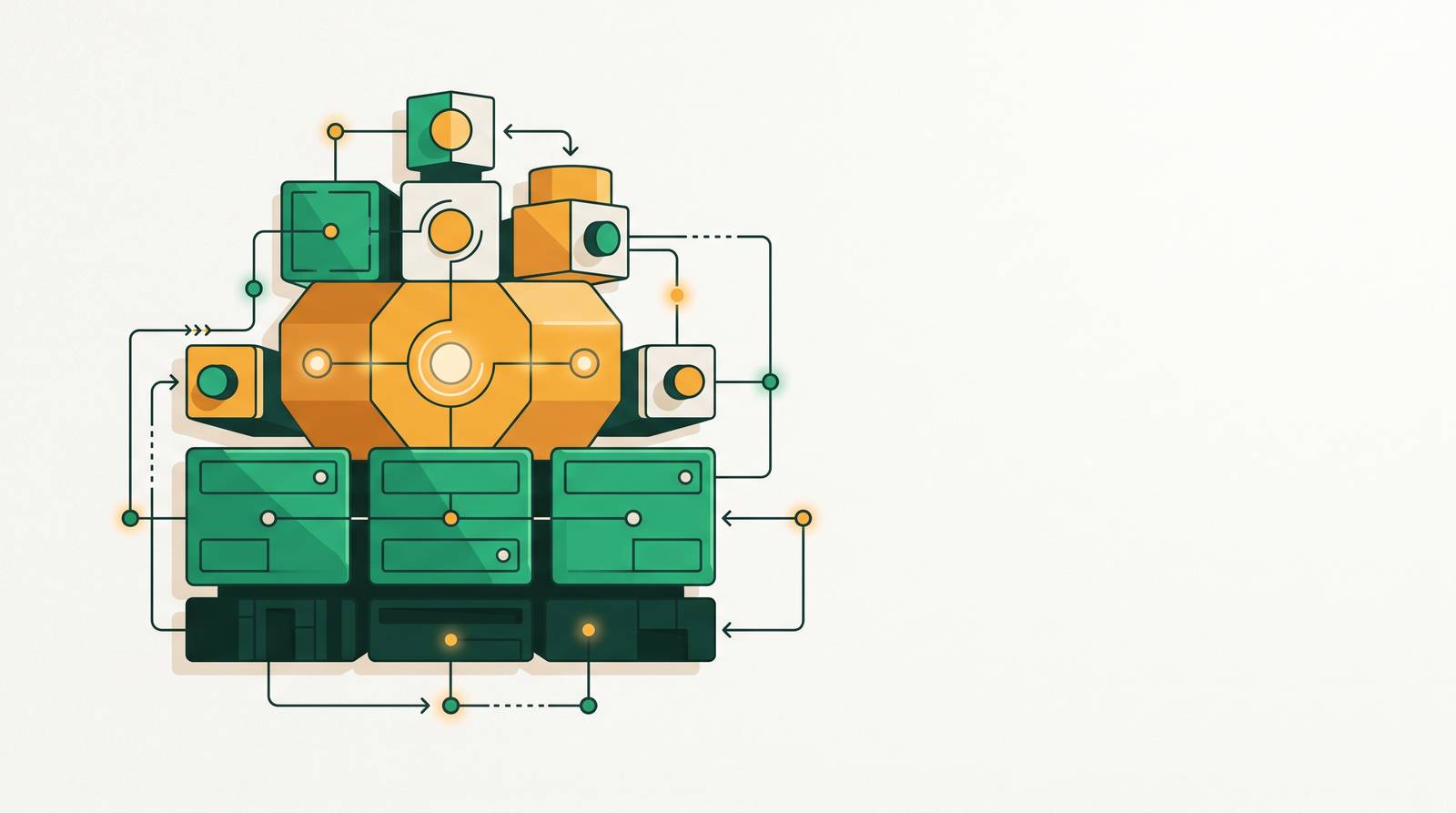
The word "stack" is doing real work here, and most people miss it. A stack implies layers. It implies each layer rests on the one below it, that the whole thing was intentional. A pile of best-of-breed tools, each living in its own world and connected mostly by copy-paste, is not a stack. It just looks like one on a slide deck.
So what actually makes something layered? The straightforward version: each layer takes data from the one below it, does something useful with that data, and passes a richer output upward. When integration breaks down, that chain breaks. The layer above has to get its data somewhere else. Usually that somewhere else is a human doing manual work.
Three questions worth asking about any tool you are evaluating:
- Where does the data it produces come from?
- Where does that data need to land?
- What happens if it does not get there automatically?
That third question is where most stacks fall apart. In a disconnected collection, the answer is almost always: a rep types it in somewhere. That is not an integration. It is just a different kind of problem wearing a process hat.
Every stack also needs one authoritative home for deal data. Without it, each layer becomes its own version of the truth. A deal that exists in the engagement platform but not in the CRM is invisible to anyone who is not inside that platform. That is a structural blind spot, and it compounds quietly until it stops being quiet.
The CRM as the system of record every other layer depends on
Here is a test I have run on sales stacks for years: if it did not happen in the CRM, did it actually happen?
That sounds extreme until you trace the logic. If a rep sent an email through the engagement platform and it did not sync to the CRM, does the manager know it happened? Does the forecast account for that touch? Does the next rep who picks up the account see it? No, no, and no. The activity existed. The record of it did not. And in sales operations, a record that does not exist might as well not have happened.
About 91% of companies with ten or more employees now use a CRM (DemandSage, 2026). Near-universal adoption. But adoption is not the same as integration. A CRM updated manually when reps remember to log things is not a system of record. It is a suggestion box.
The market scale reflects what is at stake. The global CRM market is projected to reach $126.2 billion in 2026, on its way to $254.3 billion by 2032. Eighty-seven percent of CRM systems are now cloud-based, which matters more than it sounds. On-premise CRMs were notably hard to connect to other tools. Cloud-based CRMs have APIs, and APIs are what make a layered architecture possible at all.
On the vendor side: Salesforce holds roughly 20% of the global CRM market (IDC, 2025) and has ranked first for thirteen consecutive years. HubSpot holds about 62% of SMB CRM installations, while Salesforce leads mid-market at 46% (6sense, 2025). That split matters because integration ecosystems differ significantly by platform. Tools that connect cleanly to Salesforce do not always connect as cleanly to HubSpot. Platform choice is not just a preference. It shapes what your entire stack can and cannot do.
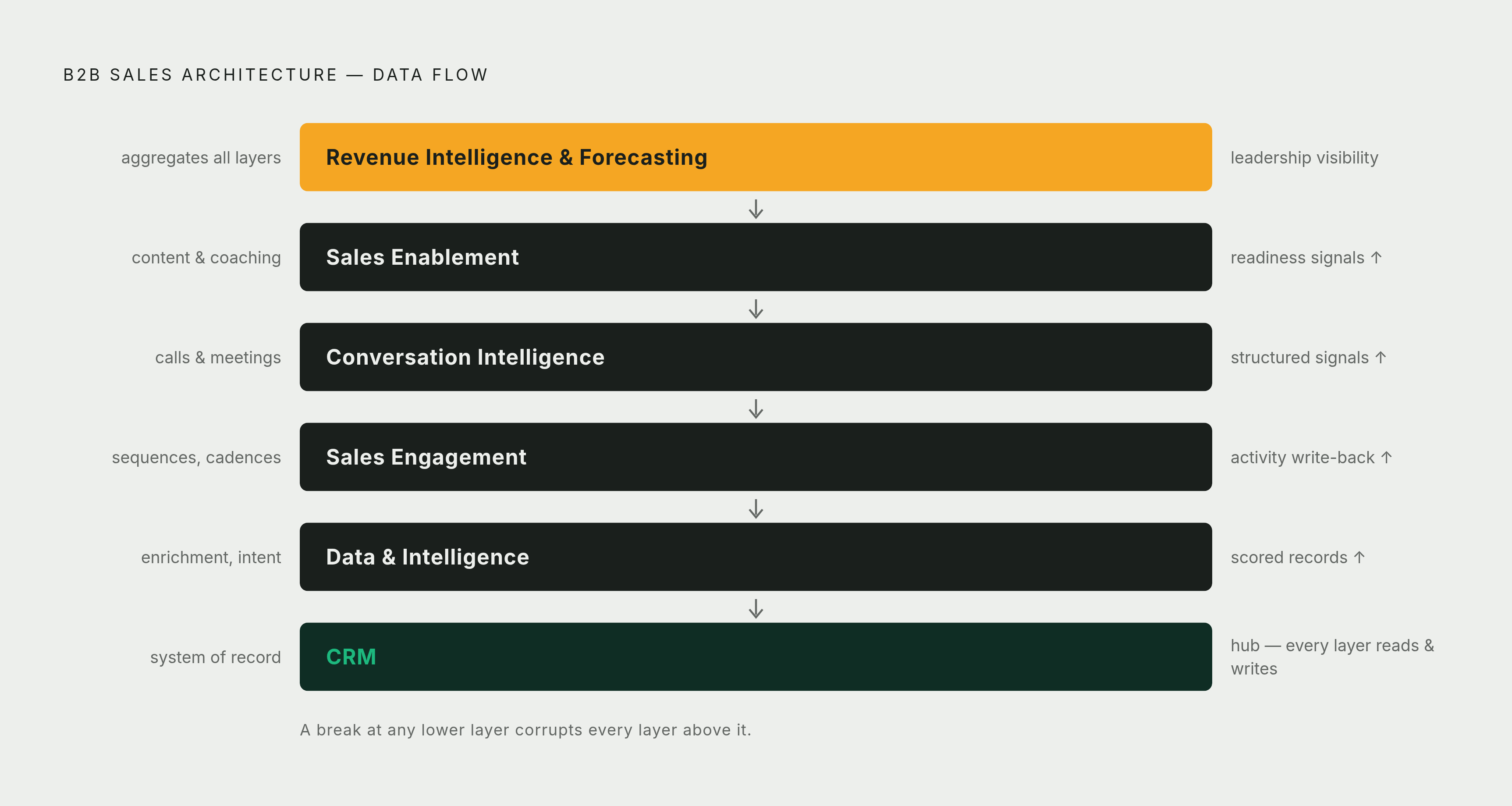
The CRM is not one tool among equals. It is the hub. Every other layer needs a defined path back to it. A tool that does not write back to the CRM creates a pocket of invisible activity, and invisible activity cannot be managed, coached on, or forecasted. Everything that follows either feeds the CRM, reads from it, or both.
The data and intelligence layer: where the CRM gets the signal it needs to be useful
What is the CRM actually worth if the data inside it is wrong?
A contact record with a bad phone number. An account missing its tech stack. A lead with no indication of whether they are even in-market right now. None of that is useful. The CRM becomes a very expensive address book. The data and intelligence layer is what turns it into something reps can act on.
This layer does a few distinct things:
- Enriches contact and account records with firmographic data (company size, industry, location) and technographic data (what software they are currently running)
- Surfaces intent signals, behavioral patterns suggesting a buyer is actively researching a solution like yours
- Validates and refreshes records so the CRM does not quietly decay into stale, outdated information
ZoomInfo processes over 1.5 billion data points daily and maintains a database of 500 million contacts, including 120 million-plus direct-dial phone numbers and 200 million-plus verified business emails. Seismic documented a recovery of 11.5 hours per week per rep after deploying ZoomInfo's data layer. Those hours came directly from eliminating manual research and record cleanup. Nearly a third of a rep's working week, given back. That number stuck with me, because the time was not being spent on something exotic. It was being spent on data hygiene that should have been automated from the start.
The sales intelligence sub-segment was valued at $4.85 billion in 2025 and is projected to reach $12.45 billion by 2034 (Fortune Business Insights).
Other tools in this category include Clay and Clearbit. Clay leans toward enrichment pipelines and workflow automation. Clearbit (now part of HubSpot) is strong on real-time enrichment at the moment a record is created. 6sense operates more on the intent signal side. The category has range, but the integration requirement is the same across all of them: enrichment data has to flow into the CRM automatically. A data tool that requires a manual export and import is adding a new step and a new place for things to go wrong, rather than removing work.
Sales engagement platforms: turning CRM data into coordinated outreach without manual effort
If the CRM is the system of record and the data layer keeps it accurate, the engagement platform is where that data gets put to work. It manages sequences, cadences, and multi-channel outreach across email, phone, and LinkedIn so reps are running a consistent process rather than improvising every morning.
Architecturally, this layer sits between the CRM and the rep. It reads from the CRM to know who to contact and what is known about them. It tells the rep what to do and when. And then, critically, it writes every activity back to the CRM once it is done.
That write-back matters more than it sounds. If reps are manually logging touches, the CRM record is incomplete. Incomplete records make pipeline reporting unreliable. And anything built on top of unreliable pipeline reporting — forecasting, coaching, revenue intelligence — is built on a foundation that is partially made up. The failure starts at the engagement layer and cascades upward through everything above it. By the time leadership sees it, it looks like a forecasting problem. It is actually a logging problem that has been compounding for months.
Multi-channel is now the norm. Voice, email, and calendar channels operate within the same coordinated workflows. The engagement layer is no longer just an email sequencer. It coordinates all three, reduces manual scheduling and logging, and keeps the rep focused on the conversation rather than the logistics of getting to it.
Common tools here include Outreach, Salesloft, and Apollo, each with varying depths of native CRM integration. The output of this layer is not just sent messages. It is a structured record of what was tried, when, and how buyers responded. That record feeds the CRM. It eventually feeds the intelligence and forecasting layers above. Done right, the engagement platform is a data producer as much as it is an execution tool.
Conversation intelligence: converting calls and meetings into structured data the stack can use
Think about where deals actually move. Not in the CRM. Not in the email sequence. On the phone. In the demo. In the discovery call where the buyer mentions, completely unprompted, that they already looked at your top competitor and have budget approval locked in before Q3.
A stack that captures every email but none of what was said on calls has a significant blind spot. Conversation intelligence is the layer that closes it.
What this layer does: it records, transcribes, and analyzes sales calls and meetings to surface coaching opportunities, deal risk signals, and patterns across the pipeline. Gong is the most widely recognized reference point here. The platform consolidates customer interactions across channels into a single view, recommends next steps, and automates workflows based on what was actually said in conversations, not just what a rep logged afterward.
Two distinct uses, and both matter.
The first is coaching. Managers can review call patterns at scale, identify skill gaps, and see what top performers are actually doing differently. Instead of riding along on one call a week and hoping it is representative, they can work from patterns across hundreds of calls. That shift alone changes what good coaching looks like.
The second is deal intelligence. If a buyer mentions budget constraints, a procurement process you did not know about, or a competitor by name, the system flags it. Those signals surface before they show up in a lost deal. Knowing a deal is at risk three weeks before close gives you something to work with. Knowing it the day after close does not.
The integration requirement here mirrors every other layer. Call data and deal signals have to flow to the CRM and to the revenue intelligence layer. A conversation tool that stores recordings only in its own platform, with no connection to the broader stack, breaks the data chain at exactly the moment the most valuable information was captured.
Sales enablement: making sure reps can act on what the stack surfaces
Here is a failure pattern I have watched repeat itself more times than I care to count. The data layer finds a great signal. The engagement platform surfaces it to the rep. The rep opens a new deal. And then they spend twenty minutes searching their inbox, a shared drive, and three different Slack channels trying to find the right case study to send.
The intelligence was there. The activation was not. That gap has a name: it is an enablement problem.
The enablement layer centralizes sales content, learning modules, and performance insights so reps can find the right material at the right moment in a deal. It is also where sales and marketing alignment lives, or is supposed to live. Organized content, consistent messaging, and a single source of truth for what materials actually exist and which ones are current.
The integration payoff here is measurable. Organizations with well-integrated enablement tech stacks are significantly more likely to boost sales productivity, per Highspot's 2025 State of Sales Enablement Report. Worth pausing on that qualifier: well-integrated stacks, not just teams that purchased an enablement tool. The integration is doing the work, not the software license.
The enablement layer also produces data. Content usage analytics show which materials reps are actually using, in which deal stages, and whether usage correlates with outcomes. That signal should flow back to marketing and to the revenue intelligence layer. A good enablement platform is not just storage. It is a feedback loop about what is actually resonating when it matters.
The global sales enablement platform market is projected to grow from $6.58 billion in 2025 to $31.49 billion by 2035 (Spherical Insights). One of the fastest-growing sub-segments in the entire stack, which says something about how widely this problem is being felt.
CPQ and contract management: closing the loop between deal data and signed documents
At some point, all of this data has to become a document that a buyer signs. And that transition — from CRM deal record to signed contract — is where a surprising number of stacks completely fall apart.
Picture the workflow without integration. A rep closes a verbal agreement. They open a separate proposal tool, manually rebuild the pricing from memory or by looking at the CRM on a second screen, add the right terms, format it, send it via email, wait for a signature, receive the signed PDF in their inbox, and manually update the CRM to reflect that the deal is closed. Every one of those steps is a place for errors to creep in, for delays to stack up, or for the CRM record to end up wrong in ways nobody catches until later.
CPQ (configure, price, quote) software eliminates the manual rebuild. It generates accurate, customized proposals directly from the deal data already in the CRM. Contract management tools handle the signature, approval routing, and document storage. PandaDoc is a concrete example of how this works when the integration holds: proposals generated from CRM data, signed documents syncing back as activities, payment status updating the deal record automatically. The data chain stays intact through the most important moment in the entire process.
Integration is not just a top-of-funnel concern. It has to hold all the way through signature and handoff. If the CRM record is incomplete at close, every downstream process — onboarding, account management, renewal — starts from incomplete information. The damage is quiet and it compounds. By the time someone traces it back to the contract layer, the original deal is ancient history.
Revenue intelligence and forecasting: the layer that only works if everything below it does
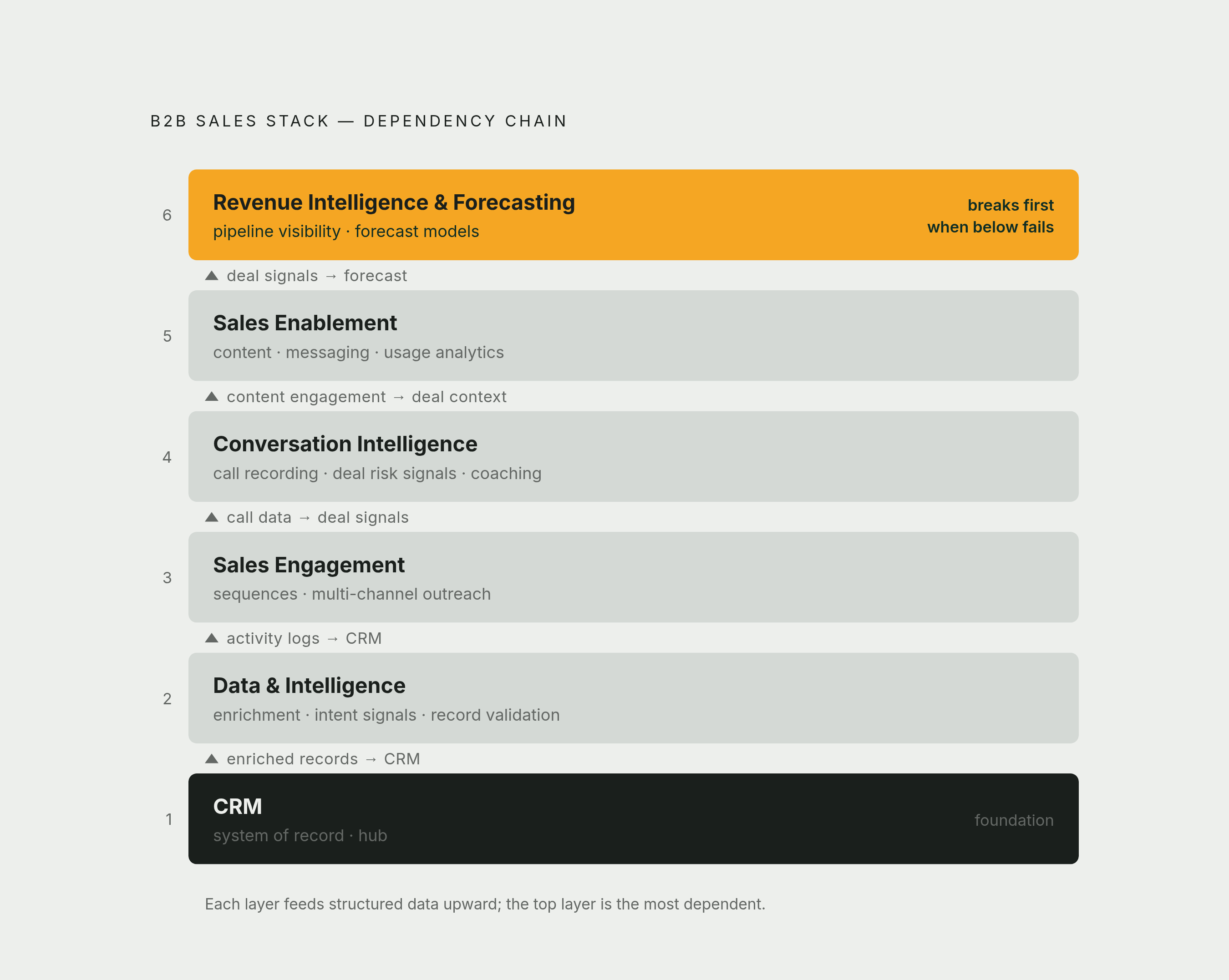
This is the layer where leadership evaluates whether the stack is working. Which creates a specific problem worth sitting with.
Revenue intelligence tools like Clari, InsightSquared, and Aviso aggregate data from across the stack. CRM records, engagement activity, conversation signals, content usage, deal stage velocity. They build models on top of that unified picture to give leadership pipeline visibility and forecast accuracy. When they work, deal risk surfaces early, pipeline gaps are visible before end of quarter, and managers coach on patterns instead of chasing status updates in one-on-ones.
But this layer is only as good as the data feeding it. If the engagement platform is not writing activity back to the CRM, the forecasting model does not know those touches happened. If the conversation intelligence layer is failing to surface risk signals, the forecast cannot account for them. If enrichment is not flowing in automatically, the model is working with stale account information. The forecasting layer is the most visible layer and the most dependent on every layer below it being functional.
A large share of RevOps professionals rated their stack ROI as average or worse in 2025 State of RevOps research, with poor integration as the leading reason. That number lands differently when you consider what leadership is actually looking at. They are looking at the forecasting output. And the forecasting output is the thing most damaged by disconnection happening quietly three layers down. The problem started in the plumbing. It shows up in the numbers.
A disconnected stack does not look broken when you are buying the tools. It looks broken when you are trying to call the quarter.
How data actually flows: the integration patterns that connect the layers
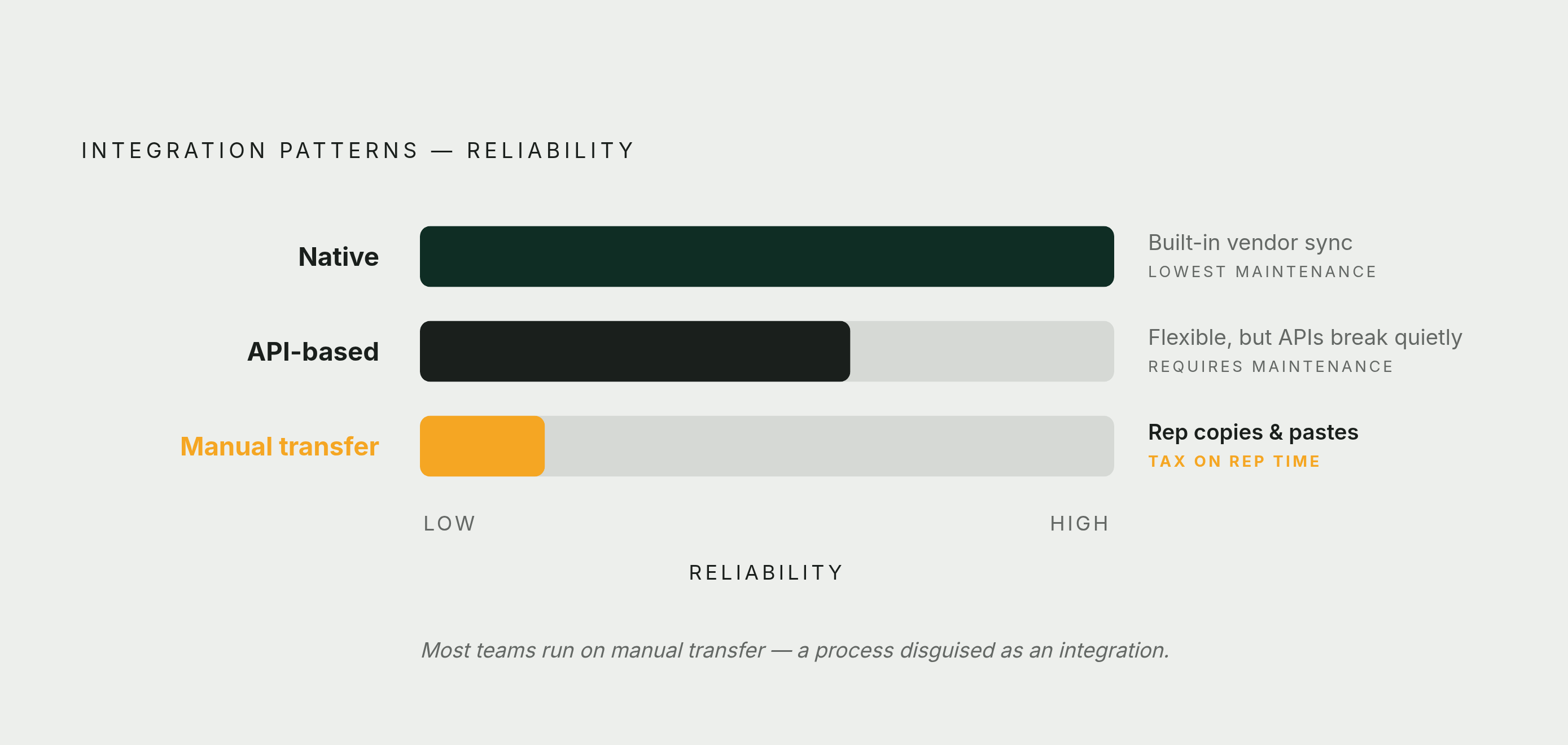
Not all integrations are equal. Three patterns worth knowing, because they carry very different levels of reliability and maintenance burden.
Native integration is when tool A and tool B are built to sync directly, often by the same vendor or through a certified partnership. Highest reliability, least configuration, lowest ongoing maintenance. If you can get native, you want native.
API-based integration is when tools connect via documented APIs, sometimes with middleware like Zapier in between, or a custom-built connector. Flexible, but it requires someone to maintain it. APIs change. Vendors update their platforms. What works in January sometimes breaks quietly in March, and nobody notices until a deal slips through a gap.
Manual transfer is a rep copying data from one tool and pasting it into another. This is not an integration. It is a tax on rep time dressed up as a process.
The CRM-as-hub model means every other layer needs a defined write-back path. Engagement activity. Enrichment updates. Conversation signals. Signed documents. Forecast inputs. If a tool cannot write back to the CRM automatically, that is either a gap worth fixing or a purchase decision worth reconsidering before it becomes someone else's problem to maintain indefinitely.
A pile of best-of-breed tools connected by human effort is not a stack. It is an architecture that has been quietly replaced by goodwill and overtime. Data silos were the top concern for a majority of respondents in DATAVERSITY's 2024 Trends in Data Management survey, an increase from the prior year. That number has been going up, not down, which says something about how the problem is scaling even as more integration tooling becomes available.
The practical test for any new tool: does it have a bidirectional sync with your CRM, or does it require a human in the middle? The integration point is the value. The feature set in isolation is not.
Where stack complexity becomes a barrier rather than an advantage
Everything above is an argument for integration. For thoughtful architecture. For layers that actually talk to each other. But there is a version of this that goes sideways, and it is worth being direct about it.
Integration complexity and high costs affect nearly 35% of potential users and are among the leading reasons for slow adoption, particularly among smaller teams (Business Research Insights). The very thing that makes a stack powerful — deep integration across multiple layers — is also one of the primary reasons teams do not actually use it. That tension does not resolve itself just because you buy better tools.
The complexity of your stack should match the operational maturity of your team. A six-layer architecture with bidirectional syncs, middleware connectors, and a revenue intelligence platform on top is quite powerful. It is also quite complex to maintain. If your team does not have someone who owns the architecture — who monitors the integrations, who catches it when something breaks quietly in the background — then all of that complexity produces the opposite of clarity. It produces noise that nobody has time to untangle.
For a lot of teams, especially earlier-stage ones, the honest answer is to simplify. Pick a platform that covers multiple layers natively. Accept some trade-offs in feature depth in exchange for coherence. A stack that works is better than a stack that is theoretically superior but falling apart at the seams.
The architecture becomes self-defeating when the overhead of managing it exceeds the productivity it creates. When reps are troubleshooting integrations instead of selling. When the RevOps team is doing data hygiene full-time instead of analysis.
The goal was never to have the most sophisticated stack. The goal was to give reps the right information at the right moment with as little friction as possible. Sometimes that is fourteen tools connected thoughtfully. Sometimes it is four tools that just work and nobody has to think about. The architecture is in service of that outcome. When it stops serving it, that is worth noticing before the quarter does the noticing for you.