Sales Engagement Platforms and CRM Integration Depth
Deep integration between sales tools is the difference between saving reps time and wasting it.
There is a version of this story where a sales team buys a Sales Engagement Platform, connects it to their CRM, and everyone's life gets measurably easier. Reps spend more time selling. Managers get cleaner pipeline data. Leadership finally trusts the forecast.
That version exists. It just isn't the version most teams are living.
The more common version looks like this: two systems, both technically "connected," neither fully trusted, and a rep who's learned to update both manually just to make sure nothing falls through the cracks. Which defeats the entire point.
Here's what's actually going on.
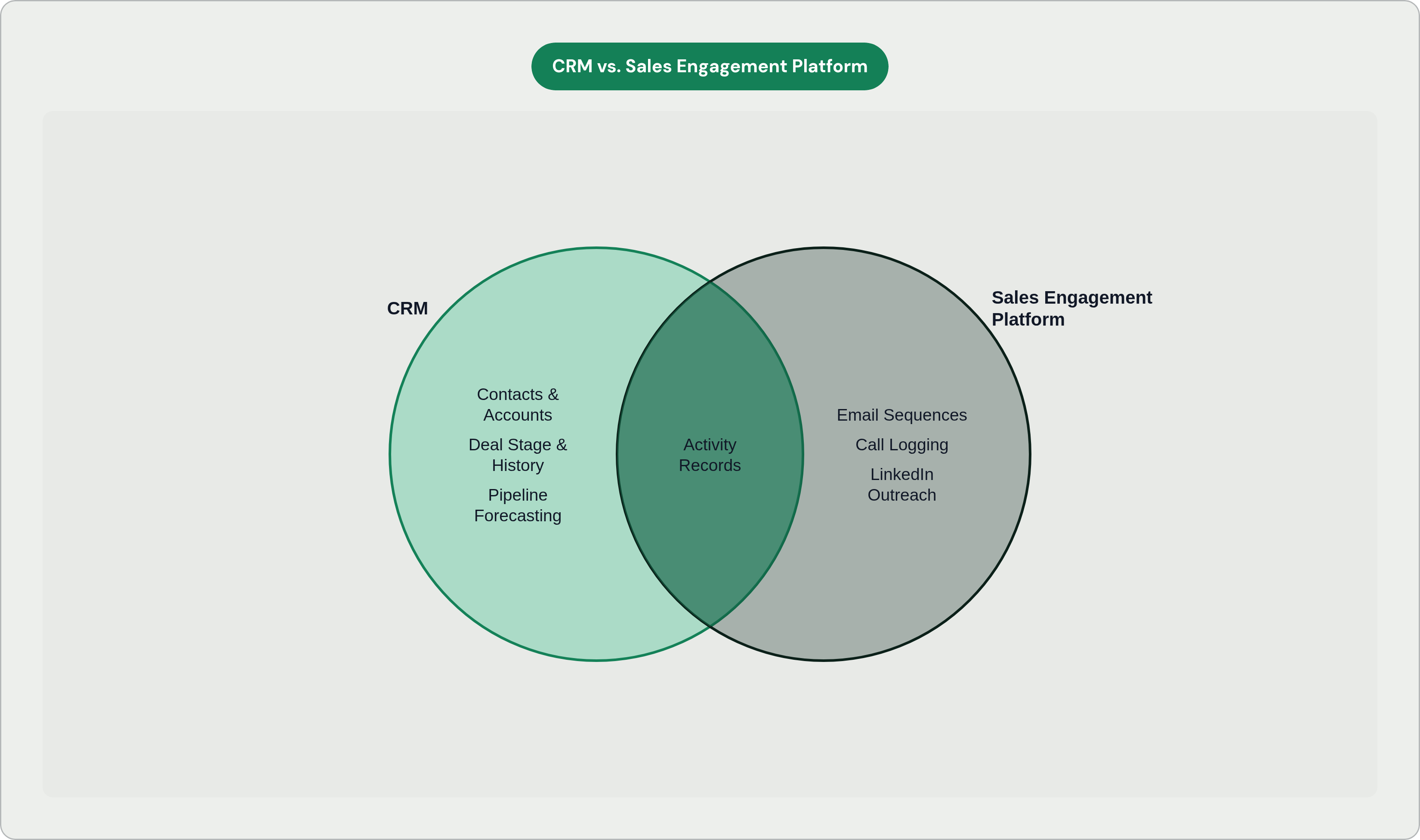
A CRM is a record system. It stores contacts, accounts, deals, and history. A Sales Engagement Platform (SEP) is an execution system. It runs sequences, tracks email opens, logs calls, and coordinates outreach across email, phone, and LinkedIn. These are different jobs. Neither tool replaces the other.
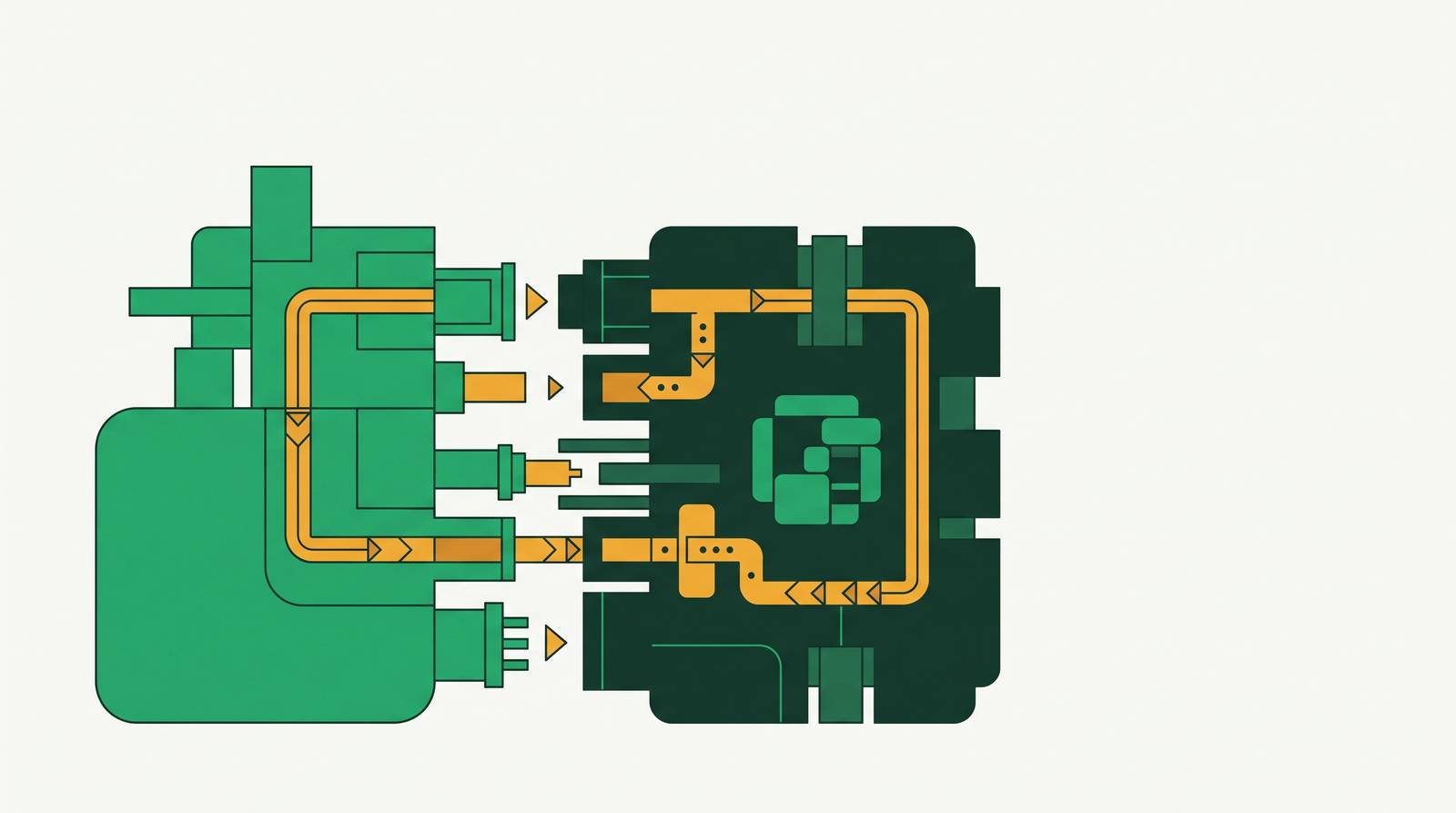
But where they meet is everything. Every action the SEP takes (a sent email, a completed call, a sequence step advancing) should write back to the CRM record automatically. When that handoff works, you have one living picture of each deal. When it doesn't, you have two partial pictures, and someone has to manually reconcile them. Think of it like two photographers shooting the same wedding from opposite ends of the room — unless they share their photos, nobody gets the full day.
That reconciliation is where the frustration lives.
CRM integration has become the largest product segment in the U.S. SEP market, accounting for roughly 45% of demand in 2024. The market itself is telling you: integration isn't a secondary feature. It's the whole bet.
Why nearly every sales team now has a SEP, and why many are still frustrated
Almost three-quarters of sales teams are already using sales engagement technology. This isn't early adoption. It's mainstream. And Gartner data shows that 90% of sales leaders plan to keep investing in these platforms. Nobody's pulling back.
The reported upside is real, too. Companies adopting SEPs report meaningful increases in productivity and revenue growth. So the frustration isn't about whether these tools work. It's about why, for so many teams, they aren't working as advertised.
Here's a number worth sitting with: over 70% of managers say their CRM does not effectively support their needs. CRM project failure rates range from 20% to 70%, with poor user adoption as the leading cause. And one of the primary drivers of that poor adoption? Lack of integration with other tools.
So the SEP market is growing. CRM satisfaction is low. And integration is the cited culprit.
That raises an important question. If SEPs are this widely adopted, why does the frustration persist? The honest answer is that adoption of a platform is not the same as functional integration. Many teams have a SEP that touches their CRM. Very few have one that's deeply connected to it. And that difference is not semantic — it's the difference between a bridge and a painted line on the floor.
The tiers of integration depth, from surface sync to true bidirectional connection
Not all integrations are the same. This is the part that doesn't show up clearly in demos.
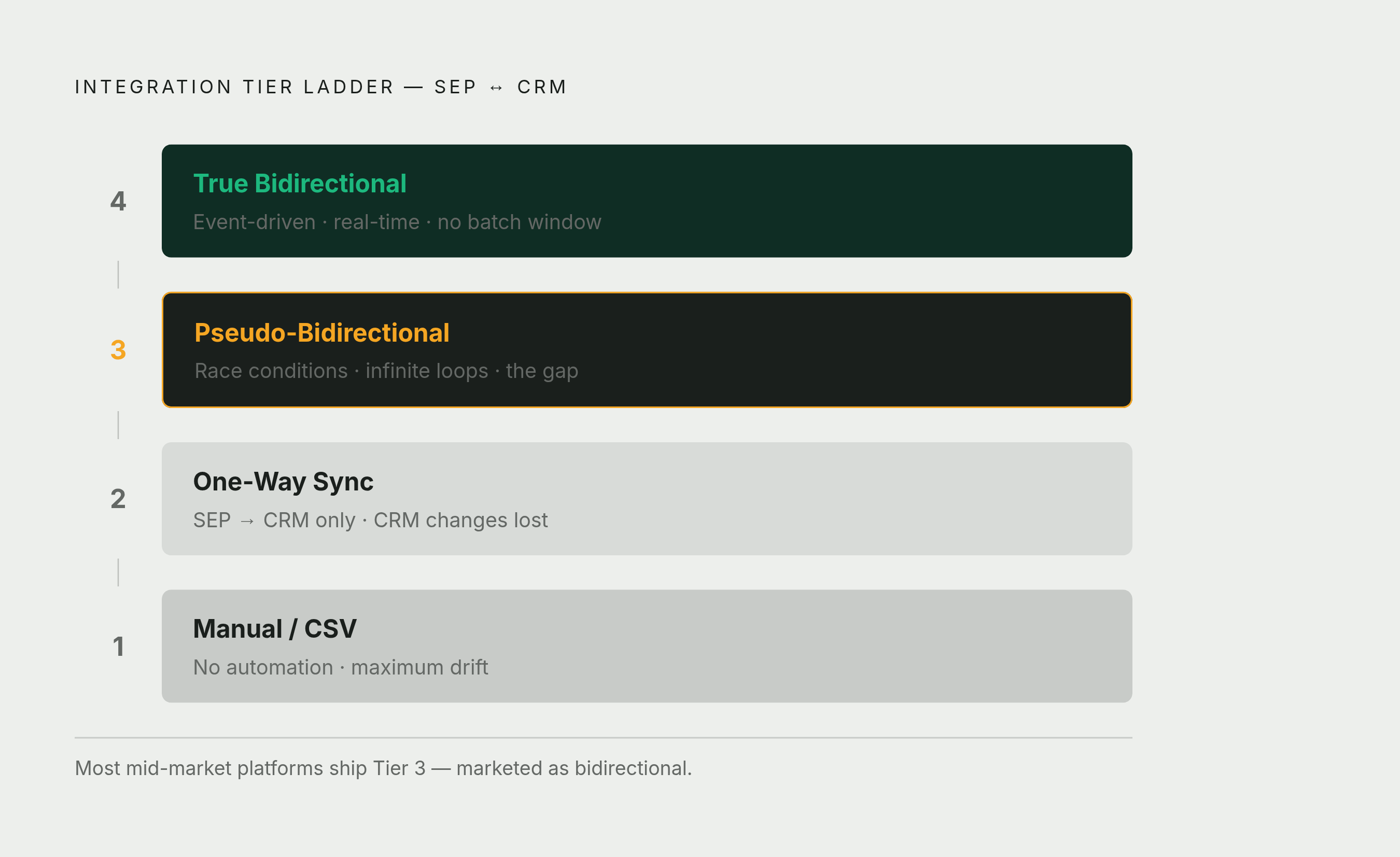
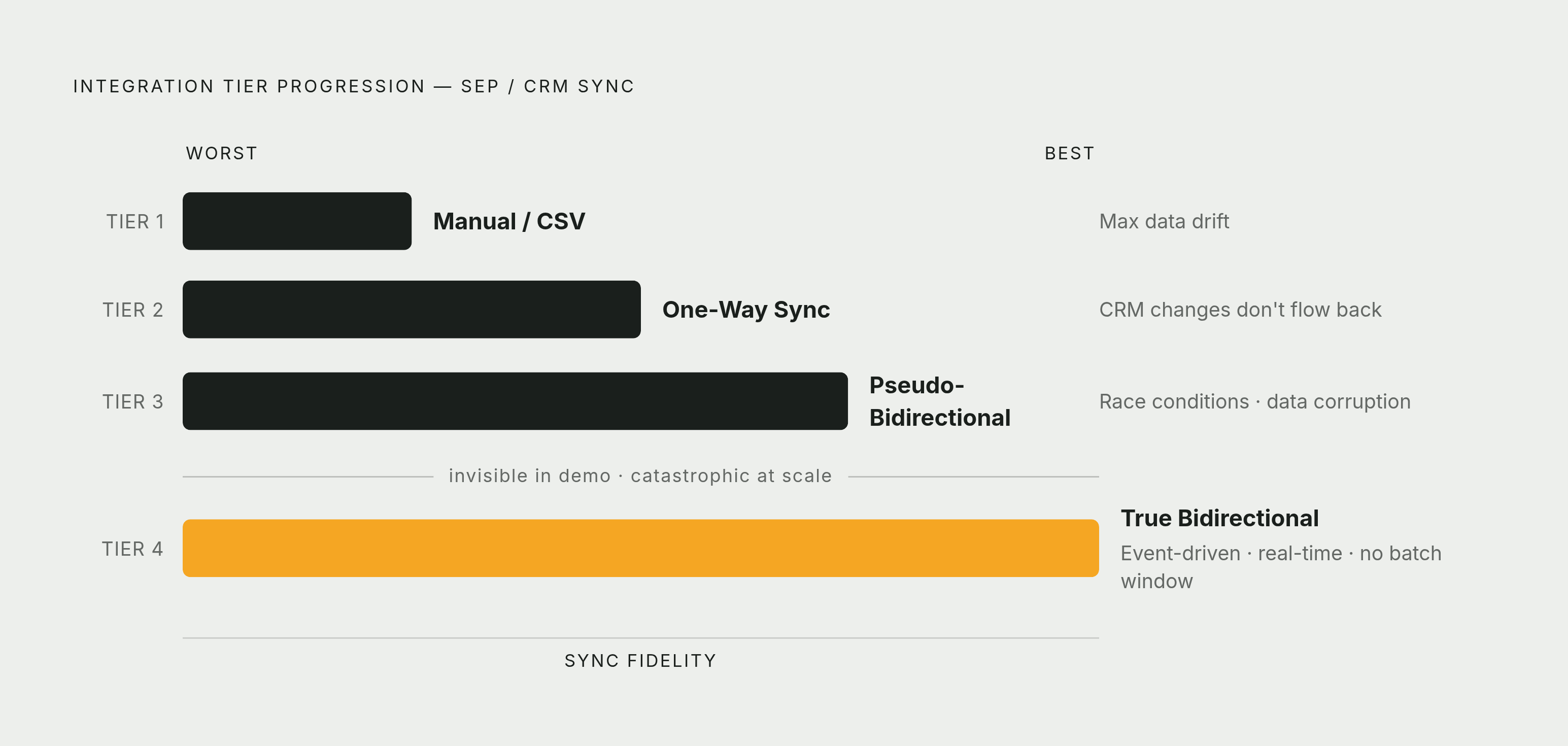
There are four meaningfully different tiers.
Tier 1 is manual or CSV export/import. A rep copies data between systems. No automation. Maximum drift. This is the worst-case scenario, and it still exists more than vendors would like to admit.
Tier 2 is one-way sync. Activities log out from the SEP to the CRM, but CRM updates don't flow back. You end up with a one-sided record. The SEP knows what happened in outreach. The CRM doesn't know the deal stage changed.
Tier 3 is what many platforms market as "bidirectional" but isn't, architecturally speaking. It's two separate one-way syncs running in parallel. This approach is prone to race conditions, data corruption, and what engineers call infinite loops, where both systems keep updating each other in response to the other's updates. It's common in mid-market platforms and looks fine at low data volumes. It surfaces badly when pipeline complexity grows.
Tier 4 is true bidirectional, event-driven sync. Changes propagate in real time the moment they occur. A CRM stage change triggers the next sequence step in the SEP. A completed call in the SEP instantly writes to the CRM opportunity record. No batch window. No latency gap where two systems hold conflicting versions of the same deal.
For most outbound teams, a sync interval of 15 minutes or less is considered the practical threshold for operational reliability. Anything longer starts creating meaningful windows where reps act on stale data.
The distinction between Tier 3 and Tier 4 is invisible in a sales demo. It becomes very visible when your pipeline doubles.
What happens to reps' time when integration is shallow
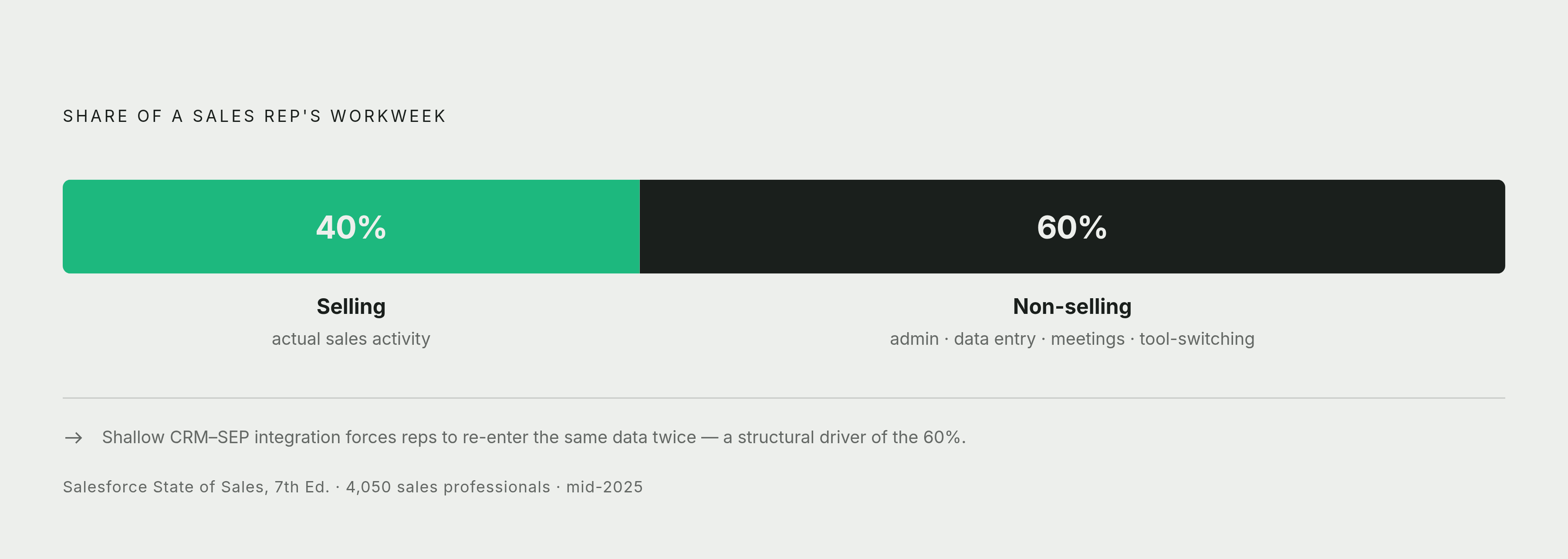
Salesforce's State of Sales (7th Edition, a survey of 4,050 sales professionals conducted in mid-2025) found that reps spend only 40% of the average workweek actually selling. The other 60% goes to administrative tasks, data entry, internal meetings, and tool-switching.
Shallow integration is a structural driver of that 60%. When the SEP doesn't write back reliably, reps re-enter the same information in two places. Not because they're inefficient. Because the alternative is a CRM record that doesn't reflect reality, which eventually bites someone in a forecast call.
Without deep sync, reps are maintaining two systems of record:
- The SEP has the outreach history.
- The CRM has the deal context.
- Neither has the full picture without manual reconciliation.
And here's the part that should bother sales leaders most. The administrative tax isn't evenly distributed. It falls hardest on the reps working the most active sequences and the largest pipelines. Exactly the people who can least afford to spend an hour a day on data entry. You could say those reps aren't just doing their job — they're doing two jobs, and neither one particularly well.
82% of revenue leaders agree that a unified tool for sales and marketing significantly improves revenue outcomes. Most teams are still patching together separate tools, creating data gaps at every handoff. The aspiration is shared. The architecture often isn't.
The CRM data quality problem that shallow integration makes worse
A 2025 study by Validity surveyed 602 CRM users across the U.S., U.K., and Australia and found that 76% of organizations say less than half of their CRM data is accurate and complete.
Let that sit for a second. Half. Less than half.
And it gets more direct: 37% of CRM users in that survey reported losing revenue as a direct consequence of poor data quality. Companies lose an average of 16 sales deals per quarter from bad CRM data. Per Gartner, poor data quality costs organizations an average of $12.9 million per year.
But here's the less-discussed reason the data gets that bad. It's not just that people forget to update fields. It's that the CRM becomes so unreliable that frontline users start entering plausible-looking entries rather than accurate ones. They put something in the field because the field is required, not because the entry is true.
And B2B contact data decays at 25% to 34% per year as people change roles and companies restructure. Even a well-maintained CRM degrades without active effort.
The shallow integration loop looks like this:
- Reps skip manual CRM updates because it's tedious.
- Stale fields cause sequences to target wrong contacts or wrong stages.
- Wrong outreach erodes confidence in the CRM.
- Reps update it even less.
Deep integration interrupts this loop by removing the manual step. But only if the sync covers the fields that actually matter. Not just contact name and email. The deal stage. The qualification criteria. The stakeholder roles. The fields that actually drive decisions.
How the major platforms compare on integration depth in practice
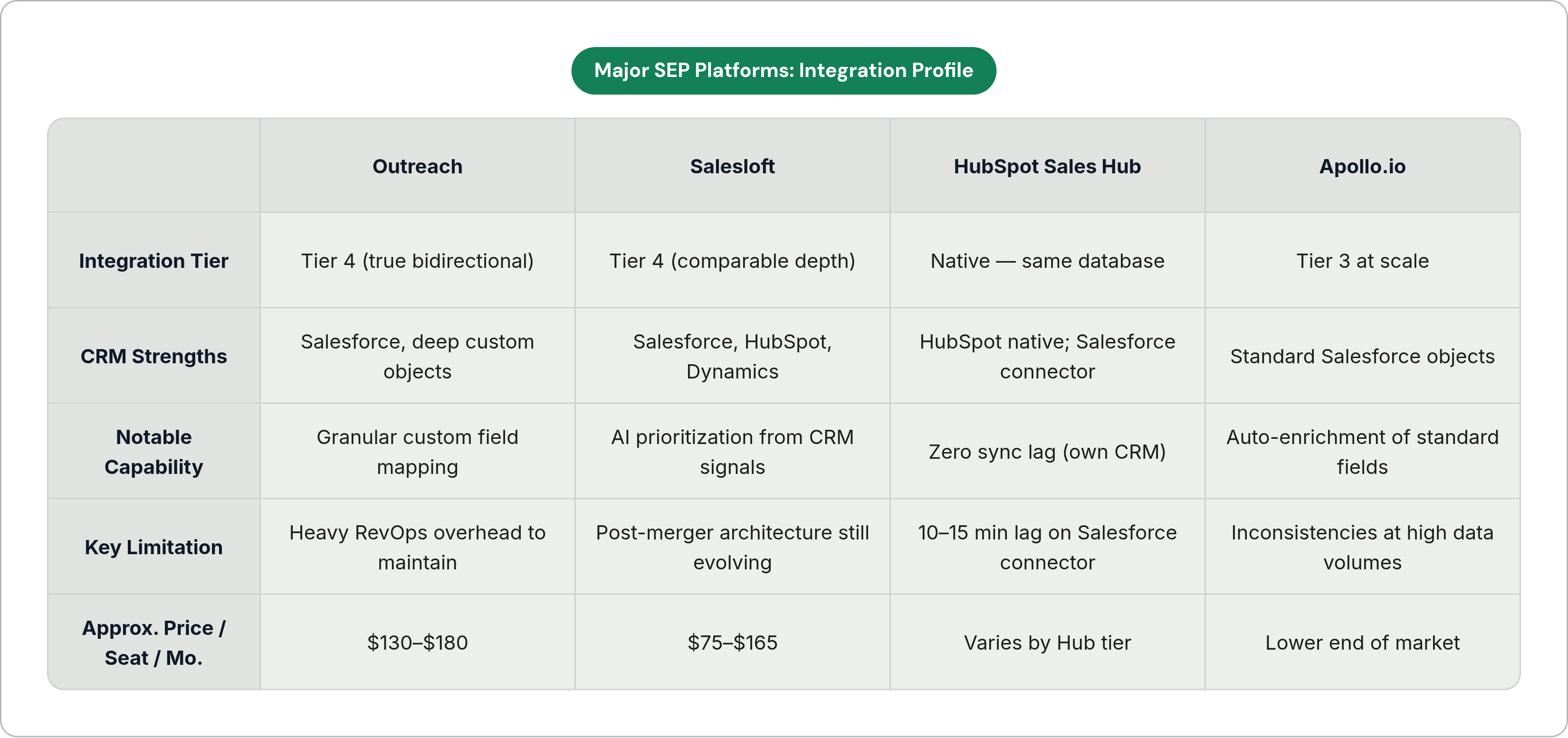
It's worth walking through the major players here because the differences are real and consequential.
Outreach
Outreach's Salesforce integration is widely regarded as the most mature in the category. True bidirectional, real-time sync with granular custom field mapping and custom object support. Implementation typically takes four to eight weeks with a dedicated admin.
That last sentence is important. Without a RevOps resource managing it, sequences fall out of date, the sync breaks, and duplicate sequences accumulate. The integration depth is real. So is the operational overhead required to maintain it. Pricing runs roughly $130 to $180 per seat per month.
Salesloft
Comparable depth to Outreach on Salesforce and HubSpot. Added Microsoft Dynamics support in 2024, which makes it the stronger choice for enterprise teams on the Microsoft stack.
Their "Rhythm" AI prioritization feature pulls signals from CRM deal data to surface which prospects to contact next. That's an example of deep integration enabling a feature that shallow sync literally cannot support. The AI needs clean, current deal data to make useful recommendations. If the CRM record is stale, the AI output is useless.
Salesloft's late 2025 merger with Clari created a combined entity with over 5,000 customers and approximately $450 million in ARR. Worth watching how that architectural consolidation plays out. Pricing is roughly $75 to $165 per user per month.
HubSpot Sales Hub
The native-integration edge case. For teams running HubSpot CRM, there are zero sync issues because the SEP and CRM share the same database. No field mapping, no lag, no duplicate records. It's a different architectural category entirely.
For Salesforce users, HubSpot offers a guided bidirectional connector with sync intervals typically every 10 to 15 minutes rather than real-time. Functional, but not in the same tier as Outreach's Salesforce integration. This illustrates a key principle: native integration isn't just a better third-party connector. It's a fundamentally different architecture.
Apollo.io
A lighter integration profile. The native Salesforce integration focuses on contact and lead sync and auto-enrichment of CRM fields like job titles, company size, and tech stack. Handles basic bidirectional sync. Custom object support is limited and works best on standard Salesforce objects without heavy customization.
Users report sync lag and inconsistencies at higher data volumes. At scale, this profiles as Tier 3 behavior despite the Tier 4 marketing.
The honest caveat
None of these platforms fully solve CRM data hygiene. Outreach and Salesloft both log engagement activity well. But deal stage, qualification criteria, next steps, and stakeholder roles still depend on reps updating them manually. And 70% of companies struggle to integrate sales plays into CRM and revenue technologies, with only about 20% reporting they've realized full value.
Even best-in-class platforms don't eliminate this problem entirely. They narrow it.
The security exposure that deeper integration introduces
Here's the part of the conversation that tends to get skipped until something goes wrong.
Deeper integration means broader credential access. A connected SEP typically holds OAuth tokens that can read and write across the entire CRM instance. 2025 OAuth token incidents involving CRM-connected platforms demonstrated that compromised integration credentials can expose entire CRM instances to unauthorized access.
The same architecture that enables real-time bidirectional sync also widens the attack surface if not governed carefully.
Token governance becomes a front-line concern, not an IT afterthought. That means knowing who holds credentials, what scope they carry, how they're rotated, and what happens when a vendor has a breach.
Before deploying, teams should be asking:
- What CRM permissions does this integration require, and are they scoped to the minimum necessary access?
- How are OAuth tokens stored and rotated?
- What is the vendor's breach notification and token revocation process?
Security exposure scales with integration depth. That's not an argument against deep integration. It's an argument for going into it with eyes open.
What deep integration actually enables when it works correctly
At true bidirectional depth, the integration stops being a logging mechanism and starts being an operational layer.
Concretely:
- A CRM stage change automatically triggers the next sequence step. No rep action required.
- A new contact added in CRM automatically enrolls in the correct follow-up sequence.
- Activity data from the SEP feeds pipeline forecasting without manual entry.
This is also where AI features live or die. Gartner's 2025 Hype Cycle for Sales Transformation named AI agents for sales among the most critical technologies, but noted that those agents need clean CRM access, metadata, and accurate permissions to function reliably. Bad integration produces bad AI output. A system that learns deal context and rep tone can only do so if the CRM record it reads is accurate and current.
Deep integration is the prerequisite for context-aware automation. Not a nice-to-have layered on top of it.
A meaningful portion of U.S. sales teams using engagement platforms are reporting improved pipeline visibility from engagement analytics. Those gains come from data that flows. Teams with shallow integration are operating in the same market, using the same platforms, and not getting the same result. The technology isn't the differentiator. The architecture is.
The administrative burden question ultimately resolves here. The platforms that genuinely reduce rep admin work are the ones where the integration handles what reps would otherwise do manually. Not the ones that simply add another interface to check.
What to evaluate before choosing or upgrading a SEP integration
The key questions are not about feature lists. They're about architecture and operational fit.
Sync architecture
- Is the sync event-driven or batch-based? What is the actual sync interval under normal load, not demo conditions?
- How does the platform handle conflicts when both systems update the same field simultaneously? (Ask for a specific answer. Vague answers here are a signal.)
Field and object coverage
- Does the sync cover custom fields and custom objects, or only standard CRM objects?
- Which fields still require manual rep input? What is the plan for keeping those accurate?
Operational overhead
- Outreach's four-to-eight-week implementation benchmark with a dedicated admin is a useful reference point. What internal resource does maintaining the integration require on an ongoing basis?
- What breaks when a CRM schema changes, and who owns the fix?
Data quality posture
- Does the platform enrich or validate CRM data, or does it only move data that already exists?
- How does it handle decayed or duplicate records?
Security governance
- What OAuth scopes does the integration require?
- What is the token revocation and breach response process?
One might argue that the best SEP is the one with the best sequencing features, the best email templates, or the best call coaching. And those things matter. But the integration tier a team chooses determines whether the SEP becomes a force multiplier on their CRM or a parallel system their reps have to maintain by hand.
The evaluation criteria above are how to tell the difference before signing the contract, not after living with the consequences.