Agentic AI Use Cases in Enterprise Sales Operations
Software now does the multi-system work that consumes most of a rep's week.
Agentic AI showed up in my LinkedIn feed about eighteen months ago, and I did what most sales ops people did: rolled my eyes and assumed it was chatbots wearing a nicer suit. I was wrong, and the data agrees with me being wrong, which is a strange sentence to type.
Here's what's actually happening. Software now qualifies leads, logs calls, drafts follow-ups, and updates forecasts on its own, inside the systems reps already use every day. Not a smarter assistant. Something closer to a quiet employee who never sleeps and never complains about Salesforce.
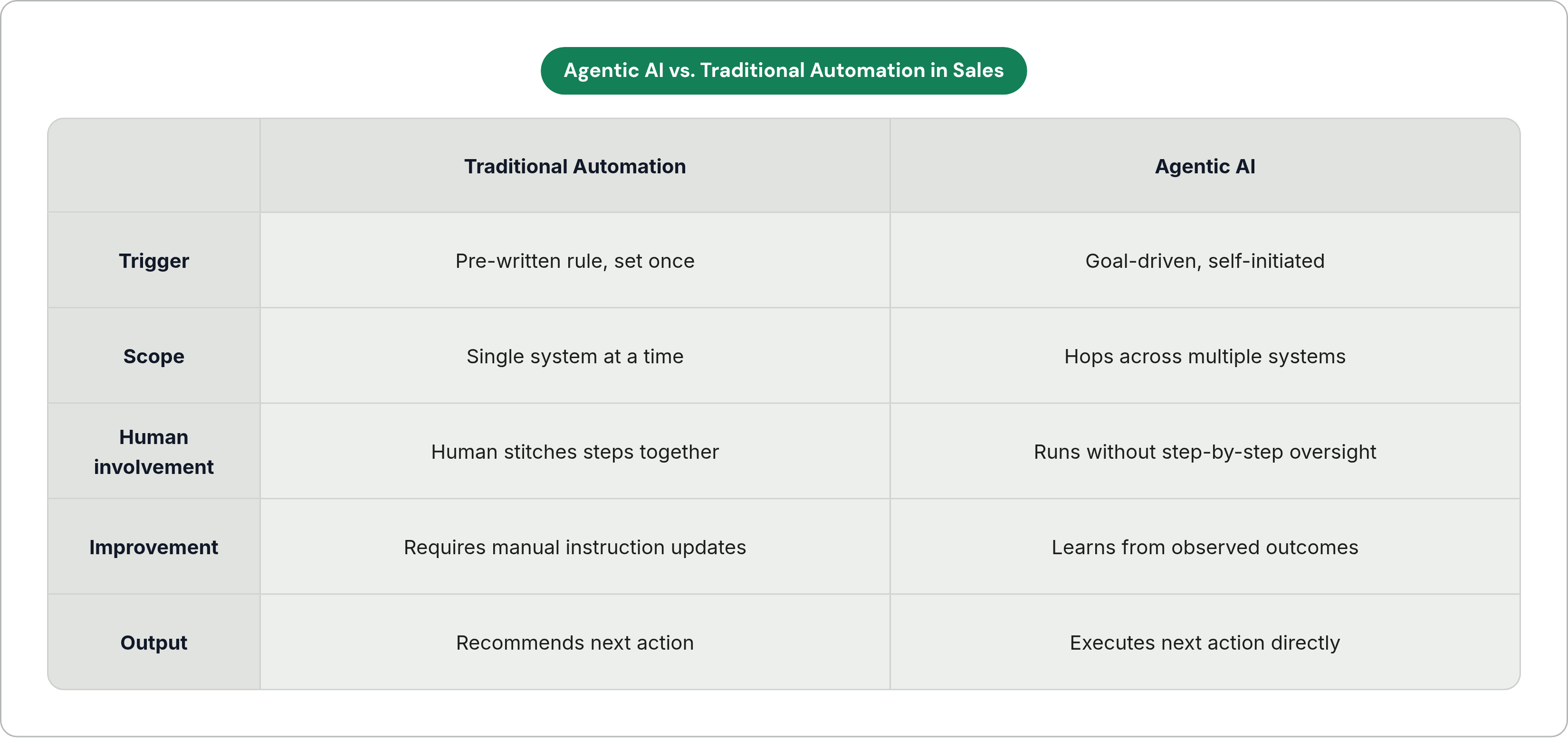
Four things make this generation different from the last one. It runs without a human babysitting every step. It chases a goal instead of waiting for a prompt. It breaks a big job into smaller steps and actually plans them. And it improves from watching what happens, not from someone retyping instructions.
Old AI told you what to do next. This one just does it. Sends the follow-up. Logs the call. Routes the lead. Updates the forecast. No approval screen in between.
Why does sales ops feel this more than, say, finance or HR? Because a single deal touches six systems before lunch: the CRM, email, a calendar, a CPQ tool, a contract, and probably a Slack thread where someone's asking "did we hear back from them?" Old automation worked inside one system at a time, triggered by a rule someone wrote down once and forgot about. It couldn't hop between tools without a person stitching the steps together by hand. This is the first version of AI that can do the stitching itself. Everything below is really just different angles on that one fact.
How fast enterprise adoption is actually moving
Here's a number worth sitting with: Jeeva AI's 2026 Agentic AI Sales Benchmark Report looked at 847 B2B companies and found 37% of them deployed agentic systems in the past 12 months alone. The two years before that, combined? 8%.
That's not a trend line. That's a cliff.
Gartner backs this up from a different angle. In 2024, less than 1% of enterprise software had agentic capability baked in. By 2028, Gartner expects that number at 33%. And by the end of 2026, they're projecting 40% of enterprise applications will include some kind of task-specific agent.
Landbase found 79% of organizations already report some level of agentic AI adoption, and 96% of those plan to expand it in 2025. Money's moving too: PwC surveyed 300 senior executives in May 2025, and 88% said they're increasing AI budgets over the next year specifically because of agentic AI, not AI in general.
I'll admit the easy move here is to say "everyone's doing it, moving on." But the more honest comparison is 8% versus 37%. That's not saturation, it's a switch flipping. Which means the use cases coming up aren't hypothetical. They're running in production right now, at companies with quarterly numbers to hit.
The administrative tax that agentic AI is built to eliminate
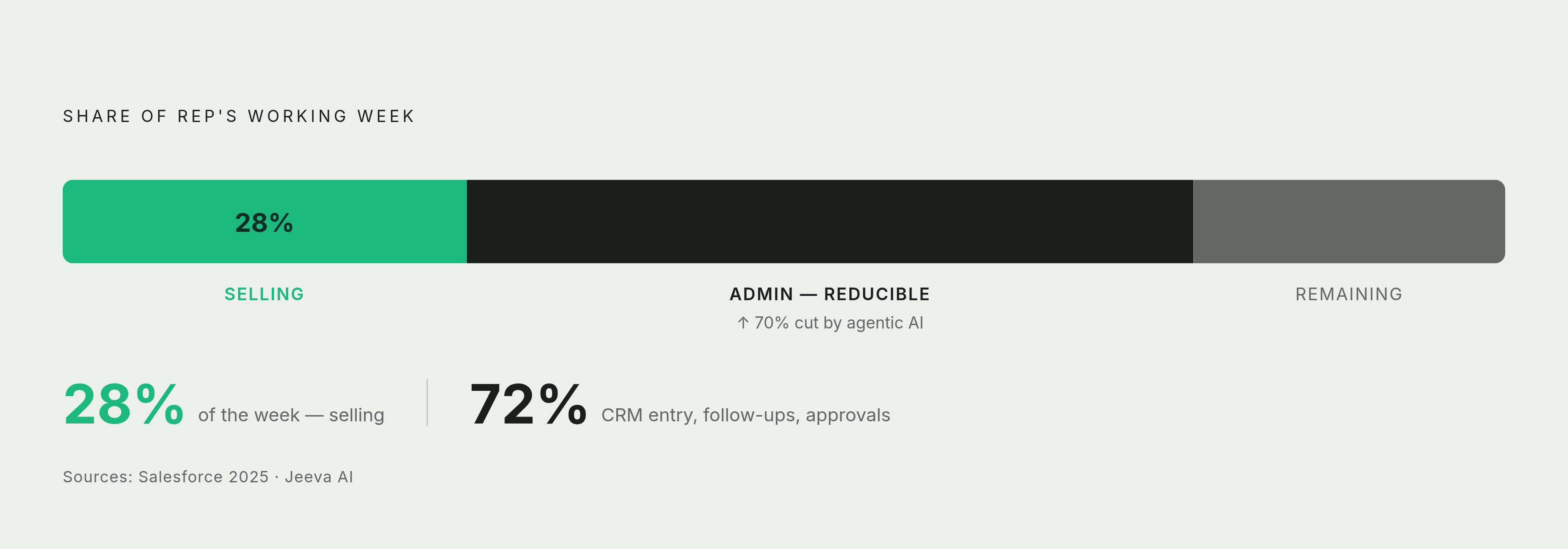
Salesforce's 2025 research found a large share of sales professionals spend 10 to 20 hours a week on admin work. Reps spend only 28% of their week actually selling.
Sit with that for a second. Less than a third of the job is the job.
Where do those hours actually go?
- Manual CRM entry after every call and email
- Updating stages, setting reminders, logging next steps
- Writing follow-ups from memory, hours after the call ended
- Chasing approvals across systems that don't talk to each other
It gets worse than wasted time, too. Teamgate's 2025 research found 37% of CRM users report real revenue loss tied to bad data quality. A rep rushing to log a call at 6pm on a Friday isn't just annoyed, they're quietly poisoning the forecast that goes to the board next month.
So here's the setup, and it's almost too neat: the exact tasks reps hate most (logging, updating, chasing follow-ups) are multi-step, multi-system tasks. Which happens to be precisely what agentic AI is good at. Jeeva AI's research found CRM-based agentic AI cuts manual admin work by up to 70%. That's not a nudge. That's most of a rep's week, handed back to them.
Autonomous lead qualification: the first workflow where agentic AI replaces a process, not just a task
Old-school qualification leaned on two shaky legs: a rep manually chasing every inbound lead, and a scoring model built on surface signals like whitepaper downloads or webinar attendance. Neither one tells you whether someone's actually ready to buy. A downloaded whitepaper means someone was bored at their desk, not that they have budget.
Agentic AI looks at different things: decision authority, a real defined need, realistic timing, and behavior patterns pulled together across multiple touchpoints. It's not smarter guessing. It's more inputs, stitched together automatically.
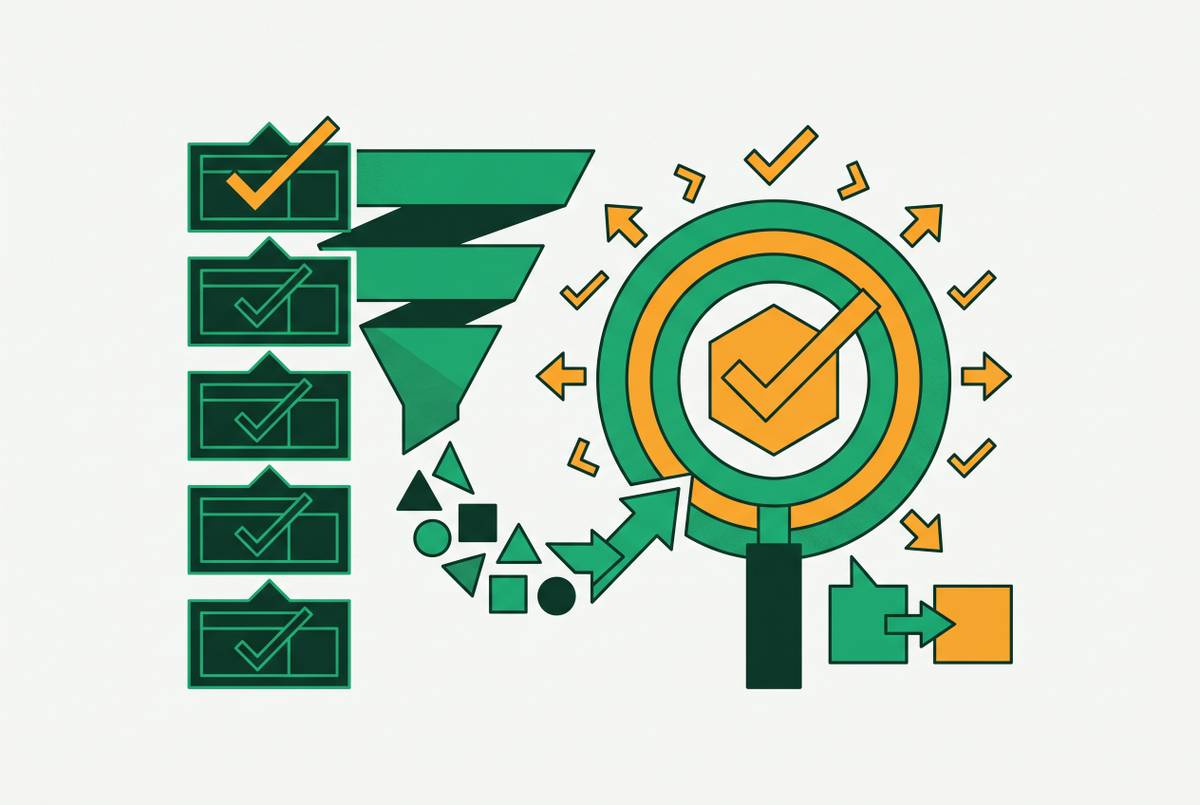
Here's what that workflow looks like in practice:
- Reaches out to the lead at first touch
- Asks qualifying questions and captures the answers
- Scores intent against defined criteria
- Updates the CRM with structured, usable data
- Routes the qualified lead to the right rep
No human kicks off any single step. That's the part worth pausing on: it's not a faster version of the old process, it's a different process.
Speed matters more than most people assume. Velocify analyzed millions of leads and found calling within one minute of inquiry increases conversion by 391%. Most companies take hours. Agentic voice and messaging agents close that gap because they don't have back-to-back meetings, they just respond.
Gartner projects organizations using agentic AI in sales see a 30% improvement in lead qualification efficiency versus teams still doing it the old way. Salesforce's research shows teams using conversation intelligence in qualification land meaningfully higher win rates than teams relying on scoring alone.
What actually changes here is the shape of the work, not just the speed of it. Qualification stops being a task wedged between other tasks. It becomes something running in the background, all the time, whether or not a rep is looking at it.
CRM logging and follow-up as a continuous automated loop, not a post-call chore
Every call produces two things: data, and things you're supposed to do next. Agentic AI closes the loop on both without waiting for a rep to find twenty free minutes.
Here's the sequence: call ends, AI logs the summary, updates the stage, drafts the follow-up, schedules the next touch. All inside the CRM and inbox the rep already lives in.
That last part matters more than it sounds like it should. If a tool asks reps to switch platforms or re-explain context they already gave somewhere else, it's dead on arrival. The value only exists if the AI works inside Salesforce, HubSpot, and the inbox, not off to the side of them.
What does "learning context" mean, really? The agent reads the deal history. It picks up the rep's tone from past emails. It checks the current stage. Then it drafts a follow-up that sounds like it came from that rep, about that specific deal, without anyone prompting it fresh each time. That's the line between a bolted-on AI feature and something that functions like an actual extension of the rep.
Nextstep is a decent example of this in the wild. It drafts replies, logs CRM updates, books next steps, and runs alongside the inbox and CRM instead of replacing either one. It plugs into Salesforce and HubSpot without asking reps to learn a new tool or master prompt engineering (which, let's be honest, most reps have zero interest in doing).
The payoff on the ops side is clean, consistent CRM data, whether or not a given rep had the energy to log things properly after a long day. Adoption backs this up: Moveworks' 2025 research found 92% of sales agents now use AI in their process, and they rank it as the best-ROI tool in their entire stack. We're well past early-adopter territory here.
Pipeline forecasting when the underlying data is finally trustworthy
Forecasting has always been part math, part gut feeling dressed up as math. Judgment-based forecasting, built on stage probabilities and rep optimism, hovers around coin-flip accuracy on a good day. Industry benchmarks show more than 55% of sales leaders miss quarterly targets because of bad projections built on stale CRM data. That's a coin flip, with the board watching.
Agentic AI reads a different set of signals than "what stage did the rep say this is in":
- How fast the prospect responds to email and calls
- Whether they've actually opened the proposal
- Who's newly showing up on their side (a decision-maker suddenly on the thread, for instance)
- Competitor mentions buried in call transcripts
Here's the catch, though, and it's a real one: none of this works without complete, current CRM data. Which only exists if the logging loop from the last section is actually running. Forecasting depends on qualification and logging, it doesn't stand apart from them. That's why these aren't three separate features on a slide, they're a sequence.
When the sequence works, the numbers move. Outreach.ai's research found forecast accuracy improves by up to 47% when agentic AI is embedded into core workflows. Jeeva AI's benchmark data found agent-led systems recover 40% or more in additional pipeline, by combining higher engagement volume with better timing on dormant accounts. That dataset covers hundreds of thousands of opportunities and billions in pipeline value across B2B companies through 2025.
For a sales ops leader, this is the section where the work upstream finally becomes visible to people with budget authority. Qualification and logging are where the labor happens. Forecasting is where someone notices.
What the early enterprise deployments show about where agentic AI actually delivers
A benchmark report is useful. An actual company running an actual pilot is more convincing.
Sandvik Coromant piloted Microsoft Dynamics 365's Sales Qualification Agent. In the first three weeks, they saved more than 120 hours and $19,000. Full rollout is projected to add 5% in revenue. That's a qualification use case with real numbers, not a projection built on hope.
Salesforce's own legal-ops team put an AI agent to work drafting, redlining, and analyzing contracts on its own. Result: more than $5 million cut from outside counsel spend. Worth pausing on this one, it's not tidy CRM fields, it's messy legal documents. Which tells you the approach isn't limited to neat database rows.
Klarna's case sits next door to sales, in customer service, but it's worth including anyway. Resolution time dropped from 11 minutes to under 2, across 23 markets and 35-plus languages. Repeat inquiries fell 25%. They saved $60 million and replaced work equivalent to 853 full-time agents.
Then they brought humans back for the complicated, emotionally loaded stuff. And the hybrid model outperformed the fully automated one on total output. Which tells you something worth remembering: full replacement was never the goal. The real work is finding where the agent should stop and a person should start.
Zoom out and the pattern holds across the board. Landbase reports an average ROI of 171% from agentic AI, with U.S. enterprises averaging 192%, roughly three times what traditional automation delivers. Google Cloud's 2025 ROI of AI Report found 74% of organizations deploying AI agents hit ROI within the first year, and 39% have already deployed more than 10 agents across the business.
What do all these cases share? The biggest returns show up in work that's high-volume, repetitive, and spread across multiple systems. Which, if you've been reading this whole time, sounds an awful lot like enterprise sales ops.
The implementation choices that determine whether agentic AI compounds or stalls
None of this happens automatically. A handful of choices decide whether this compounds over time or fizzles out after the pilot's initial glow wears off.
Integration comes first, and it's non-negotiable: if reps have to leave their existing tools to use the agent, adoption dies at the rep level. The agent has to live inside Salesforce, HubSpot, the inbox, wherever reps already spend their day. Otherwise it's a tool nobody opens after week two.
Context matters just as much as access does. An agent that drafts a follow-up without knowing the deal history, the rep's usual tone, or the account's situation produces something generic. And generic gets rewritten by the rep every time, which defeats the whole purpose of having it. Agents that actually learn from a specific rep's emails and CRM history produce drafts people send as-is. That's the real adoption test, whether people trust it enough to hit send, not how often they log in.
Then there's the human-in-the-loop question, which Klarna already answered for us. The right design isn't "automate everything." It's "automate the high-volume, low-judgment steps, keep humans where relationship and emotional nuance actually decide the outcome." In sales, that means qualification, logging, follow-up scheduling, and pipeline updates are strong candidates. Late-stage negotiation and relationship repair stay firmly human.
Sequencing is the part people skip, and skipping it is expensive. Roll out the full sequence, qualification, then logging, then forecasting, and returns compound, because each stage feeds better data to the next one. Deploy one piece in isolation and you get a fraction of what's actually on the table.
Measurement discipline separates the companies actually winning from the ones just running a pilot. Google Cloud's 2025 research found 52% of executives are now deploying AI agents in production. But the ones seeing 5x to 10x ROI aren't counting completed tasks. They're tracking rep time recovered and CRM data accuracy, the outcomes that actually matter, not activity for its own sake.
So where does that leave enterprise sales ops? The adoption numbers already answered whether this belongs in the workflow. What's left is figuring out where the handoff sits, so the software handles what it's good at, and a person stays right where judgment still beats speed.