Conversational AI for B2B Sales and Customer Engagement
Buyers increasingly prefer digital self-service, but human reps still own trust and confidence.
Buyers moved first, and the shift happened quietly.
Gartner surveyed 646 B2B buyers last fall. Sixty-seven percent said they'd rather not deal with a sales rep at all. Seventy percent want to buy the whole thing digitally, no human required, start to finish. Nobody made them answer that carefully.
And this isn't just people buying $200 software seats who can't be bothered with a call. McKinsey found 71% of B2B buyers will spend more than $50,000 through self-service or remote channels. Twenty-seven percent will go past $500,000 without picking up the phone once.
Some of this is the org chart catching up to who's actually in it. Forrester's 2025 Buyers' Journey Survey found 64% of business buyers at manager level and above are Millennials or Gen Z, a generation used to getting a personalized answer from an app before they finish typing the question. Forrester also found these buyers are now twice as likely to name generative AI or conversational search as their most useful source of information, ahead of vendor websites, product experts, and reps.
Meanwhile the path to a purchase got longer and more tangled. McKinsey clocked 6.8 average digital touchpoints in a B2B deal in 2024, up from 4.2 in 2019. Every one of those touchpoints is a fork in the road: does a person show up there, or does the buyer handle it alone?
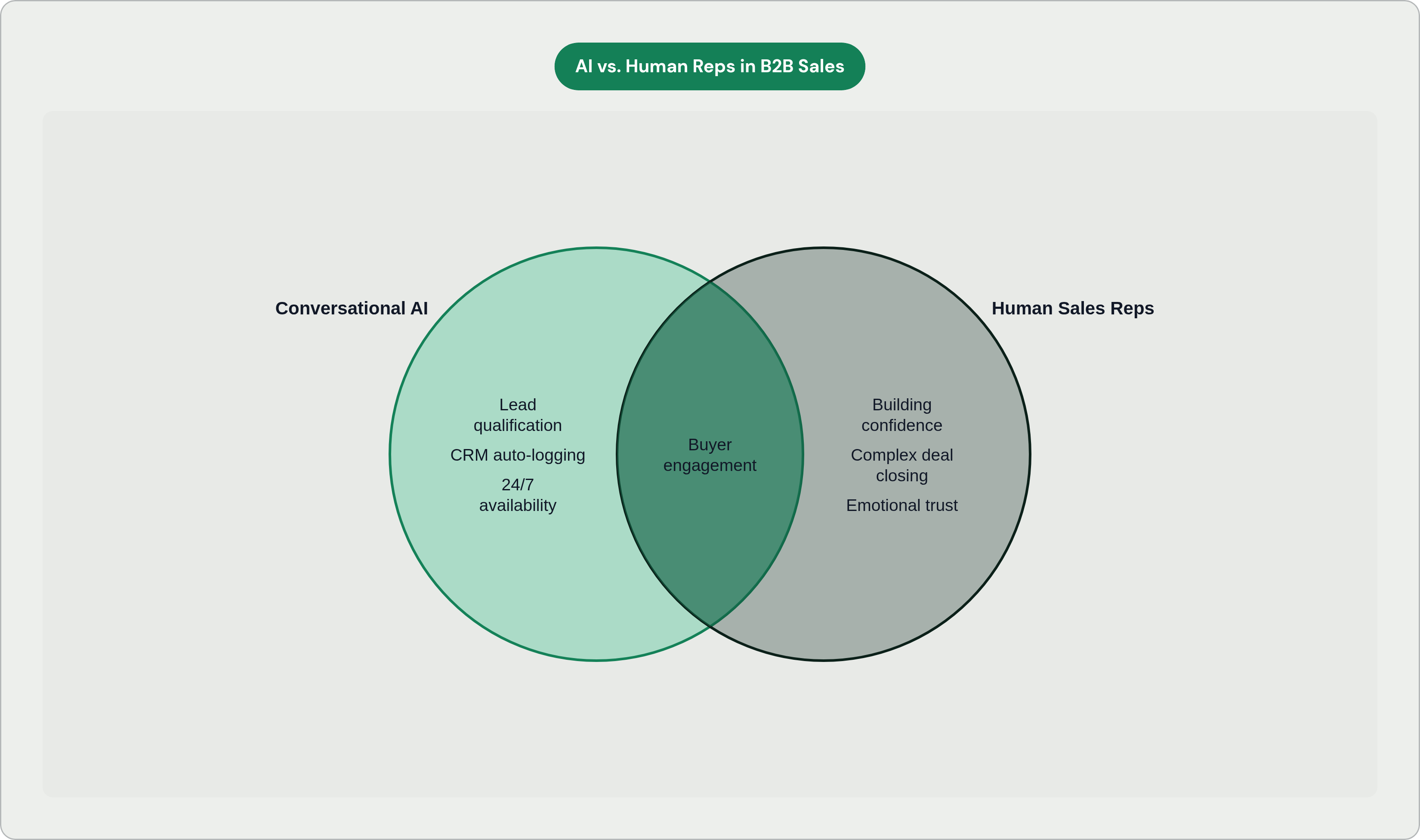
But here's the twist. The same buyers who say they want less contact with a rep also credit a human as the reason they trusted the purchase they made. That's not a contradiction; it's two different jobs getting confused for one. AI is built for one of them, while people still own the other. Figuring out which is which is the point of what follows.
Where human sellers still outperform AI (and why that shapes where the technology belongs)
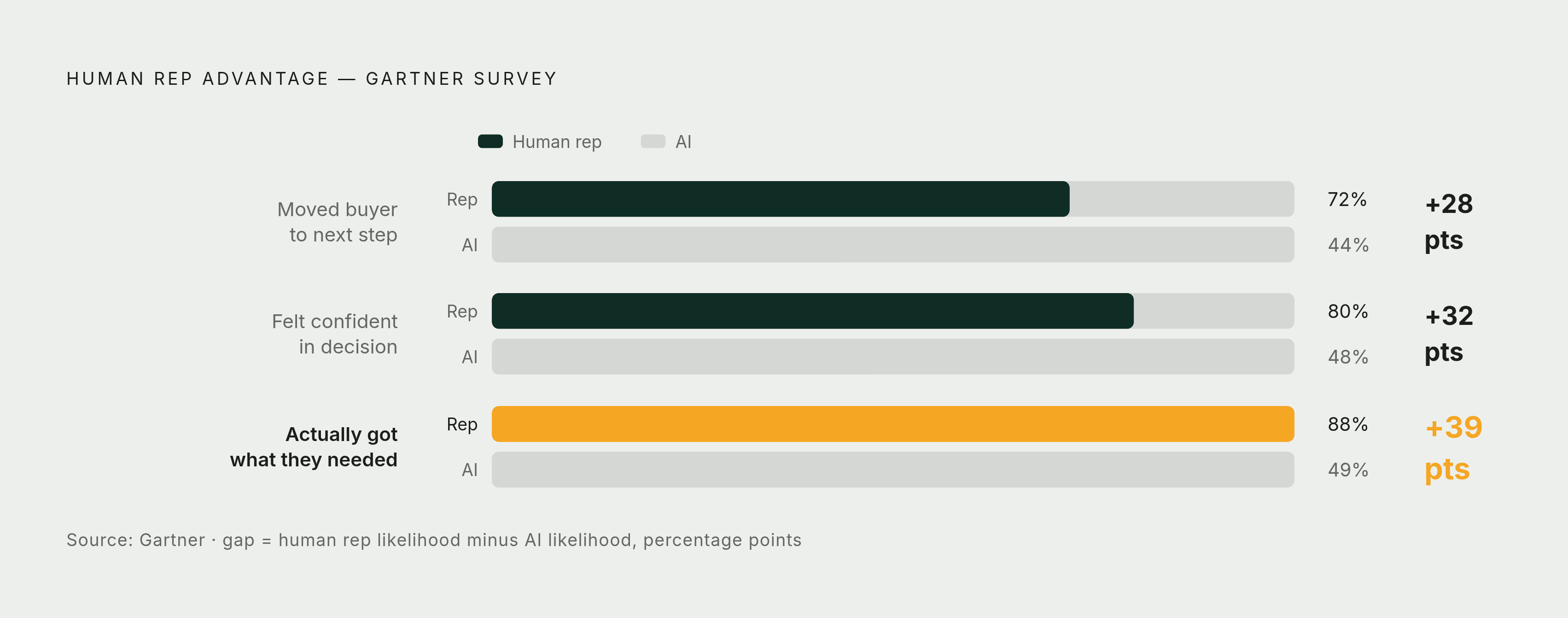
Same Gartner survey, a different number, and it cuts hard the other way.
Buyers were 28 percentage points more likely to say a human rep helped them move to the next step, compared to GenAI. Thirty-two points more likely to say a rep made them feel confident in the decision. Thirty-nine points more likely to say a rep actually got what they needed.
That gap reflects a rep doing something the technology, as it stands today, can't.
Skipping that step costs something too. Gartner's data shows self-service purchases carry a much higher rate of buyer's remorse. Faster through the funnel, more second-guessing once you're out the other side.
Customer service tells the same story. Gartner surveyed over 250 service leaders in August, and AI agents didn't crack the top ten most valuable technologies on their list. Leaders have started using the phrase "agent-washing" for a real problem: rules-based chatbots dressed up as agentic AI, promising more than they deliver.
So where does the technology belong? Not as the closer, and rarely as the stand-in for the moment a buyer needs to feel understood by another person. Its job is everything that surrounds that moment, the volume work that eats a rep's week without ever touching the part of the sale that requires a human. Deployments that respect that boundary tend to work; the ones that don't tend to annoy the buyer and the rep in equal measure.
The four communication jobs conversational AI is taking off the sales rep's plate
Four jobs, all communication-heavy, all things a rep used to grind through by hand.
Lead response and qualification. Speed is nearly everything here. Respond to a lead within five minutes and it's 21 times more likely to convert. No rep is sitting by the inbox at 2am to hit that window, but AI is. Optif.ai's research on B2B sales trends found conversational AI cutting average response time from 38 hours down to 30 seconds, which lifted meeting bookings by 15%. Across roughly 550 B2B websites studied in 2024, about 11% of chatbot conversations turned into a marketing qualified lead. The real win is what happens before the rep even says hello: intent, company size, use case, urgency, all captured up front. The rep inherits a warm lead instead of a cold form fill.
Personalized outreach at scale. A 2024 study of about 720 B2B buyers found 67% said AI-personalized content shaped a recent purchase. No rep can hand-write a thoughtful follow-up to everyone in a full pipeline. AI can draft those messages, pulling from CRM notes, past conversations, deal stage. But generic AI outreach at scale is exactly what buyers have already learned to ignore. The line between helpful and spam was never about automation; it's about whether the message knows something true about the deal.
CRM logging and the admin grind. Retell AI's analysis found the average rep spends only 28% of the workday actually selling. The other 72% goes to typing notes, clicking through deal stages, updating fields nobody reads. Conversational AI running quietly behind a call or email thread can log all of it straight into Salesforce or HubSpot, no prompting required.
Support deflection mid-cycle. Salesforce's 2025 report found roughly 30% of service cases already get resolved by AI, expected to climb toward half by 2027. In B2B, a lot of what looks like a support ticket mid-sales-cycle, pricing tiers, integration specs, contract terms, is really a buying signal in disguise. Answer it instantly and the buyer keeps moving. Make him wait for a callback and he cools off.
What adoption actually looks like across B2B sales organizations right now
Salesforce and Sopro's joint 2025 research found 81% of sales teams already experimenting with or fully using AI tools. HubSpot found only 8% of sellers report using zero AI in their role at all.
Narrow it to conversational tools specifically, and adoption still holds. Gartner found 42% of B2B commerce teams using AI-powered conversational interfaces for order management and support this year. Chatbot.com puts overall chatbot integration at 58% of B2B companies, about 4.7x growth since 2020.
Here's the number worth pausing on: Gartner projects 95% of seller research workflows will start with AI by 2027. That's close to the floor, not a niche tool anymore.
But wide adoption and good adoption aren't the same thing. A lot of teams bolted point solutions onto workflows that were never built to hold them. The rep ends up juggling four tabs instead of doing the work in one place.
The abandonment numbers back this up. S&P Global found 42% of companies scrapped their AI initiatives in 2025, more than double the year before. Access to tools isn't the bottleneck anymore. What happens after the purchase order gets signed is the actual problem.
Why most conversational AI deployments underperform and what separates the ones that don't
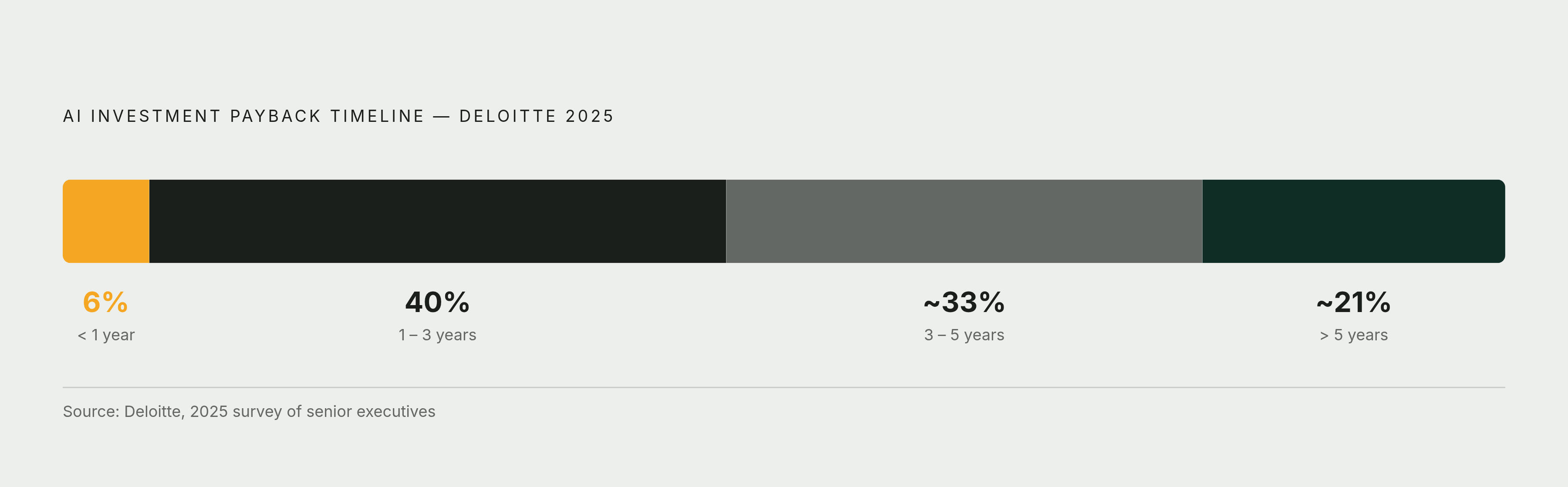
ROI is slower than the decks promise, and the gap catches most teams off guard.
Deloitte's 2025 study of senior executives found only 6% of companies see payback within a year. Forty percent land somewhere in the one-to-three-year window. Roughly a third take three to five years. Payback is real, but it's slow.
On the marketing side, a 2024 study of about 395 CMOs across North America and Europe found a large share of AI marketing initiatives missed their own ROI targets in year one. That failure rate drops sharply when quantitative success criteria get locked in with finance before the program launches — a sign the problem usually isn't the AI. It's that nobody agreed on what "working" meant before flipping the switch.
A few patterns keep showing up wherever deployments fail:
- AI that lives outside the CRM and inbox, forcing reps to copy outputs by hand from one tool into another.
- Generic, untrained models with no deal context and no sense of company tone, so reps stop trusting the output and quietly stop using it.
- AI aimed at the wrong stage, trying to replace the human confidence-building moment instead of clearing the admin clutter around it.
- Agent-washing: a rules-based bot with an agentic paint job, falling apart the second a real conversation goes off-script.
What actually works: AI that learns from the specific deal and conversation history without making the rep write a prompt every time, and that pushes its output into the tools already open on the rep's screen instead of opening a new one.
Klarna's case gets cited constantly, the one where an AI agent absorbed work that used to take a large human team. It's an interesting story about scale economics, but a poor comparison for most mid-size B2B sales teams. The better question isn't "can this replace dozens of people." It's "does this measurably cut the admin load on the reps I already have." Sopro found teams using predictive and conversational AI together seeing 20 to 30% higher conversion — with using doing the work in that sentence. Buy it and let it sit unused, and none of that shows up.
How the right conversational AI fits into the tools a sales team already uses
Here's a test that cuts through most of the noise: does the tool reduce the number of screens a rep has to open, or add to it?
The AI should sit alongside the inbox, the call, the CRM, reading context from where the work already happens and writing outputs right back into that same place. Skip the separate platform, and skip the new workflow to learn on a Friday afternoon. Build a layer underneath what's already there, not a new floor on top of it.
Salesforce and HubSpot are where most B2B deal context actually lives. If a conversational AI tool can't read from and write to those systems, the rep becomes the bridge between two pieces of software that won't talk to each other — exactly the admin burden this technology was supposed to remove.
Tone matters more than people give it credit for. If the AI drafts a reply that misses the rep's voice or the specifics of the deal, he rewrites it from scratch. At that point the math has to work: editing time has to beat the drafting time it replaced, or the tool gets quietly abandoned inside a month.
There's also a prompt-engineering trap worth naming. If a rep has to write a detailed prompt every time just to get something usable, the mental load hasn't gone away — it's just moved to a different part of the page. The good tools infer context from what already exists, the CRM notes, the email thread, the call transcript, instead of asking the rep to re-explain the deal from scratch every time.
Some tools are built around this idea, running alongside a rep's inbox, calls, and CRM, drafting replies, logging updates, booking next steps, and plugging directly into Salesforce and HubSpot, so there's no new platform to learn and no prompt to write. The cleaner examples on the market build "reduce the interfaces, don't add to them" into the product instead of bolting it on afterward.
What B2B sales teams should expect as conversational AI matures through 2027
The near-term picture is unusually clear, mostly because the numbers line up without much squinting required.
Gartner projects digital assistants will be the primary client service channel for a quarter of all businesses by 2027. Pair that with the earlier number: 95% of seller research workflows starting with AI by that same year. Two years out, and this is a concrete near-term shift, not a hazy prediction about some distant future.
The underlying technology is getting sharper fast, too. Generative AI agents are the fastest-growing slice of the conversational AI market, at a 25.5% compound annual growth rate. Whatever teams are piloting today will look primitive next to what's available in 24 months.
Buyers are moving fast on their end as well. Gartner's 2025 survey found 45% of B2B buyers already used AI during a recent purchase. More of them are walking into a sales conversation having already done their own AI-assisted research on your product, your pricing, your competitors. A rep showing up without similar support is entering a fair fight already a step behind.
The tension from the start of this piece isn't going anywhere. Buyers will keep wanting more self-service. And the confidence gap Gartner found, the fact that a human still makes people surer about a big decision, is likely to stick around, especially on complex, high-stakes deals. The actual answer isn't AI replacing the relationship. It's AI handling everything around the relationship, so the relationship itself gets more attention instead of less.
If you're trying to figure out where to start: track the admin time you're actually saving, plug into the tools your team already lives in instead of stacking on new ones, and keep a human in the room for the moments that decide the deal. The teams doing that now will likely skip the failed rollout twelve months from now. They'll just be further along than everyone still arguing about which chatbot to buy.