Generative AI Applications in B2B Sales Workflows
Most B2B teams have adopted AI but few have deployed it to actually automate sales work.
By 2025, the adoption numbers look almost absurd. Salesforce's State of Sales report, based on a survey of over 4,000 sales professionals, put AI adoption at 87% of sales organizations. Gartner's 2025 Sales Technology Report landed at 89%, up from just 34% in 2023. Only 8% of sellers say they don't use AI at all.
That compression of an adoption curve is worth sitting with for a second.
But here's what those numbers don't tell you: only 24% of B2B teams using AI have implemented anything you'd call agentic. The autonomous kind that actually replaces manual processes, rather than sitting alongside them looking productive. McKinsey's B2B Pulse Survey found that only 21% of commercial leaders report full enterprise-wide implementation of generative AI. Gong's 2026 State of Revenue AI report, drawn from millions of opportunities, found that a large majority of AI deployments fall short of expected commercial impact.
So nearly everyone has AI. Almost nobody has it doing the hard work. Why?
BCG's 2025 research offers a useful frame: most teams are stuck at what they call "augmented selling," where AI enhances human decisions but humans still carry the load. The real strategic value shows up at higher tiers. Getting there means understanding what AI is actually doing at each stage of the workflow — not just whether it's installed and technically in use.
That distinction matters more than the adoption rate.
Prospecting: Where AI Compresses the Research-to-Pipeline Gap
The traditional prospecting problem is simple to describe and miserable to live through. Reps manually research accounts, qualify leads against criteria someone set two years ago, and build sequences by hand. It takes forever. Results vary wildly across reps. And a meaningful chunk of that effort goes into accounts that were never going to buy.
Generative AI attacks this from two directions.
The first is ML-based lead scoring. Instead of ranking accounts by static rules somebody wrote in a spreadsheet, AI reads firmographic data, intent signals, and behavioral patterns to rank by actual conversion likelihood. Teams using ML-based scoring see conversion rate improvements of up to 75% over traditional models. Signal-qualified leads report higher conversion rates, larger deal sizes, and more closed deals per quarter across the studies tracking this.
The second is AI SDR tools. These handle research, sequencing, and follow-up autonomously, with human reps stepping in only once a prospect actually engages. About 22% of teams had already fully replaced human SDRs with AI agents as of 2025. Nearly 45% run a hybrid model.
Prospecting is where the efficiency argument for AI is easiest to make: smaller team, more pipeline, no headcount increase.
But here's the part that gets glossed over. AI scoring is only as good as the inputs feeding it. Most CRMs carry serious data debt — stale records, missing fields, contacts who changed jobs 18 months ago and nobody updated the entry. The real constraint on prospecting AI isn't the algorithm. It's the quality of the data you're feeding it.
Outreach Personalization: Moving From Mail-Merge to Contextual Drafting
Before generative AI, personalization at scale had no good answer. You either sent generic templates (fast, low-converting) or hand-crafted messages (slow, maybe covering a few dozen named accounts per quarter if you were disciplined about it). That was a real, structural constraint — not a failure of effort.
Generative AI changes the economics.
Contextual drafting at volume means AI reads account-level signals, company news, role-specific context, and prior interaction history, then generates messages that read like someone did their homework. Signal-personalized outreach achieves reply rates of 15 to 25%, versus the 3 to 5% industry average for cold email. LinkedIn attributes an average 28% improvement in cold-email response rates to generative AI drafting. HubSpot's 2025 research found that 83% of sales professionals say AI helps them personalize prospect interactions, and 82% say it surfaces better insights from existing data.
The failure mode is worth naming clearly: generic output that just swaps in a prospect's first name and company size. Customized emails generate roughly double the reply rates of generic templates. That gap only holds if the AI is producing content that's actually specific to the account — not performing personalization while secretly delivering a template.
Tools integrated with CRM history and prior correspondence have a structural advantage here over standalone generators. AI drafting that learns tone, deal context, and company-specific language outperforms prompt-engineered one-offs because the rep isn't starting from zero every time. Nextstep is built around this: drafting contextually relevant replies without requiring reps to engineer prompts from scratch, drawing from existing tone and deal history so the output reflects what's actually happened in the relationship.
Content Generation Across the Deal Cycle: Proposals, Battlecards, and Follow-Ups
Think about everything a rep produces across a single deal. Intro email. Discovery summary. Proposal draft. Objection-handling notes. Case study selections. Follow-up recaps after every call. Most of it gets created from scratch, every time, by someone who would rather be on a call generating new pipeline.
Generative AI handles a meaningful share of this now. It drafts follow-up emails from call transcripts. It generates proposal sections customized to account-specific context. It produces battlecard summaries and objection responses keyed to the specific deal. It even analyzes buyer sentiment in written communication and flags tone shifts or urgency changes a rep might miss buried deep in a long thread.
Walnut's 2025 State of Generative AI in B2B Marketing report found that a notable share of teams already produce over half their content with AI. Salesforce Research found that 78% of sales leaders believe generative AI can create sales content in ways that improve both conversion rates and deal velocity.
The quality risk is identical to the outreach problem. AI-generated content that sounds generic, or inconsistent with the rep's actual voice, erodes trust — with the prospect and within the deal itself. The value compounds when AI learns the rep's tone and the deal's history over time. It largely disappears when it's generating from a cold prompt with no memory of what came before.
One thing that's undersold here: content generation is where AI most dramatically levels the playing field for small teams. A two-person team can now produce account-specific proposals and follow-ups at the volume and consistency of a team with dedicated content support. That was not true five years ago.
Conversation Intelligence: What Happens to the Information Captured on Calls
Here is a problem most sales teams have quietly accepted as unavoidable. What gets said on sales calls is largely undocumented. Reps take partial notes. CRM fields go unfilled. Coaching is based on what people remember, not what actually happened. The information from a single call — arguably the most valuable data point in the whole deal — largely evaporates the moment the Zoom window closes.
Conversation intelligence AI was built to fix this, and it's pretty good at it.
It records and transcribes calls automatically. It identifies talk-time ratios, objections raised, competitor mentions, sentiment signals. It flags deal risk based on language patterns — buying signals missing from a conversation where they should appear, urgency language absent from a deal supposedly closing next week. It generates coaching recommendations for managers based on actual call behavior, not what reps remember to self-report.
Gong is the established leader here. Their framing for what they've built is a "reality layer" of customer interactions: what was actually said, versus what reps logged. That distinction is the entire point of the category. The conversation intelligence software market is projected to grow from $28.5 billion in 2025 to $52 billion by 2030, one of the faster-growing segments within sales AI.
But there's a gap worth naming. Conversation intelligence is only useful if the insights and CRM updates actually get captured somewhere durable. In most organizations, humans are still expected to close that gap manually. Which raises a pretty obvious question: why are we still doing it that way?
CRM Logging and Data Hygiene: The Administrative Job AI Is Best Positioned to Eliminate
CRM data entry is the part of the job nobody talks about when they're recruiting salespeople, and the part that eats more time than almost anything else. Manual, repetitive, error-prone, and structurally at odds with what reps were actually hired to do. Bain's 2025 research makes the cost explicit: reps spend only about 25% of their working hours actually selling. The rest goes to admin, CRM entry, and internal reporting.
I've watched talented reps get buried in this. It's not a discipline problem. It's a system design problem.
AI-automated logging attacks this directly. It transcribes calls and extracts structured updates — deal stage, next steps, stakeholders mentioned, commitments made — and pushes those into CRM fields without anyone having to open a browser tab. It enriches existing records with third-party data and intent signals. It flags stale or inconsistent entries that would otherwise corrupt everything downstream.
ZoomInfo's 2025 research found that 45% of sales professionals use AI-powered CRMs at least weekly, making this the most commonly used category of sales AI tool. Productivity research suggests AI automation saves reps an average of over two hours per day. Seventy-eight percent of reps say it helps them dedicate more time to work that actually moves deals forward.
This is core to what Nextstep is designed to do: logging updates and booking next steps automatically across Salesforce and HubSpot, without requiring reps to context-switch into the CRM mid-day. The record reflects what actually happened in the deal, not what the rep remembered to type at the end of a long Friday.
The data-quality payoff compounds further than just recovered time. Lead scoring, forecasting, and reporting are only as reliable as the data feeding them. Logging accuracy at the deal level shows up in forecast quality at the pipeline level.
Pipeline Forecasting: Where AI Operates on Aggregated Deal Data Rather Than Individual Interactions
Forecasting is broken in most sales organizations. Not dramatically broken. Quietly broken, in a compounding way that shows up every quarter in a slightly different form.
Gartner's 2025 data is pretty stark: only 7% of teams achieve forecast accuracy at the highest levels. Median accuracy sits well below 80%. And a majority of sales operations leaders say forecasting is harder than it was three years ago — which is a strange thing to say in an era of more data and more tools.
Why does traditional forecasting fail? It relies on rep self-reporting into CRM. Reps enter the close probabilities they feel like entering, on the days they get around to entering them. That's the foundation most forecasts are built on. It's a confidence-weighted opinion survey dressed up as a data product.
AI forecasting reads underlying activity instead. Email engagement. Call frequency. Deal-stage velocity. CRM activity patterns. It identifies deals that are stalling before the rep reports them as stalled. It models pipeline coverage gaps against quota, not just against current commit. Leading AI forecasting systems achieve accuracy in the low-to-mid 90s in vendor studies, compared to significantly lower rates with traditional approaches.
That said, AI forecasting is only as good as the data feeding it — which loops directly back to CRM logging quality. Logging accuracy at the deal level and forecast reliability at the pipeline level are the same problem at different altitudes.
How BCG's Three-Tier Model Helps Teams Locate Themselves on the Deployment Spectrum
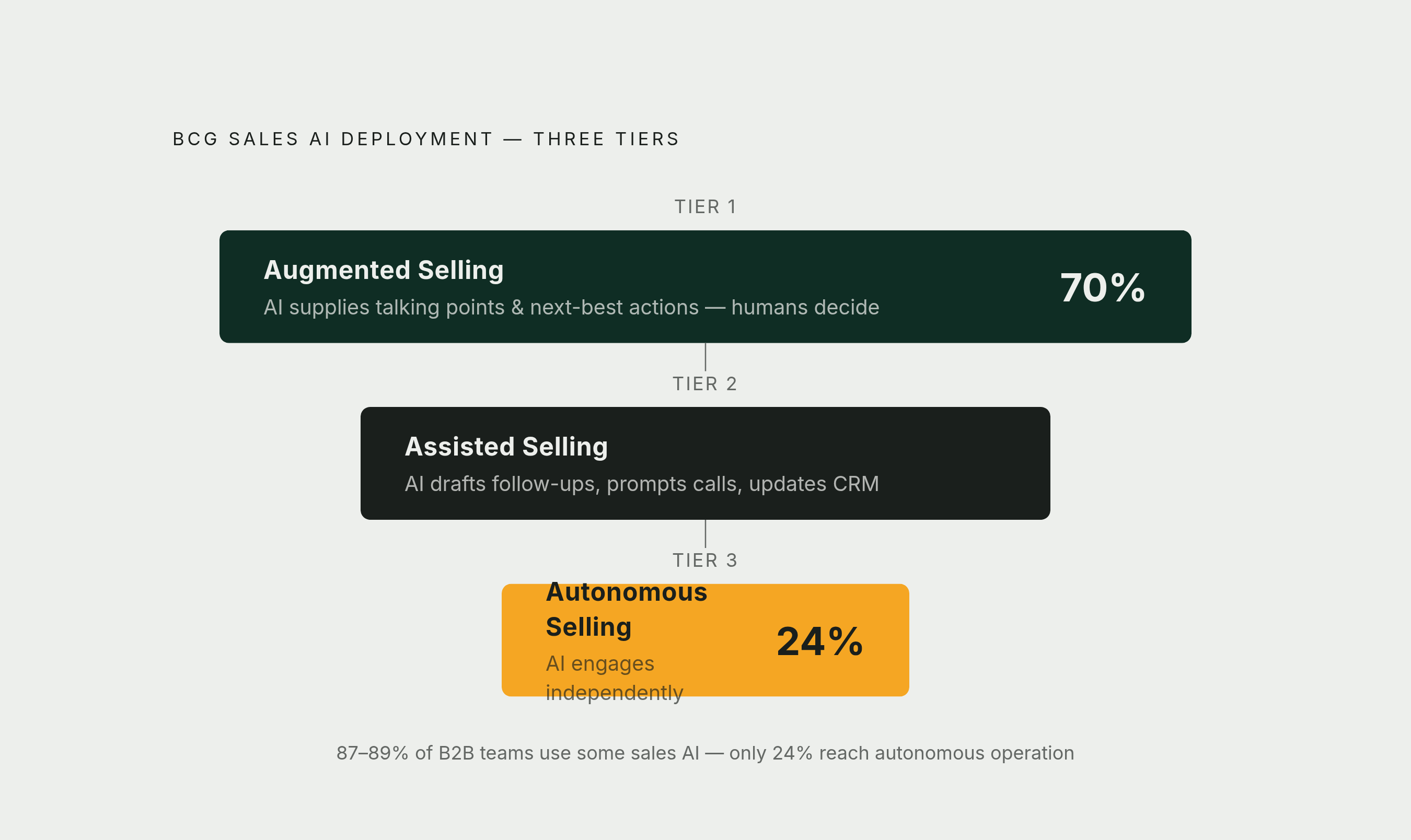
BCG's 2025 research names three deployment tiers. They're useful less as a ranking system and more as a diagnostic — a way to figure out where your team actually sits versus where it assumes it sits. Those two answers are often not the same.
Augmented selling. AI supplies talking points, collateral, and next-best actions. Humans make every decision. Most teams are here. Roughly seven in ten sellers rely on general-purpose AI tools for tactical productivity tasks: drafting emails, summarizing calls, automating follow-ups.
Assisted selling. AI operates as a real-time partner. It prompts during calls, drafts follow-ups, updates CRM fields. Humans still direct, but AI handles a meaningful share of execution. This is where efficiency gains start to show up in the numbers.
Autonomous selling. AI independently engages customers across touchpoints. Human oversight is supervisory, not transactional. This is where the 24% who've actually implemented agentic AI are operating.
The more useful question to ask your team isn't "are we using AI?" It's: at which tier, and for which specific jobs?
AI is not a single capability deployed uniformly across a workflow. It compresses research time in prospecting. It enables volume with quality in outreach. It reduces production friction across the deal cycle. It converts call data into structured records. It makes forecasts accurate enough to actually plan against. Each of those is a different job, with different inputs, different failure modes, and different returns on the investment.
The teams getting real commercial impact are the ones asking "what specific job is AI doing here, and is it the right job for AI?" — at each stage of the workflow, separately. That question is more useful than any adoption statistic you'll find in a vendor report.