MEDDIC Sales Methodology Explained for B2B Teams
A qualification framework that separates real deals from time-wasters.

Where MEDDIC came from
MEDDIC wasn't dreamed up in a workshop or bolted together by a consulting firm trying to sell a framework. It came out of Parametric Technology Corporation (PTC) in 1996, built by Dick Dunkel and Jack Napoli, with John McMahon overseeing its development and rollout across the company.
The first version of MEDDIC wasn't a slide deck. It was integrated into how PTC onboarded and trained new hires, so every rep, from day one, qualified deals using the same language. No guessing about what "qualified" meant. No two reps calling different things "ready to close."
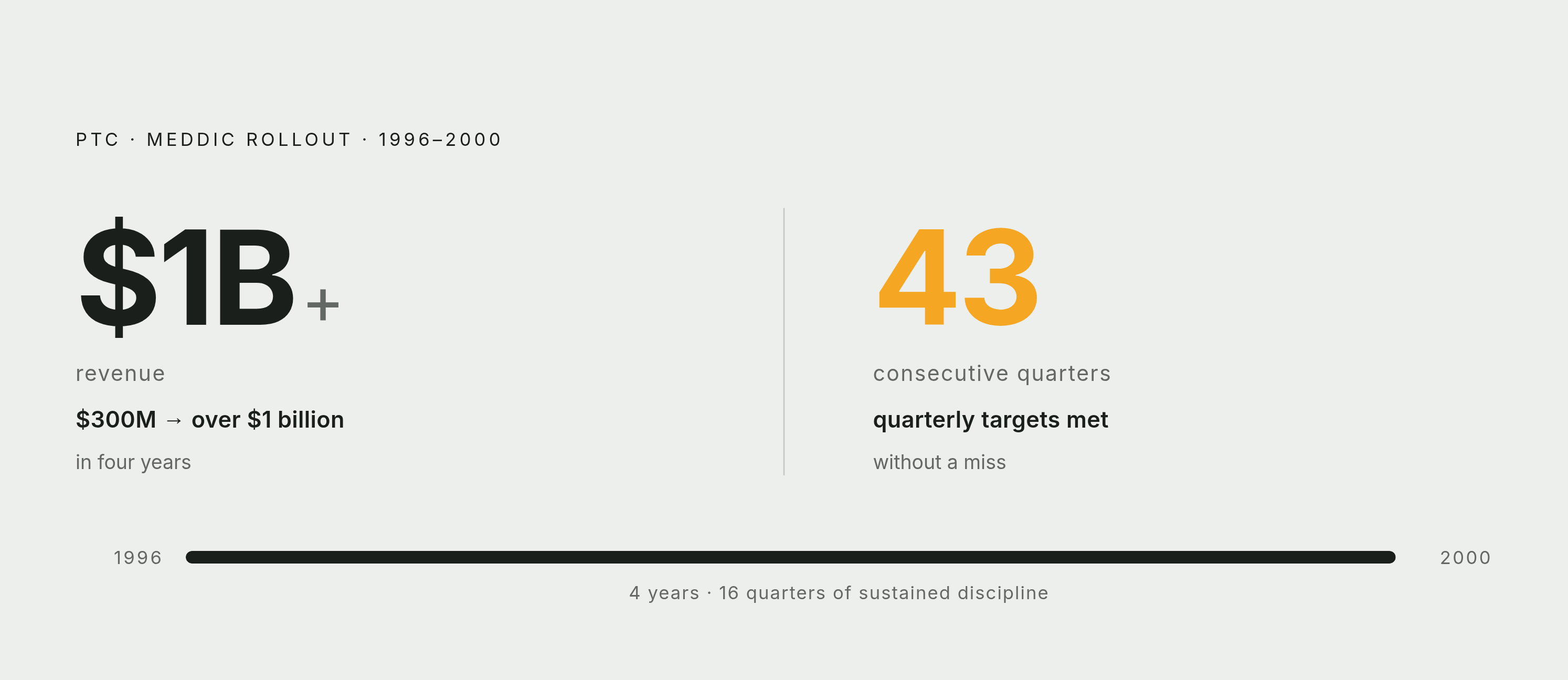
The results are the reason people still talk about this thirty years later. PTC's revenue grew from $300 million to over $1 billion in four years, and the company hit its quarterly targets for 43 consecutive quarters. That run didn't happen by accident. It happened because every rep in the building was qualifying deals against the same six checkpoints instead of trusting their gut.
From PTC, the framework spread. Major fast-growing enterprise software companies picked it up, and it became close to the default qualification language across the sector.
The reason it stuck isn't nostalgia. Enterprise deals have only gotten more complicated since the 1990s: more stakeholders, longer cycles, more approval gates. The job MEDDIC was built to do, figuring out if a deal is real before a rep burns months on it, has only gotten more necessary as those deals got harder to read.
A US federal court ruled MEDDPICC a generic term, one that can't be owned as a trademark, and ordered the existing registration cancelled. The ruling just confirmed what practitioners already knew: MEDDIC and its variants are shared industry vocabulary. Nobody owns this language, which is a large part of why it spread as far as it did.
What MEDDIC is, and what it is not
Most people file MEDDIC in the same drawer as SPIN Selling or Challenger Sale. That's a mistake, because MEDDIC is a qualification framework rather than a sales-conversation playbook like SPIN Selling or Challenger Sale. MEDDIC doesn't tell a rep what to say on a call or how to structure a pitch. It's a qualification framework, and its entire job is answering one question before anyone spends real time and real budget chasing a deal: is this opportunity real, winnable, and worth pursuing?
That distinction affects what a rep chooses to sell into, not how they sell. MEDDIC doesn't change how someone sells. It changes what they choose to sell into.
It's also not a checklist a rep fills out once during discovery and files away. Treated that way, it turns into the exact paperwork exercise that gives frameworks a bad name. MEDDIC only works as a living set of checkpoints, revisited as the deal moves, because the economic buyer who mattered in week one might not be the one signing in month four.
Lined up against other frameworks, the role gets clearer. BANT tells a rep whether a conversation is worth having. MEDDIC tells a rep whether the deal already in motion is likely to close, and gives a structure for winning it. SPIN Selling shapes how a discovery conversation unfolds. Challenger Sale shapes how a rep teaches a prospect something new. MEDDIC governs pipeline health and deal scoring. None of these compete with each other. A rep can use SPIN's question style to surface the exact information MEDDIC needs.
The real payoff appears in how a team talks to itself. When every rep qualifies against the same six checkpoints, a pipeline review stops sounding like "the deal's going well, I think" and starts sounding like specific, answerable questions: who's the economic buyer, what's the compelling event, does the champion actually have influence or just enthusiasm. That specificity is what lets a five-person sales team and a five-hundred-person sales org run on the same logic.
The six elements of MEDDIC, one by one
M: Metrics
Metrics are the prospect's numbers. What outcome does the buyer actually need to hit? Revenue targets, cost reduction, time saved, whatever their leadership already tracks.
Without agreed metrics, there's no real urgency behind the deal. "This looks interesting" doesn't get a budget approved. Metrics are what makes value visible instead of assumed.
Determine what success looks like in actual numbers. Ask what this problem is costing right now, in dollars or hours. Ask what KPIs leadership already tracks that this touches.
E: Economic Buyer
This is the person, or group, who controls the budget and can say yes. Not the enthusiastic end-user. Not the internal champion who forwards emails. Not even a senior-sounding contact who turns out to have zero purchasing authority.
The classic failure mode in B2B sales: months spent building a relationship with someone who can't approve the check, while the actual economic buyer has never heard of the deal. Get to the economic buyer early, or lose the deal to a competitor who did.
The question to ask early and often: who controls this budget, and has anyone actually talked to that person directly?
D: Decision Criteria
These are the specific requirements, technical, financial, cultural, that the buyer will use to judge one solution against another. Knowing them lets a rep build a proposal around what actually matters instead of guessing at priorities.
Criteria shift mid-deal, especially once new stakeholders show up. Checking this once and moving on defeats the point. A rep who knows the criteria can push back on a flawed evaluation. A rep who doesn't is just hoping the buyer picks correctly.
D: Decision Process
This is the map: who's involved, in what order, what approvals are required, and what the real timeline looks like. It covers procurement steps, legal review, committee sign-offs, and every internal gate standing between "we like this" and a signature.
Skipping this means a rep can't see roadblocks coming, can't set a realistic close date, and can't help a champion clear internal resistance. It also ties straight back to forecast accuracy. A rep who has mapped the decision process can back a close date with evidence. A rep who hasn't is just guessing and calling it a forecast.
Identify Pain
Pain is the specific, pressing problem making the purchase urgent now, not eventually. Without it, a prospect has no real reason to change, no reason to spend, and no reason to fight for the deal internally once the seller leaves the room.
Naming the pain also does something to pricing: once a rep can put a number on what the problem is costing the business, in the buyer's own terms, the price tag stops looking expensive and starts looking cheap by comparison.
Good qualification pushes past the surface complaint into business impact: revenue at risk, operational drag, ground lost to competitors. MEDDPICC later sharpens this into "Implicate the Pain," pushing reps to make sure the buyer feels the weight of the problem instead of just admitting it exists. More on that below.
C: Champion
A champion is someone inside the account who wants the seller to win and has the internal standing to make that happen. Not a friendly face in meetings. Someone with real political capital and a personal stake in the outcome.
A true champion coaches the seller on internal politics, rallies other stakeholders, pushes back on resistance, and takes action when the seller isn't in the room. Most of the internal conversation that decides a deal happens without the seller anywhere near it. That's where priorities actually get set and objections actually surface, and a champion is the only one who can steer that conversation on a seller's behalf.
The test that separates a champion from a friendly contact is simple: a contact shares information. A champion takes risk on the seller's behalf. Deals without a confirmed champion close at dramatically lower rates than deals with one. Building a champion takes work: testing, coaching, and equipping that person throughout the deal, not hoping they show up when it counts.
The deals MEDDIC is built for, and the ones where it is overkill
MEDDIC earns its keep on high-value transactions, roughly £20,000 and up, where the time spent qualifying is worth it against what's on the table. It fits long sales cycles with multiple touchpoints stretched over weeks or months, buying committees with three or more decision-makers, and formal evaluation processes involving procurement, legal, or multi-stage sign-off.
Technology and SaaS are its natural home, but it's been used with documented success in other high-value, complex industries too. Anywhere a deal is big enough and slow enough that a bad qualification call costs real money.
It doesn't belong in simple, transactional sales with a short decision cycle and modest stakes. Running the full six-element process on a deal like that adds paperwork without adding insight. A useful gut check: if losing a deal costs days or weeks of wasted effort, MEDDIC pays for itself. If losing it costs an hour, skip it.
The framework can be overly rigorous and slow for simple transactional sales where the decision process is short and the financial stakes are low. That's a sign the framework is being applied where it doesn't belong, not a flaw in MEDDIC. It's a sign the framework is being applied where it doesn't belong. The fix is treating it as a guide for understanding the buyer, not an interrogation script a rep has to run line by line on every call regardless of deal size.
Keeping MEDDIC data current inside a CRM is real work that gets skipped when reps get busy. Agentic AI tools sitting alongside a CRM can cut that overhead: flagging missing metrics, surfacing decision-makers nobody's identified yet, logging deal intelligence automatically. That's a workflow layer that keeps the framework alive for reps who are already stretched thin.
MEDDIC, MEDDICC, and MEDDPICC, which variant fits which situation
Most sales orgs run on the wrong instinct here: bolt extra letters onto MEDDIC because it sounds more rigorous. It doesn't work that way. Added complexity just gives reps more fields to fill in badly. Skip the fuller variants unless the deal actually demands them.
The original six-element MEDDIC still covers plenty of B2B sales cycles, particularly ones under about three months with a smaller cast of stakeholders. No need to add complexity a deal doesn't require.
MEDDICC adds a second C for Competition. It forces a team to map who else is in the deal, understand how rivals are positioning themselves, and articulate what actually makes the offer different. It earns its place when direct competitors show up in evaluations regularly, not as a rare exception.
MEDDPICC adds Paper Process, which covers everything between a verbal yes and a signed contract: legal review, procurement steps, security assessments, contract redlines, internal approvals. A deal can look won in the pipeline and then die quietly in legal review three weeks later. Enterprise teams that have watched that happen once tend to add this element permanently.
MEDDPICC also sharpens "Identify Pain" into "Implicate the Pain," pushing past simple acknowledgment of a problem into making sure the buyer feels its full weight.
Adoption of the fuller framework has been rising as enterprise deals get more complicated, more stakeholders, more competitive bake-offs, more approval layers. That's a signal for organizations selling into large, competitive, multi-approval deals. It isn't a reason for every sales team to bolt on letters it doesn't need.
What MEDDIC-qualified pipelines produce, the performance evidence
Forecast accuracy shows the sharpest improvement, and the mechanism is straightforward: MEDDIC surfaces deal risk early, so it is caught in pipeline reviews instead of appearing as a surprise in the final week of the quarter. Microlise's case, documented by coffee.ai, gives one of the clearest before-and-after numbers available: forecast accuracy went from 25% to 85% through consistent MEDDIC pipeline reviews. A forecast finance can actually plan a budget around depends on that kind of consistency. Without it, nobody trusts the number, and sales spends its energy defending a guess instead of closing deals.
Win rates follow the same logic. Companies adopting MEDDIC tend to see close rates well above teams running loose or informal qualification, because the framework forces a rep to find out the deal is dead before the quarter ends, not after.
Sales cycles shrink too. Less time spent chasing deals that were never going to close means more time on the ones that will.
Coffee.ai reports that Fastmarkets used MEDDIC's focus on economic justification and decision-process mapping to drive a 24% increase in average order value and grow cross-sell revenue by 147% through structured MEDDIC execution. That's a framework driving a measurable revenue outcome, not a vague cultural benefit. That's a rep knowing exactly who signs, what they need to see, and what the problem is costing them, and using all three to ask for more.
The pattern across every one of these examples points to the same underlying fact: training once isn't enough. Organizations that keep reinforcing the methodology through coaching and pipeline review see the gains hold. Organizations that run one workshop and move on watch the framework decay back into guesswork within a couple of quarters.
The PTC numbers from three decades ago still hold up as the clearest proof point available: $300 million to over $1 billion in four years, 43 straight quarters hitting target. That's disciplined qualification sustained over years, not one good stretch that got written up afterward.
How to implement MEDDIC without it becoming a CRM paperwork exercise
The most common way MEDDIC fails inside a sales org has nothing to do with the framework itself. It fails when it turns into a form. A manager requires it, reps fill in six fields in the CRM, nobody checks the answers for truth, and the deal gets marked "qualified" based on a guess dressed up as data.
The fix is treating each MEDDIC element as a question that needs evidence rather than a box that needs checking. "Economic Buyer: confirmed" should mean a rep has actually spoken with that person, not that someone on the buying team mentioned a name in passing. "Metrics: defined" should mean specific numbers the buyer cares about, entered as a genuine data point rather than a placeholder a rep typed in to move the deal stage forward.
That's a habit built through coaching, not software. Pipeline reviews built around MEDDIC's six checkpoints give managers something concrete to push on: not "how's the deal going" but "who exactly is the economic buyer, and when did you last talk to them directly." Kept up consistently, that's what separates a framework that lives on a slide in a sales kickoff deck from one that actually changes which deals get chased and which get dropped early, before they cost anyone a quarter.