Conversational AI Companies Serving B2B Sales Teams
Five different products hide under one label, and picking the wrong one wastes your budget.
"Conversational AI for B2B sales" sounds like one thing. It's actually about five things wearing a trench coat.
A website chatbot, an AI SDR that cold-emails your prospects, a call recorder that scores your reps' pitches, a CRM copilot that drafts your follow-ups. All of them get filed under the same label. None of them do the same job.
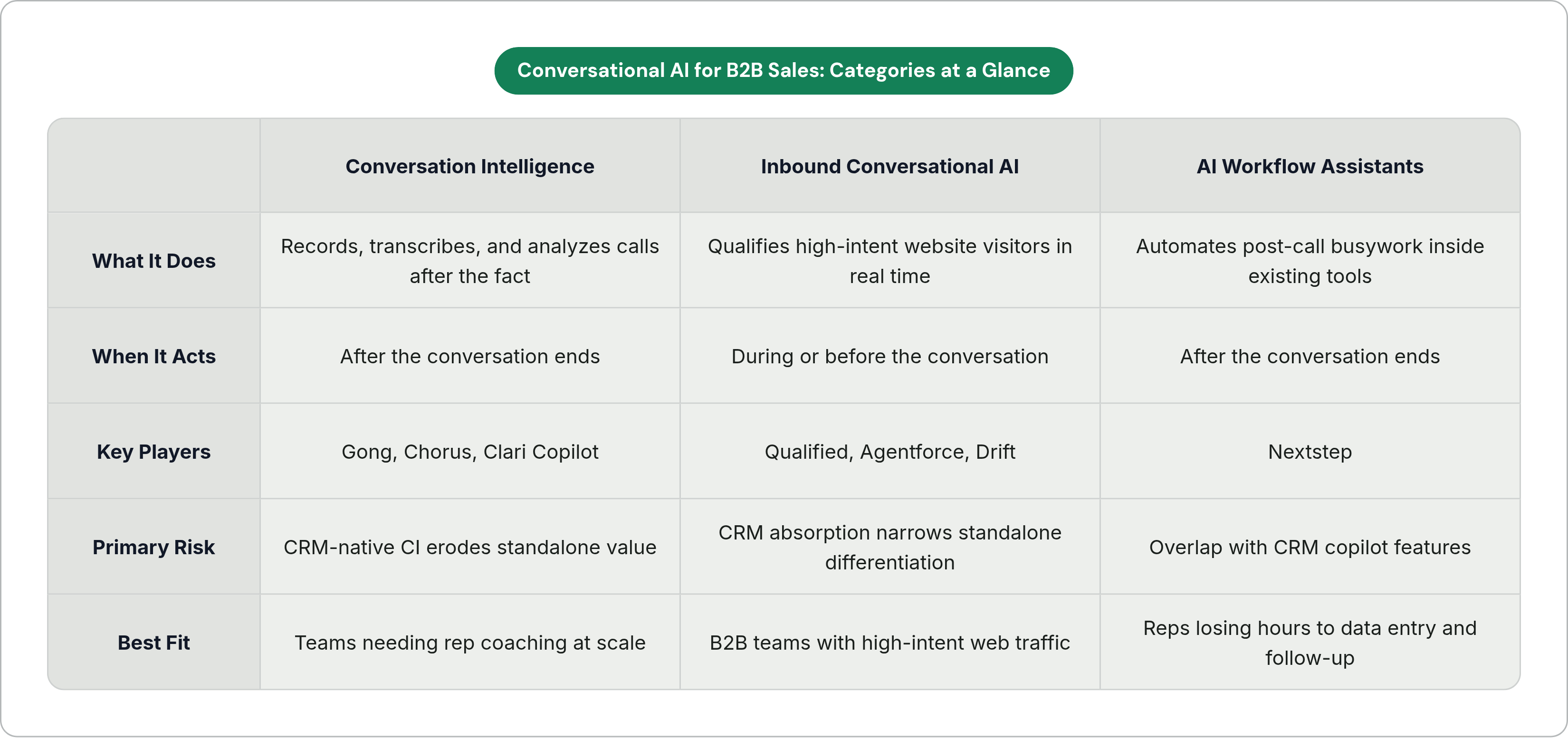
That distinction matters more than it should. Some of these tools start or run conversations (inbound chat, AI SDRs, voice agents). Others show up after the conversation is already over and pick it apart (conversation intelligence, coaching platforms). A third group just lives inside tools you already pay for (CRM-native agents, sales engagement copilots), and it's getting harder to tell where "dedicated AI product" ends and "feature the CRM shipped last Tuesday" begins. Compare all of these as one category and you're comparing products that were never actually competing with each other.
The size of this thing is real, though. Grand View Research pegged the global conversational AI market at $11.58 billion in 2024, heading toward $41.39 billion by 2030. That's 23.7% a year. MarketsandMarkets expects B2B sales to be the biggest single use case by revenue over that stretch. So no, this isn't a niche. It's a crowded room where everyone's talking at once. Let's separate the voices.
Why so many vendors showed up at once, and what that tells you as a buyer
Gartner's 2025 Sales Technology Report found 89% of revenue organizations using AI in some form. In 2023, that number was 34%. That's not adoption. That's everyone sprinting through the same door at the same time.
And sprints leave gaps. Demand outran what any single platform could build fast enough, which is how the AI SDR space went from under 10 vendors in 2020 to more than 60 by 2024 (per G2's Sales Automation Market Report). Sixty companies chasing the same problem isn't a mature market. It's a land grab, plain and simple.
Three things caused the pileup:
- LLMs got cheap and easy. Building something that sounds smart takes a weekend now. The bar for "credible-looking product" dropped through the floor.
- Nobody wrote the spec. There's no agreed definition of what "conversational AI for sales" is supposed to do. Prospecting, coaching, qualifying, call logging. Each one was already a big enough problem to build a company around, so they all did.
- Buyers were desperate enough to try anything. Sales productivity pressure meant teams would pilot almost any tool that promised relief, no matter how thin the evidence.
The market didn't pick a winner and consolidate. It split by workflow stage instead. And that's actually good news if you're the one buying: it means stop shopping for "a conversational AI tool" like it's one thing. Shop for a fix to one specific problem you actually have.
Nowhere is the urgency sharper than AI SDRs: projected to grow from $4.39 billion in 2025 to $17.58 billion by 2030, a 32.3% compound rate that outpaces the rest of the conversational AI market. Fast growth like that usually means integration gaps, not maturity. So before you sign anything, ask the vendor one blunt question: what happens to your value the moment my CRM ships this same feature for free?
Conversation intelligence platforms: what they do and who's actually winning
Conversation intelligence has one job. Record your calls and meetings, transcribe them, mine them for patterns. What are reps actually saying? How do deals really get discussed, versus how we think they get discussed? Managers get coaching material. Reps get pointers for the next call. All of it happens in the rearview mirror. It's reflection, not participation.
You can buy this standalone (Gong, Avoma) or bundled into something bigger (Salesloft, Outreach, Clari, ZoomInfo).
Gong basically invented the commercial version of this category. Founded in 2015, it's raised around $584 million, and hit a $7.25 billion valuation at its 2021 Series E. Then a secondary sale through Nasdaq Private Market in November 2025 reset that to $4.5 billion. Sit with that for a second: a company can grow revenue and still watch its valuation get cut almost in half.
And Gong has grown. Estimated ARR of $500 million in 2026, up from $332.3 million in 2024, across roughly 4,000 customers. The product line has stretched way past "we record your calls": AI Composer for content, AI Tasker for automating follow-up work, Ask Anything for querying revenue data in plain language, Gong Engage for outreach, a Data Cloud tying it all together. Then in February 2026 they launched Mission Andromeda, an AI coaching chatbot with open MCP integrations. Read that as a deliberate pivot from "call recorder" to "AI-native revenue platform." Gartner named Gong a Leader in its 2025 Magic Quadrant for Revenue Action Orchestration. Pricing runs about $1,600 per user per year for smaller teams, dropping to $1,360 above 250 seats. That price tag tells you the whole story: enterprise teams, 200+ seats, an actual RevOps function running the show.
So here's a question worth sitting with. If Gong, at this scale, still lost nearly half its valuation, what does that say about how defensible standalone CI really is as CRM-native agents keep getting better? I don't think there's a clean answer. But it's worth asking before you sign a multi-year contract.
ZoomInfo's Chorus plays a different game entirely. It's not trying to win as standalone CI. It's CI bolted onto a data platform, backed by 14 proprietary patents on the recording and transcription layer. The real trick: it automatically matches every call participant against ZoomInfo's database of more than 260 million contacts. You don't hunt down who was actually in the room. It already knows.
ZoomInfo serves more than 35,000 customers, and Forrester named it a Leader in its Wave for B2B Intelligence Platforms. Revenue's had a bumpier road: $309 million in 2024 (down 2% year over year), climbing back to $319 million in 2025. That kind of pressure shapes how hard a company leans on its bundle to prove value. And the bundle does show results: Tegus cut CI spend in half after switching to Chorus, and Smartsheet reported an 84% lift in marketing qualified leads with a 26% bump in opportunity rates running CI and data together. Worth flagging, those numbers are the bundle working in concert, not CI standing alone.
Here's what Gong and Chorus have in common, and what separates them from almost everyone else in this piece: they both look backward. They analyze the conversation after it happened. Neither one starts it.
The Clari-Salesloft merger, and what it means if you're buying a bundle
Want one data point for how fast this market is consolidating? Look at Clari and Salesloft. Announced August 7, 2025. Closed December 3, 2025. One of the biggest consolidations revenue tech has seen in years. The combined company now manages more than ten trillion dollars in revenue across over 5,000 organizations. That's trillion, with a T. Not a typo.
But size makes its own mess. The combined stack now runs two conversation intelligence tools (Wingman, rebranded as Clari Copilot, alongside Salesloft's native recording), two sales engagement platforms (Salesloft and Groove), a conversational chatbot layer (Drift, which Salesloft picked up in early 2024), and Clari's forecasting engine on top of all of it. That's a lot of overlapping parts trying to live under one roof.
Forrester's take on mergers like this is blunt: unifying overlapping platforms is a "lengthy, iterative process." Translation, for anyone about to sign: don't take a vendor's word when they promise it'll all "come together soon." Ask for a roadmap with actual dates on it.
Drift's story is worth pausing on. It used to be the dominant standalone B2B chatbot. Now it's fully absorbed into Salesloft, acquired for a price reportedly in the hundreds of millions. If you're not planning to run the full Salesloft stack, you may end up paying for overlap you'll never touch. Some users have already flagged declining support quality and CSM availability since the deal closed. And a 2025 security incident tied to the Drift platform, linked to a financially motivated threat group with effects rippling across several third-party integrations, is a real due-diligence item. Not a footnote you skim past.
Consolidation makes sense if you're the vendor protecting margin. But if you picked a tool because it was the best at one specific thing, and that tool just got folded into a bigger suite that's now being "rationalized," you inherit that risk whether you asked for it or not.
Outreach's all-in-one bet: conversation intelligence feeding deal execution directly
Outreach is playing a different hand. Its Kaia assistant handles the table stakes: records calls, transcribes, summarizes, syncs to the CRM. Nothing new there. The interesting part is what happens next. Those insights feed straight into Outreach's own deal management and forecasting, and the rep never has to leave the platform.
The sharper piece is Deal Agent. It reads the content of a call and suggests updates to opportunity fields in the CRM directly. That's a different kind of value than a transcript. A transcript is homework. A recommended field update is someone else doing the homework for you.
Outreach reported well over $200 million ARR in 2023, up from the prior year, putting it in the same weight class as Gong and Salesloft. But it's arguing for a completely different architecture: one platform running the whole revenue workflow, instead of stitching together three or four best-of-breed tools.
That's the real tradeoff. A rep who lives entirely inside Outreach gets a tight loop between "what got said on the call" and "what changed in the deal." A rep juggling Gong, Salesforce, and a separate engagement tool deals with more friction, but keeps the flexibility to swap any single piece out later. Neither answer is wrong. It comes down to whether you value integration more than optionality, or the other way around.
Outreach's all-in-one pitch is now going head-to-head with the combined Clari-Salesloft suite. If you're choosing between them, don't just count features on a spec sheet. Ask which platform's native deal management your reps would actually open every single day, versus tolerate.
Inbound conversational AI: Qualified, Agentforce, and the fight for pipeline generation
This category has a narrower job, further upstream: catch high-intent visitors on your website in real time, qualify them against your ideal customer profile, then either route them to a rep or carry the conversation forward on its own.
Qualified built specifically for B2B teams already running Salesforce. It spots known accounts visiting your site, pings the right rep instantly, and kicks off an AI-driven conversation with the visitor while that rep gets up to speed. Forrester named it a Leader in its Q4 2025 Wave for Conversation Automation Solutions for B2B, with the top score in 17 of 31 evaluation criteria covering innovation, privacy, compliance, adoption, and pricing.
Then Salesforce bought it. Announced December 2025, reportedly valued in the low billions, per VantagePoint. That's a strong signal Qualified is becoming the default conversational layer for anyone already living in Salesforce. But it also means Qualified's roadmap is Salesforce's roadmap now. Ask yourself: does that dependency speed you up, or does it box you in?
Agentforce, Salesforce's own agent layer, spans Sales Cloud, Service Cloud, and Marketing Cloud. On the sales side, its agents qualify leads, summarize accounts, draft follow-ups, and increasingly handle voice conversations too. The traction is hard to argue with: about $800 million ARR at the end of fiscal Q4 2026, up 169% year over year, past 29,000 deals with deal volume climbing nearly 50% sequentially. Add Data 360 and Salesforce's AI-related ARR crossed $2.9 billion by the end of fiscal 2026. At that scale, this stopped being a feature preview a while ago. It's a structural shift in what a CRM does natively.
So if your team already lives in Salesforce, you're facing a real build-vs-buy question. Agentforce's native reach might already cover most of your pipeline generation and lead qualification needs, which makes the case for a separate standalone chatbot a lot weaker.
And that's really the question this whole category is forcing. As CRMs absorb inbound conversational AI as a built-in feature, what's actually left for a standalone chatbot vendor to compete on? Probably the depth of its intent data, the quality of its routing logic, and how tightly it fits into workflows reps are already using day to day. Feature lists alone won't cut it.
AI workflow assistants: working inside your tools instead of replacing them
Here's a problem none of the above actually solves. It's not about generating conversations. It's not about analyzing them at scale either. It's the pile of manual busywork a rep is left holding after the conversation ends: logging CRM fields, writing the follow-up, booking the next call. Small on their own. But they stack up across dozens of interactions a week, and that adds up to real hours a rep isn't spending selling.
The bet behind this category, stated plainly: a rep's biggest productivity leak probably isn't a lack of insight from call recordings. It's losing hours to data entry and inbox triage. And AI can chew through a lot of that, if it can read context across email, calls, and CRM at the same time.
What makes this category different, architecturally:
- It runs alongside the tools you already have. Nothing gets ripped out. No new system of record.
- It learns deal context and how each rep actually writes and talks, instead of making someone hand-craft a prompt every time they need something done.
- The output is an action, not a report. A drafted reply. A logged update. A booked meeting. Not a coaching score, not a risk flag.
Nextstep sits in exactly this lane. It drafts replies, logs CRM updates, and books next steps on its own, working inside Salesforce and HubSpot rather than asking anyone to adopt something new. It learns each rep's tone and the context of the deal, so what comes out actually sounds like something that rep would send, without anyone engineering a prompt or hopping into a separate tool to make it happen.
Worth being precise about how this differs from everything else here. It's not Gong or Chorus: it doesn't hand you a coaching score or a risk flag. It's not Qualified or Agentforce: it's not trying to generate pipeline off your website. And it's not the Clari-Salesloft model: it's not a new system of record you migrate into. It sits on top of what you already run, and its job is narrow on purpose: close the gap between a conversation ending and the busywork that conversation leaves behind.
That narrowness might be the whole point. In a market this crowded, the tools that stick around aren't the ones trying to do the most. They're the ones that solve one problem cleanly enough that you stop thinking about it at all.