Salesloft Platform Features, Pricing, and Alternatives
The merger reshapes pricing and roadmap, but full unification won't finish for years.
Salesloft calls itself a Revenue Orchestration Platform now. That's a mouthful, and I laughed the first time I heard someone say it out loud in a sales meeting with a straight face. But underneath the label is a real bundle: sales engagement, conversation intelligence, revenue intelligence, and deal management, all stitched into one system. Over 5,000 companies run on it, including Google, IBM, Shopify, and 3M. Then in December 2025, it merged with Clari, and every conversation about this tool changed overnight, pricing, roadmap, support, all of it.
I've spent enough hours inside this platform, and enough hours listening to procurement people complain about it, to have opinions. So let's get into what it actually does, what it costs once the add-ons show up (they always show up), and which alternatives make sense depending on where you sit.
A little history helps explain the current mess. Salesloft started in Atlanta in 2011 as a sales engagement tool, back when that meant cadences and email tracking and not much else. At some point the category felt too small, so it rebranded as a "Revenue Orchestration Platform." Forrester liked the pitch enough to name it a Leader for Q3 2024. G2 put it on its Best Software Companies and Best Sales Software Products lists for 2025.
Why does a rebrand matter to you, the buyer? Because it's a bet on an idea: winning deals isn't about sending more emails faster, it's about connecting who you're talking to, what they said on the call, what the CRM shows, and what to do next. That's a bigger promise than "send more emails." Whether Salesloft delivers on it, especially while it's still digesting Clari, is worth chewing on for the rest of this piece.
One note before we go further. If you run a sales team of 15+ reps, sit in RevOps, or you're the poor soul in procurement stuck evaluating this for the whole org, this is for you. If you're a five-person team closing deals on a shoestring, some of this still applies, but you're not really who Salesloft built this for. More on that later.
The four pillars of the Salesloft platform and how they connect
Four legs hold this thing up: Sales Engagement, Conversation Intelligence, Revenue Intelligence, and Deal Management. Let's walk through each, including where the seams show. They show more often than the sales deck admits.
Sales Engagement is the original product, and still the one people actually like. The cadence builder runs multi-step, multi-channel sequences across email, phone, LinkedIn, even direct mail, with branching logic (open an email three times without replying, and the sequence adjusts on its own). This part works.
Except LinkedIn isn't automated. You get a nudge that says "go do something on LinkedIn," and then a person has to go do it by hand. If your team leans on social selling, that's someone's daily task, not a feature.
Conversation Intelligence covers call recording, transcription, and coaching, and it got a real upgrade in spring 2025. Capterra reviewers call it "pretty close" to a standalone tool. Independent analysis has been blunter: the Clari merger doesn't close the gap to Gong here. Keep that in mind if coaching from call data is your main reason for shopping.
Revenue Intelligence is where the AI story lives. The centerpiece is something called the Rhythm experience, which sorts a rep's book of business by likelihood to convert at the account level, instead of a flat to-do list. Opportunity agents summarize deals, flag engagement signals, and suggest next steps. It also pulls signals from G2, Seismic, Highspot, and Vidyard, so it's reading more than just your own CRM back to you.
Deal Management handles pipeline and forecasting, and it's the layer the Clari merger touches most directly. Clari's forecasting engine is being folded in, with the first joint release landing April 2026. Full unification, by the company's own admission, is a multi-year project. Merged doesn't mean finished.
On integrations: the Salesforce sync gets strong marks, called "almost perfect" and over 98% accurate. HubSpot works fine too. On ease of setup, G2 scores Salesloft 8.5 out of 10 against Outreach's 7.6. If implementation speed matters to you, and it usually does, that gap is real time saved.
Salesloft's AI agent layer and what it actually automates
Salesloft rolled out 15 new autonomous agents in spring 2025, bringing the total to 26 either live or in the pipeline. That's a lot to track, so let's look at what a few actually do. "AI agent" gets thrown around loosely across this whole industry, and not every use of the term means the same thing.
- Enhanced Account Research Agent: pulls current account info before you reach out, so you're not calling in blind.
- Person Research Agent: surfaces a contact's goals and priorities, saving you the manual digging.
- Ask Salesloft Agent: answers deal questions (objections, next steps) right inside your workflow, no tab-switching.
- AI Knowledge Library: holds your playbooks and messaging, and the agents draw from it to write content that sounds like your company, not a chatbot.
Fall 2025 added in-workflow coaching tips, stakeholder mapping (who influences the deal and how), and early warning flags on deals going sideways. April 2026 brings an MCP Server, letting outside AI tools pull live pipeline, call, and account data straight from the platform.
Put it together and the direction is obvious: Salesloft wants agents that draft the reply, log the update, and suggest the next move without being asked. That's a real step past basic automation, not just a marketing word for automation that already existed.
Here's the catch. Agentic AI across the combined Clari-Salesloft stack is still under construction. If you're evaluating the merged platform, ask point blank which agents are live today and which are roadmap items. "Coming soon" and "available now" do very different jobs in a sales deck, and only one of them should affect your price.
Worth knowing too: standalone AI sales assistants take a narrower swing at this problem. They focus on inbox, calls, and CRM logging instead of a full agent suite. Smaller scope, but worth considering if you don't want to buy a whole platform to get three specific jobs done.
What the Clari merger changes for current and prospective buyers
The deal closed December 3, 2025. The combined company reports $450 million in ARR, more than 5,000 customers, and a reported $10 trillion in annual revenue running across its enterprise base. Big numbers. None of them tell you what changed for the person actually clicking around inside the product, which is the only question that matters to you.
Here's what actually moved:
76 positions got cut on February 12, 2026. Worth knowing if you're wondering about support and customer success capacity, since layoffs at a freshly merged company rarely thin out the executive floor first.
New executive leadership showed up in May 2026, with a strategic push branded the Predictive Revenue System.
The first joint product release, April 2026, folded Clari's forecasting into Salesloft's execution layer. That part shipped. That part is real.
What hasn't shipped: Salesloft and Groove (Clari's 2023 acquisition) are still two separate sales engagement systems. Two separate conversation intelligence systems still run side by side. No published plan to merge either.
Interfaces are still separate. Full unification is, again, described as multi-year, which is a nice way of saying "not now."
Forrester's summary of the whole thing: the merger raised "more questions than answers." Steal that line for your own leadership deck.
User sentiment backs it up. Reading G2 and Capterra reviews from 2025 into 2026, complaints about support responsiveness and roadmap clarity keep surfacing alongside the platform's well-documented usability strengths.
So what do you do with all this? Ask Salesloft directly what's live in the combined platform right now, not what's planned. Get any roadmap commitment in writing, not a verbal promise from a rep who won't be around in a year. And nail down your support tier in the contract itself. "We'll sort out support levels later" should make you nervous every time you hear it.
How Salesloft is priced and what the real cost looks like after add-ons
Salesloft doesn't publish pricing anywhere. Every deal is quote-based, every contract is annual, and there's no free trial or freemium tier to poke around in first. You start with a demo and negotiate in the dark, like most enterprise buyers do.
Based on third-party procurement data from 2026, here's the rough shape:
- Advanced tier: roughly $100 to $140 per user, per month
- Elite/Premier tier: roughly $140 to $185+ per user, per month
- A typical mid-market deal lands around $125 to $165 per user per month at list price. Negotiated deals tend to settle closer to $100 to $130.
- Annual contracts, depending on team size, generally fall between $20,000 and $120,000.
Most contracts carry a minimum seat commitment, usually 10 to 15 seats, and many bake in an automatic annual price increase of 5 to 8%. Small in year one. Over a three-year contract, that compounds into real money. Push to cap or kill that escalator before you sign. Not after.
Now the part that catches people off guard: add-ons.
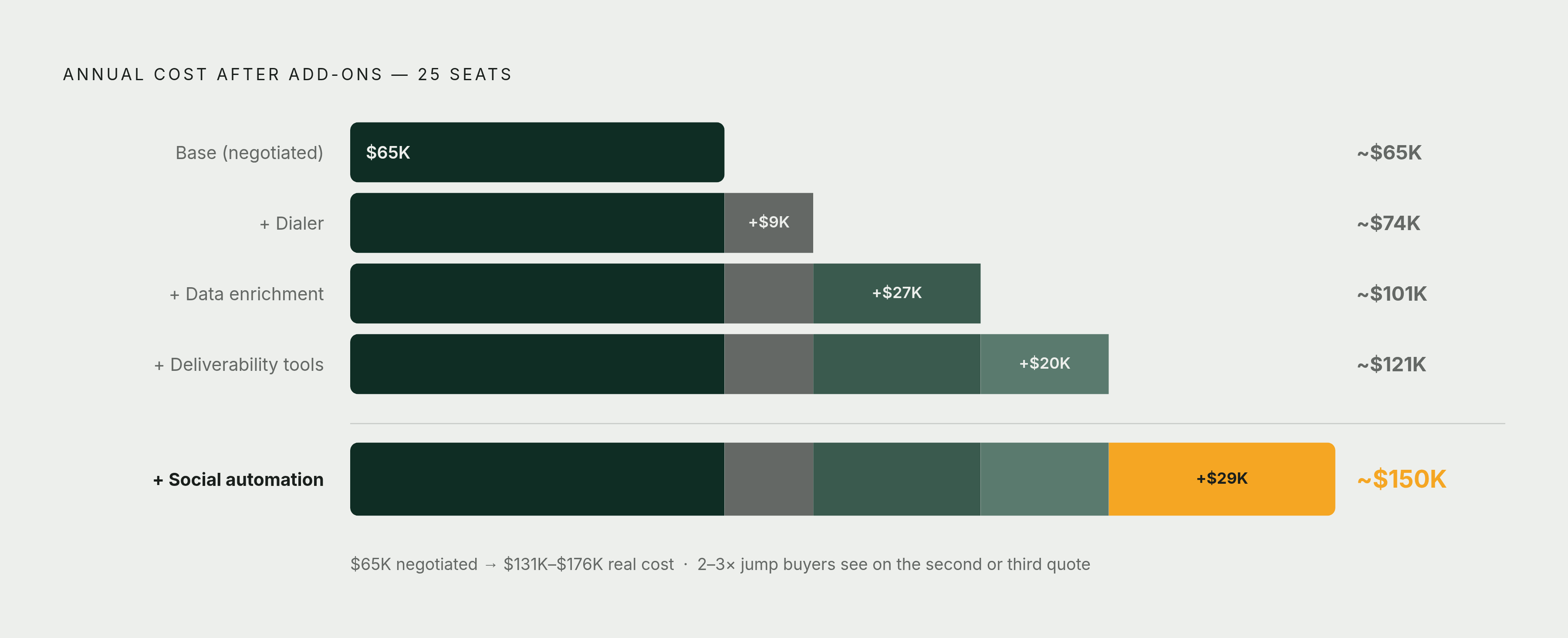
Say you negotiate a solid Advanced tier deal for 25 people. You land around $62,000 to $68,000 a year. Feels reasonable. Then the "mandatory extras" show up: dialer, data enrichment, deliverability tools, social automation. Your real annual cost lands somewhere between $131,000 and $176,000. That's a 2 to 3x jump most buyers don't see coming until the second or third quote hits their inbox.
The dialer is its own line item, running $200 to $480 per user per year, on top of your tier price. Not bundled. Not optional if your reps make calls. Budget for it from day one, not after the first invoice.
Implementation and onboarding tack on another $2,000 to $5,000 or more, depending on team size and how tangled your CRM setup already is.
A couple of negotiation benchmarks worth knowing: median contract value in procurement data sits around $30,760 a year, and buyers who negotiate well save about 17.5% on average. There are volume breakpoints at 25, 50, and 100+ users that unlock better per-seat rates. If you're close to one of those numbers, it's often worth negotiating at the higher tier before you've even filled every seat.
One more thing that bites people at signing: Sandbox environments, multi-team support, and no-code Custom Object Signals are Elite-tier only. Need any of those? Budget for the top tier from the start.
Who Salesloft fits well and where it falls short
This is built for enterprise and upper mid-market teams, 15 to 500+ reps, with an established CRM, a real sales ops function, and a process that isn't held together with tape and hope. If that's you, Salesloft tends to earn its keep.
What G2 reviewers keep praising:
- Ease of use for day-to-day selling
- Cadence building and email tracking
- Pipeline visibility and organization
- Workflow automation for lead tracking
What they keep complaining about, just as consistently:
- No auto-dialer or domain rotation built in
- Call quality issues: poor caller ID, delayed voicemails
- Salesforce sync hiccups, despite the strong reputation mentioned above
- A real learning curve for teams coming from Outlook
A few structural weak spots deserve to be said plainly, since they don't always show up in star ratings. LinkedIn automation is manual, not built into sequences the way email is. Conversation intelligence is solid, not best-in-class, if calls are your top coaching priority. Admin complexity runs high, and without someone dedicated to running the platform (ideally a RevOps person), teams end up paying for features nobody touches. And the post-merger support questions from earlier are a real risk if your team relies on a close relationship with a customer success manager.
Who's likely to feel over-engineered and overcharged here:
- Small teams, under 15 reps, with no sales ops support
- Teams doing mostly high-volume, low-cost cold email
- Teams that need conversation intelligence to be the best tool in the building, not just a decent one
- Teams that want LinkedIn outreach fully automated, not manually prompted
If you saw your team somewhere on that second list, keep reading. That's the next section.
How the main alternatives compare to Salesloft on the dimensions that matter
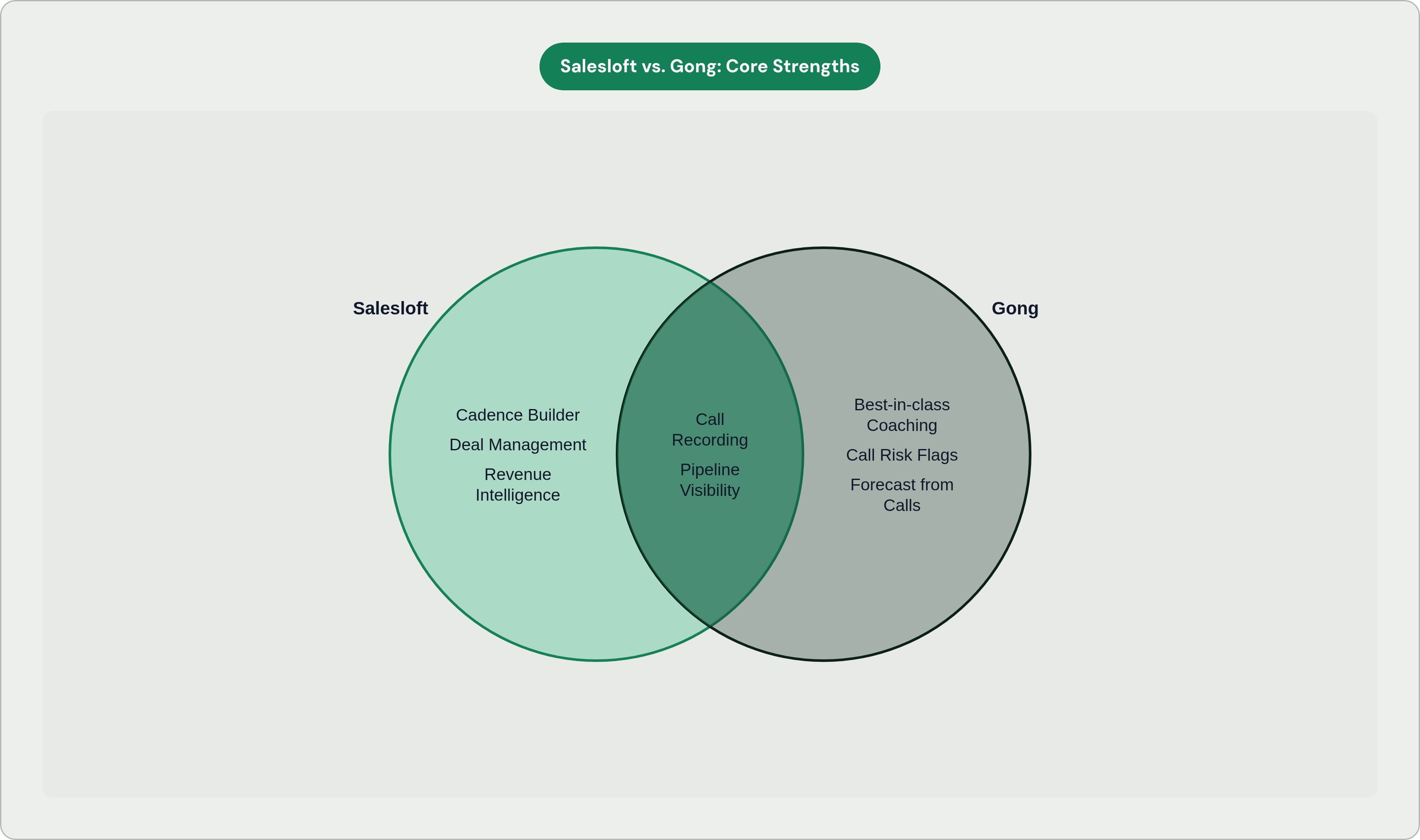
A feature checklist won't tell you much here. What matters is matching each alternative to the specific gap Salesloft leaves open for your situation.
Outreach is the closest direct competitor for enterprise sales engagement. The two get compared constantly on admin flexibility and enterprise integrations, and they're neck and neck on multi-channel cadences. Salesloft wins on ease of setup, 8.5 versus 7.6 on G2. Outreach targets the same enterprise buyer at a comparable market position. If Salesloft's post-merger support questions worry you, weigh that organizational context as part of your evaluation. But judge both on where the product stands today, not on which one looks less chaotic this particular month.
Gong is the pick if conversation intelligence is the whole reason you're shopping. Forrester said flatly the Clari-Salesloft merger doesn't close the gap to Gong here. Gong's strength is call coaching, deal risk flags, and forecasting built off actual call data. If conversation intelligence is your core investment, not a nice-to-have, it's worth evaluating seriously on that dimension.
Apollo.io fits smaller or budget-tight teams. It pairs a prospecting database with engagement sequences at a price point well below Salesloft's typical contract range. Good fit under 15 reps, or for anyone leaning heavily on cold outbound volume. The trade-off is scope: Apollo targets outbound execution rather than the broader deal management and pipeline intelligence Salesloft is built around.
HubSpot Sales Hub makes sense if you already live inside HubSpot. Sequences run natively in your CRM, so there's zero integration overhead. The cadence builder isn't as strong, and there's nothing like Rhythm's prioritization. But it's more affordable for mid-market teams, and it saves you from bolting on yet another system your reps have to learn.
Groove, now part of the same corporate family as Salesloft under Clari, deserves a mention. Clari bought Groove back in 2023, and it's historically served mid-market Salesforce users at a lower price than Salesloft. What happens to Groove's roadmap post-merger is genuinely still unclear, so if you're looking at it, ask it the same hard roadmap questions you'd ask Salesloft.
Nextstep is worth a look if you want AI help without ripping out your existing stack. It runs alongside your current inbox, calls, and CRM (Salesforce or HubSpot) instead of asking you to migrate anywhere. It drafts replies, logs updates, and books next steps automatically, aimed at cutting admin work rather than replacing your whole revenue system. It also learns from deal context and how your reps actually talk, with little prompt engineering needed. For teams under 15 reps, or bigger teams who want AI layered on top of what they already use instead of a full platform swap, it's the lower-friction option.
Questions buyers should ask before signing a Salesloft contract
Ask these before you sign anything. They save real money, and more importantly, they save you from a nasty surprise six months in.
On features: Which AI agents are actually live today, versus still in development? How does Rhythm's prioritization work with our specific CRM data? Is LinkedIn outreach a manual nudge or a truly automated step in our plan?
On the merger: What's actually unified between Salesloft and Clari right now, versus what's roadmap talk? Are we staying on Salesloft, or is there a plan to move us toward Groove eventually? What does our support tier look like today, and has anything shifted since the February 2026 layoffs?
On pricing: What's the complete list of mandatory add-ons, and what's the real annual cost once they're all in? Can we cap or remove the annual price escalator? Are we close enough to a volume breakpoint (25, 50, 100 seats) to negotiate at that tier now instead of later?
On fit: Do we actually have the RevOps capacity to run this well, or will half of it sit unused? Is conversation intelligence a core need or a nice-to-have? That answer alone changes which platform you should pick. Would a lighter add-on tool solve most of the actual problem for a fraction of the price?
None of these questions have one right answer for every buyer. Salesloft can be a strong platform for the right team and an expensive mismatch for the wrong one. The only way to find out which one you are is to ask the specific questions, out loud, in the room, instead of nodding along to the pitch.