Best Sales Engagement Platforms for Enterprise Teams
Rhythm AI ranks deals by priority each morning, cutting decision fatigue at scale.

CRM integration depth. There's a real gap between native, two-way sync and a Zapier-style connector bolted on after the fact. Only the first keeps your CRM alive as the record of truth. Sit through a demo and ask directly: does a call or email log itself, or does the rep have to click something? Does the AI check the CRM's deal stage before it drafts anything, or is it working blind? Salesforce and HubSpot run most enterprise sales orgs. Any platform that treats either as an afterthought should worry you.
Admin work that happens on its own. Manual logging doesn't just eat time, it feeds bad data into your forecast. Look for calls and emails that log themselves, AI that drafts the follow-up instead of the rep, next steps that book on their own, and CRM fields that update without anyone touching them.
AI that reads the deal versus AI that waits for a prompt. If reps have to type out a prompt to get anything useful, you've added a new manual step, not removed one. Adoption falls apart once you're past a few dozen users. The AI worth paying for reads deal history, tone, CRM stage, and past messages, then hands the rep something useful without being asked.
Governance and admin controls. This is where enterprise really splits from mid-market: sequence approval workflows, role-based permissions, guardrails for GDPR and CAN-SPAM, and audit trails. Skip these and a 200-rep team turns into 200 people making up their own outreach rules. That's its own kind of compliance headache.
Scalability signals. How long does rollout actually take, and does it need a dedicated RevOps hire just to keep running? Check the pricing model too. Per-seat pricing behaves very differently at scale than AI-credit systems does. In enterprise procurement, a spot on the Gartner or Forrester list isn't decoration. Security and vendor-stability reviews lean on it.
Channel coverage. Enterprise reps need email, phone, LinkedIn, and increasingly chat and intent signals working together. Split those across five tools and reps end up coordinating by hand anyway. That defeats the point of buying a platform in the first place.
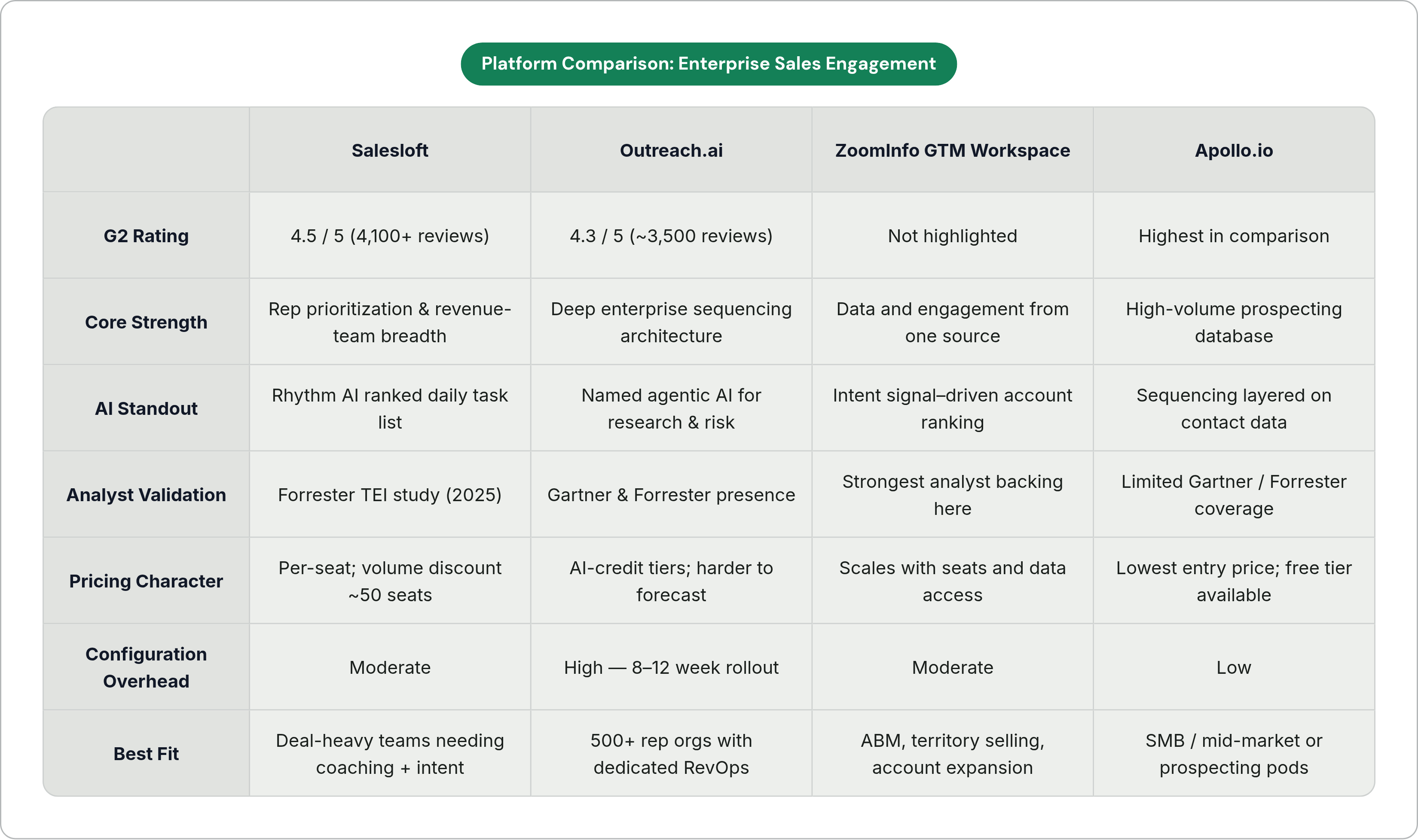
Salesloft: strongest on rep prioritization and revenue-team breadth
Salesloft's product line covers Cadence for sequencing, Conversations for call intelligence, Deals for pipeline, Drift for chat and intent, and Forecast. That's a full revenue-team stack, not a tool for SDRs firing off cold emails.
The standout feature is Rhythm AI. Each rep opens a ranked list every morning showing what to do first, pulled from email opens, CRM stage changes, intent spikes, and meeting follow-ups, with context attached. That cuts into the decision fatigue that hits a rep juggling a hundred deals at once.
Salesloft holds a 4.5 out of 5 on G2 across more than 4,100 reviews, the highest score of any platform here. It connects to over 160 applications, with native, two-way sync into both Salesforce and HubSpot. A Forrester Total Economic Impact study from April 2025, built on a composite $7 billion revenue enterprise, found a 3.3x return over three years, a 12% lift in close rates, and payback in under eight months. That's one of the more carefully documented ROI numbers in this space.
Here's the wrinkle: Salesloft and Clari finished merging in late 2025, creating a combined company serving thousands of customers. As of early 2026 the two products are still separate, with a joint roadmap set to play out over the next few years. My advice: buy for what the platform does today, not for what the merger might eventually turn into. Roadmaps slip. Mergers get messy. You're signing a contract for the product in front of you.
Pricing starts around a hundred dollars or more per user per month for core Cadence, and climbs once you add Conversations, Deals, and Forecast. Volume discounts kick in around 50 seats.
This one earns its spot when reps are drowning in deals and coaching consistency has become a real problem, especially if you want intent data and forecasting under the same roof as sequencing.
Outreach.ai: deepest enterprise sequencing architecture with significant configuration overhead
Outreach rebranded from Outreach.io to Outreach.ai in 2025 and leaned hard into agentic AI, with named agents handling research, deal risk, and account revenue. Pricing shifted too, moving from flat seat fees to AI-credit tiers under a plan called Amplify.
The platform includes Kaia for conversation intelligence, Smart Account Plans, Smart Email Assist, Deal Insights, and Commit for forecast governance. It's built for the kind of selling where five people touch one deal before it closes.
Outreach serves over 6,000 customers, most of them enterprise. On G2 it sits at 4.3 out of 5 across roughly 3,500 reviews, a touch below Salesloft but backed by a large enterprise review base.
Expect to pay roughly a hundred to a few hundred dollars per user per month billed annually, with add-ons like conversation intelligence and advanced forecasting pushing the total cost meaningfully higher. Budget for setup time too: a real rollout takes 8 to 12 weeks, and the platform rewards teams that configure it carefully. You need someone internally who can own that setup close to full-time, and that's a real cost sitting on top of the license price, not a footnote you can wave away.
The AI-credit pricing adds a wrinkle for finance teams too. Usage-based costs are harder to forecast than a flat per-seat number, especially once you're budgeting for hundreds of reps.
This is built for enterprises with 500-plus reps, a dedicated RevOps function, and a real need for forecast governance layered on top of sequencing. The configuration overhead isn't a flaw here, it's the tradeoff for depth. But a team without RevOps capacity will pay full price for a lot of features it never touches.
ZoomInfo GTM Workspace: strongest when data and engagement need to run from the same source
ZoomInfo's core argument is that data and engagement should originate from the same platform rather than being bolted together from separate tools.
The analyst backing here is the strongest in this comparison. ZoomInfo has accumulated meaningful recognition in analyst coverage, including from Gartner and Forrester. As a public company, it serves a large and diverse enterprise customer base. For a procurement team worried about vendor stability, that's about as low-risk as this category gets.
ZoomInfo's own case studies report strong numbers: Some customers report meaningful gains in rep productivity and pipeline attribution in ZoomInfo's own case study materials. Other customers cite substantial improvements in closed-won rates and quota attainment. These numbers come from ZoomInfo's own materials, so check them yourself before you repeat them in a board deck. But the level of detail behind them is unusual for this kind of vendor case study.
Pricing varies considerably by seat count and data access tier, with enterprise contracts typically running well into five figures annually. Entry plans run lower, but enterprise tiers scale with both seat count and data access.
Buy this one when ranking accounts by intent signal is the daily job: ABM programs, territory selling, account expansion. If your core need is rep-level sequencing and coaching rather than account intelligence, ZoomInfo's engagement layer is thinner than what Salesloft or Outreach offer. The data is the product here. Sequencing just rides on top of it.
Apollo.io: the highest-rated platform on G2 but with real enterprise ceiling concerns
Apollo's foundation is its database: over 230 million contacts, 30 million-plus companies, and email accuracy reported at 97%. Sequencing sits on top of that data layer, not the other way around.
The growth numbers are hard to ignore. Apollo hit $150 million in annual recurring revenue by May 2025, with a broad user base spanning companies of varying sizes. That scale reflects dominance in the SMB and mid-market world, not necessarily readiness for enterprise.
On G2, Apollo holds a strong rating that sits above the other platforms in this comparison. Worth knowing: its review base skews toward smaller teams, so read that number with enterprise context in mind. Pricing starts well below Salesloft and Outreach on a per-user basis, with a free tier available. The Organization tier requires a minimum of three users, which tells you exactly who this product was built for.
Here's the gap that actually matters for enterprise buyers: Apollo does not carry the same level of analyst validation from Gartner or Forrester that ZoomInfo, Salesloft, and Outreach have accumulated. That's a real problem when procurement treats analyst validation as part of a standard security and vendor review. A rough but useful way to think about fit: Apollo tends to serve smaller teams, Salesloft scales well into mid-market, and Outreach is purpose-built for large enterprise deployments. Team size alone won't decide this for you, but it's a reasonable place to start filtering.
Apollo fits teams running high-volume prospecting with heavy data needs and lighter governance demands, or an enterprise running a separate prospecting pod outside its main revenue stack.
Where AI-native sales automation fits alongside a traditional SEP
Here's the gap none of the big three fully close. Salesloft, Outreach, and ZoomInfo all ship AI features, but that AI mostly lives inside the platform. Reps still switch tabs, log things by hand the moment they step outside the SEP, and have to prompt the AI to get it to do anything.
And even with an SEP in place, the overhead doesn't disappear. Roughly 75% of sales teams already use engagement technology, yet reported productivity gains average only around 25%. Sit with that gap for a second. Time is still leaking out somewhere: writing post-call summaries, updating CRM fields from an email thread, booking next steps from a conversation that happened over text or LinkedIn, drafting replies to inbound messages that never fit into a sequence in the first place.
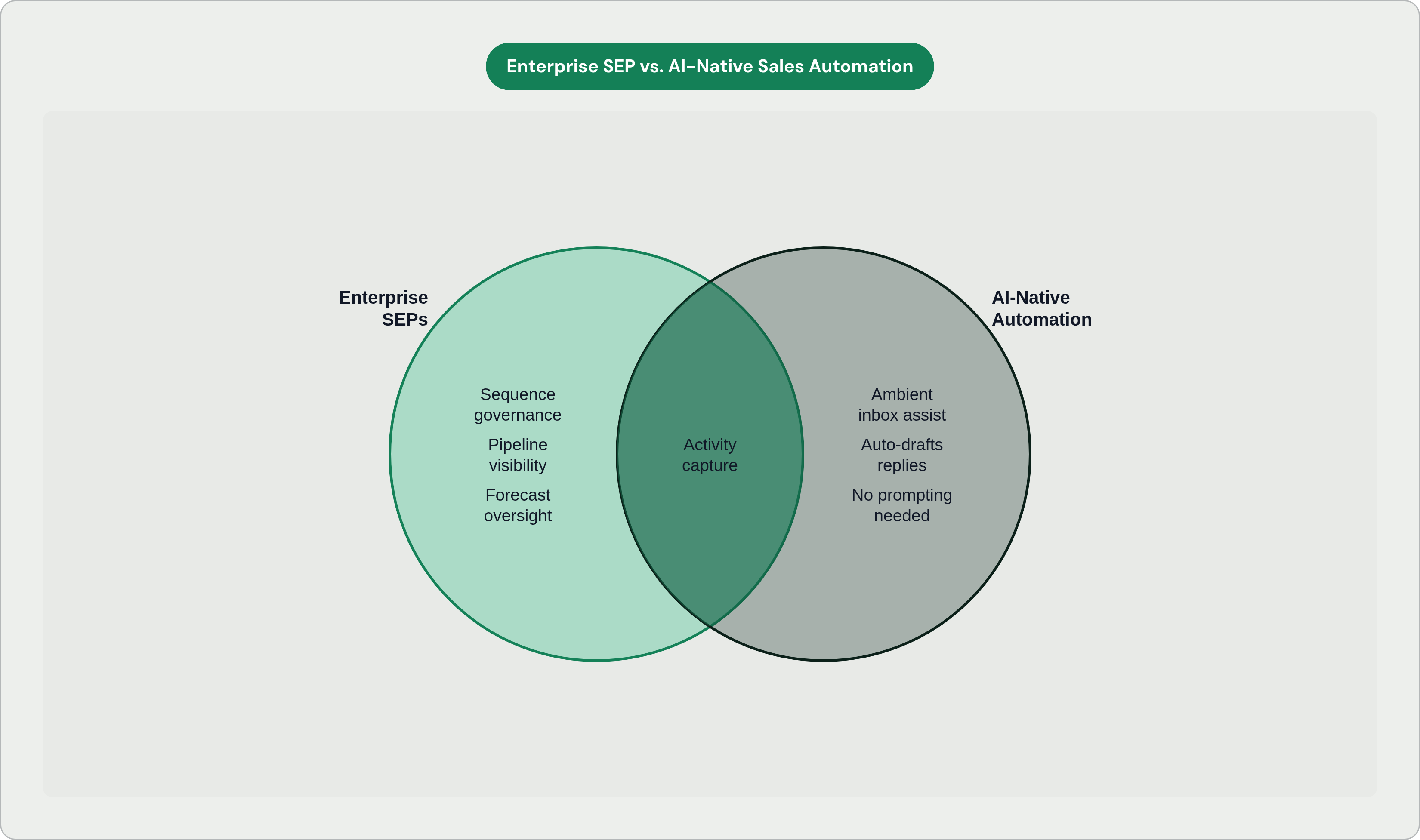
This is where tools built to run alongside the inbox, the phone, and the CRM, rather than replace any of them, start to matter. The good ones learn deal context and a rep's own tone well enough to draft replies, log updates, and book next steps without anyone opening the SEP or typing a prompt. A tool that writes back to Salesforce or HubSpot on its own keeps your CRM as the single source of truth. One that doesn't just builds another silo.
For teams already running Salesloft or Outreach, adding something in this category isn't a competing purchase, it's additive. The SEP handles sequence strategy and pipeline visibility. The ambient layer cleans up the manual work that happens in between those touchpoints. The real question to ask your own team: is the biggest pain point sequencing and pipeline orchestration, or the administrative drag on individual reps between touchpoints? Most large enterprise teams, if they're honest, have both.
How to structure the evaluation process for a team of this scale
Start with an integration audit before you sit through a single demo. Map every tool your revenue team touches daily: CRM, dialer, inbox, video conferencing, intent data, forecasting software. Each connection point is a potential gap if the SEP handles it poorly. When you get to the demo, ask for a live look at Salesforce or HubSpot sync, not a slide. Ask exactly what writes back on its own and what still needs a rep to click something.
When you pilot a platform, do it properly. Include a real mix of rep profiles: senior enterprise AEs, SDRs, and at least one manager who'll own sequence governance once it's live. Track admin time before the pilot starts and all the way through it. You'll need that baseline to make the case to your CFO later.
Budget usually isn't the obstacle here. Gartner reports that 90% of sales leaders plan to invest in SEPs, so the money is generally there. The real hurdle is proving measurable productivity gains inside the pilot window, before the contract gets signed. Total cost of ownership runs well past the license fee: factor in setup time, the internal admin hours needed to run the platform, and how pricing behaves once you scale past your pilot group into the full team.