Seamless.ai Data Accuracy and Comparison to Competitors
Real-time freshness claims crumbled when LinkedIn banned the platform's scraping in March 2025.

Seamless.ai's pitch fits on a bumper sticker: we're not a database, we're a search engine. It crawls the web in real time, the story goes, instead of sitting on a pile of contacts that got refreshed sometime around Groundhog Day. I've spent enough time pulling lists from this thing to have opinions about whether it holds up, and the honest answer is: sort of, in some places, not even close in others.
Here's the mechanism. You're on LinkedIn, or a company site, and the Chrome extension checks contact info on the spot instead of pulling from an old file. Stack a large claimed database on top of that, add Buyer Intent, Job Changes, and Data Enrichment, and you've got a product marketed as an engine, not a filing cabinet.
Seamless runs on credits. One credit buys a phone number plus an email, bundled together whether you wanted both or not. That detail decides how expensive a bad record actually is. On G2, the product ranks among the higher-rated sales intelligence tools, with a satisfaction badge in 2025.
Where the real-world accuracy numbers diverge from the marketed rate
Seamless advertises accuracy in the high nineties. Skrapp.io, a third-party review source, scores its data accuracy at 6 out of 10.
Email bounce rates are the complaint that shows up again and again on G2, Capterra, and Trustpilot. Users describe bounce rates well above what a sending domain can absorb. Phone numbers are worse, and the pattern is specific: mobile numbers for non-executive roles, and contacts outside the US, are where things fall apart most. Job titles go stale often enough that it's a recurring complaint too.
A high bounce rate wastes more than your morning. It damages your sending domain's reputation, which makes your next campaign harder to deliver even after you've scrubbed the list clean.
To be fair, email is the strongest data type Seamless has. Cross-checking against public data and partner networks does real work here. It just doesn't land anywhere near the number on the homepage.
There's a stranger wrinkle too: Trustpilot and G2 tell nearly opposite stories. Happy users rave about the workflow, the speed, the "find anyone" feeling. Unhappy users describe something closer to being handed a bad list with no way out. The gap between the two stories is too wide to be normal noise.
Budget for the middle of those two stories. Not either edge.
How the March 2025 LinkedIn ban disrupted the real-time verification model
On March 6, 2025, LinkedIn kicked both Apollo.io and Seamless.ai off its platform. The stated reason: automating data collection from user profiles at scale, in violation of LinkedIn's terms of service.
The Chrome extension still runs. The pipe feeding it works differently now. Live pulls from LinkedIn profiles, the exact thing that made "real-time" mean something, got cut off.
A large chunk of Seamless's freshness came straight from LinkedIn's live updates. Once that feed disappears, job titles and role changes go stale fast. It's fair to wonder whether LinkedIn's motive here is purely about enforcing terms of service, too — scraping at scale is also a direct threat to LinkedIn's own paid product, Sales Navigator.
Here's the part worth noticing if you're shopping around: ZoomInfo's Chrome extension overlays its own pre-existing data on top of a LinkedIn page. It never pulled from the live profile in the first place, so the ban didn't touch it. That's not a compliance difference. It's a structural one, and it only shows up once you stop reading the feature list and start asking how the thing works underneath.
The ban wasn't isolated, either. More scraping-related removals followed in May 2025. For anyone weighing Seamless today, the thing it built its whole identity on, real-time crawling, sits on shakier ground than it did a year ago.
What Credit Back Protection fixes and what it does not
Seamless rolled out Credit Back Protection in the 2025-2026 window. The mechanic is simple: an invalid email lookup gets your credit refunded automatically. That's a direct fix for the credit-waste complaint that shows up constantly in reviews. Paying for dead emails and getting nothing back used to be a real sore spot; now there's a way to claw some of that back.
But be clear about where the line sits. Phone numbers aren't covered. The refund applies to emails only, so mobile verification risk still sits on your side of the ledger. And it does nothing for the job title problem the LinkedIn cutoff created. A refunded credit can't un-stale a job title.
There's a quieter cost the refund doesn't touch: the damage to your sender reputation that happens before a bounce even registers. By the time your credit comes back, the hit to your domain may already be done.
Small footnote worth knowing: UpLead has had a similar credit-back setup for email accuracy for a while now. Seamless isn't inventing anything here; it's catching up to a standard a competitor already set. Credit Back Protection cuts down on wasted money. It doesn't raise the ceiling on data quality.
What Seamless actually costs once contract terms are factored in
There's no price on the website. You talk to sales, which makes comparison shopping harder than it should be. SpendHound's 2026 analysis of actual customer invoices (not list prices, actual bills) puts average SMB spend around $8,000 a year and average enterprise spend around $18,000.
The Pro plan requires a minimum number of user licenses and usually comes as a 12-month contract, billed upfront. That's a lot to commit to on the strength of one sales call.
Then there's the auto-renewal clause. The contract renews for another 12 months automatically unless you file a non-renewal form at least 60 days before it ends. That single clause is behind a lot of the negative Trustpilot reviews. It turns "I forgot to cancel" into a second year of spend nobody planned for.
Credits on the Pro plan refresh daily but expire at midnight. Use them or lose them. Any day you're not prospecting is a day of credits gone for nothing.
Here's a detail easy to miss on the pricing page: four features shown with a checkmark on Pro, AI Assistant, Data Enrichment, Autopilot, and Buyer Intent, are actually separate paywalled add-ons. The checkmark implies included. It isn't, not without paying more.
For context, SpendHound's numbers put ZoomInfo well above Seamless at both tiers, while Lusha and Apollo sit in different price bands entirely. Seamless lands in the middle on sticker cost, but the contract terms add a tax of their own that not every competitor charges.
How Apollo.io's accuracy and model compare to Seamless on the dimensions buyers actually measure
Apollo runs its own large contact database, but the accuracy piece is built into the product itself: a multi-step email verifier baked into the architecture, not bolted on after complaints started piling up.
In practitioner comparisons, Apollo's reported bounce rates come in meaningfully lower than Seamless's, and that gap holds across multiple reviewer sources. Neither one hits zero bounces, but the gap between them is real and consistent.
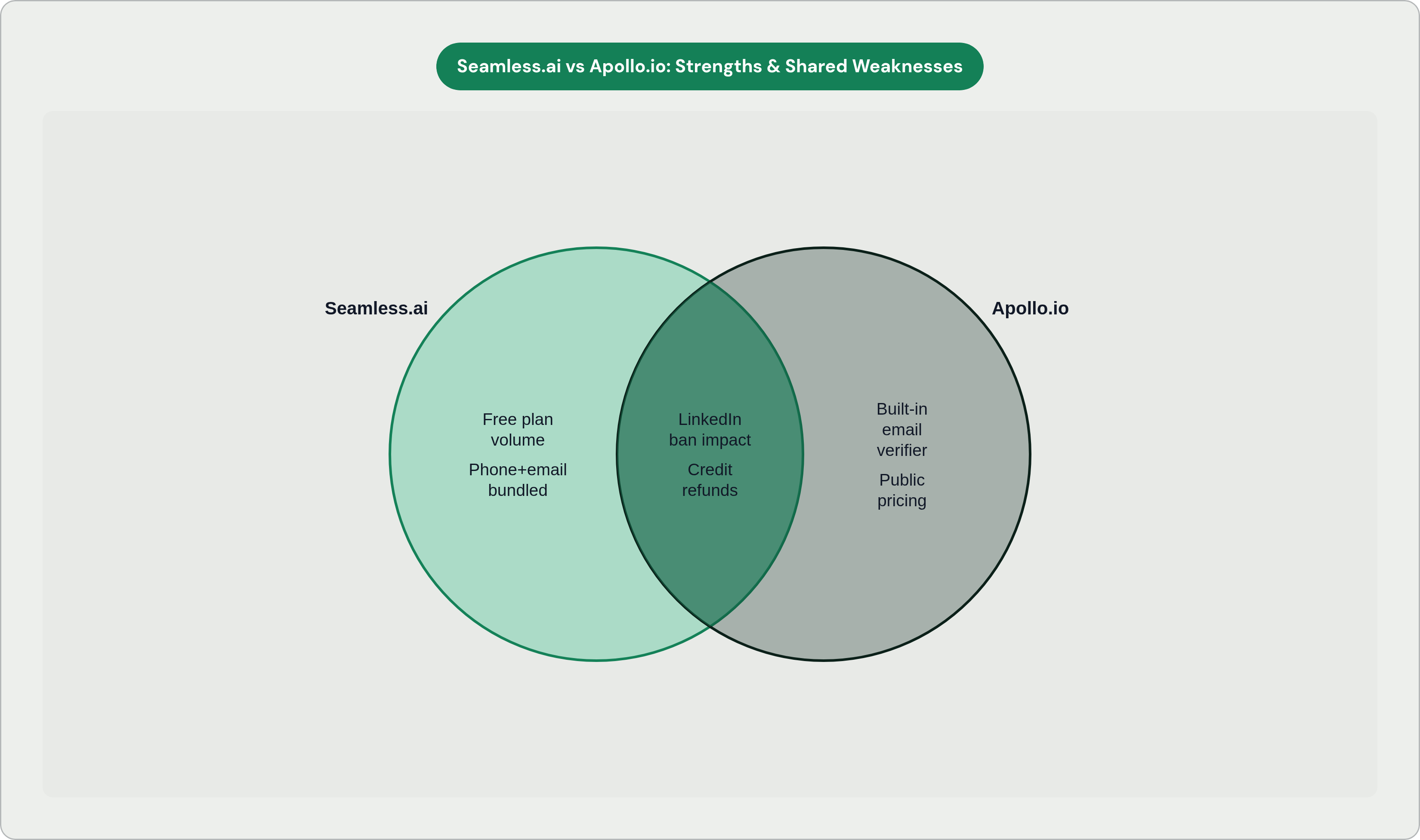
Apollo got caught in the same March 2025 LinkedIn ban, for what it's worth. Both platforms share that exact structural weakness on LinkedIn-sourced freshness.
Where Apollo pulls ahead: pricing is public, and you can pay monthly without locking into a year upfront. Apollo also bundles sequencing, a dialer, and a meeting scheduler into the core product, where Seamless charges extra for each one. Whether that bundling actually saves you money depends entirely on whether your team needs those tools in the first place.
Seamless still holds two things over Apollo: the one-credit-equals-phone-plus-email math, and a free plan that works for high-volume prospecting on a tight budget.
On Trustpilot, Apollo's standing is stronger, too. The love-it-or-feel-trapped split that follows Seamless around barely shows up over there.
Depends on what you're actually optimizing for. If verified quality matters more than raw volume, Apollo's the safer bet. If you need to blanket a market cheaply and can tolerate more misses, Seamless's economics still make sense.
Where ZoomInfo's accuracy leads and where its guarantees are narrower than advertised
ZoomInfo's verification works differently. It runs addresses through NeverBounce across multiple checks and pulls data partly from a contributor network built on inbox-level signals. That's a different animal from crawling the open web, and it shows in the results.
But read the guarantee closely. ZoomInfo's 95% accuracy figure covers company affiliation, meaning whether the person actually works where it says they work. It doesn't cover email deliverability, phone accuracy, or how fresh the job title is. Real-world email accuracy in user reviews lands somewhere in the mid-to-high seventies to mid-eighties percent, and a bounce rate in that range still hurts your sender reputation.
UnboundB2B's benchmark testing found the large majority of ZoomInfo emails checked out accurate, with data attribute accuracy well above typical provider rates. That's a real, third-party-verified strength, not just a marketing line.
And because ZoomInfo's Chrome extension overlays existing data instead of scraping live LinkedIn profiles, it sailed through the March 2025 ban without a scratch — a structural advantage that's easy to overlook until you've lived through the alternative.
The weak spots are just as clear, though. International coverage, especially Europe and APAC, is a known gap, and connect rates for those regions drop noticeably in user reports. And because it's a static database at its core, data decays between refresh cycles. Export a list today, and a good chunk of those contacts may have moved on by the time you use it.
Cost is the other side of it. SpendHound's 2026 numbers put ZoomInfo's average annual spend several times higher than Seamless at both SMB and enterprise tiers. The accuracy edge is real, but it isn't cheap. ZoomInfo makes the most sense when North American accuracy and org-chart depth are what you need and the budget can absorb it. It's a tougher sell if you're international-first or working with less money to spend.
Cognism for European coverage and UpLead for email accuracy as category specialists
Some tools don't try to win everywhere. They pick one lane and own it.
Cognism owns European phone numbers, full stop, through what it calls Diamond Data, a human-verified layer that ZoomInfo, Apollo, and Seamless don't match for European mobile numbers. The verification model produces connect rates well above standard database averages for prospecting lists across Europe. Not a marginal edge — the category benchmark.
Cognism also builds GDPR and CCPA compliance into the core product instead of bolting it on as an afterthought. For teams working under European data rules, that's the line between a usable tool and a legal headache. Seamless doesn't compare well here. The tradeoff is price: Cognism runs at a premium, usually with annual contracts and real minimum spend. Not really built for SMB budgets, and Cognism doesn't pretend otherwise.
UpLead specializes differently: real-time email verification at the moment you unlock a contact. Every record gets checked right when you export it, not on some batch schedule, and bounced emails get their credits back. Practitioner tests put UpLead's email accuracy near the top of the category, with bounce rates well below Seamless's. The catch: the credit-back guarantee, like Seamless's newer version, covers emails only, not phones.
UpLead's database is also smaller than what Seamless claims to have. That's the trade: less total volume, more verified quality on what you do get.
If you're prospecting across Europe under GDPR, Cognism is worth the premium. If email deliverability is your bottleneck and raw volume isn't the priority, UpLead earns its keep.
How to match the right platform to the accuracy dimensions your team actually needs
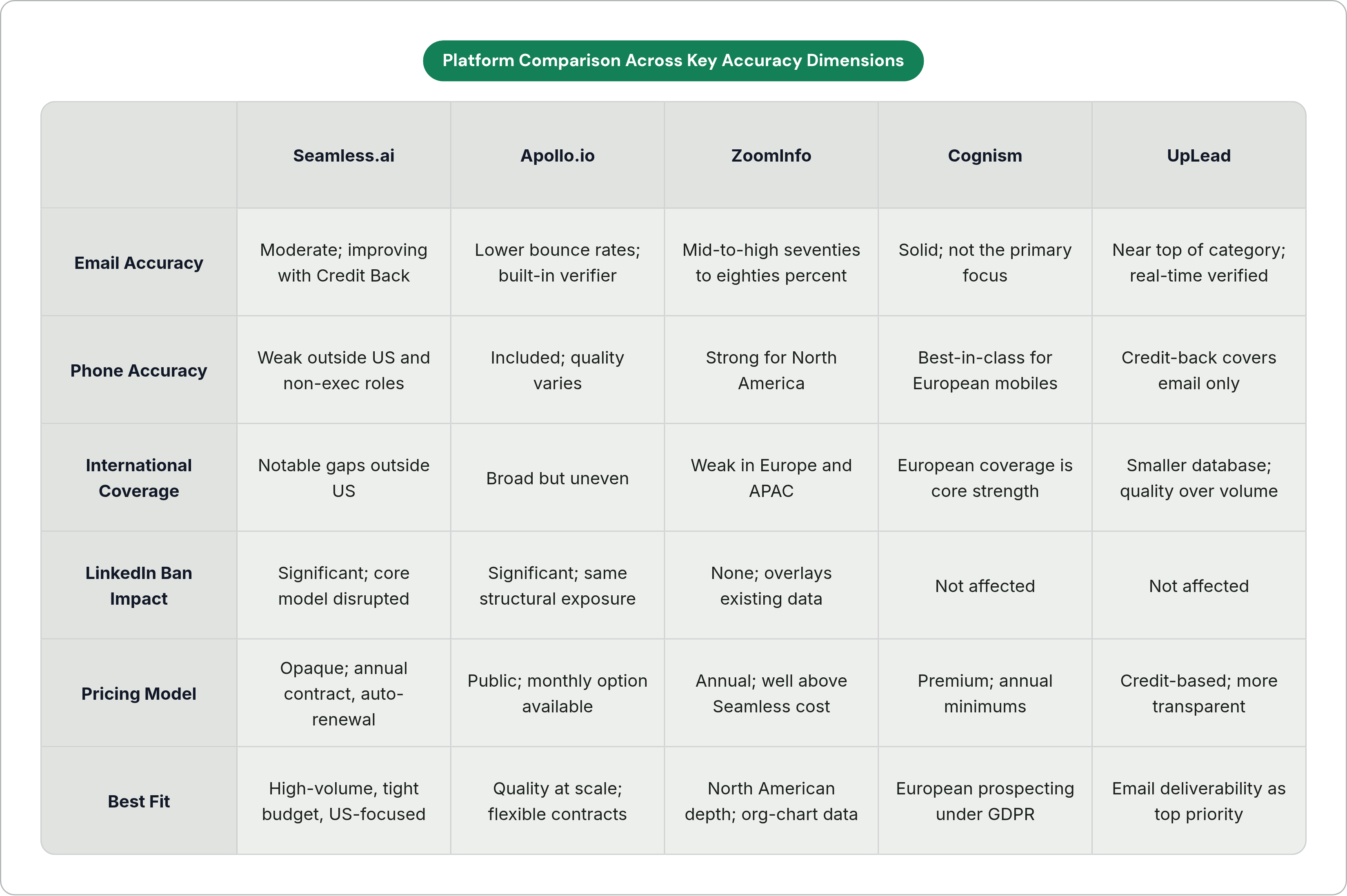
"Accuracy" isn't one number, no matter how confidently it's printed on a homepage. It's at least five separate things: email deliverability, phone connect rates, job title freshness, international coverage, and compliance posture. Every platform in this piece falls short on at least one.
So ask yourself what you're actually optimizing for.
Chasing email deliverability at scale? Apollo's lower bounce rates and UpLead's real-time verification both beat Seamless, and the LinkedIn disruption has only widened that gap.
Need phone-verified mobile numbers in Europe? Cognism's Diamond Data is the benchmark. Nothing else here comes close.
Working with a tight budget and need database size and credit economics that stretch further? Seamless still holds up, especially now that Credit Back Protection cuts down on wasted credits from bad emails.
There's a dimension that doesn't get enough airtime: workflow. Bad prospecting data bounces and then lingers. It sits in your CRM quietly rotting unless something actively keeps it current. That's less a data-provider problem and more a process problem. Tools that run alongside your inbox, calls, and CRM, logging updates automatically and surfacing deal context without manual entry, limit how much damage a bad contact record can do down the line. The accuracy problem isn't only about a vendor's crawl or database. It's also about whether your own systems catch what slips through, no matter who you're buying from.
One more thing worth weighing alongside all this: contract terms. Seamless's auto-renewal clause and paywalled add-ons mean the real cost of a bad fit runs higher than the sticker price suggests. Apollo's month-to-month option cuts that risk down considerably.
There's no single most accurate platform in this whole comparison. There's the most accurate platform for your geography, your use case, your budget. Figure out which dimension actually costs you money when it fails, and buy for that one first.