Conversational AI Examples in Sales Onboarding and Enablement
Conversational AI gives sales teams three ways to practice reps faster and coach them continuously.
This piece looks at conversational AI in sales onboarding: where it actually shows up, what each version of it does, and how sales leaders can tell which one fits which problem. Start with the problem, because the tools only make sense once you see what they're fixing.
Picture a new hire's first month. They sit through product decks, shadow a few calls if a manager has time to invite them along, and then get put on the phone with a real buyer who has no idea (and no reason to care) that this is the rep's first week. There's barely any rehearsal in between.
Layer a second constraint on top. Managers only have so many hours. So the honest version of most onboarding programs looks like this: a little bit of shadowing, a little bit of feedback, and a lot of hoping the rep figures the rest out on live calls with real money on the line.
Slower ramp times, deals lost to reps who weren't ready yet, and an uneven customer experience depending on who picked up the phone appear where managers can least afford them. None of this is news to anyone running a sales org. What's changing is how leading teams think about the fix. Instead of treating onboarding as a one-time event (a few weeks of training, then you're on your own), stronger organizations are starting to treat it as the first stretch of a much longer, ongoing enablement process. That shift matters because it changes what kind of tooling actually works. A training program that runs in batches, once a quarter, in a conference room, can't support something that's supposed to run continuously. The tooling has to keep pace with the new philosophy.
How conversational AI addresses both constraints at once
Conversational AI is useful here for a simple reason: it attacks both constraints in the same motion. It also gives feedback instantly, without pulling a manager away from their own pipeline, which eases the bandwidth constraint too. One tool, two long-standing bottlenecks.
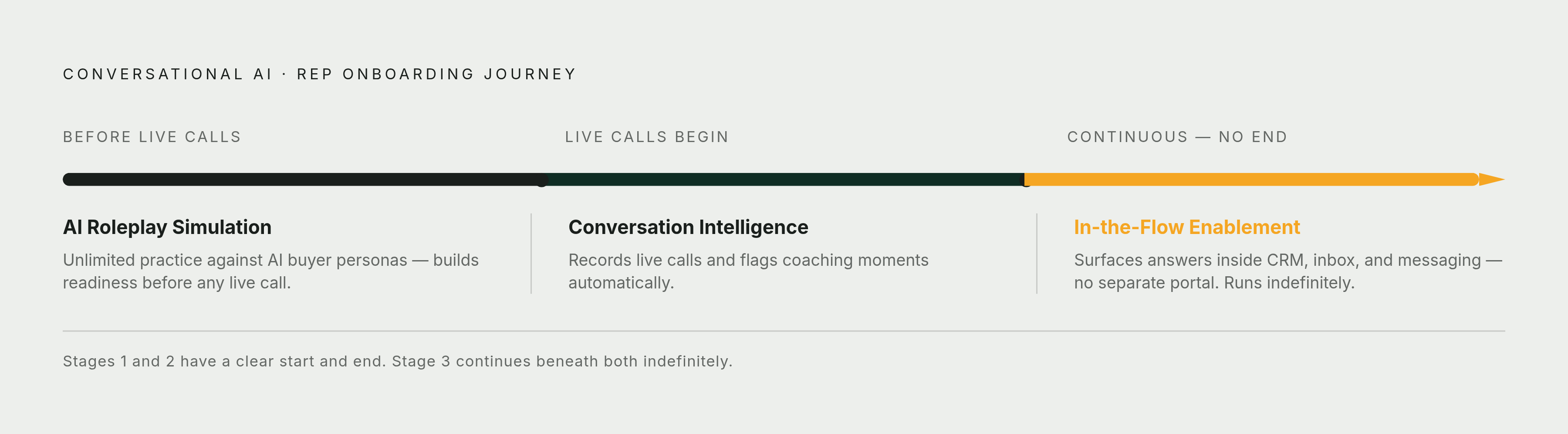
In practice, this appears as three distinct modes, and each one lives at a different point in a new rep's timeline. And running underneath both of those, in-the-flow enablement delivers answers and guidance right inside the tools reps are already using while they sell, instead of asking them to go dig for information somewhere else.
Each of these modes solves a different piece of the onboarding puzzle, and none of them is a stand-in for the other two. The rest of this piece walks through each one in turn, with real platforms and concrete examples, so the differences stop being abstract.
AI roleplay simulation: giving new reps unlimited practice reps before live calls
Of the three modes, AI roleplay simulation has the clearest, most direct line to faster ramp times. It solves the single scarcest resource in traditional onboarding: somebody to practice against. A manager can only sit in so many mock calls a week. An AI buyer persona can run through scenarios all day, every day, and never once say it's too busy.
The mechanics are straightforward. New hires work through cold calls, discovery conversations, product demos, and objection handling out loud, against an AI persona built to act like a real buyer and adjust its responses based on how the rep is doing. One associate at a company using this kind of practice setup said they were able to keep rehearsing until they genuinely felt ready. That's a very different experience from waiting around for a slot on a manager's calendar to open up.
A handful of platforms cover this ground, each with its own angle. Hyperbound calls itself a Revenue Activation Platform, stretching across onboarding, certifications, quality assurance, and deal coaching, with AI roleplay as a core piece of how it works. Mindtickle pairs AI role-play with a Copilot feature, aimed at coaching and readiness at scale, and prices its offering on a custom basis. Salesforce Agentforce builds its version straight into the CRM, through a feature called Agentforce Sales Coach, and prices it either as part of the package or on usage. Second Nature shows up in comparisons of top sales onboarding tools as another option built around AI sales simulations.
Even the best AI roleplay happens in a controlled space. Real sales conversations bring uncomfortable silences, objections nobody scripted for, and emotional undercurrents that don't appear neatly in a training scenario. The job of AI roleplay isn't to replace the mess of a real conversation, but to get a rep ready to handle that mess with more confidence than they'd otherwise have on day one, and conversation intelligence picks up that gap once reps start taking real calls.
Conversation intelligence: turning every early call into a coaching moment
Simulation gets a rep ready to make the first call. Conversation intelligence picks up once that call actually happens. Most early calls in a traditional onboarding program are never reviewed by anyone. The rep hangs up, moves to the next call, and never finds out what they missed, what landed, or what nearly cost them the deal.
Conversation intelligence platforms record, transcribe, and break down real calls and meetings, then flag coaching moments on their own, without waiting for a manager to pull the recording and watch it back. The platform flags whether the new rep talked too long during discovery. Did they fumble a pricing objection? Did they miss a clear buying signal the buyer practically handed them? The platform catches it and surfaces it.
For onboarding specifically, this changes what a rep's first few weeks of live calls actually produce. Instead of experience that just passes by unexamined, those early calls turn into a running, structured coaching feed. IBM's description of agentic AI in sales enablement gives a sense of how far this can go: an AI agent can watch a rep's pipeline, spot a deal that's gone quiet, draft a personalized follow-up message, pull in whichever case study fits the situation best, and alert the manager that coaching is needed, all as one connected workflow rather than four separate features bolted together.
A few platforms anchor this space. Highspot focuses on content-performance analytics, using a feature called Scorecards to tie content usage directly to deal outcomes, priced on a custom basis. Seismic covers enterprise content governance and uses a feature called Aura to recommend content, also custom-priced. Mindtickle shows up again here too, since its platform covers conversation analysis alongside its roleplay tools, making it a kind of bridge between the practice stage and the real-call stage.
The payoff for managers is less about saving time (though it does that) and more about where their time goes. AI can handle the repetitive, foundational layer of coaching on its own: reviewing recordings, flagging filler words, spotting objection patterns that keep recurring. That frees managers from grinding through post-call debriefs line by line, so they can spend their limited hours on the strategic coaching and deal mentorship that actually needs a human in the room.
In-the-flow enablement: surfacing answers inside the tools reps already use
The first two modes both happen at a fixed moment, a scheduled practice session or a review after the call ends. The third mode delivers help without waiting for a scheduled moment. It delivers the right answer the moment a rep needs it, inside whatever tool they're already working in, whether that's a CRM, an inbox, or a messaging app. No separate portal, no stopping to go look something up.
IBM frames this as a shift from "pull" enablement to "push" enablement. In the old model, a rep has to stop what they're doing, go find a portal, and search for the right battlecard. In the new model, the battlecard shows up on the call itself, without the rep ever leaving their workflow. For onboarding, this matters because new reps can't be expected to remember every policy, every process step, and every objection-handling tactic they were shown during their first weeks of training. In-the-flow tools put that knowledge within reach exactly when it becomes relevant, rather than expecting it to stick from a slide deck shown three weeks earlier.
The same pattern applies to inbox and CRM work, where some tools surface guidance directly inside the tools reps use to manage deals and correspondence. The point of calling it out isn't to crown a winner in this category: it's to show what the mode looks like when it's working, with help that appears inside the rep's existing workflow instead of requiring them to go find it somewhere else.
Scaling conversational AI from individual reps to team-wide enablement
Everything so far has been about one rep at a time: practicing, getting reviewed, getting helped in the moment. But run these same mechanisms across an entire team, and something new appears that individual coaching alone can't produce: structured, comparable data across every rep, every call, and every stage of the deal pipeline.
IBM points to this as a distinct benefit for sales leadership. And the data doesn't just sit with sales. Over time, that closes the gap between what a training program delivers on day one and what live deals actually demand six months later.
Highspot's Scorecards tie content usage, pitch performance, and buyer engagement together, turning team-level conversation data into actual enablement decisions, not just isolated feedback for one rep on one call.
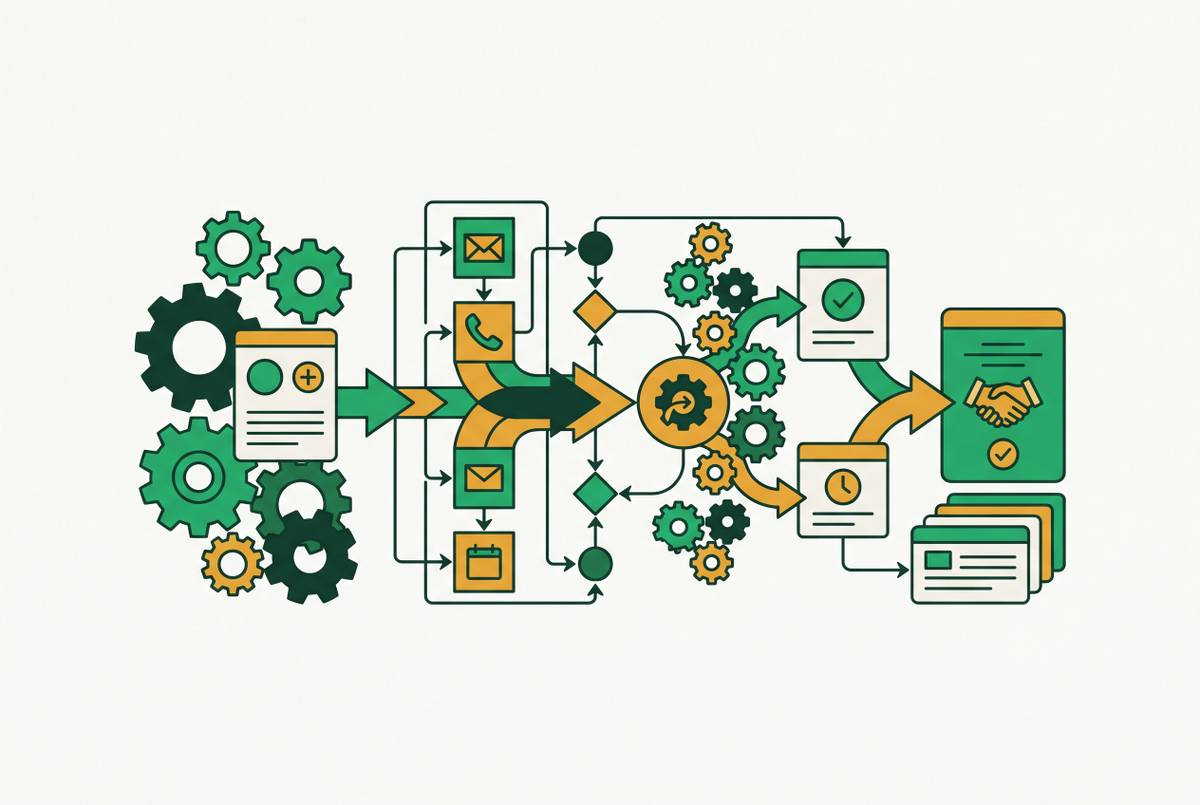
The next layer building on top of this is agentic AI, separate from everything described so far. Instead of just surfacing an insight for a human to notice and act on, an AI agent can monitor a pipeline on its own, draft a follow-up message, pull the case study that fits, and alert a manager, all strung together as one coordinated workflow. That piece turns a handful of separate use cases into something closer to a system, where the practice tool, the call review, and the in-the-moment help all feed each other instead of running in isolation.
More capability also means more surface area for things to go wrong on the adoption side, which is exactly where the conversation needs to go next.
Why adoption is harder than deployment
None of the capability described above means much if reps don't actually use it, a gap in adoption rather than deployment that produces the real problem. Buying a tool and getting people to genuinely change how they sell are two different jobs, and most organizations are further along on the first one than the second.
Sales technology spending keeps climbing, yet results aren't matching the investment. IBM's 2024 data put sales teams' net promoter score at just 16% that year. Training programs exist on paper in plenty of organizations, but adoption is spotty, and getting reps to actually change their behavior has turned out to be a much harder problem than buying the software suggested it would be.
Reps who feel like AI coaching is watching them rather than helping them will find quiet ways to work around it. Managing that risk takes real change management, not just a good product. Someone on the team needs to own how AI fits into onboarding and make sure it's built into the process by default, not offered as an optional extra reps can skip.
And there's a hard ceiling on what any of this can do on its own. AI can tell a rep they used too many filler words on a call. It can't tell them which executive stakeholder to prioritize in a six-figure, multi-stakeholder deal. Judgment calls like that still need a human who's seen enough deals to read the room. Enablement programs that lean on AI as a stand-in for manager coaching, rather than a way to make that coaching go further, will come up short.
Matching the right conversational AI mode to each stage of the onboarding journey
Pulling this together, the three modes aren't interchangeable and shouldn't be picked based on which one sounds most impressive in a product demo. Each one solves a different problem at a different point in a rep's timeline, so the real work is matching the mode to the stage a rep is actually in.
Before a rep ever gets on a live call, AI roleplay simulation is the right tool, because what they need most at that point is practice reps, not more theory. Which one fits best depends on the rest of the tech stack already in place and on whether the bigger priority is coaching or formal certification.
Once a rep starts taking live calls and finishing them, conversation intelligence becomes the right mode, because real calls produce a kind of data no simulation can fake.
In-the-flow enablement runs continuously beneath both of those, covering the stage that never really ends. Spekit fits here for teams that want just-in-time answers regardless of which app a rep happens to be in, Cirrus Insight fits teams built heavily around Salesforce and inbox workflows, and other tools fit inbox, CRM, and call-centered workflows. The help that all three provide appears inside the rep's existing workflow, not tucked away in a separate portal they have to remember to visit.
The three line up in a sequence that makes sense on its own. Simulation builds the readiness a rep needs before the first real call. Conversation intelligence sharpens that readiness against real deals once calls start happening. In-the-flow enablement keeps reinforcing it every day after, quietly, in the background, for as long as the rep is selling.