Cold Calling Script Formats for B2B Sales Reps
Conversation frameworks beat scripts because reps adjust in real time.
RAIN Group research finds that 82% of B2B buyers accept meetings with sellers who reach out to them first. That number alone should settle any lingering debate about whether cold calling still works. The phone is the only channel where a rep asks a question, hears the real answer, and adjusts on the spot. Email can't do that. A voicemail definitely can't do that.
Senior buyers back this up with their own preferences. None of this means the channel does the work by itself. The channel has recovered. What a rep does once the call connects is the variable actually worth optimizing, and that's the real subject of this piece.
Word-for-word scripts versus conversation frameworks
A script that has to be read word for word produces exactly the kind of delivery a buyer can spot in the first five seconds: flat, rehearsed, slightly panicked underneath. A conversation framework solves this by keeping the structure and losing the memorization. The rep still knows where the call is headed. The rep just isn't reciting it.
The shift from monologue to framework changes one thing and keeps another fixed. A framework also does something practical for the rep's own performance. It gives new hires a repeatable path to a booked meeting. And it gives managers something to actually coach, because a framework can be broken into parts and measured, while a memorized paragraph can only be graded as pass or fail.
The opener alone shows how much structure matters, even when you strip away any rep's charisma or delivery. That gap is a structural choice, repeatable across thousands of calls, moving the outcome by more than ten times.
Don't the best reps break from scripts constantly, improvising their way through calls without any visible structure? They have, in most cases, internalized a structure so completely that it no longer sounds like one. The framework hasn't disappeared. It's just become instinct. And that instinct is built on a specific four-part spine that holds across every format covered in this piece.
The four-part structure that every effective B2B cold call shares
Every effective B2B cold call, no matter the scenario, runs through the same four parts. The formats that follow (cold opener, trigger event, referral, follow-up, gatekeeper) are adaptations of this structure, not substitutes for it.
The prospect already knows this is a cold call, and pretending otherwise burns credibility before the conversation has a chance to start. It's to earn permission to keep talking.
That reason should be framed around a problem the prospect's role owns, not a feature of whatever the rep is selling.
Discovery (1-2 minutes): one or two open questions confirm whether the prospect actually has the problem being solved. This step drops the product pitch and gets the prospect talking.
The close (15 seconds): offer two specific time slots. An open-ended ask hands the prospect an easy default: decline. Two concrete options make saying yes the path of least resistance.
Everything that follows in this piece bends one or more of these four parts to fit a specific scenario. The spine never changes.
The cold opener with a permission ask, and when it is the right default
The cold opener with a permission ask is the fallback format: no trigger event, no referral, no prior contact. It's the most honest version of a first call, and that honesty does most of the structural work on its own.
Gong's data backs this up directly. The permission-based opener scored above 11% success, among the highest of any opener type tested, because it hands the prospect a sense of control. It also signals, right away, that the rep isn't about to launch into a pitch no matter what the prospect says next.
A specific-number variant sharpens this further. A precise, slightly odd number stands out against the vague time estimate every prospect has heard a thousand times, and it tends to earn a "go ahead.
A cold opener built this way might sound something like: "Hi, this is [name] from [company]. That's illustrative, not a script to memorize word for word. The structural moves inside it matter more: the rep acknowledges the cold call honestly, asks for a short, defined slice of time (not open-ended permission to pitch), then moves straight into the value statement once permission is granted.
One data point complicates this format without undermining it. So the rep should internalize the logic behind the format, earning attention honestly and keeping it short, treating the specific phrasing as a flexible guide.
The trigger-event opener, and why a buying signal changes the structure
When a rep can point to a real buying signal (a funding round, a senior hire, a product launch, a leadership change) the opener shifts from a permission request to a relevance statement. Conversion rises as a result: trigger-event personalization drives conversion to 7-9% meetings booked, compared to a 2-2.5% baseline for generic cold openers. The signal proves the rep did research, and that research immediately changes how the prospect listens.
The structure shifts in a specific order. The value statement then pivots to the challenge that specific trigger typically creates, instead of a generic pitch that could apply to any company. Discovery questions get sharper too, since the rep already has context: "How are you thinking about structuring outbound at this scale?" lands differently than "What's your biggest challenge right now?"
The format only works when the trigger is both real and relevant to what's being sold. Each one points to a specific, timely problem the rep can speak to directly.
The referral opener
Referral openers achieve 15-25% meeting conversion, the highest of any format in this set. That number comes from a different mechanism than the trigger-event format produces. A trigger signals relevance. A referral removes friction, specifically the "I don't know this person" hesitation that colors every other cold call before the rep says a word about their product.
The structure adapts around that friction removal. Because trust is partially pre-established, the value statement can run shorter, and the call can move into discovery faster than a cold call would allow.
This format only exists when a real referral exists, which raises the practical question of where reps find them. LinkedIn connections, existing customer networks, and internal introductions from colleagues are the usual sources. A referral only works as an asset when it's genuine and named.
The follow-up call after a silent email
A call that follows an unanswered email isn't starting from zero. The prospect has already seen the name and the company, even without replying, and acknowledging that prior contact is what makes this format function.
The structure adapts around that acknowledgment. Reference the specific email content rather than a generic "I wanted to reconnect": something closer to "I'm following up on the email I sent Tuesday about [specific topic]." Then use discovery to test whether the topic is genuinely relevant or just sitting on the back burner: "Is [topic] something you're actively working on, or is it more back-burner right now?" The answer determines what happens next, whether that's a booked meeting or a note to circle back in a quarter.
A voicemail version of this format shares the same logic but needs different execution. The voicemail should reference the email directly, stay under 30 seconds, and include a specific callback number, said twice.
The gatekeeper script, and the structural goal most reps get wrong
When the person answering the phone isn't the decision-maker, the four-part structure doesn't apply yet. The gatekeeper script has one goal: reach the target contact. Most reps fail here because they either pitch the gatekeeper directly or go evasive about who they're trying to reach, and both reactions tend to produce the same result, a screen.
A few structural principles hold this format together. Never imply a prior relationship that doesn't exist. And it should stay professional and direct rather than overly friendly, because gatekeepers screen for evasiveness and excessive flattery just as readily.
This format isn't a sales pitch aimed at the gatekeeper, and it isn't the place to deliver a value statement. The only job in this moment is getting transferred, or at minimum, learning the best way to reach the contact directly. Reaching a verified direct dial or mobile number gets past the gatekeeper. The gatekeeper script is a contingency for when better data isn't available, not the primary strategy.
Why data quality sits upstream of every script format
The best script in the world fails against a wrong number. Data quality is the foundation every call rests on, and it's the area most teams under-invest in relative to the improvement it would produce.
The numbers make the gap concrete. Teams with verified contact lists convert at 9-11% on connected calls, compared to under 3% for teams dialing unverified lists. That spread is larger than any script improvement could produce on its own, which reframes the whole question of format selection. Picking the right opener matters. Calling a real, reachable person matters more.
B2B contact data decays continuously. Treating a list as something bought once and left alone, instead of infrastructure that needs ongoing maintenance, is one of the most common and costly mistakes outbound teams make. And the direct-dial advantage ties straight back to the previous section: reaching a verified mobile or direct line gets past the gatekeeper entirely and lifts connect rates across the board. Good data is the lever that makes every format in this piece more likely to reach a human being. Even verified data, though, performs better as part of a sequence than as a one-off dial.
How multi-channel sequencing amplifies a single call
No format covered so far works best as a single, isolated event. Each one performs better as a touch inside a coordinated sequence. Coordinated multi-channel sequences, calls, email, LinkedIn together, deliver meaningfully more conversions than cold calling alone.
Some of these formats only make sense inside a sequence to begin with. The follow-up call format presupposes a prior email touch; it doesn't exist without one. The trigger-event opener works best as the first call after a personalized email that references the same trigger. Referral calls benefit from a brief email introduction before the call, so the prospect sees the mutual contact's name before they pick up the phone.
Persistence inside that sequence matters as much as the sequence design itself. It takes an average of eight call attempts to reach a prospect, yet most reps quit after one or two. A sequence is what makes that level of follow-up manageable and systematic rather than something a rep has to track manually in their head.
Adapting any format to the buyer's role and industry without rewriting from scratch
The formats stay fixed in structure but flexible in language. Almost all of the adaptation happens in the value statement and the discovery questions, not in the opener or the close.
Role matters first. A VP of Sales or CRO should hear language they already use daily: pipeline, quota, conversion, ramp time, not a list of product features. They've made a thousand calls like this one themselves and will spot a generic SDR script within seconds, so leading with a peer credibility signal lands better than leading with a pitch. A VP of Operations or CFO responds to a different frame, built around efficiency and cost. A director-level buyer, often closer to the actual problem day to day, can handle a value statement that's more specific and tactical than what a C-level buyer would want up front.
Industry shapes which format to lean on. In slower-moving verticals, like medical devices or enterprise manufacturing, triggers are rarer, so the cold permission-ask format paired with a strong peer-outcome reference tends to outperform a trigger-event approach.
None of this adaptation matters much if the minutes after the call get lost to admin work. AI-assisted call logging and CRM updating removes that burden: tools that integrate with Salesforce and HubSpot can log call outcomes, draft follow-up emails, and set next-step reminders automatically. That keeps a rep in calling mode instead of data-entry mode, and over a full week of dialing, that difference compounds into real pipeline that would otherwise get buried in forgotten notes.
Choosing the right format for a given scenario, a practical decision guide
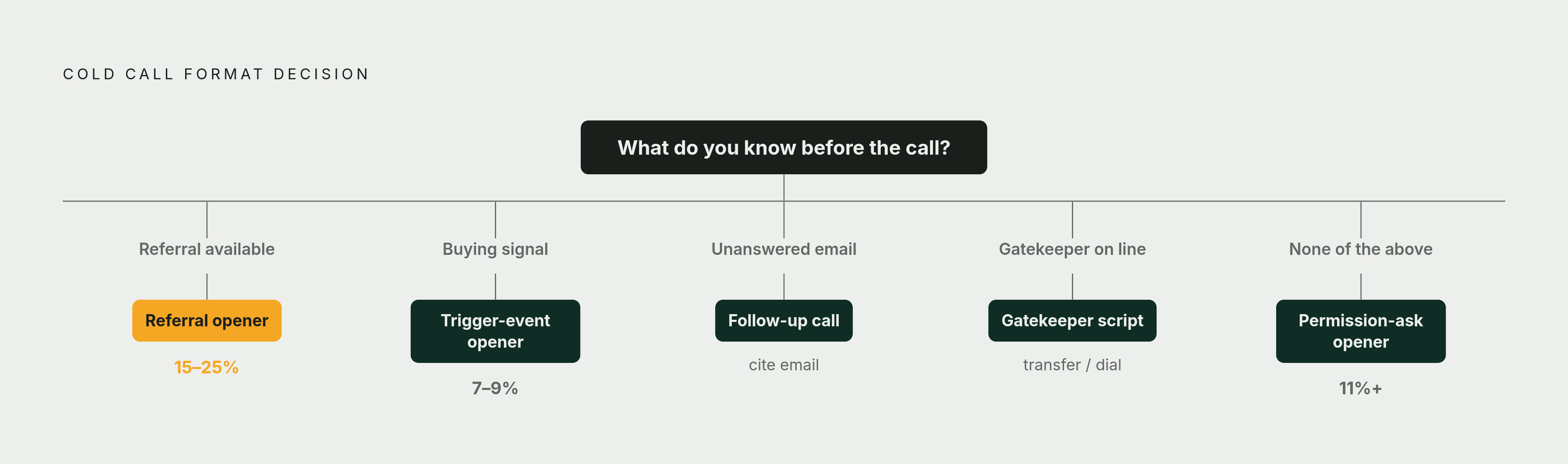
Choosing a format isn't a matter of taste. It follows directly from what a rep knows about the prospect before the phone starts ringing. A referral available for this call means the referral opener is the right move, since it's always the highest-converting option when one exists. A genuine buying signal, funding, hiring, a leadership change, a product launch, means the trigger-event opener applies, because real research earns real conversion. An email already sent to this prospect that went unanswered calls for the follow-up format, referencing that email specifically. An assistant or receptionist on the line calls for the gatekeeper script, with one goal only: get transferred or get a direct dial. And when none of those conditions apply, the cold permission-ask opener is the right default, because honesty is the strongest tool available when nothing else has earned attention first.
What separates reps who book meetings consistently from reps who don't is recognizing, before the call connects, which of these five situations is actually in front of them.