Why Sales AI Breaks When It Lives Outside Your CRM
Bad data in your CRM makes AI confidence dangerous, not helpful.
A rep opens an AI-generated account summary: confident tone, clear next step, plausible reasoning. It's also wrong: the deal closed two weeks ago and nobody updated the field it pulled from. That same pattern repeats across a whole sales floor. Sales AI fails because it can only act on data it can see, and that data is almost always incomplete, stale, or fragmented. When an AI agent produces a bad output or invents a detail that isn't true, the language model is usually working exactly as designed. The data pipeline feeding it is what's broken.
That distinction matters because it changes where teams should look when things go wrong. This isn't a fringe problem affecting a few disorganized teams. ZoomInfo's 2025 GTM Intelligence Report found 95% of GTM leaders experienced negative outcomes tied to poor-quality data in 2025, an industry condition rather than one company's bug. HubSpot CEO Yamini Rangan said bad context is worse than having no AI at all. Everything that follows is really an argument about what "context" means and why so much sales AI never gets access to it.
What context-starved AI sees in a CRM record
Most enterprise CRMs are landscapes of duplicate records, stale fields, and inconsistent definitions, causing AI to act with false confidence on unreliable inputs. RevOps teams recognize the same handful of failure modes on sight. Duplicate records pile up because reps can't find an existing account in the system and simply create a new one rather than search harder. Job titles go stale for months after role changes, so AI ends up pitching the wrong person on the wrong premise. Leads get misrouted when someone uses a personal Gmail address instead of a work email, defeating whatever territory or ownership logic was supposed to route it.
Even when the data isn't missing, it's often just inconsistent in ways that scramble machine scoring. A job title field containing "VP Sales," "VP of Sales," "Vice President, Sales," and "vp sales" looks like four roles to a scoring model, a problem that destroys the signal the model needs. A 45-person B2B IT services firm in India ran into exactly this. The company deployed an AI CRM that auto-logged calls and scored leads, but its eight sales managers each defined pipeline stages differently, so the AI fired constant false "hot lead" alerts with no consistent definition of what that meant.
There's a deeper problem: the richest behavioral signals, like call transcripts, email threads, Slack messages, and meeting notes, mostly live outside the CRM entirely. An AI system reasoning only on CRM activity logs is missing the context that actually determines whether an account is ready to buy. Because AI takes a record at face value and acts on whatever version it finds first, it doesn't produce errors a human would catch. It produces unreliable decisions that look normal, making bad data more dangerous in an AI-assisted workflow than a human-run one: the mistake stays invisible until it costs something real.
Bad data's cost: lost deals and abandoned tools
Bad AI output causes immediate damage. The second, larger problem is that bad output quietly destroys the human trust that any AI tool needs in order to get used at all. That erosion follows a predictable sequence. A rep finds a job title that doesn't match the CRM, decides the whole system can't be trusted, and that verdict spreads through the team faster than retraining can undo it. When the CRM and the AI tool disagree on something as basic as the last contact date, reps freeze. Conflicting sources of truth chip away at confidence in both systems until people revert to gut instinct and personal spreadsheets, erasing whatever efficiency the AI was meant to add.
The stakes are easiest to see at the level of a single deal. On a 23-person sales team, an AI tool flagged a contact as high intent while the CRM showed that same contact had unsubscribed. The rep trusted the AI, reached out, got a complaint back, and lost not just that deal but the account relationship behind it. Similarly, a client lost 20% of qualified leads because an AI sentiment analyzer had no access to HubSpot contact notes, one missing connection with compounding commercial cost.
The same pattern repeats at the organizational level. When a high-visibility AI project fails publicly, VPs write off the whole investment as hype and the engineers who built it start looking for the exit, turning a data problem into a talent and leadership problem. A Deloitte 2025 study found most AI CRM projects hit integration trouble early, usually from incompatible data formats or API rate limits, and trust damage often starts before launch even finishes.
Why middleware doesn't fix the structural problem
The instinct to fix this with middleware, stitching tools together with connectors and enrichment vendors, is understandable. It's also not integration, but latency with extra steps, introducing new failure points while leaving reps to connect the systems by hand. Teams have paid for middleware only to hit sync delays that make real-time selling impossible, turning live AI assistance into a recommendation that arrives after the moment has passed.
Layering on multiple enrichment vendors doesn't solve this either. Each vendor has its own API contract and data format, and managing that patchwork is a maintenance burden. When one vendor changes its API, the entire enrichment chain can degrade before anyone notices. Reps absorb the friction: switching between conversation intelligence tools, forecasting dashboards, engagement platforms, and the CRM costs measurable time, since the tools were never built to talk to each other. Composio's research names specific patterns: shallow context, where AI accesses only standard fields while the valuable data lives in custom objects, notes, and tickets; read-only access preventing AI from writing back to the record; and data lag that makes scoring stale by the time a rep acts.
A Prospectory case study put a number on the hidden cost of this setup. Factoring in ops time maintaining integrations plus losses from onboarding and context-switching, one team's real tool-stack cost was far higher than the subscription total suggested. After cutting down to six tools, revenue per rep went up. Middleware doesn't give AI access to customer reality. It gives AI a delayed, filtered, often broken copy of reality; the gap teams think a smarter model will close is actually a data architecture gap only native integration can close. Every workaround in this section ends the same way: the rep becomes the integration layer, manually reconciling what the tools were supposed to reconcile on their own.
What "deep CRM integration" means in practice
Genuine CRM integration has nothing to do with whether two tools show a green "connected" status. It comes down to whether the AI can read from and write back to the objects that govern selling decisions, in real time, across the whole record. That's a useful test to apply to any stack: does the AI just generate text, or does it change something? SynkrAI frames the minimum bar this way: does the deal stage change? Does a next-step date populate on the contact record? Does a stalled opportunity alert the rep? If the answer is no across the board, the tool is generating suggestions into a void, not integrating with anything.
The four criteria for actionable data are: accuracy, verified against live sources; freshness, via continuous enrichment rather than quarterly batches; structure, with consistent field formats; and connection, across CRM, marketing automation, and outreach without custom middleware. Most tools fail the "connected" criterion first, reading only standard fields and missing custom objects like "Active Subscriptions" or "Onboarding Projects," plus the unstructured notes, tickets, and call logs where real account history lives. The output looks personalized, but it's built on a surface-level profile, not the full picture.
monday.com's framing draws a useful line between a system of record and a system of action: a system of record stores information, a system of action uses that information to drive revenue. Picture a call where a prospect signals urgency: in a genuinely integrated system, the call gets transcribed, the urgency identified, deal stage and close date updated, follow-ups created, and the forecast adjusted, all within minutes without a rep clicking anything. A bolt-on AI tool, by contrast, produces a transcript summary and leaves the rep to manually reconcile it with whatever the CRM currently says. Salesforce's Data Cloud approach, pulling data from multiple sources, stitching identities together, maintaining one unified real-time profile, points toward architecture where a rep can act on AI recommendations directly rather than double-check them.
The objection worth taking seriously: what if the CRM itself is the broken system
There's a fair challenge to everything above: what if the CRM was never a reliable foundation to begin with, AI or no AI? That objection is correct as a description of how things actually stand. It just points to the wrong conclusion. The CRM has no credible substitute as the system of record for sales context, so the answer can't be to route around it.
Ask most reps whether they actually trust what's in the CRM: the honest answer is no. ZoomInfo's GTM Intelligence Report found 25% of GTM leaders aren't confident their data reflects real-time changes, and everyday reality backs that up: incomplete records, spotty activity logs, shorthand-only notes, pipeline numbers reflecting hope rather than fact. The deeper issue often isn't the technology at all. Reps don't log activity consistently because logging doesn't help them sell, so the CRM becomes a reporting artifact rather than a selling tool, and any AI layered on top inherits that disconnect.
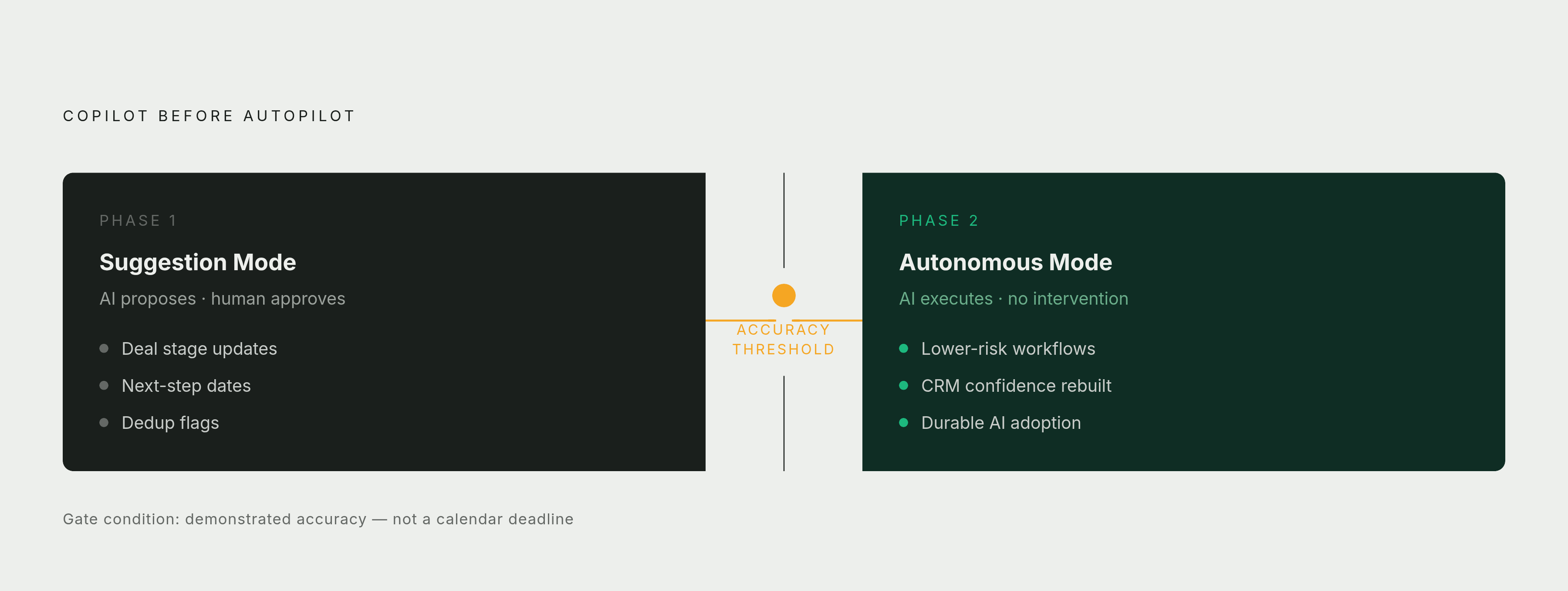
That's a real diagnosis of a real problem. It doesn't follow that AI should wait on the sidelines until the CRM is spotless. Integration and cleanup must happen together because a broken CRM will otherwise keep undermining the AI running on it. AI deployed on a broken CRM accelerates existing fragmentation, but AI mandated to clean and maintain the CRM as it operates can close that gap while working. SynkrAI's practical version is a "data contract": required fields, dedup logic based on domain plus phone number, and a designated owner running weekly dedupe checks, built into the rollout rather than run alongside it. Girikon's pre-AI checklist (mapping where data lives, deduplicating it, standardizing key fields, reviewing user behavior) is a necessary condition before AI gets turned on. It's the condition that keeps the AI investment from being wasted; skipping it just produces wrong answers faster and more convincingly. SynkrAI's "copilot before autopilot" principle: start AI in suggestion mode requiring human approval, then graduate it to autonomous action on lower-risk workflows once trust is established. That's how a team rebuilds confidence in the CRM and the AI together, rather than treating them as competing problems.
What integrated sales AI looks like
When AI is built directly into the CRM instead of bolted onto its side, its output becomes assistance a rep can actually rely on rather than polished guesswork. Buyer psychology sets the limit on how much of the process AI should be allowed to run on its own, beyond what clean architecture alone can determine. With genuine integration, predictive scoring reflects actual behavior rather than gut feeling, emails and calls and documents get captured automatically into CRM fields, and next-step recommendations come from real account history rather than a generic template. Companies pulling ahead on customer experience into 2026 treat AI as part of the CRM backbone, not a separate layer, so the value of sales AI comes down to how few interfaces stand between the model and customer reality. That number needs to keep shrinking toward one.
There's a limit on all of this that no amount of integration removes. Gartner's 2026 research found most B2B buyers still want a human to check AI-generated insights before acting, so even a perfectly integrated system has a ceiling set by buyer acceptance, and the right design keeps a person in the loop for discovery calls, objection handling, and anything high-stakes. Nextstep exemplifies this CRM-native operation: it drafts replies, logs updates, and books next steps automatically alongside inbox, calls, and CRM, integrating directly with Salesforce and HubSpot to pull deal context and rep tone without prompt engineering or a separate login. The AI writes back into the record itself, not into a side panel a rep has to remember to check.
The Prospectory case study shows a smaller, well-connected stack beats a sprawling one held together with connectors: cutting to six properly integrated tools raised revenue per rep. Where the AI sits, embedded natively in the CRM versus running as a standalone tool, affects performance more than how sophisticated the model is. A simpler model that can see the whole record will outperform a more advanced one working from a fragment of it every time.
Sources
- Salesforce CRM Implementation with AI: Complete 2026 Guide
- AI Isn't Enough: Fix These Sales Problems First
- AI and the future of CRM: 7 ways to stay ahead
- Why most AI agents fail at sales automation: 9 CRM integration failures - Composio
- When AI CRM Software Fails: What Sales Teams Overlook Most | SynkrAI Blog
- 【GUIDE】 Troubleshooting AI CRM Issues: Fixes 2026 | BizAI