What Happens to Deal Context When a Rep Leaves
When a sales rep leaves, their unwritten deal knowledge walks out the door too.

What Happens to Deal Context When a Rep Leaves.
Why sales rep turnover is structurally different from other attrition problems
Sales rep turnover is the normal operating condition of the industry. Annual turnover in U.S. sales roles is roughly 35%, nearly three times the cross-industry average of 13% Everstage Sales Compensation Statistics Kondo B2B Sales 2025 Report. Average tenure for a B2B sales rep is just 18 months Bridge Group Sales Rep Tenure Research. And at the entry level, where reps are still building the muscle to run full deal cycles, SDR and BDR attrition runs at 45% a year, the highest of any function in the revenue org Optifai Sales Rep Turnover Survey ZoomInfo CRM Data Quality Research Kondo B2B Sales 2025 Report.
Compare that to how most companies talk about it. "We lost a quota." That's the reflex response, and it's the wrong one. Quota is a number. You can hire someone new and eventually hit that number again. What you can't hire your way back to, at least not quickly, is the deal intelligence that rep built up over months or years of actually talking to the customer.
Why does this matter more now than it used to? Because deals have gotten more complicated. Buying committees have swelled to an average of 25 stakeholders on a single purchase decision ZoomInfo CRM Data Quality Research Gangly Sales Rep Turnover Statistics Kondo B2B Sales 2025 Report. Deals over $100,000 now commonly take 6–9+ months to close Treeline Sales Talent Hiring Study. That means an enterprise rep is managing dozens of threads, tracking who said what, who's skeptical, who's the real decision-maker, across the better part of a year. The longer and more tangled the deal, the bigger the blind spot the moment that rep walks out the door.
This is a cause for clarity. Before you can fix a leak, you need to know where the water is actually going.
The three categories of intelligence a departing rep takes with them
Not all of what a rep knows is equally hard to replace, and that distinction matters. If you treat "knowledge loss" as one big blob, you'll reach for one big blob of a solution (usually a CRM export) and wonder why it didn't help. Roughly 80% of critical knowledge inside any organization is tacit, never written down anywhere SugarWork Tacit Knowledge Research. Annual sales turnover in the U.S. is roughly 35%, nearly three times the cross-industry average of 13% Everstage Sales Compensation Statistics Kondo B2B Sales 2025 Report.
Relationship knowledge is the first. Who actually makes the decision, versus whose title suggests they should. Who quietly blocks progress. What each stakeholder cares about, and why. None of this lives on an org chart. It's built one conversation at a time, and almost nobody writes it down because it doesn't feel like "data," it feels like just knowing your customer.
Deal-level context is the second. Why did this customer actually choose you? What was promised informally, in a hallway or on a call, that never made it into a contract line? This context is what you need for renewals, upsells, and pitching similar prospects down the line. And it almost never survives in the CRM beyond a line like "Good call, moving forward."
Competitive and institutional intelligence rounds out the third. What does a specific competitor's sales team actually say in the room? Which argument lands in manufacturing but falls flat in healthcare? Which internal process shortcut gets a contract through legal two weeks faster? This kind of knowledge gets sharpened over dozens of deals. Nobody documents it because nobody thinks to. It's just what they know.
These categories interact, which makes this worse than three separate problems stacked on top of each other. Lose the relationship knowledge on an account, and the competitive intelligence about that account becomes close to useless, because you no longer know which stakeholder that intelligence was even supposed to persuade. The loss isn't additive. It compounds. Not all losses are equal; naming the categories prevents teams from thinking a CRM export solves the problem.
Why the CRM captures only a fraction of what a rep knows
The CRM is supposed to be the system of record. In practice, it captures something closer to 30% of the deal-level context that actually exists Infield Deal Context Preservation Research.
Why does this gap persist, year after year, tool after tool? Start with incentives. A rep under quota pressure is rewarded for closing, not for immaculate CRM hygiene. So they do just enough data entry to keep their manager off their back, while the real, working version of the pipeline lives in whatever system they personally trust, usually their inbox. It's telling that 83% of sales teams say their CRM actually slows them down rather than speeding anything up Salesforce analytics. Only 35% of sales professionals say they fully trust their CRM data Everstage Sales Compensation Statistics Kondo B2B Sales 2025 Report ZoomInfo CRM Data Quality Research Gangly Sales Rep Turnover Statistics Kondo B2B Sales 2025 Report. If you don't trust the system, you don't feed it your best information. You feed it the minimum.
One might argue this is a training problem. Just teach reps to log things properly. But that misses the deeper issue: you cannot train someone to re-create information a system was never built to capture in the first place. A rep isn't skipping a field out of laziness. When a rep leaves, the real loss isn't their quota, it's the undocumented deal intelligence that lived in their inbox, calls, and memory rather than the CRM.
Layer on data decay, and the picture gets worse before anyone even leaves. B2B contact data decays at roughly 25% to 30% a year, with a quarter of what's in the CRM going stale annually just from job changes and reorganizations, with no departure required Infield Deal Context Preservation Research ZoomInfo CRM Data Quality Research Gangly Sales Rep Turnover Statistics Kondo B2B Sales 2025 Report. And reps are already burning about 27% of their time wrestling with bad data, a cost estimated at 550 hours and $32,000 per rep every year MarketingProfs Data Quality Impact Study. So the CRM a successor inherits is incomplete and decaying, showing a stage and a close date and very little that tells anyone what the customer has actually lived through.
Where deal context lives and how it scatters at departure
If the CRM only holds a fraction of the story, where's the rest of it?
The inbox holds a lot of it. Email threads carry the nuance no one logs anywhere else: informal commitments made in passing, the actual tone of the relationship, objections that got raised and quietly talked down. When a rep leaves, that inbox access is usually revoked, or it sits untouched. Even when IT preserves the account, nobody left behind has the context to make sense of what they're reading. A thread that says "let's revisit pricing after the board meeting" means nothing without knowing which board meeting, and why it mattered.
Calls and meetings hold more of it. Some teams record everything, but recordings sitting in a folder aren't the same as knowledge. They're an archive, not an index. A successor cannot realistically sit down and listen to six months of calls before their first meeting with that customer, so the calls exist, technically, and are functionally invisible.
And then there's memory, which is the deepest layer and the one that truly cannot be exported. What's the actual blocker, the one nobody says out loud in a status meeting? What got agreed informally over dinner that never made it into a follow-up email? That lives in one person's head, and when that person leaves, it leaves with them.
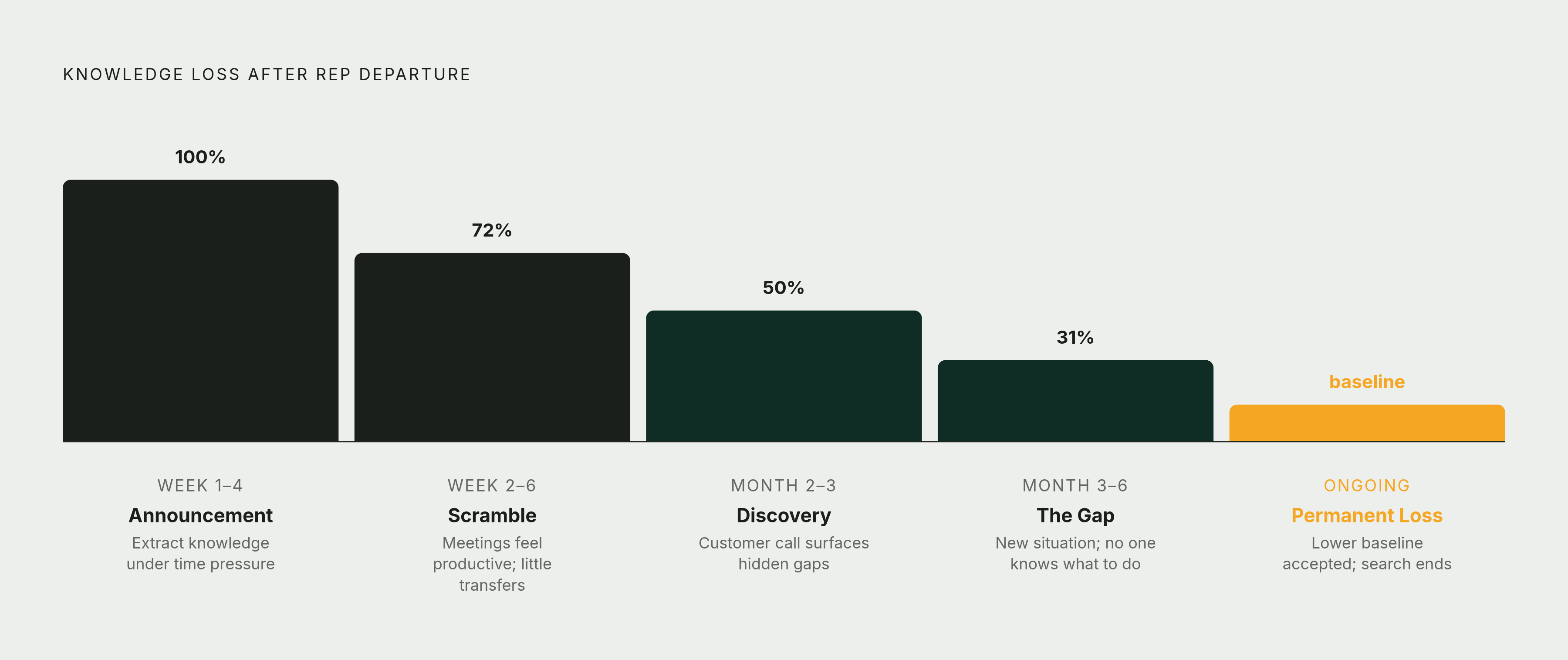
What does departure actually look like, mechanically, once it's set in motion? It moves through stages, including a final stage where the organization adapts by accepting a lower baseline rather than recovering the knowledge. First comes the announcement, typically giving the team two to four weeks to extract what someone knows, under real time pressure. Then the scramble: hastily scheduled knowledge-transfer meetings that feel productive in the moment but rarely capture what actually matters. Then discovery, where a customer conversation that goes sideways surfaces gaps that no internal audit caught. Then the gap itself, when a new situation comes up that only the departed rep knew how to handle. And finally, permanent loss, where the organization doesn't recover the knowledge so much as it quietly adapts to a lower baseline and stops noticing what's missing.
Why exit interviews and offboarding checklists fix the wrong point in the timeline
The standard playbook when a rep gives notice tightens up the exit interview, requires a handoff document, and runs a CRM cleanup sprint before their last day. It feels responsible. It looks like due diligence on paper. So why does it keep failing?
Because it's aimed at the wrong moment in the timeline. Two hours with HR cannot pull out years of accumulated pattern recognition, and it is structurally impossible rather than just difficult because the departing rep often doesn't know what they know. Much of it is subconscious, built through repetition, not the kind of thing you can prompt someone to recite in an exit interview. And by the time that interview happens, the rep is already mentally somewhere else. Their motivation to document carefully is at its lowest exactly when the need for documentation is at its highest.
That raises an important question: what is the exit interview actually capturing? Mostly a list of open deals and a few names from an org chart. Not the intelligence that made the rep effective in the first place.
The deeper issue underneath all of this is one of ownership. The company never owned the knowledge that rep built deal by deal. It was leasing it, for the length of that person's employment. When the lease ends, the asset leaves with the tenant. CRM data protection has to be continuous, not something that switches on the moment someone hands in their notice. A cleanup sprint at departure is, by definition, too late: once someone has decided to leave, documentation gets rushed, and details get forgotten or quietly left out.
The downstream proof appears in onboarding. 56% of managers say knowledge loss makes bringing on new hires harder and less effective, which is the clearest evidence that offboarding fixes don't actually contain the damage ProcedureFlow Knowledge Management Study. They just push it further down the line.
What the business absorbs when deal context disappears
Once the context is gone, what does the business actually feel? Start with the top line. It's a knowledge problem that shows up in revenue.
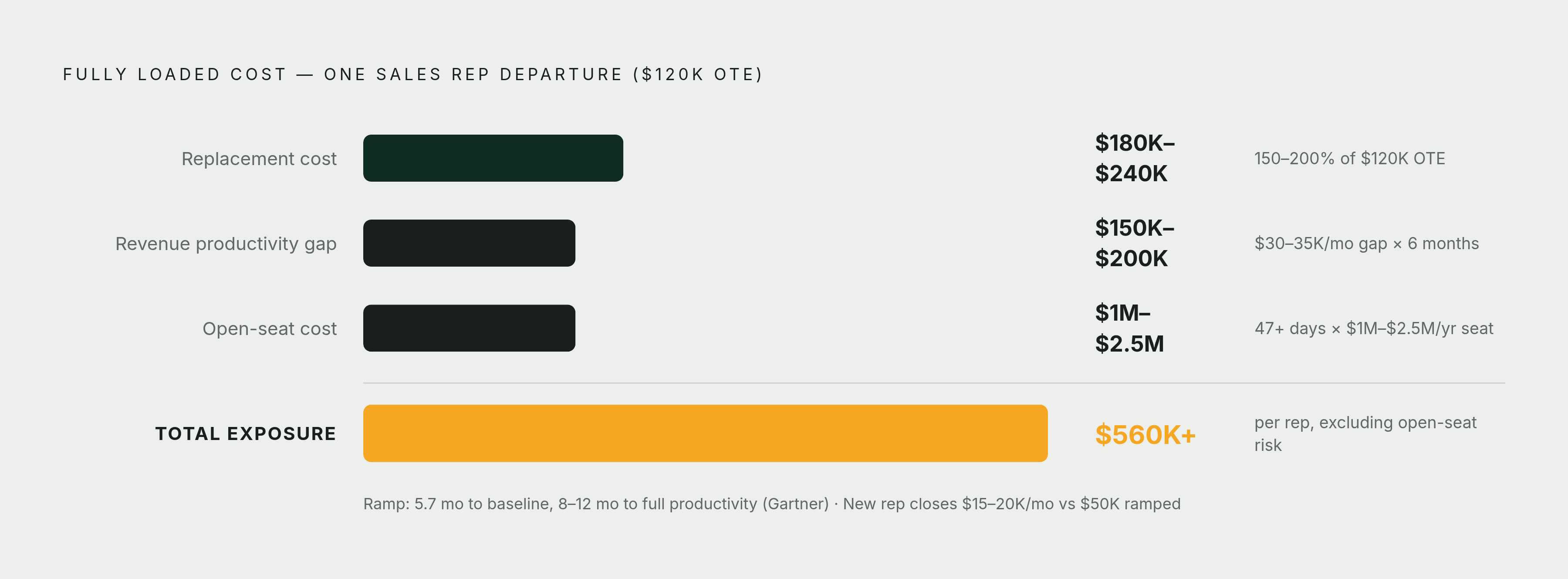
The cost compounds with scale. A 5% increase in rep attrition raises selling costs by 4% to 6% Optifai Sales Rep Turnover Survey Exactly Corp Sales Turnover Statistics ZoomInfo CRM Data Quality Research Kondo B2B Sales 2025 Report. Push attrition from 5% up to 25%, and cost to sell rises by more than 50%, while revenue drops by 20% Optifai Sales Rep Turnover Survey Exactly Corp Sales Turnover Statistics ZoomInfo CRM Data Quality Research Kondo B2B Sales 2025 Report. Then there's the hiring gap itself: average time to fill a sales role runs past 47 days, longer for enterprise positions, and every open enterprise seat represents $1 million to $2.5 million in lost annual bookings, with mid-market and SMB roles losing $300,000 to $750,000 National Association of Sales Professionals Study. That's before the new hire has closed a single deal.
Once someone is hired, the clock doesn't stop. Full productivity takes 8 to 12 months by Gartner's estimate, and even reaching a baseline level now takes 5.7 months Gartner Sales Rep Ramp Time Research Zyverno Sales Rep Ramp Time Analysis. That gap is about the institutional knowledge the departed rep never wrote down, which the new hire now has to rebuild from zero.
Add it all up, ramp time, lost pipeline, management overhead, and the Bridge Group's 2024 research puts the fully loaded cost of one departure at 150% to 200% of that rep's annual on-target earnings Bridge Group Sales Rep Tenure Research Exactly Corp Sales Turnover Statistics Treeline Sales Talent Hiring Study Bridge Group 2024 Sales Development Report. For a rep earning $120,000 OTE, that's $180,000 to $240,000 walking out the door with them Bridge Group Sales Rep Tenure Research Exactly Corp Sales Turnover Statistics Treeline Sales Talent Hiring Study Bridge Group 2024 Sales Development Report.
And the people meant to catch all this are stretched thin, too. During high turnover, sales managers spend 25% to 50% of their working hours on hiring-related tasks, time that would otherwise go to coaching the reps who are still there Exactly Corp Sales Turnover Statistics ZoomInfo CRM Data Quality Research Gangly Sales Rep Turnover Statistics Kondo B2B Sales 2025 Report. Turnover doesn't just cost money; it eats the exact attention that might have prevented the next departure. It compounds itself. A difference-in-differences analysis of a Fortune 500 firm found that sales rep transitions produce 13.2%–17.6% losses in annual sales, with new hires less effective than existing reps at mitigating those losses (Journal of Marketing) (Journal of Marketing Sales Transition Research). If a ramped rep closes $50,000/month and a new rep closes $15,000–$20,000/month during ramp, the company absorbs a $30,000–$35,000/month productivity gap for nearly six months, totaling $150,000–$200,000 in foregone revenue per replacement (Treeline Sales Talent Hiring Study, Zyverno Sales Rep Ramp Time Analysis).
How to prevent deal context from being a single point of failure
If exit interviews fix the wrong moment, what's the right one? Every day the rep is employed is the right moment. Prevention means never letting critical context pool in one person's head in the first place, not bolting on more offboarding steps.
A few structural habits make the biggest difference. Capturing activity automatically, so emails, calls, and meetings get logged without anyone having to remember to do it, means the information exists in the system before anyone has a reason to leave. Multi-threading accounts on purpose, so more than one person on the team has a real relationship with each key stakeholder, means a single departure doesn't sever the whole connection. Running regular deal reviews where context gets said out loud and recorded works less as a retention tool and more as a way of spreading knowledge across more than one head. And treating CRM data as something the company owns, not something an individual rep happens to maintain, changes the whole posture. That's not a small semantic point. Ownership language shapes what people actually bother to write down.
A handful of tools have emerged around different pieces of this problem. Conversation intelligence platforms like Gong give successor reps and customer success teams access to call recordings, transcripts, and deal insights they can review after the fact; recent additions, including agentic tools that act on deal signals and unified coaching features, extend what the platform can do, and Gartner recognized Gong as a Leader in its inaugural Magic Quadrant for Revenue Action Orchestration, ranking it first across four use cases ZoomInfo CRM Data Quality Research Gangly Sales Rep Turnover Statistics Kondo B2B Sales 2025 Report. It's worth noting Gong doesn't auto-generate a handoff document on its own, so teams typically still compile that separately ZoomInfo CRM Data Quality Research Gangly Sales Rep Turnover Statistics Kondo B2B Sales 2025 Report.
Other tools go after the handoff moment directly. AskElephant is built specifically for the sales-to-success transition, scanning the entire deal history across calls, emails, and CRM notes to auto-generate a handoff package, rather than asking the departing rep to type up a summary from memory. Gainsight's Horizon AI takes closed-won data straight from Salesforce and drafts a multi-month onboarding plan, flagging early churn risk if post-sale engagement doesn't match the energy of the sales cycle that got the deal signed.
And some tools aim earlier still, at the everyday layer where the actual leakage happens. Nextstep runs alongside the inbox, the calls, and the CRM, drafting replies, logging updates, and booking next steps automatically. Because it captures context continuously, across every interaction, rather than reconstructing it after someone's already given notice, deal intelligence ends up preserved in the system well before a departure, not scrambled together after one. It integrates with Salesforce and HubSpot, and it's built to pick up a rep's tone and deal context without needing constant manual input, which goes after the actual root of the problem: context living in someone's personal tools instead of a shared one.
None of these tools erase the fact that people leave jobs. What changes is whether a departure takes the knowledge with it, or leaves it behind for whoever's still standing there, staring at a pipeline stage and a close date, trying to figure out what actually happened.
Sources
- The State of B2B Sales in 2025: A Data-Driven Report for Sales Leaders
- When top performers leave, most of what they knew is gone | Mojar AI
- 7 Fatal CRM Mistakes Crushing Sales Rep Morale In 2025
- Sales Compensation Statistics 2026: Trends & Insights
- Sales Rep Turnover Statistics 2026: The Real Cost of Rep…
- floral.so
- tryinfield.com
- marketingprofs.com