How AI Is Replacing Manual Data Entry Inside Sales Intelligence Tools
AI pulls sales data from emails, calls, and meetings so reps stop typing.
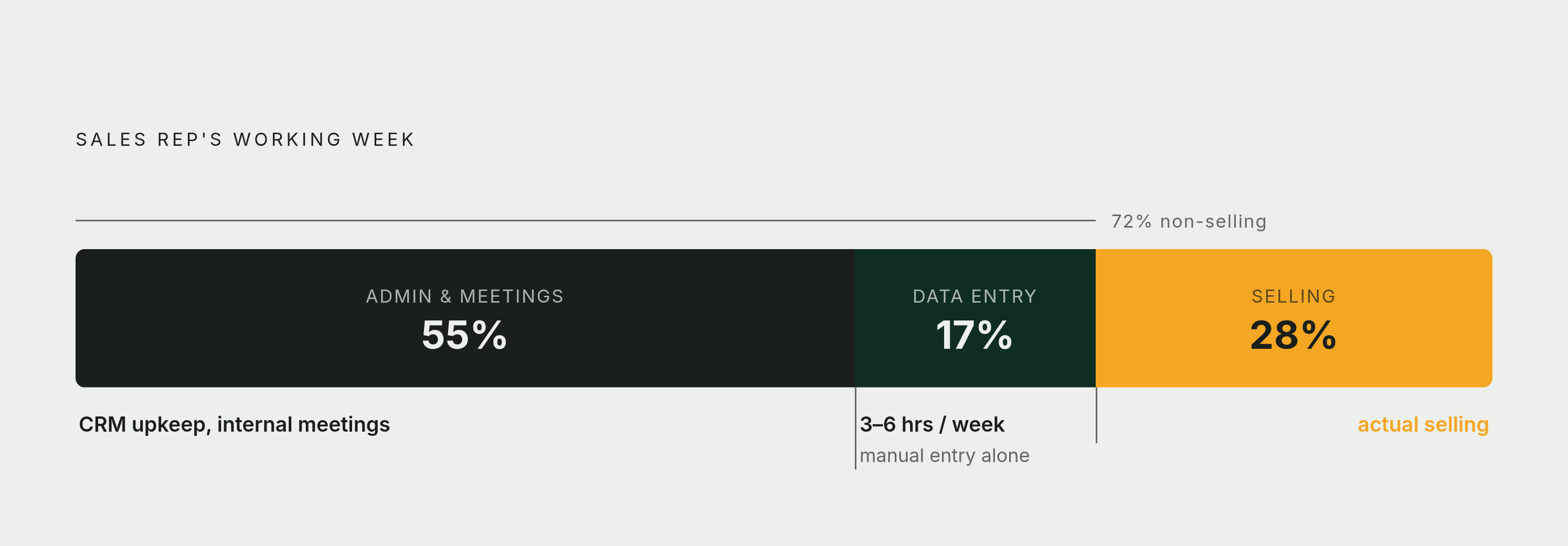
Sales reps spend most of their week not selling. Something like 70 to 72% of it goes to admin work, internal meetings, and CRM upkeep, leaving only around 28 to 30% for actual selling. AI is closing that gap now by pulling sales data straight out of emails, calls, and meetings, no rep required to type a single field. That's what this piece is about: how it works, who's building it, and what changes once the data starts entering itself.
Start with the number that should bother anyone running a sales floor: a rep spends 3 to 6 hours a week on manual data entry, according to industry estimates. Even a rep running a flawless playbook still loses 17% of the week just typing things into Salesforce or HubSpot. 71% of reps say they spend too much time on data entry, and 40% name admin work as their single biggest frustration on the job.
This isn't a comfort problem. It's a quota problem. Ebsta and Pavilion's 2025 GTM Benchmarks report found 78% of sellers missed quota in 2025, up from 69% the year before. Run the math on a rep carrying a $500,000 annual quota: 5.5 lost hours a week works out to roughly $71,000 in pipeline activity that never happens. And the data that does get typed in isn't reliable either. Reps fail to log 79% of opportunity-related data they gather, according to industry estimates, so the CRM record that exists is often thin, outdated, or just wrong. IBM's Institute for Business Value found in 2025 that 26% of organizations lose more than $5 million a year from poor data quality alone. That's not a rep's problem to fix. That's a balance-sheet line.
Why legacy CRM architecture made the problem structural, not behavioral
Most sales leaders still treat this as a discipline problem. Hire sharper reps, run better training, tie logging to comp, and the CRM fills itself in. That's backwards, and it's worth saying plainly: no amount of coaching fixes a database that can't read.
Salesforce and HubSpot, in their classic form, run on relational databases: rows, columns, fields. Great at holding structured information. Useless at reading an email thread, a call transcript, or a meeting note on its own. Someone has to translate the messy, human version of a conversation into the tidy version the database understands. That someone is the rep.
Every call. Every email. Every Zoom. Each one needs a separate act of manual translation before it counts as CRM data. The rep isn't selling in that moment. The rep is standing between two systems that can't talk to each other, doing the talking for both of them.
And given a choice between two tasks, people pick the one that pays. Selling earns commission. Logging earns nothing. So reps skip it, shorten it, or do it two days later from memory, which is worse than not doing it at all. That's not laziness. That's a rational response to a system that rewards the wrong behavior.
The phrase gaining traction through 2025 for the fix is "Zero-Entry CRM." The idea is simple: a human should never type data that could have been captured automatically. AI isn't stepping in to make reps more disciplined. It's stepping in to take them out of the loop entirely, because the loop itself was the problem.
The four core mechanisms AI uses to capture and structure sales data automatically
Strip away the branding and AI-driven data capture comes down to four jobs, each replacing one specific manual task.
Automated activity capture. Gartner calls this activity intelligence: software that watches email, calendars, video meeting tools, and collaboration platforms, and logs what happens without anyone touching a keyboard. A rep sends an email, it's logged. A prospect books a meeting, the deal record updates. A call ends, the summary drops into the contact notes. In March 2026, Slack announced it was expanding Slackbot through the Model Context Protocol to transcribe meetings and fill in CRM fields in the background, about as close to invisible as this gets.
AI data enrichment. Enrichment tools pull from public databases, proprietary datasets, and third-party APIs to fill in what's missing: job titles, buying signals, tech stack, recent funding rounds. Salesforce estimates 70% of CRM data decays every year and that 91% of records are incomplete at any given time. Enrichment isn't a one-time cleanup. It runs constantly in the background, keeping records from quietly rotting.
Conversation intelligence and auto-logging. Modern platforms transcribe sales calls in real time on Zoom, Meet, or Teams, then go further: they pull out goals, pain points, objections, and decision-makers, and write structured notes straight into the pipeline record. The framing has shifted from "logging the call" to "understanding the call." Data cited by Apollo from Vena Solutions puts the daily time saved at roughly two hours and fifteen minutes per sales professional, once data entry and scheduling run on their own.
AI prospect research automation. Before this, prospect research meant digging through news, funding announcements, and org charts by hand, a process that could eat 3 to 5 hours a week. Sales intelligence platforms now pull intent signals from more than 100,000 sources and compress that same research into 10 to 15 minutes.
Put together, these four mechanisms remove the rep from every point where a conversation used to require manual translation into CRM fields. Data cited by Apollo from Everready AI puts the cut in CRM data entry time at up to 70%.
The shift from copilot AI to agentic AI, and what it changes about who does the work
The bigger change happening across CRM platforms in 2026 isn't faster capture. It's who, or what, decides what to do with the data once it's captured.
Copilot AI suggests, and the rep acts. That's the model everyone got used to over the past few years. Agentic AI works differently: it acts on its own, across multiple steps, inside guardrails a human already set, without waiting for someone to click "approve." That's a real change in what a CRM can do without a person in the loop, whether that's handling a service case start to finish, qualifying an inbound lead, or moving a deal to the next stage based on what happened on a call.
Here's where most people get the story wrong: they treat agentic AI as just a faster copilot. It isn't. A copilot waits to be asked. An agent doesn't wait. For the narrow but heavy category of CRM housekeeping, logging calls, updating contact fields, tracking deal stages, agents aren't assisting anymore. In most commercial sales settings today, they're the ones doing the work.
The guardrail part matters. Agents don't roam free. An organization sets the rules; the agent runs the volume inside those rules. Salesforce's Agentforce is the clearest large-scale example: autonomous agents working across lead qualification, case routing, opportunity management, and customer service, running multi-step workflows on Salesforce's own native tools rather than just answering chat questions. Agentforce has been reported to have reached $540 million in annual recurring revenue. That's not a pilot number.
So what's left for the rep, once the agent handles capture and routine action? Judgment. Deciding which flag from the agent actually matters, how to respond to what it surfaces, and when to override it. That's a different job than the one reps had five years ago. Arguably a better one.
How the major platforms divide the automation landscape in 2026
No single tool owns this space. Each major platform picked a different piece of the problem and went deep on it instead of trying to do everything, and the pricing gap between them tells you who they're actually built for.
ZoomInfo runs the broadest database, over 500 million contacts and 100 million companies, and enriches CRM and marketing automation records in real time through native integrations with HubSpot and Salesforce. It tracks intent signals across 210 million IP-to-organization pairings and adds more than 6 trillion new keyword-to-device pairings a month. A March 2026 test by Cleanlist on 1,000 leads found a 67% mobile match rate for ZoomInfo compared to 41% for Apollo. Pricing starts around $15,000 a year, quote-only, built for enterprise budgets, not for a five-person team testing the waters.
Apollo.io combines a prospecting database with more than 65 filters, built-in outreach sequencing across email, call, and LinkedIn, and native CRM sync with HubSpot and Salesforce that cuts out the manual back-and-forth between tools. Its AI call assistant transcribes calls and is built to reduce the manual work of updating CRM records afterward. Pricing starts at $49 per user per month, the accessible entry point for teams that don't need ZoomInfo's coverage or its price tag.
Gong builds its whole platform around conversation data: recording, transcribing, and analyzing every sales call and email, then feeding that into deal intelligence, coaching, and forecasting. Gong was named a Leader in the first-ever 2025 Gartner Magic Quadrant for Revenue Action Orchestration, ranking first across all four evaluated use cases in the accompanying Critical Capabilities report. Enterprise pricing is quote-based and positions Gong for teams whose real pain point is coaching and forecasting accuracy, not database size.
Salesforce Agentforce deploys autonomous agents across the full CRM lifecycle: lead qualification, case routing, opportunity management, customer service, running multi-step work on Salesforce's native tools. Its reported ARR figures suggest agentic CRM automation has already moved out of pilot mode and into systems running real revenue. Best fit: organizations already built on Salesforce that want agent automation without bringing in another vendor.
Piper, from Qualified, is an AI SDR agent that engages website visitors as they arrive, qualifies them, and routes the hot ones to a rep, syncing all of it into the CRM automatically. It integrates with Salesforce. Built for B2B teams focused on inbound pipeline who want the top of the funnel, qualification and logging both, handled without a human touching it.
Nextstep is designed to handle routine CRM tasks alongside a rep's existing workflow, reducing the manual steps between a conversation and an updated record. The aim is automation folded quietly into tools teams already use, rather than a new platform layered on top of everything else. Built for teams that want the automation folded quietly into tools they already use, rather than adopting a new platform on top of everything else.
How fast this market is growing, and what the adoption curve says about where teams currently stand
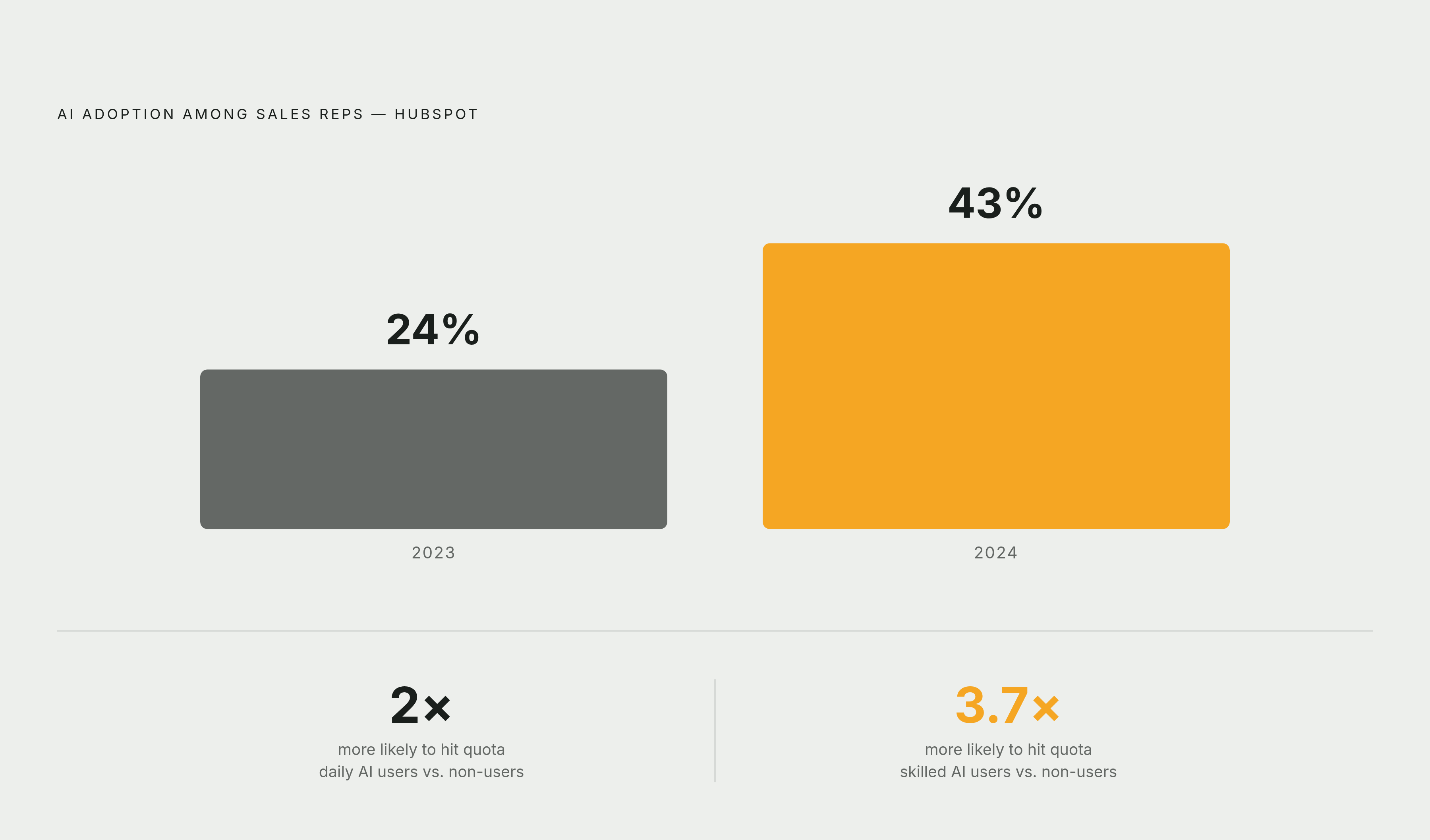
The adoption rate tells its own story. AI use among sales reps nearly doubled between 2023 and 2024, going from 24% to 43%, according to HubSpot. That's not a slow curve. Standing still for a year or two, at that pace, puts a team meaningfully behind.
The sales intelligence market, the narrower slice covering enrichment, intent data, and workflow automation, was valued at $4.42 billion in 2025, projected to hit $4.99 billion in 2026 and $9.15 billion by 2031. Within that market, integrated solutions, as opposed to standalone point tools, hold a 71.12% share. Teams want enrichment, intent, and workflow automation bundled together, not stitched from five different vendors.
Zoom out to the broader AI-in-sales market and the numbers get bigger fast: one estimate puts it at $24.64 billion in 2024, growing to $145.12 billion by 2033. A separate forecast puts 2026 at $50.8 billion, climbing to $383.1 billion by 2034. Different methodologies, same direction. And CRM software held the largest revenue share by type in 2024, which confirms something worth sitting with: CRM automation sits at the center of AI spending in sales, not on the edge of it.
The top five players by market share, Microsoft, Oracle, SAP, Alphabet, and Salesforce, together held about 29% of the market in 2024. The rest is fragmented, which is exactly why specialized tools like Gong, Apollo, and ZoomInfo still hold real ground instead of getting swallowed by the giants.
So what does the curve actually say? Teams still relying on manual entry aren't just slower. Their CRM data is thinner and staler than a competitor's, and that shows up eventually in forecasting accuracy, pipeline visibility, and, per the 2025 GTM Benchmarks data cited earlier, in missed quota.
What changes for reps, RevOps, and sales leaders once the data captures itself
Once capture runs on its own, the math behind that $71,000-a-year unrealized pipeline figure runs in reverse. Time that went to typing goes back to calls, follow-ups, and deal work, the stuff that actually moves a number.
Gartner reports that sellers who use AI tools well are 3.7 times more likely to hit quota than those who don't. And 56% of sales professionals now use AI daily, with that group roughly twice as likely to hit their numbers as reps who don't touch it.
For RevOps, the change is different but related: cleaner, more current data means forecasts stop being guesses dressed up in a spreadsheet. For sales leaders, the conversation with a rep shifts from "did you log this" to "what did the data tell you, and what did you do about it." That's a harder conversation to have, honestly. It's also a far more useful one.
The rep who used to stand between the conversation and the CRM, translating one into the other by hand, is free now to just have the conversation. What reps do with that time back is the real question, and every sales floor is about to answer it differently.