Conversational AI vs Generative AI in Sales Tool Purchasing
Understand which AI type solves your sales problem.
Sales teams bought a lot of AI in the last two years. HubSpot's State of AI in Sales found rep adoption nearly doubled between 2023 and 2024, from 24% to 43%. That's a fast climb. Faster, it turns out, than most buyers' ability to explain what they actually bought.
This isn't a knock on anyone's intelligence. It's a labeling problem. "AI-powered" now shows up on chatbots, email assistants, call recorders, and lead scoring engines alike. Two tools can both wear that badge and do completely different jobs. One manages a live conversation. The other writes a first draft. Both get called "AI." Only one of them fixes the problem you actually have.
So the real purchasing question was rarely "does this use AI?" It's "which kind, and does that kind match my problem?" Let's get specific.
What conversational AI and generative AI actually do differently
Here's one clean way to split it.
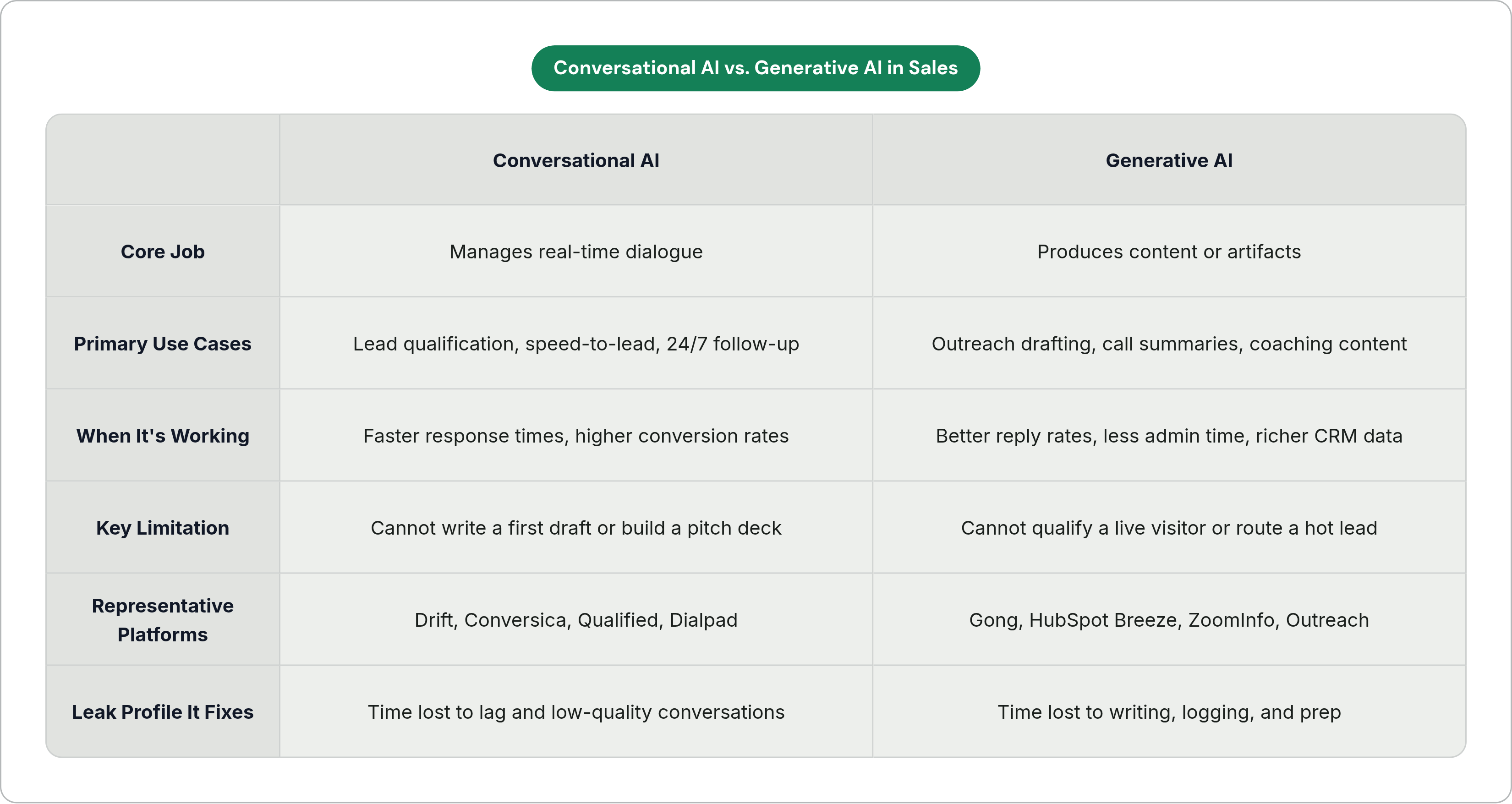
Conversational AI automates two-way, real-time dialogue. It uses natural language processing to figure out what a person is asking, right now, and responds inside an ongoing back-and-forth. It tracks state: what was said a minute ago, what the goal of this exchange is, where the conversation needs to go next.
Generative AI creates things. Feed it a prompt or a context signal, and a large language model produces an output: a draft email, a call summary, a battlecard, a training script.
The difference, boiled down: conversational AI manages a dialogue. Generative AI produces an artifact. One is a live process. The other is a finished (or semi-finished) thing sitting in an inbox or a CRM field, waiting for a human to use it.
Here's the wrinkle. Both technologies run on overlapping infrastructure. Both use NLP. Increasingly, both draw on the same large language models. That overlap is largely why the "AI-powered" sticker tells you little on its own. It's also why modern conversational AI agents draw on generative AI to write more natural, context-aware replies mid-conversation. A chatbot that drafts a personalized answer on the fly is technically doing both. But that doesn't mean the relationship runs both ways. Generative AI is the broader category. A generative tool doesn't automatically know how to hold a conversation.
Want a quick test? Ask this: is the tool responding to a person in real time, or is it creating something a person will use later? That question alone sorts most products on the market into one bucket or the other. Skip the interface trap, too. Chatbot doesn't automatically mean conversational AI, and writing assistant doesn't automatically mean generative AI. What matters is purpose and interaction model, not the box it lives in.
The sales problems conversational AI is built to solve
Conversational AI's job is simple to state: engage a human who is present right now, without a rep needing to be available at that exact second.
A few concrete jobs it does well:
- Speed-to-lead. Research across large volumes of sales activities found conversion rates jump dramatically when the first response lands within five minutes — a window few teams can consistently hit without automation. Few teams staff around the clock to hit that window. Conversational AI can, at scale, without burnout.
- Qualification and routing. It asks discovery questions, scores intent, filters out the tire-kickers, and hands the hot leads to a rep the moment buying signals show up. That's rep time saved on conversations that were unlikely to go anywhere.
- 24/7 follow-up. Platforms like Conversica run multi-touch conversations over email and text that read like a real person wrote them, re-engaging leads that went quiet, with little rep involvement.
- Conversation intelligence. A related but distinct piece: recording and transcribing human-to-human sales calls to surface patterns in sentiment, talk tracks, and objections. Technically this is analysis of conversation, not automation of it, but it lives in the same family. It's also no longer a side feature. Future Market Insights projects the conversation intelligence market reaching $32.25 billion by 2026, growing at a 23.5% compound rate through 2033. Adoption has grown to the point where conversation intelligence is now embedded across a broad share of customer interactions at many organizations.
Platforms like Drift, Intercom, Qualified, Conversica, Dialpad, and RingCentral all sit here, centered on managing or analyzing dialogue.
What conversational AI tends to struggle with: writing you a first draft, digging through a prospect's public filings to build a personalized pitch, or composing a follow-up email that references what was actually said on the call. That's a different job entirely.
The sales problems generative AI is built to solve
Generative AI's job: produce content by pulling from context, whether that's CRM records, a call transcript, firmographic data, or where the deal sits in the pipeline.
Where it shows up in practice:
- Personalized outreach at scale. Drafting emails using CRM data, which LinkedIn research linked to a 28% average lift in response rates. The lever here is relevance across volume, not conversation management.
- Call and meeting summaries. Tools in this category turn a recorded call into a structured summary with action items and next steps, cutting much of the manual note-taking reps face after calls.
- Content on demand. One-pagers, proposal summaries, outreach sequences built around a specific buyer's industry and pain points, without waiting on marketing's queue.
- Coaching at scale. Personalized training modules and simulations built off a rep's actual recorded calls, at a scale few sales managers could replicate one-on-one, for every rep, every week.
- Account intelligence. Sellers using AI for buyer intelligence have reported meaningful account growth through better upselling and cross-selling. The mechanism isn't the call itself. It's walking into the call with better context.
McKinsey estimates generative AI could add somewhere between $0.8 and $1.2 trillion in productivity across sales and marketing combined. That's not a feature-level number. That's a category shifting.
Representative names here: Gong for call intelligence, HubSpot Breeze for drafting, ZoomInfo's GTM Workspace for AI-drafted outreach, plus Outreach, Salesloft, and Clari.
What it tends to struggle with: holding a live conversation, qualifying a website visitor in the moment, or routing a hot lead mid-chat. That requires the conversational layer.
Where the two types overlap and where tools combine them
This is where things get complicated, and arguably more complicated every year, not less.
Modern conversational agents increasingly use generative AI under the hood to write more contextual, less robotic replies. Platforms like HubSpot Breeze and Salesforce Einstein now layer content generation directly on top of conversational interfaces. The line that used to separate "chatbot" from "writing assistant" is blurring on purpose, because vendors have realized combining both makes for a more compelling pitch.
Here's the catch for buyers: a platform can do both and still be meaningfully stronger at one than the other. And more often than you'd think, the weaker half is the half you actually needed.
So how do you probe that in a demo instead of taking the slide deck's word for it? Ask the vendor directly: which capability drives the core loop? Does this tool primarily start and manage conversations, or does it primarily produce things a rep or another system acts on afterward? Vendors built after 2022 on generative foundations like GPT-4 or Claude tend to have more tightly integrated workflows. Older platforms with AI features added onto an existing product sometimes use the same language without the same underlying integration. The label reads identically either way.
One useful test: walk the workflow end-to-end. Does the generated content actually land in the CRM? Does it trigger the right sequence? Does it show up in the forecast without someone copying and pasting it there by hand? If the answer to any of that is "well, sort of," you're looking at a feature list dressed up as a workflow.
The five questions that surface which capability a buying team actually needs
Before you take a single demo, sit with these.
1. Where is the pain actually sitting in your pipeline? Leads going cold before a rep reaches them, or inbound volume outrunning rep bandwidth? That's a real-time dialogue problem, conversational AI territory. Reps burning hours on email, logging, or prep instead of selling? That's a content and admin problem, generative AI territory. Salesforce's State of Sales research puts reps at only 28 to 30% of their time actually selling. Knowing that number doesn't help you, though, until you know roughly what's eating the other 70%.
2. Is a human interacting live, or using an output later? Real-time chat, call, or text: conversational AI. A draft, summary, or analysis a rep picks up before or after the fact: generative AI.
3. What does "working" look like, in numbers? Speed-to-lead, conversion rate, meeting-booking rate, response time: those are conversational AI's scoreboard. Email reply rates, content production time, CRM completeness, debrief quality: that's generative AI's scoreboard. If you can't name which metric you're trying to move, you're not ready to buy yet.
4. How deep does the CRM integration need to go? For conversation intelligence specifically, Accurate transcription has become widespread enough that nearly every major vendor now offers it. Transcription stopped being the differentiator. What happens after the transcript, how it flows into the CRM, feeds coaching, and surfaces deal risk in the forecast, is where vendors actually separate from each other. For generative tools, the question is whether outputs land automatically in the system of record or need a rep to copy-paste them over. That second option undermines adoption more reliably than almost anything else.
5. Does the tool need to learn your tone, or just follow a decision tree? Rule-based dialogue flows work fine for structured qualification, a lighter conversational AI setup. Tone-matching, context-aware drafting that gets better as it learns your specific deals and personas needs a generative tool with real contextual learning, not a prompt box.
What to evaluate inside each category before signing a contract
Once you know which category you need, don't stop at "does it work." Push further.
For conversational AI, six things determine whether it'll hold up:
- NLP quality. Can it handle an ambiguous question, keep track of a multi-turn conversation, and understand your industry's vocabulary without the dialogue falling apart?
- CRM integration. Does it write back into Salesforce, HubSpot, or your system of record automatically, or does it quietly build its own separate data silo?
- Omnichannel coverage. Does it work across the channels your buyers actually use, web chat, email, text, voice, or just one of them?
- Compliance posture. In a regulated industry, can you set guardrails on what it's allowed to say, and does it log everything for audit purposes?
- Total cost of ownership. Factor in implementation, training, and ongoing tuning. Conversational AI usually needs more setup than a generative assistant does.
- Coaching workflow fit. For conversation intelligence tools, how does flagged call data actually get to a manager, and how does objection data feed back into training?
For generative AI, the evaluation shifts toward output quality and how well it plugs into your existing workflow:
- Context depth. Is it drawing on live CRM data, deal history, and prospect signals, or generating from a bare prompt with little idea what deal it's even writing about?
- Tone learning. Does it adapt to a rep's voice and your company's messaging over time, or does every output need a manual rewrite to sound human?
- Output destination. Does the content land directly in the email client, the CRM, the sequence tool, or does someone have to move it there by hand?
- Hallucination risk. For anything customer-facing, what stops it from confidently stating something false about your product or the prospect?
For hybrid platforms, test the whole workflow in the demo, not the feature list. The real question is whether the conversational and generative sides share one data layer, or whether they're two separate modules stapled together and marketed as one product. Some tools, built with generative AI plus deep integration in mind, draft replies, log CRM updates, and book next steps automatically by learning deal context and a rep's tone. That's often useful if your core problem is admin overhead and content generation. It's typically the wrong purchase if your core problem is inbound dialogue you're not catching fast enough.
How to match the buying decision to where your team's time is actually leaking
Reps spending only 28 to 30% of their time selling is the root problem everyone's chasing. But that stat alone doesn't tell you which tool to buy. It tells you there's a leak. You still have to find where.
Two common leak profiles:
Profile A. Time lost to lag and low-quality conversations. Reps manually working an inbound queue, chasing leads gone cold, sitting through calls that should've been filtered out before they ever got booked. Conversational AI fixes this by handling the dialogue layer before a rep ever steps in.
Profile B. Time lost to writing, logging, and prep. Reps drafting emails from a blank page, manually updating the CRM after every call, building one-pagers with no help from marketing. Generative AI fixes this by producing the content and logging the data on its own.
Most teams have some of both. That's exactly where the "AI-powered" label trips people up a second time: buying one platform hoping it solves both, without ever confirming it actually does either.
The sequence that avoids that trap: diagnose your primary leak first. Run it through the five questions above to figure out which AI type actually addresses it. Evaluate vendors inside that category against the criteria that matter for your stack. Only after that, ask whether a hybrid platform has earned both jobs, or whether two focused tools would better serve you than one tool trying to do everything.
LinkedIn's 2025 research and HubSpot's 2024 data both point to reps saving between one and five hours a week through AI automation. But that range hides a real split. Those hours come from different tools doing different jobs for different teams. Which is exactly the point of this whole exercise: the teams pulling ahead aren't the ones who bought the most heavily marketed platform. They're the ones who figured out, before signing anything, which kind of problem they actually had.