Post-Sale NPS Survey Question Sequencing for SaaS Accounts
Different lifecycle moments demand different follow-up questions to route detractors correctly.
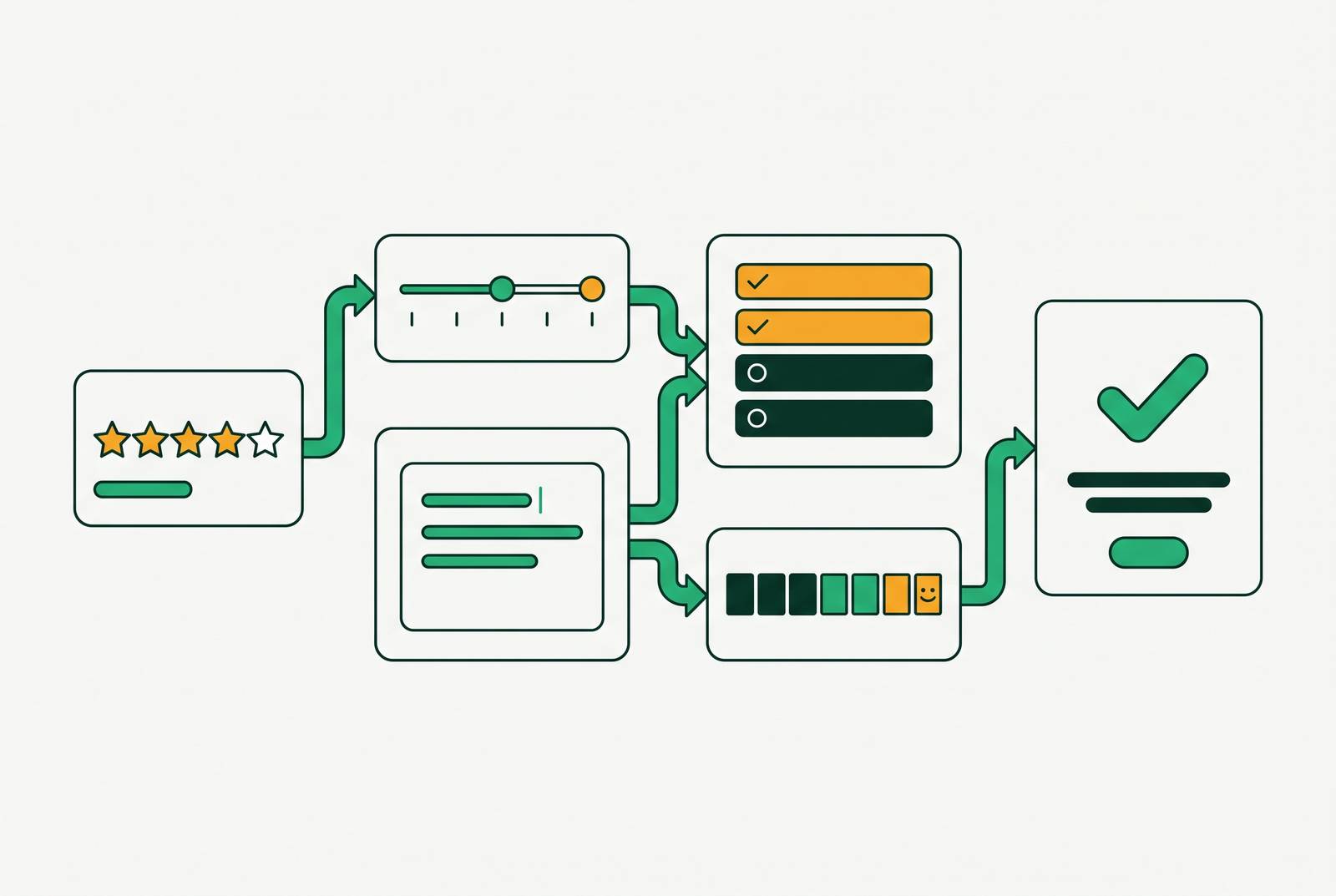
A 6 isn't a diagnosis. It's a symptom with four possible causes, and each one demands a different response. Post-sale NPS works when the questions are ordered so that every answer makes the next one interpretable. The sequence is the system.
Why the NPS score alone is an unreliable signal for SaaS retention decisions
A single 0–10 score tells a Customer Success team that something is wrong, but not what to do about it. A 6 could mean a billing error. It could mean a missing feature, a confusing onboarding, or a competitor evaluation. None of those responses are the same, and none of them call for the same fix.
NPS works as an early warning system precisely because scores drop before churn happens. That's what makes it genuinely useful. The problem is that a score without a structured follow-up creates a lag of a different kind: you know a customer is at risk, but not which lever to pull. You've swapped one kind of blindness for another.
The B2B SaaS complication compounds this. Who receives the survey changes what is measured. Executive buyers and end users score differently, and a score averaged across both hides the specific friction point. You see a number move. You don't see which relationship is breaking, or why.
What "question sequencing" actually means in a post-sale NPS context
Sequencing means two things at once, and most teams conflate them. The first is the internal order of questions within a single survey. The second is the external order of survey types across the customer lifecycle. Conflating the two produces programs that optimize for either the score or the moment, never both.
The lifecycle distinction matters because there are two fundamentally different instruments. Relational NPS measures overall loyalty on a fixed cadence, typically quarterly, and answers the question "are we winning or losing this account over time?" Transactional NPS fires after a specific event and answers "did this interaction help or hurt?"
For post-sale SaaS, the lifecycle events that warrant a transactional trigger include post-activation (around day 7–14), post-onboarding completion, after a support resolution, after a major feature release, and shortly before renewal. Each moment calls for a different follow-up question. That's why sequencing cannot be a single universal template.
QuestionPro's NPS question guide reinforces that timing affects data quality as much as wording. Ask before a customer has formed a complete opinion and you get noise. Ask after the experience has faded and you get retrospective rationalization. The window is part of the design.
The core sequence: score first, one open "why," then stop or branch once
The sequence that produces usable signal in post-sale SaaS has three steps. First comes the 0–10 rating question. Then exactly one open-ended "why" question. Then at most one lifecycle-specific follow-up. The order is non-negotiable because each step depends on the previous one to be interpretable.
The rating must come first because it anchors the respondent's overall judgment before they're asked to articulate it. Reverse the order and you prime a specific complaint, contaminating the score. You've turned a measurement into a prompt.
The open-ended "why" is where the actionable content lives. A score of 6 can only be routed correctly once the CSM knows whether it reflects a product gap, a support failure, a pricing concern, or a competitive evaluation. Without that, follow-up is guesswork. And guesswork at renewal time is expensive.
Survey length is a hard constraint. SurveyMonkey's NPS question guide confirms that the core NPS structure is the rating question plus one or two open-ended follow-ups. Adding questions beyond that introduces completion risk, and that degrades the signal from every prior question. A half-finished survey isn't partial insight. It's unusable data.
The third step deserves a rule: stop or branch once. That at most one lifecycle-specific follow-up is conditional, not default. It earns its place only if it triggers a distinct action the open-ended response cannot. Examples include a call-request for detractors, an advocacy prompt for promoters, or a renewal-readiness flag for at-risk passives near contract end.
There's a wording detail worth noting. QuestionPro points out that the standard NPS wording uses "friend or colleague" in the recommendation question, without singling out B2B SaaS as a context requiring "colleague" alone. The word "friend" in a professional context can feel off. Small wording choices materially affect response authenticity.
How to branch the follow-up question by score segment rather than using a single second question
Branching the follow-up by promoter, passive, or detractor segment is what converts the sequence from a data collection exercise into a routing mechanism. Ask the same second question of all three segments and it's useful to no one. A promoter doesn't need the detractor's resolution prompt. A detractor won't answer the promoter's advocacy ask.
For passives (7–8), the follow-up targets the specific gap preventing a higher score. "What's one thing we could improve to better meet your needs?" or "What would make you rate us higher?" surfaces the marginal friction. Address it and you can convert a passive to a promoter before renewal. That's the cheapest retention win available.
For detractors (0–6), the follow-up should present a structured path to resolution, not only an open text box. A three-choice quick-tag list identifying the primary issue category works. Add an optional comment field for detail. And include a direct offer of a follow-up call. SurveyMonkey lists "How can we make things right for you?" and "What could we have done to improve your experience?" as proven detractor follow-ups.
The call-request option for detractors deserves its own treatment. It is simultaneously a data-collection step and a retention action. Offering it signals organizational priority and gives the CSM a consented opening for outreach. That's different from a cold re-engagement call. The customer asked for the conversation.
Zonka Feedback's NPS question guide reinforces that follow-up questions reveal what keeps customers loyal, what pushes them away, and which improvements have the highest impact. But only when they're targeted to the specific sentiment group. Generic follow-ups produce generic answers. Targeted ones produce routes.
Lifecycle stage changes what the follow-up question should ask
A detractor score at day 60 post-activation points to onboarding friction or a time-to-value failure. The same score well before renewal points to a business case problem or a competitive evaluation. Treating both with the same follow-up produces the same useless resolution path. The score is identical. The problem isn't.
Mid-lifecycle NPS, the quarterly relational pulse, can keep the follow-up open-ended because the intent is trend-tracking, not immediate intervention. The third question here may be skipped entirely, unless a detractor score triggers a branched path. You're watching a line, not triaging a wound.
Post-support NPS is a transactional variant that sits outside the relational sequence but feeds into it. A low score here should suppress the next scheduled relational survey for that contact. Surveying someone who just had a bad support experience about their overall loyalty doesn't get you clean data. It gets you a compounded frustration. Zonka Feedback notes the principle of not surveying the same user more than once in a short window across Email and SMS survey types combined.
Why does lifecycle matter so much? Because the CS motion changes. Onboarding recovery looks like a training session or a configuration fix. The renewal conversation looks like an executive re-pitch. The same third question cannot serve both. The sequence has to know where in the lifecycle it's sitting.
Survey fatigue as a structural constraint on how many questions any sequence can carry
Survey fatigue isn't a soft engagement concern. It's a data quality problem. A respondent who drops out halfway through leaves a partial record that cannot be routed. A respondent who rushes through to finish provides answers that don't reflect genuine sentiment. Both corrupt the dataset in different ways.
The fatigue risk is not uniform across account types. Enterprise users tolerate more structured surveys, but they expect personal follow-up in return. SMB users are more sensitive to length and more likely to abandon surveys that exceed a short threshold. The sequence must be calibrated to the segment, not standardized across all accounts.
This points to a practical governance rule. Cap total survey exposure per contact across all survey types (NPS, CSAT, CES) at one survey per contact within a defined window. Overlapping programs from CS, Product, and Support teams are the most common way survey fatigue is created and the least visible. Each team thinks it sent one survey. The customer received four.
The follow-up action after a detractor response is where sequence discipline pays off
A sequenced survey that produces a detractor score plus a categorized reason plus a call-request response gives a CSM three inputs for a recovery conversation. A score alone gives them one. The difference determines whether outreach is targeted or generic, and targeted outreach is what saves accounts.
Speed matters. The window between score submission and first contact is where the sequencing investment is either cashed or wasted. Every hour compounds. The customer has told you something is wrong. They're waiting to see if anyone noticed.
The routing logic makes this concrete. A detractor score tagged "product gap" routes to a CS-to-Product escalation. Tagged "billing issue," it routes to Account Management. Tagged "competitive evaluation," it routes to a senior CS or AE. This is only possible because the branched follow-up provided the tag. The sequence created the route.
For high-value accounts, automated routing should be augmented by a personal outreach protocol. An executive sponsor call or a QBR acceleration. The signal value of the response in those accounts is high enough to warrant direct investment. AI-driven follow-up alone does not replicate the relationship signal that a personal call sends.
Where the standard two-question NPS sequence falls short and what to do about it
Here's the honest objection to everything above. The core structural weakness of the score-plus-open-text sequence is that the "why" field is left blank, or too brief to code, by a large proportion of respondents who do complete the survey. The follow-up that the whole routing argument depends on often does not exist. That's a real problem, and pretending otherwise would be dishonest.
It's not a reason to abandon the sequence. It's a reason to design the "why" step carefully. A short structured tag list with an optional open-text field outperforms a blank text box alone for detractors, because it lowers the effort of responding without eliminating qualitative depth for those who choose to add it.
AI-moderated conversational follow-up is the direction the field is moving. It preserves the 0–10 anchor but replaces the static text box with adaptive probing questions based on the score. It addresses the blank-field problem by making the follow-up feel like a dialogue rather than a form, which increases the proportion of responses with usable detail.
But fully automated follow-up has a real limitation for high-value B2B accounts. A VP of CS calling a strategic account's CIO after a detractor score is itself a retention action. It demonstrates organizational priority and relationship investment that an automated conversation cannot replicate. The data is better with automation. The signal sent to the customer is different.
The practical resolution is clean. Use structured branching and optional AI-assisted follow-up for the broad account base. Reserve personal executive outreach for strategic accounts, where the relationship signal matters as much as the diagnostic data. The sequence is the system. The human call is the signal.