Sales Ops vs Revenue Ops Role Boundaries
Clarifying what RevOps actually does versus Sales Ops, and why the distinction matters.

A CEO comes back from a conference and announces the company is "moving to RevOps." Three weeks later, nothing has actually changed. Same CRM, same team, same reporting line, just a new title on someone's email signature. That scenario plays out constantly, and it's the reason so many people think Sales Ops and RevOps are the same job with different branding.
They're not, and the confusion makes sense once you see where it comes from. Both functions rely on the same CRM. Both use the word "operations." Both spend their days untangling spreadsheets and chasing down why a number in one dashboard doesn't match the number in another. But they were built to solve different problems at different points in a company's growth. Sales Ops grew up to make a sales team run better inside a defined pipeline: leads come in, reps work them, deals close. Gartner defines Revenue Operations as "an end-to-end model unifying customer engagement across functions by integrating people, processes, and technology," a scope that simply has no equivalent in how Sales Ops gets defined.
RevOps didn't appear because consultants needed a new word to sell. It appeared because the pipeline stopped being the only road to revenue. Subscription pricing, usage-based billing, and product-led growth created renewal motions, expansion motions, and contraction motions that a sales-only view can't see, let alone track. That's a structural shift in how revenue actually gets generated, not a rebrand.
The rebrand objection still deserves a fair hearing, because it's often true in practice. Plenty of companies promote their Sales Ops lead, swap the title, and call it a day, with the function itself never actually changing. That's a real pattern, but it's a critique of execution, not a critique of the model. The question this piece is working through is what each function is supposed to do, not what any one company happens to have done with the label.
Sales Ops: execution within the sales team's boundary
Sales Ops answers to one job: make the sales team better at closing deals. Everything it touches flows from that single mandate.
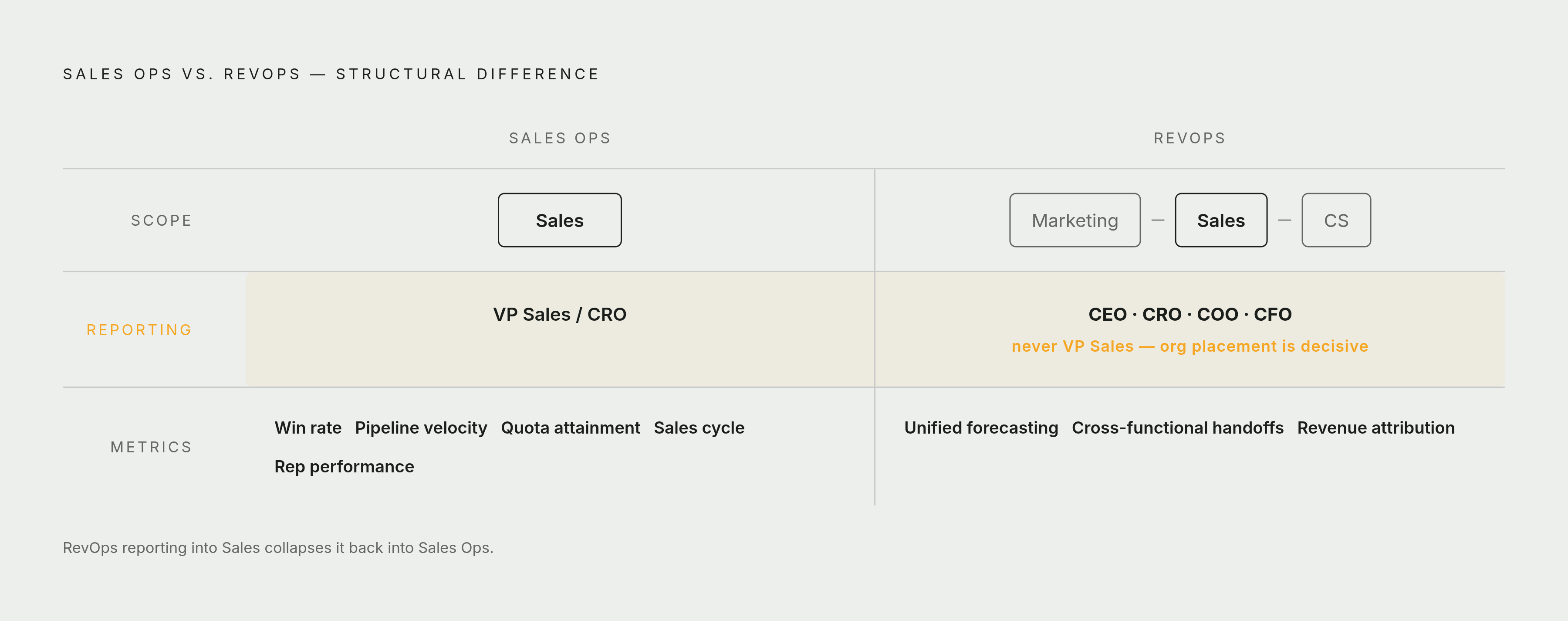
Forrester's framework, cited by Outreach, lays out four core areas: sales process architecture, the technology stack reps use to sell, analytics on sales performance, and territory and quota management. The metrics line up exactly with that mandate: win rate, pipeline velocity, quota attainment, sales cycle length, conversion rates, individual rep performance. These are the numbers that tell you whether a sales team is running at capacity.
Sales Ops usually reports to the VP of Sales or the CRO, and that reporting line marks the edge of its authority. Its job stops at the boundary of the sales organization. It has no formal reach into what marketing does before a lead shows up, and no formal reach into what customer success does after a deal closes.
That boundary is a real strength, not just a limitation. A function that focuses entirely on one team can get genuinely excellent at that team's problems: poor CRM usage, weak pipeline hygiene, reps who perform inconsistently quarter to quarter. These are execution problems, and Sales Ops is built to fix them. A platform like Next Step, for instance, tackles one piece of that execution gap directly: it automates CRM updates in real time so reps spend their hours selling instead of logging activity by hand, which is exactly the kind of operational overhead Sales Ops exists to manage. Sales Ops done well is worth having. It just doesn't have the vantage point to see what happens outside the sales team's four walls.
RevOps: the revenue lifecycle from first touch through renewal
RevOps takes everything Sales Ops does well and stretches it across marketing, sales, and customer success, so one function owns the handoffs between teams instead of three functions each owning their own slice and hoping the edges line up.
Outreach's framework breaks this into three areas. First, a unified revenue tech stack: data governance across the CRM, marketing automation tools, and customer success platforms, so the same account doesn't look like three different accounts depending on which system you're in. Second, cross-functional process mapping: tracking a customer's full journey from first touch through renewal, so a lead doesn't quietly vanish in the handoff from marketing to sales, or from sales to CS. Third, forecasting accuracy: it's built on one shared version of the truth that all three teams work from, instead of three separate spreadsheets that each tell a slightly different story.
In mature organizations, RevOps ideally reports to the CEO, the CRO, the COO, or the CFO, not to the VP of Sales. Its mandate spans three functions, so its data has to stay neutral across all three, and a reporting line into any single function undercuts that neutrality from the start.
CRM governance is where this plays out in a way you can actually point to. CRM platform governance increasingly sits with RevOps, because the platform touches every function that generates or uses customer data. Sales Operations still handles the sales-specific configuration inside that platform: the fields reps use, the stages in the pipeline, the territory rules. One function sets the rules of the road. The other drives inside them.
The data fragmentation problem that appears when scope is misassigned
When a company tries to run a cross-functional revenue motion through a Sales Ops-only lens, the data falls apart, quietly at first, then all at once.
The mechanism is simple enough to see coming. Marketing data sits in the marketing automation tool. Sales data sits in the CRM. Customer success data sits in the support platform. In a Sales Ops model, no function owns the connections between those three systems, so nobody notices when the connections stop working. Marketing counts pipeline by MQLs. Finance counts revenue by deferred bookings. The two numbers never reconcile, and forecast accuracy breaks down right when the business most needs an accurate forecast.
A case study on a digital asset management firm, published by the consulting firm Vantage Point, shows what this looks like at full scale. The firm ran Salesforce and HubSpot side by side with zero native synchronization between them, two completely isolated platforms doing two completely separate jobs. Leadership described the internal dynamic as a "civil war" between marketing's data compilation and sales execution. Marketing teams exported lead lists into Excel spreadsheets and physically handed them off to distribution teams, a workaround standing in for a system that should have existed. After a multi-phase RevOps transformation, revenue attribution went from nonexistent to fully closed-loop, and thousands of orphaned accounts got re-mapped to their correct territory.
A separate case involving Cariloop, documented by RevBlack, shows the same failure wearing a different face. Without a true RevOps function in place, pre-pipeline activity went largely untracked, and deals appeared close to closing on the dashboard despite having almost no real engagement behind them. That's the kind of forecast distortion a Sales Ops function, reporting up through Sales, has no built-in reason to catch and flag.
An obvious objection follows: can't you just fix fragmented data with better integrations, no org chart changes required? Integrations solve the technical half of the problem, connecting system A to system B. They don't answer who owns the logic when two systems disagree, or who arbitrates when marketing's numbers and sales' numbers point in opposite directions. That's a governance question, and governance is an organizational problem, not a technical one.
Organizational signals that indicate which function a company needs
There's no revenue number where a company magically needs RevOps instead of Sales Ops; the right question is how complicated the revenue motion has gotten, not how big the top line is. Gartner's own readiness assessment focuses on qualitative signals, not ARR triggers, and deliberately avoids prescribing a universal revenue milestone where companies should flip the switch.
Sales Ops is the right fit when the revenue motion is still linear: leads come in, reps work them, deals close, and that's the whole story. It fits when there's one main go-to-market motion and one product line. It fits when marketing and customer success are still small, early-stage functions that haven't yet produced data complex enough to need cross-functional management. If the presenting problems are poor CRM usage, weak pipelines, and inconsistent rep performance, Sales Ops is the correct tool for that job.
RevOps becomes the right fit under a different set of conditions. Multiple product lines that each need their own technical and field sales motions. A go-to-market that spans several channels at once. International expansion that needs coordination across regions. Cross-functional dysfunction as the actual presenting problem: marketing and sales arguing over what counts as a qualified lead, handoffs from sales to CS failing, multiple teams each keeping their own "source of truth," hours burned every week reconciling reports that should already agree. And when real revenue starts coming from renewals, expansion, or usage rather than new sales alone, forecasting that revenue accurately requires CS and marketing data that a sales-only function was never built to use. If the presenting problems are misalignment, fragmented data, and growth that nobody can predict with confidence, Sales Ops cannot fix those from where it sits in the org chart.
The most common misstep here has a name: shadow ops. A company promotes its head of Sales Ops to "Head of RevOps" and leaves the reporting line pointed at the CRO exactly where it always was. Six months later, the marketing team has quietly built its own parallel ops function, because it doesn't trust the "RevOps" team to represent marketing's interests fairly. The org design breaks on day one, title change or not.
The reporting line and RevOps' mandate
The most important decision in building out a RevOps function is who the function reports to, because that single line on the org chart decides whose interests it's actually built to serve.
RevOps reporting to the CEO or CRO, Sales Ops reporting to the Head of Sales or CSO: that difference is the scope of each mandate, written directly into the org chart. If the person running "RevOps" reports to the VP of Sales, the company doesn't have RevOps. It has Sales Ops wearing a nicer title, and the function will shade its read of pipeline health and attribution toward whatever story Sales wants told, instead of giving marketing and CS an honest, neutral view.
Pavilion CEO Sam Jacobs has argued RevOps should report into Finance for precisely this reason: the function's real job is owning the honest forecast, and that only happens from a seat outside the CRO's org.
AI adoption raises the stakes on this question in 2026. Marketing runs a model that scores leads. Sales runs an agent that updates records in the CRM on its own. CS runs automated alerts flagging churn risk. Somebody has to own the logic behind all three models, the data feeding them, how accurate they are, and how they get governed day to day. Sales Ops has no mandate to referee that. And a RevOps function that reports into Sales is unlikely to overrule Sales' own AI model when it contradicts what Marketing's model says about the same account.
One defense of the status quo comes up often: "our CRO has a broad enough mandate to hold the function accountable across all three teams anyway." A strong CRO can paper over structural misalignment for a while, running on sheer leadership skill. But that doesn't survive a leadership change, and it leaves data integrity resting on one person instead of one design.
Where AI administration fits into this structure
AI tools are spreading across marketing, sales, and customer success at the same time, and that's widening the gap between what Sales Ops can govern and what RevOps has to govern. Sales Ops can set rules for the AI tools its own reps use day to day. It has no authority over the models running inside marketing or CS, and when those models start disagreeing with each other, a rep ends up staring at three contradictory signals instead of one clear answer.
The failure mode is concrete and specific: marketing's model flags an account as high-priority, sales' model scores the same account as medium, and CS's model is simultaneously raising a usage-risk flag on it. Faced with three numbers that don't agree, a rep tends to trust none of them and falls back on gut instinct. RevOps, not Sales Ops, is the only function actually positioned to step in and settle which model gets believed.
RevOps' value here isn't just referee duty. Standardizing process and cleaning up data quality across the full revenue lifecycle has to happen before AI tools can work. Skip that foundation, and AI multiplies the fragmentation that comes from unsynced systems and disconnected teams instead of fixing it, because now there are three automated systems confidently producing three different answers instead of three manual ones quietly drifting apart. A platform's reach across the customer journey, from first touch through renewal, depends on an integration layer that can read every tool in the stack without forcing a company to rip out and replace its existing systems. Revenue operations platforms, Next Step included, are increasingly built to solve this by turning inbox and meeting data into CRM records logged the same way no matter which team captured the interaction.
AI governance now sits as a fourth pillar of RevOps, alongside process, enablement, and tech stack: owning the logic behind the AI and automation layer running across marketing, sales, and CS, along with the data feeding it and the accuracy of what it produces. When sales logs a customer commitment one way, and CS logs the same kind of interaction a different way, that mismatch doesn't stay contained. It cascades into bad forecasts and missed handoffs down the line, and solving it takes more than a governance policy on paper. It takes tools that standardize how commitments and interactions get captured in the first place, before three teams each build their own version of the truth.