CRM Software Types and Real-World Use Case Examples
Learn which CRM type matches your business model and why the wrong choice drains productivity.
The global CRM market hit $112.91 billion in 2025 and is projected to reach $126.17 billion in 2026, on its way to $320.99 billion by 2034. That's a 12.40% compound annual growth rate, and it's already one of the dominant categories in enterprise software. Depending on which research firm you ask, the numbers shift quite a bit: Grand View Research puts 2024 at $73.40 billion with a 14.6% CAGR, while Mordor Intelligence has 2026 at $87.96 billion growing at 7.93%. The gap comes down to what counts as "CRM" in the first place, whether social CRM, contact management, or marketing automation get folded in.
None of that disagreement changes the basic picture. CRM is huge, it's growing, and survey data show that 91% of companies with 10 or more employees are already using one. Which means the real question companies face isn't "should we get a CRM?" It's "do we have the right kind?" And that question gets skipped more often than it should.
What the four CRM types divide (and what they share)
Every CRM platform, no matter the vendor, is built on the same skeleton, with centralized contact records, a history of interactions, pipeline tracking, and some amount of workflow automation. That part is not up for debate. What separates one CRM from another is emphasis.
Four types tend to appear in how the software gets used:
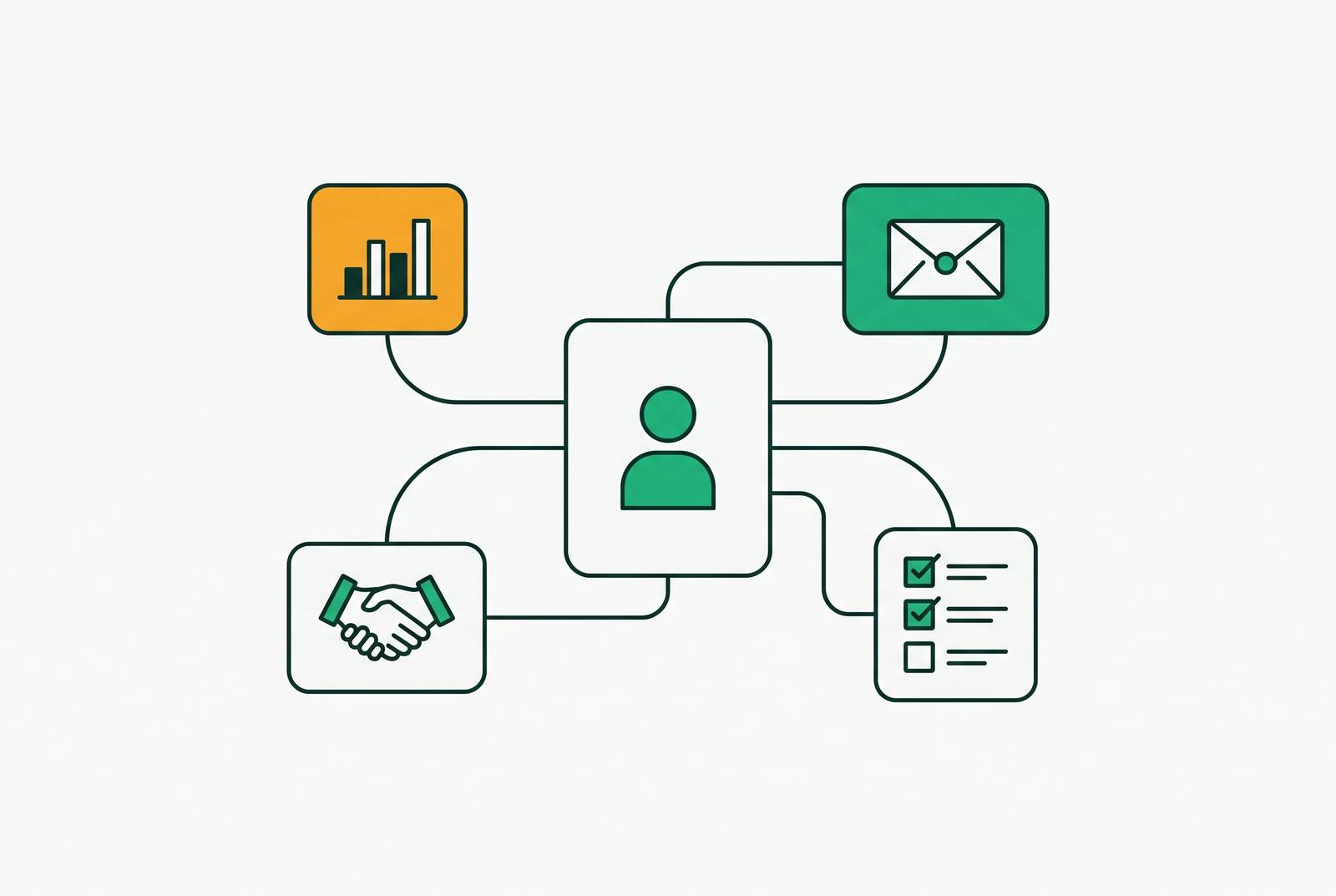
Operational CRM automates the daily grind: follow-ups, lead assignment, support ticket routing. Analytical CRM digs through the data already sitting in the system to find trends, segments, and forecasts. Collaborative CRM makes sure sales, marketing, and support are looking at the same customer record instead of three different ones. Strategic CRM puts the customer relationship at the center of the whole business model, not just the sales function.
The best enterprise platforms blend all four. The "type" label just describes which muscle a given tool flexes hardest. Some guides only name three types, folding strategic into the other categories. Others, including Salesforce, split out four. Both framings are used in the industry. This piece sticks with four, because lumping strategic in with analytical blurs a distinction that matters: long-term relationship strategy and short-term data crunching are not the same job, even if they run on the same platform.
Operational CRM: what it solves and which scenarios call for it
Operational CRM has one job: get the busywork off a rep's plate so they can actually sell. Automated follow-ups. Lead routing. Activity logging that doesn't require a human to remember to do it.
This is the right fit when:
- A growing small or mid-sized business has reps tracking deals in spreadsheets, and the pipeline has grown past what one person can hold in their head. Follow-ups start slipping. Deals go cold for no reason other than nobody remembered to call back.
- An e-commerce or inside-sales team is running high volume, short sales cycles, where whoever responds first usually wins the deal.
- A service business needs appointment reminders and support routing to just happen, without someone building custom scripts to duct-tape it together.
The numbers back up why this matters. Salesforce research shows companies using CRM report 29% increases in sales, 34% improvements in sales productivity, and 42% better forecast accuracy. Reps also spend 17% less time on administrative tasks. That last figure is the tell: administrative drag is the actual disease operational CRM treats. Without it, the inbox becomes the CRM. Deals stall in someone's "to follow up" folder. No manager has a real-time view of the pipeline, because the pipeline doesn't exist anywhere except in people's memories.
Analytical CRM: turning accumulated data into decisions that were previously guesswork
Operational CRM records what happened. Analytical CRM asks what it means, and what's likely to happen next. It mines the pile of interaction data the operational side generates, and turns it into churn predictions, lead scores, and customer segments.
Scenarios where this earns its keep:
- A B2B sales team with a long sales cycle needs to know which deals are actually going to close, not just which ones a rep feels good about. Gut instinct and forecast accuracy are not the same thing.
- A marketing team is spending budget on campaigns with zero visibility into which segments convert, which stick around, and which quietly churn.
- A subscription business wants to catch disengagement signals before a customer ghosts the renewal conversation entirely.
CRM use overall is tied to a 27% boost in customer retention, and a key part of that is spotting an at-risk account before it walks, instead of finding out after the invoice bounces. That's the whole value proposition in one sentence. Data that already exists gets put to work instead of sitting there unused.
Collaborative CRM: the scenario where the customer suffers because internal teams don't talk
Picture this, because it happens constantly: a sales rep closes a deal. Six months go by. Nobody can find the original negotiation thread, the exact contract terms, or what was promised to close it. Meanwhile marketing is still sending "welcome, new customer!" emails to someone who's been paying for years. That's not a hypothetical. That's the textbook collaborative CRM failure, and it happens because sales, marketing, and support are each keeping their own partial version of the truth.
Collaborative CRM exists to fix exactly that, by giving every department a shared, live record of the relationship. It fits:
- A SaaS company where the handoff from sales to customer success keeps breaking, support reps inherit accounts blind, customers have to repeat their whole history, and churn follows right behind.
- A professional services firm where multiple partners touch the same client and need one shared record, so nobody gives conflicting advice or reaches out twice about the same thing.
- Any org where sales and marketing are fighting over lead quality, mostly because neither side can see what the other is actually doing with a given contact.
This is a structural problem, not a people problem. Put teams on separate tools, and each one builds an incomplete record almost by default. Collaborative CRM forces a single source of truth, no matter who touched the account last.
Strategic CRM: when the business model depends on relationships, not transactions
Strategic CRM is less a feature and more a philosophy, wired into how a company operates. The idea: align products, service, process, even culture, around building long-term, profitable relationships, instead of optimizing each transaction as its own event.
Where this actually matters:
- A wealth management or financial advisory firm, where the relationship is the product, and a single client relationship might span decades.
- An enterprise B2B vendor with a small number of very high-value accounts, where going deeper with an existing account beats chasing a new one.
- A subscription or membership business where lifetime value dwarfs acquisition cost, and retention has to be baked into every touchpoint, not bolted on afterward.
Here's the line that separates it from analytical CRM: analytical CRM produces the insight. Strategic CRM is what happens when that insight actually changes something, pricing, the product roadmap, how service gets designed, where executives spend their attention. One tells you something. The other rebuilds around it.
Mapping the four types to company size and sales motion
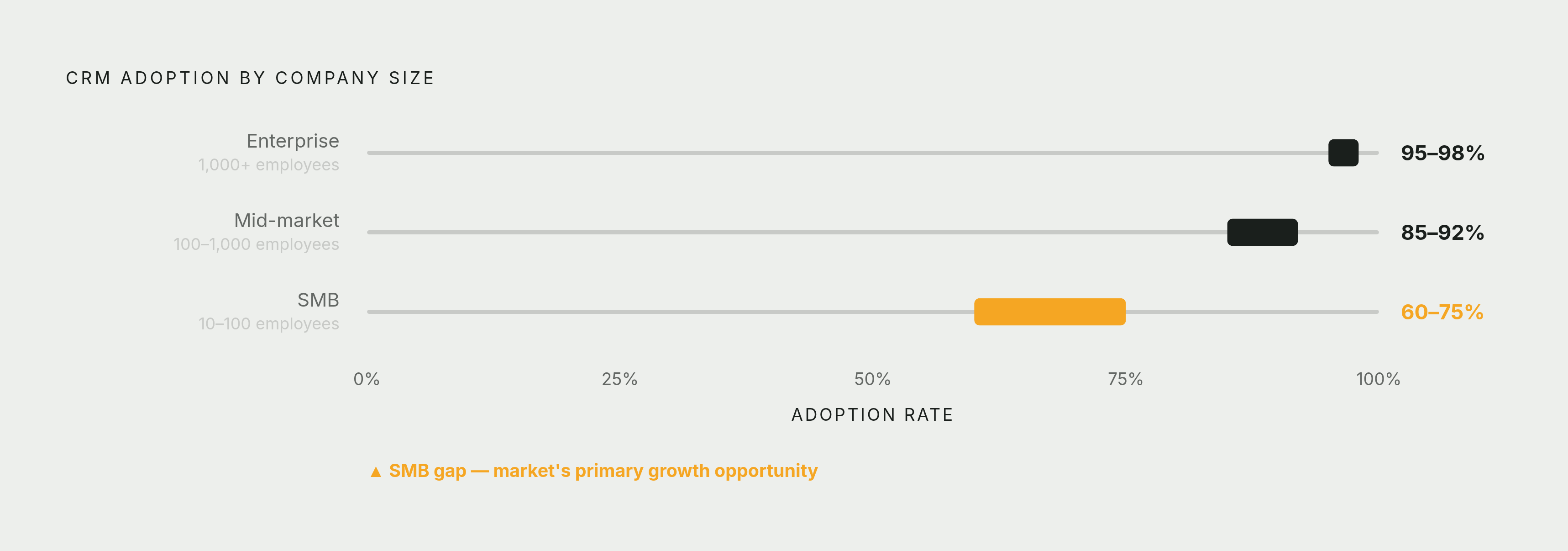
Adoption tracks pretty closely with company size. Enterprise firms, more than 1,000 employees, run at 95 to 98% CRM adoption, often juggling more than one system across departments. Mid-market companies, 100 to 1,000 employees, are at 85 to 92%. Small and mid-sized businesses, 10 to 100 employees, are at 60 to 75%. That gap at the bottom is where most of the market's future growth is sitting.
A rough map of what fits where:
Early-stage or SMB with high transaction volume → start with operational CRM. Keep it simple. Prove it's working. Add analytics later. SMB or mid-market with an established pipeline but no real visibility → the gap is analytical. The data's already there. It's just not being used. Mid-market or enterprise with multiple customer-facing teams → collaborative CRM. The bottleneck isn't speed, it's coordination. Enterprise or professional services with long, high-value sales cycles → strategic CRM, but only once the operational and analytical layers are solid underneath it.
Sales motion matters just as much as headcount. High-volume, short-cycle businesses (inside sales, e-commerce, product-led SaaS) lean operational. Long, complex cycles (enterprise B2B, professional services, financial advisory) lean strategic, backed by strong analytics. Account-based or multi-stakeholder deals lean collaborative, to stop context from getting lost every time a deal changes hands internally.
Most platforms can do more than one of these jobs. The real evaluation question is: what does this platform do best, and does that match the actual pain point right now?" It's: what does this platform do best, and does that match the actual pain point right now?
How leading platforms align to the four types in practice
No platform lives in exactly one box. But each has a center of gravity, and knowing where that center sits is what makes a comparison useful instead of just a features checklist.
Salesforce Sales Cloud leans operational and analytical, built for enterprise scale. It's highly customizable, backed by the AgentExchange ecosystem, and starts at $25 per user per month. Salesforce brought in $41.5 billion in FY2026 revenue, and Agentforce, its agentic AI layer, is already at $800 million in annual recurring revenue, up 169% year-over-year. Agentforce now processes more than 3 billion monthly agent workflows across roughly 18,500 customers. It's best suited to organizations that already have the data foundation to support that kind of automation, not ones just getting started.
HubSpot CRM leans operational and collaborative, and it's built with SMBs and growing teams in mind. The free tier is genuinely useful, and paid plans start at $9 per seat per month. HubSpot's ARR is $3.1 billion, growing 19%. Its AI suite is branded Breeze: Breeze Copilot as an in-app assistant, Breeze Agents handling autonomous work across customer service, prospecting, content, and social media, and Breeze Intelligence on top. It serves more than 279,000 customers, and among the major platforms, it probably strikes the best balance between AI usefulness and how easy it is for a team to actually adopt.
Zoho CRM is the all-in-one option for SMBs, with real analytical strength via Zia AI, included at no extra cost in the Enterprise tier. Zia handles predictive forecasting, anomaly detection, and Vision AI for image validation and intelligent character recognition from photos and documents. It starts at $14 per user per month, and runs 67% to 76% lower total cost of ownership compared to Salesforce.
None of these three is "the answer" in the abstract. The answer depends on which problem is actually costing money today, missed follow-ups, blind forecasts, siloed teams, or a business model that hasn't caught up to the fact that relationships, not transactions, are what it's actually selling.