Customer Feedback Surveys for Sales Process Improvement
Match NPS, CSAT, and CES to your sales cycle stages to actually fix what matters.

Three metrics run most sales feedback programs, and people talk about them like they're the same thing. They're not. That confusion is probably why your dashboard has forty numbers on it and nobody can tell you what to fix.
NPS asks how likely someone is to recommend you. Promoters score 9-10, Passives 7-8, Detractors 0-6. It measures the relationship, not the moment. Ask someone their NPS the day after a rough demo and you'll learn almost nothing about the demo.
CSAT is narrower on purpose. One interaction, scored 1-5 or 1-7, reported as percent positive. Most industries sit around 75%-85%. In competitive sectors like SaaS and e-commerce, top-performing teams target 90% or above. Different game.
CES measures friction. How hard was it to actually do business with you. This is the metric that catches what the other two miss: the clunky AE-to-CS handoff, the approval process that makes a buyer want to throw a laptop across the room.
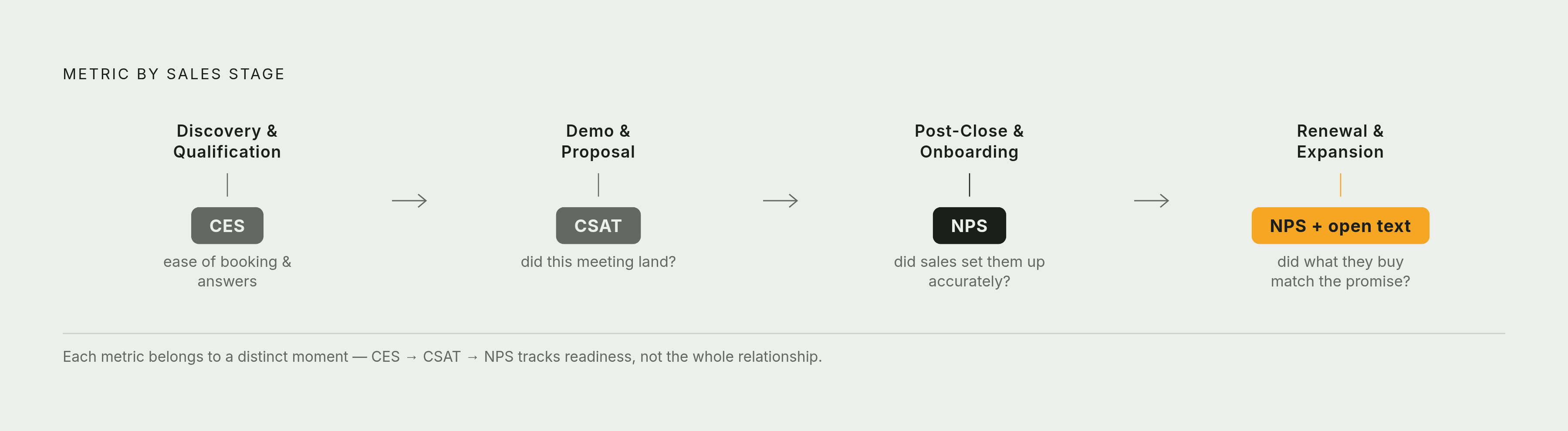
Match them to the sales cycle and they start earning their keep:
- Discovery and qualification: CES. Easy to book the meeting? Easy to get a straight answer out of anyone?
- Demo and proposal: CSAT. Did this specific meeting land?
- Post-close and onboarding: NPS. Did the sales process set them up accurately?
- Renewal and expansion: NPS plus open text. Did the thing they bought match the thing they were promised?
A low NPS score on its own is a mystery. It's a smoke alarm with no fire visible. Add CSAT and you can point at the room. Add CES and you find out if people were unhappy, or just worn down by your process. Stack all three by stage and you've gone from a thermometer to something closer to an X-ray.
And here's a thing worth sitting with: B2B and B2C often don't score the same, and that gap isn't a performance problem, it's a structural one. Retently's 2025 NPS Benchmark Report, built off many thousands of surveys per industry, put B2C at an average NPS of 49 against 38 for B2B. Eleven points. Most of that comes down to how much messier B2B relationships tend to be by nature, more stakeholders, longer timelines, more places for things to go sideways. So if you're B2B and beating yourself up against a flat global average of 32, maybe stop. You might be doing fine.
Designing surveys around sales stages rather than generic satisfaction
Try this test before any survey question ships: can a rep actually do something with the answer, or will they just nod and move on? "How satisfied are you overall?" fails that test more often than not. It flattens the whole buyer journey into one number and tells you little about where it went wrong.
Stage-specific questions tend to survive the test:
- Discovery call: Did the rep ask about your actual problem? Do you know what we offer now? (CSAT)
- Demo or proposal: Did the demo hit the challenges you described? (CSAT)
- Decision or close: Was the contract process straightforward? (CES)
- Post-close, onboarding: Does what you're experiencing match what you were sold? (NPS)
Each question points at one moment. One owner. One thing that can get fixed without a committee.
Keep the survey short. One scored question, one open box. The principle holds regardless of who's saying it: over-survey people and the feedback turns into noise. Trigger the send off the actual interaction, not a weekly calendar reminder, or you risk training people to ignore you within a month.
Timing matters more than most teams admit. Feedback collected right after an interaction tends to beat feedback collected the next day, and often by a wide margin. Surveying the moment a stage ends isn't a nice touch. It's the difference between real data and a guess dressed up as data.
Don't cut the open-text box to save space, even though it's tempting. The score tells you something's wrong. The open text tells you what. Tag those by stage, even loosely, by hand if you have to, and patterns tend to show up faster than you'd expect from a handful of sentences.
Timing and channel choices that determine whether responses are usable
You can write a sharp survey question and still get garbage back if you send it the wrong way at the wrong time.
Email sits at 15%-25% response rates. That's the floor, not something to celebrate. In-app and post-interaction surveys tend to do better than email. Anything past 40% is worth a small party. Anything under 15% means fix your timing before you touch the wording again.
Match the channel to the stage:
- Post-call: SMS, or a short link in the follow-up email, sent immediately. Recency is doing most of the work here.
- Post-demo, post-proposal: Email, one scored question. The buyer's already in an email thread with the rep anyway.
- Post-close, onboarding: In-app or portal. They're inside your product now, not thinking about sales calls anymore.
The usable window is short and it tends to close fast. Send it soon after the interaction and you get something real. Wait a day and quality often falls off sharply. What tends to work is automating the send off a CRM stage change, because hoping a rep remembers on a Friday afternoon is not a strategy.
Length costs you too. Every question past the first one or two bleeds completions. One scored question plus one open box tends to beat a five-question survey on completion rate. Keep it to one survey per interaction cycle and you protect what comes back.
Building the workflow that converts survey responses into process changes
Collecting responses is the easy part. Almost nobody builds the next piece: collect, analyze, act, close. Skip any one of those four and you've built an expensive way to make people feel unheard.
Analyzing means routing, not reading. A low CSAT on a demo belongs in a coaching conversation between a rep and their manager. A high CES score at contract stage belongs on sales ops's desk for a process audit. Mix those two up, send everything to one inbox, and watch good feedback die quietly in a spreadsheet tab nobody opens twice.
A rough map that works:
- Low CSAT on demo quality: sales manager, rep, coaching review
- High CES friction at contract stage: sales ops or RevOps, process audit
- Low NPS post-onboarding: customer success escalation, plus a signal back to sales about what got over-promised
- Detractor responses: someone follows up today, not next month's report
Acting means the fix gets written into an actual playbook. Not mentioned once in a coaching call and forgotten by the next deal cycle. If it's not written down somewhere a new rep will find it, it likely didn't happen.
None of this scales without the CRM in the loop. Put survey responses next to the deal record and reps see the feedback where they're already working, instead of a dashboard that exists mainly to get screenshotted into a QBR deck once a quarter. Tools that integrate with Salesforce and HubSpot can log the response and kick off the next step automatically. The alternative is a rep remembering to do it by hand, which, let's be honest, isn't much of an alternative.
One response is an anecdote. Fifty tagged responses over a quarter, sorted by stage, start looking like evidence. Review that pile quarterly, not just the headline NPS number, and real patterns tend to surface on their own. Same complaint, same stage, across different reps? That's not a coaching problem anymore. That's a playbook problem, and it needs a different fix entirely.
Companies that have built this kind of closed loop consistently report meaningful reductions in churn over time. The mechanism matters more than any single result. But the mechanism behind it, faster routing and faster resolution rather than fancier dashboards, is the repeatable part.
What to do with feedback that points back to sales behavior, not just process
Not every bad score is a process problem. Sometimes it's just a rep who needs help with one specific thing, and forcing that into a "process fix" wastes the insight sitting right in front of you.
The pattern tells you which one it is. Low CSAT on discovery calls clustered around a single rep? Coaching. Low CSAT on discovery calls across most reps at that stage? Process. Break the responses down by rep, by stage, by deal type, and the answer tends to fall out on its own, with little debate required.
Some open-text answers should stop you mid-scroll:
- "Felt like a pitch, not a conversation" (discovery skills gap)
- "Wasn't clear what happens next" (handoff and expectation-setting gap)
- "The demo didn't address what I told them mattered" (nobody was listening closely)
Bring these into coaching as the customer's own words, not your interpretation of them. Reps tend to hear "the buyer said this" very differently than "I think you did this." The second one puts them on defense before you've said anything useful. And patterns tend to beat single incidents: "this came up in three of your last five deals" starts a real conversation. One bad score by itself is often just noise, a bad day, a mismatched buyer, and treating it like gospel can burn trust with a rep who didn't deserve it.
One more thing worth saying plainly: reps buried in manual CRM updates and call notes don't have much left over to absorb coaching feedback, however gently you frame it. Automate the logging and tagging so the response gets captured without adding to their workload, and the feedback has a better shot at landing somewhere useful.
Closing the loop with customers and measuring whether changes are working
Telling customers what changed because of what they said isn't a nice gesture. It's closer to the price of admission. Research consistently shows that customers expect companies to act on their feedback. Skip this step and you risk training people to stop filling out your survey at all, which, fair.
Closing the loop doesn't require a company-wide memo. A direct message to a Detractor, naming the specific thing that changed because of what they said, tends to build more trust than any release note. At the individual level, that's a rep or CS person sending a short note. At the pattern level, a playbook update deserves a mention in a newsletter or a check-in call: you said this, here's what we did.
Track the metric tied to what you actually fixed, not the company-wide NPS average sitting on a slide. Fixed a discovery-stage friction problem? Watch the discovery CES score, specifically. And pay attention when the numbers don't move together: discovery improves but post-close NPS stays flat. That tells you your fix was real, just not the whole story. Something downstream may still be broken, and that's your next thing to chase down.
Do this quarterly. Track trends instead of one-off snapshots. Response rates tend to climb on their own once people believe their answer actually goes somewhere. The revenue case backs this up too: 85% of companies that prioritize customer feedback report a revenue increase tied directly to it.
None of this works because it's clever. It works because people can see themselves in what changed. That's close to the whole mechanism.