Win-Loss Interview Question Design for B2B Sales
The right questions uncover why deals actually fail, not what buyers say on the surface.
A sales rep logs a lost deal as "no budget." The buyer who actually made that decision never said those words in that order. What happened in between is the entire subject of this article: the question design that decides whether a win-loss interview captures what really happened or just records a tidier version of it.
This is a craft problem, not a philosophical one. Win-loss programs fail constantly, and not because companies skip them. Most run the interviews, fill out the templates, and still end up with the same lost deals, same quarter after quarter, because the questions they ask stop at the first answer the buyer offers. That first answer is almost never the real one.
Price, timing, and "fit" are the three answers that show up most often in these interviews, and buyers can name all three with the least discomfort. CRM close-lost codes make the problem worse before an interview ever happens: those codes record the rep's self-reported explanation, not the buyer's account, and they over-index on "no budget" and "bad timing" because those are the two easiest boxes to check before moving to the next deal.
This cost appears downstream, not in the interview itself. Every one of those decisions rests on a surface answer nobody pushed past, and the questions asked in that one interview are the only thing standing between a company and another year of guessing.
How Buyers Construct Their Decision Narrative
Buyers are not hiding the truth on purpose. Saying "your team didn't inspire confidence that this would work" or "my boss overruled me and I didn't fight for it" requires quite a bit.
When a buyer says price, a second sentence almost always goes unsaid: everything else about the offer wasn't strong enough to justify that price next to the alternative. Price is the symptom. The actual diagnosis is usually buried somewhere else entirely: a disagreement among stakeholders that never got raised during the evaluation, anxiety about implementation that the demo never addressed, switching costs the rep never thought to ask about, or a procurement veto the champion kept quiet because admitting it felt like admitting failure.
No-decision outcomes follow the identical pattern. Nobody forced the buyer to reckon with the cost of staying put, so staying put won by default.
There's a clock running on all of this too. At roughly 30 days out, a buyer's memory of the decision starts to compress. A great question asked 90 days late is interviewing a memory, not a decision.
Why a single undifferentiated question guide misreads every buyer
A single, generic question guide run across every interview produces shallow answers on a predictable schedule, because the people sitting across the table don't share the same priorities. What lands with a CFO bounces off the engineer who ran the technical evaluation, and vice versa.
Executives weigh risk, return on investment, and whether the organization feels confident backing this decision. Commercial buyers are tracking something else entirely: budget structure, procurement process, and the internal approval chain the deal has to survive.
Running one undifferentiated guide across all three forces every buyer into the same frame. The dominant concern of at least two of those three personas gets missed in most buying committees, every single time, because the interviewer never asked a question built for the thing that actually mattered to them.
The same logic extends to deal type. A no-decision interview needs a different architecture than a competitive loss interview, because the decision driver in a no-decision usually lives inside the buyer's own organization. Asking "why did you choose them instead of us" to a buyer who chose nobody is the wrong question.
A balanced sample matters here too. Won deals, lost deals, and no-decision outcomes each expose a different failure mode, and each one needs questions calibrated to what that specific buyer actually lived through. Calibrating the guide to role and deal type isn't a refinement to add once the basics are working. It has to happen before a single question gets written, because a guide built for the average buyer is built for nobody in particular.
The Journey-Mapping Principle
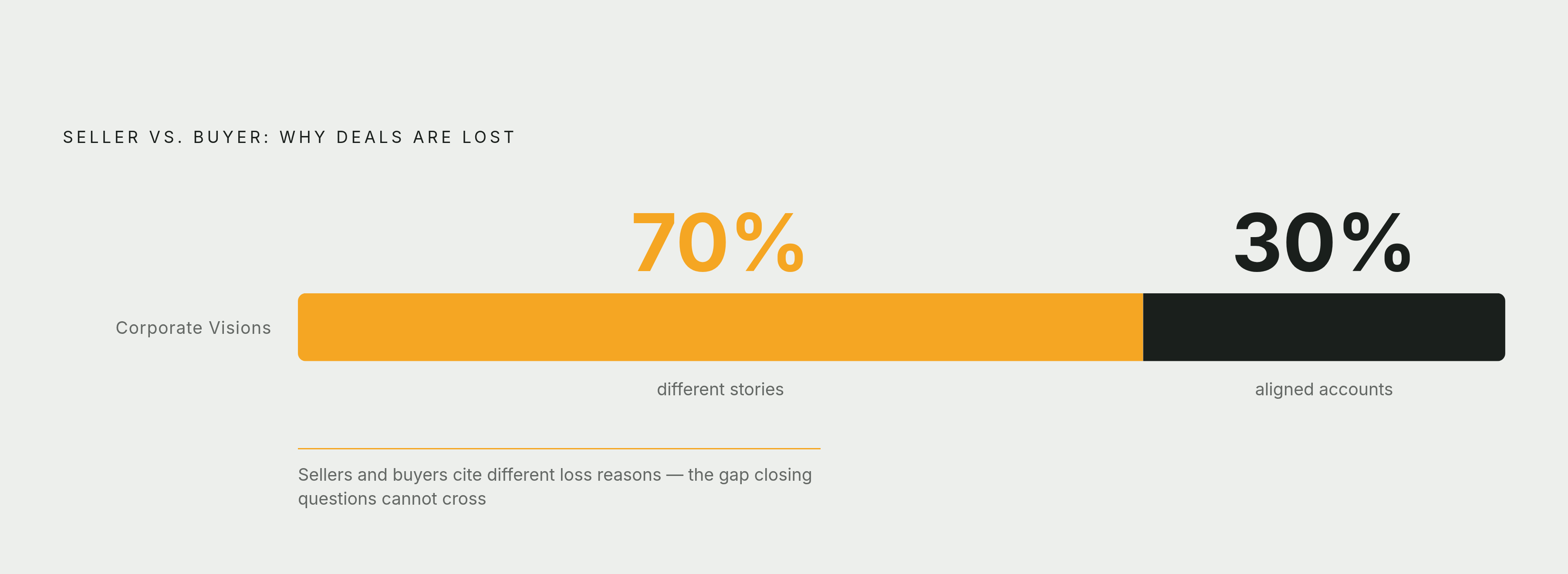
The most useful win-loss questions don't ask for a verdict. They trace the sequence of how the buyer actually got there. The moment a deal turned is almost never the moment a buyer names as the reason when asked directly, and the gap between those two things is wide. Corporate Visions' analysis of these conversations found that sellers and buyers give completely different answers for why a deal was lost 70% of the time.
That 70% figure is the whole argument for why "why did you choose them?" is a weak question. It invites a summary, and summaries are reconstructed after the fact, smoothed out, stripped of the specific moment that actually mattered. Compare it to something like "walk me through how you structured the evaluation and what changed your thinking along the way." That question asks for a story instead of a judgment, and stories carry details a verdict strips out, the specific email, the demo moment, the stakeholder conversation where confidence actually shifted one way or the other.
Starting broad helps the rest of the interview land harder. There's a relationship benefit buried in this sequencing too: working through the less confrontational questions about the sales experience first builds enough trust that the interview can survive the harder questions about why the deal was actually lost.
Organize the guide around the buyer's actual timeline, awareness, consideration, decision, rather than around a single closing question asking for the final answer. That structure lets the interviewer find the exact point where the deal started to slip instead of settling for whatever verdict the buyer hands over at the end.
Conversation intelligence helps here in a very specific, practical way. Reviewing summaries of the actual sales calls before the interview gives the interviewer something to probe against: real moments from the real evaluation, not a reconstructed narrative built from a memory that's already a month old. That groundwork matters most on deals that closed weeks or months after the decisive conversation actually happened, which is most of them.
Open-Ended Questions as the Default
Most of a win-loss interview should run on open-ended questions, and there's a practical reason for that default beyond politeness. Open questions carry less bias into the room and keep the conversation moving on its own momentum, so the buyer's actual priorities appear in the answers instead of a confirmation of whatever the interviewer walked in expecting to hear.
"What" and "why" questions do most of the real work. They ask for an explanation rather than a confirmation, and they rarely tip the interviewer's hand about which answer they're hoping to get.
Numbers belong somewhere else. A question like "on a scale of 1 to 5, how helpful was our sales team" is useful data, but it doesn't belong inside the interview itself. Inside the interview, it just stalls momentum for a data point that could've come later.
Narrowing works only once an open question has already surfaced a theme worth chasing. If a buyer mentions implementation timing as a concern, that's the cue to follow with something specific: "which part of the implementation timeline concerned you most?" Asked too early, that same question forecloses everything the buyer might have said instead.
Klue's D.E.P.T.H. framework gives this narrowing move an actual structure. When a buyer gives a flat or half-hearted answer on something that matters, the interviewer asks "why?" Then takes that answer and asks "why?" again. And again, as many times as it takes, until what comes back is a concrete mechanism rather than another round of summary. That repetition is the entire skill. Leaving an interview with "they weren't a great fit" is not the same as leaving with the specific stakeholder conversation that killed the deal.
Five question areas that reliably surface the decision drivers buyers don't volunteer
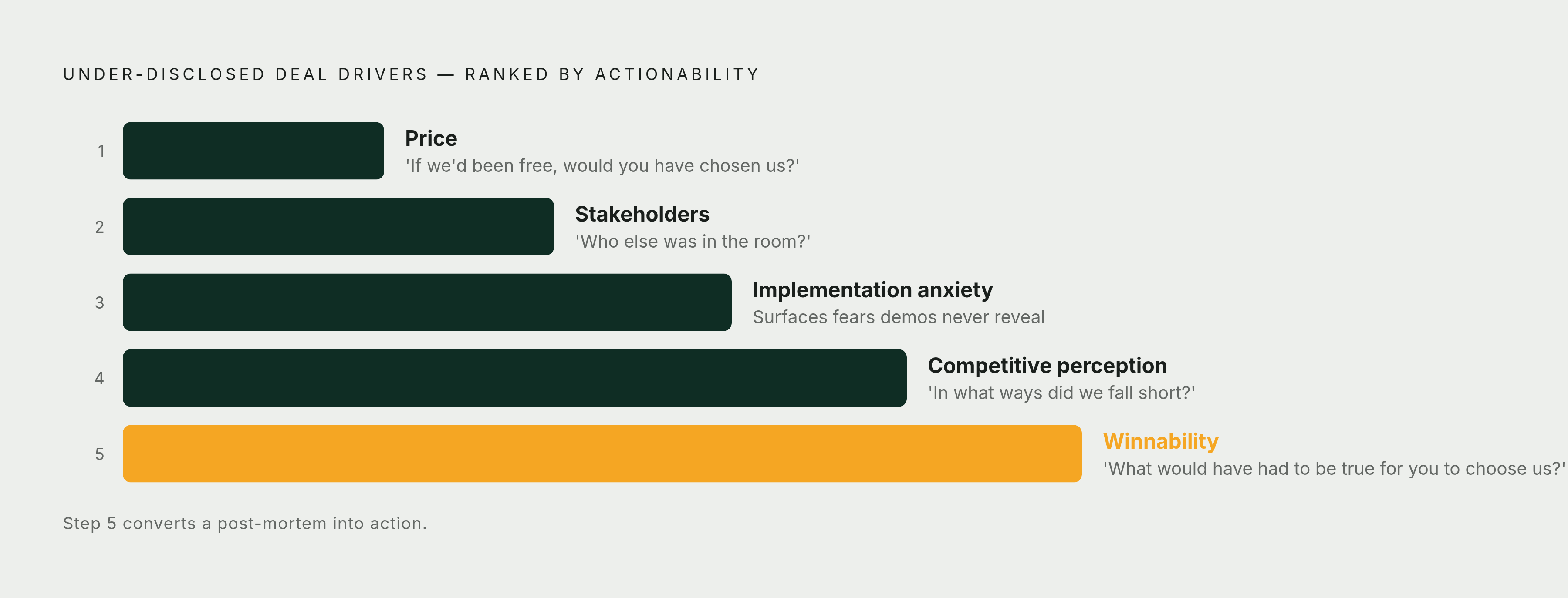
Five areas account for most of what buyers under-disclose in a win-loss interview: what "price" actually meant, who else was really in the room, anxiety about implementation, how the competition was perceived, and whether the deal was ever winnable. Each one needs its own angle of attack.
Price is rarely the whole story, so it needs a direct test. Asking "if we had been free, would you have chosen us?" gives a clean split: a yes means price really was the constraint, a no means price was cover for something else, usually a gap in value or trust that never got addressed. The follow-up matters just as much as the test itself. Each of those points toward a completely different fix, and lumping them all under "price" guarantees the company fixes the wrong one.
Stakeholders rarely get named unless someone asks directly. "Who else was in the room when the final call got made, and what did each of them want?" reveals the procurement veto or executive override the rep never even knew existed. Buying committees often contain people pulling in different directions, and mapping each person's priority reveals whether a deal was lost on merit or because the champion never had the internal authority to push it through. There's a second use for this question beyond loss analysis: buyers who reach a stable internal consensus report higher-quality purchase decisions overall, while messaging aimed at individuals instead of the group can actively work against that consensus. That makes this line of questioning useful for customer success planning on won deals too, not just for understanding losses.
Implementation anxiety almost never gets said out loud unless the question creates room for it. That question surfaces fears a sales demo never touches, because admitting those fears can feel, to the buyer, like admitting the organization might not be able to execute even after picking the right vendor. Implementation risk drives a lot of late-stage deal failure, and this kind of question gives a buyer a way to say so without having to say it as a direct confession.
Competitive perception needs a sharper instrument than "why did you pick them?" That question asks for a verdict. "In what ways did we fall short compared to the vendor you chose?" asks for a specific gap instead, which is a very different and far more useful answer. A second question worth running alongside it: "how clear was it to you what made us different from the other options?" Clozd's competitive landscape framework adds a third angle: "did your perception of our brand change between the start and end of the evaluation?" That question is built to catch the exact moment confidence eroded, and that moment is where the most useful intelligence in the whole interview tends to live.
Winnability is the closing test, and it's the one that turns the interview from a post-mortem into something the company can actually act on. "What would have had to be true for you to choose us?" demands a concrete condition in response, a specific feature, a different pricing structure, a reference customer, a faster path to implementation. If the buyer can't name a condition, the deal probably was never winnable to begin with, and that answer matters almost as much as a clear condition would. It tells a company whether to go fix something specific or to stop spending resources chasing a category of deal it was never going to close.
Questions to avoid and the framing mistakes that close buyers down
Certain questions shut a buyer down fast, either by putting them on the defensive, annoying them, or collecting data that's already too late to use.
Asking a buyer to re-litigate their own decision is one of the clearest ways to do this. "Do you feel satisfied with the choice you made?" or "would you have made the same decision again?" The buyer ends up defending a choice rather than describing one, and that defensiveness tends to carry past the interview itself. The person on the other end of that question may well be back in the market at a different company within a year or two, and a defensive interview is not the way to keep that door open.
Questions about process details the sales team should already know, discovery timelines, must-have versus nice-to-have criteria, arrive too late to help once the interview is happening. Asking them now doesn't generate insight. It signals that the sales process itself had a gap nobody noticed at the time, and that's a different problem than the one the interview is meant to solve.
Leading questions carry their own bias straight into the data. "Would you say our pricing was too high compared to the competition?" hands the buyer the answer before they've had a chance to think about what actually happened. That's the exact distortion a win-loss interview exists to remove, reintroduced by the interviewer's own phrasing.
Scale-based ratings dropped into the middle of a conversation cause a smaller version of the same problem. That kind of question belongs in a follow-up survey, not inside the conversation.
The last framing mistake sits at the level of the whole program rather than any single question, because a guide that only interviews losses produces a one-sided, negative picture by design. Won deals show what's actually working, the genuine differentiators and the buying conditions that favored the company, and skipping them means the whole program is built to confirm what's broken while learning nothing about what to protect.