Challenger Sales Training for Complex B2B Deal Cycles
Teaches buyers something new to break through stalled enterprise deals.
Where Challenger came from and what its research showed
Most B2B sales teams don't lose deals to a competitor. They lose to nothing happening. The buyer goes quiet, the deal sits in "still evaluating," and six months later it gets marked closed-lost with no name attached to who actually won. Challenger sales training exists because of that exact problem. Its three core habits (teaching, tailoring, and taking control) are built to attack the reasons long B2B cycles stall.
Indecision is estimated to kill up to 60% of deals that were qualified and looked winnable, a number large enough to sit with. That's the number to sit with. Buyers now complete close to 80% of their research before a rep ever gets a call, and the buying committee behind an enterprise purchase has grown to an average of 13 stakeholders. More people means more opinions, and more opinions raise the risk of getting it wrong. When switching costs are high and consensus is hard to reach, doing nothing is the safest move on the table. It's the easiest decision there is.
Challenger didn't start as a sales philosophy. It started as a data problem. Matthew Dixon and Brent Adamson, working at CEB (later absorbed into Gartner), set out to figure out what actually separates top sales performers from everyone else. They surveyed more than 6,000 reps across 90 companies, scored each one against 44 observable selling behaviors, and matched those scores against real quota attainment.
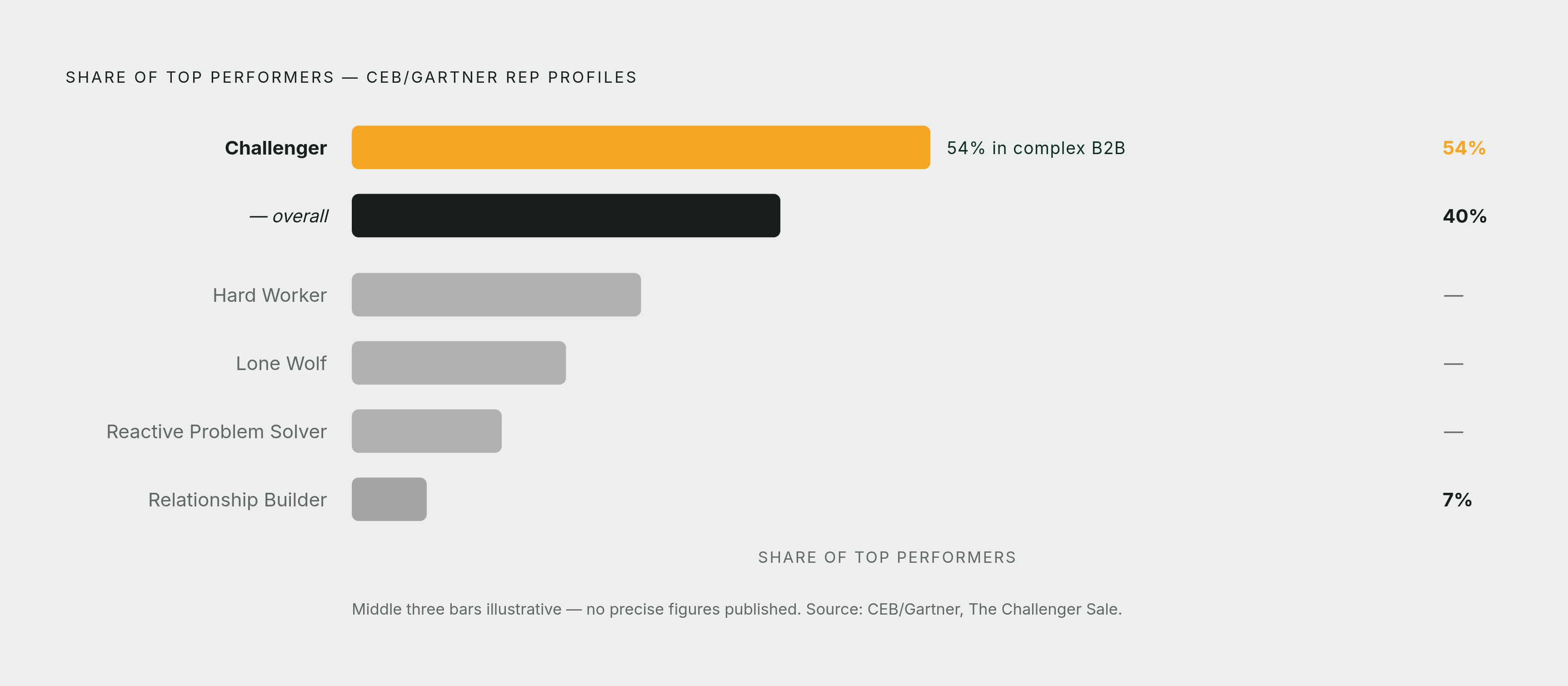
The research sorted reps into five profiles: the Hard Worker, the Relationship Builder, the Lone Wolf, the Reactive Problem Solver, and the Challenger. One finding turned conventional sales wisdom on its head. Relationship Builders, the reps who lead with warmth and rapport and being easy to work with, made up only 7% of top performers. Out of five profiles, that's dead last.
Challengers made up 40% of top performers across the board. Narrow the lens to complex B2B sales specifically, and that number climbs to 54% of high performers. Being liked matters less than being useful in a complicated deal, and being useful means teaching the buyer something they didn't already know. That's the finding the entire methodology stands on.
The three disciplines that define how a Challenger rep sells
Challenger rests on three behaviors. They aren't sequential steps to check off in order. They work together, reinforcing each other inside the same conversation.
Most sales training tells reps to ask questions until the buyer's pain reveals itself. Challenger flips that. Instead of digging for a problem the buyer already knows about, the rep opens with a perspective the buyer hasn't considered yet. That's the whole point of "commercial insight": a piece of information that changes how the buyer sees their own business, and that happens to lead directly toward the seller's solution.
A structured sequence of steps builds that insight, moving the buyer from initial engagement through a reframe of their situation, toward an emotional and rational case that the status quo is riskier than assumed, before the rep ever mentions the product by name. SPIN Selling pulls a realization out of the buyer through careful questioning. Solution selling responds to whatever pain the buyer states out loud. Challenger does neither. It hands the buyer an opinion they didn't ask for, on the bet that a sharp enough opinion beats a warm enough relationship.
An insight that lands with a CFO lands completely differently with a head of operations, or a frontline manager who has to live with the change day to day. Tailoring means adjusting the same core insight for each seat at the table without losing the thread that ties it together. Tailoring the same core insight for every seat at the table is one of the harder skills in a complex sale, and most reps working a room of 6 to 10 people land with only a fraction of them. Tailoring is the mechanism that keeps a stalled multi-stakeholder deal from stalling further. Skipping tailoring means the insight only ever reaches one seat at the table.
This is about who drives the conversation. Challenger reps set the pace and direction themselves rather than waiting to see what the buyer wants to talk about next. That includes deliberately creating tension, not hostility, but a willingness to name the cost of standing still even when it makes the room uncomfortable. Taking control separates a buyer who says "great conversation, let's circle back" from a buyer who actually moves. Without it, teaching and tailoring produce insight with nowhere to go.
How Challenger addresses the multi-stakeholder problem specifically
Thirteen stakeholders, on average, sit inside a modern buying committee. That number alone explains why no single champion, however enthusiastic, can carry a deal to close alone. Consensus has to be built, not assumed.
Dixon and Adamson's 2015 follow-up book, The Challenger Customer, was built to answer exactly that question: who inside the buying group can actually drive consensus, and how do you find them? The framework sorts stakeholders into three archetypes.
Talkers are generous with information. They'll tell a rep what's broken day to day. They usually don't carry the internal weight to convince anyone else to act. Blockers actively resist change and tend to wave off anything an outside seller brings to the table, insight or otherwise. Mobilizers are the hard ones to win over: skeptical, not easily impressed, unwilling to just nod along. That skepticism is what makes them credible once they're on board. Their colleagues trust them because they don't buy things easily.
Sellers naturally gravitate toward Talkers, because Talkers are friendly and accessible and make a rep feel like the deal is progressing. That instinct is the wrong one, and it's the single biggest reason multi-stakeholder deals go quiet. Chasing the easiest conversation in the room feels like progress and produces none. The deal moves when the stakeholder who actually drives change is won over, not when a friendly contact is kept happy. A sales team that measures progress by how pleasant its calls feel is measuring the wrong thing, full stop.
Where Challenger outperforms other methodologies
Neil Rackham's SPIN framework, built on analysis of more than 35,000 sales calls, sequences questions (Situation, Problem, Implication, Need-Payoff) to walk a buyer toward their own realization. That's a strong approach when trust needs to be built slowly and the buyer is genuinely open to exploring the problem together. Challenger assumes something different: the buyer already did the homework and arrived with a fixed view. More questions just confirm what they already believe. A reframe is what actually moves them.
MEDDIC serves a different purpose. It's a qualification and execution framework, checking whether a deal meets defined criteria, who the decision maker is, and how it should be forecasted. It says nothing about shaping a buyer's thinking before that point, which is exactly the gap Challenger fills. Selling into a genuinely new or disruptive category, the two often run at once: Challenger reframes the problem the buyer thinks they have, MEDDIC makes sure that reframe turns into a signed contract.
Challenger earns its keep in complex, multi-stakeholder deals with long cycles, high switching costs paired with well-informed buyers, situations where the buyer's stated requirements are incomplete or wrong, and selling something genuinely new, where the buyer has no existing mental model for the problem being solved. More than a third of complex B2B purchases end with no decision made. Cutting that number is the entire reason the methodology exists.
Challenger backfires just as reliably in the wrong setting. In simple or transactional sales, teaching adds friction to a cycle that should move fast. Renewals and account expansion carry a particular risk, since constructive tension can damage the relationship on which a customer's decision to stick around depends, and existing customers are not a side business to treat carelessly. Commodity and price-driven purchases don't need reframing. They need confirmation. And a rep without real industry depth should not attempt to teach: a provocation with no substance doesn't read as insight, it reads as a stunt, and it burns credibility with the exact stakeholders a rep needs as champions. Running Challenger everywhere, regardless of deal type, is the surest way to make it look like it doesn't work.
What documented outcomes from Challenger implementations show
A methodology consulting firm reports that organizations adopting the model since 2022 have generated more than $1.1 billion in resulting revenue. Treat that figure with some caution: aggregate numbers like this depend heavily on which companies get counted and how "resulting revenue" is defined.
The individual company results are more specific, and more useful for that reason. At SAP, reps trained on Challenger closed 26% more deals, also saw meaningful gains in sales revenue and shorter sales cycles. At Xerox, Challenger adoption was tied to a 17% increase in sales and $65 million in added contract value, alongside a 50% jump in coaching effectiveness once managers had a shared framework to coach against.
One data point cuts straight to the issue of which stakeholder to target, raised earlier: bringing the economic decision maker into the conversation early, a habit Challenger explicitly trains for, is associated with roughly a 55% lift in win rate. That's the effect of targeting the right stakeholder showing up directly in the numbers, not some downstream side effect of good selling in general.
What a Challenger implementation requires from a sales organization
Standing up Challenger properly is not a weekend workshop, and any vendor who pitches it that way is selling something else. The core build runs 12 to 16 weeks: developing commercial insights, designing the teaching pitch, training reps on delivery, then layering in ongoing coaching, often supported by software-assisted call review. Measurable results tend to appear on a 6 to 12 month horizon, not sooner.
The rollout generally follows four phases:
- Assess what the sales team can already do.
- Build commercial teaching strategies around real market insight.
- Translate that insight into stakeholder-specific messaging.
- Coach continuously using actual call data instead of gut feel.
One requirement doesn't appear on any roadmap, and it matters as much as the four phases combined. Challenger asks a rep to hold a genuine, informed point of view about the buyer's business, and that's not something a training deck can manufacture. It works best with experienced sellers who've already built up enough industry knowledge to say something worth hearing. Junior reps, however well-trained on the framework, tend to struggle here, because insight requires depth that no amount of role-play can substitute for.
Then there's time. Real Challenger prep, developing a sharp insight, tailoring it to each stakeholder, takes real hours, and a rep carrying 50 or more named accounts doesn't have unlimited hours to give. That's the actual bottleneck, and it's the one most rollouts underestimate.
How AI tooling extends what Challenger-trained teams can realistically do
That time problem is exactly where AI tooling has started to matter. Commercial insight, stakeholder-specific tailoring, and account-level research all scale badly when done by hand across a large book of business. A rep with 50 named accounts cannot produce 50 well-researched, tailored insights without something picking up part of the load, no matter how good that rep is.
Commercial insight development is where AI's impact appears first. Instead of a rep manually scanning news, analyst reports, and market data for something to lead with, AI tools can monitor those sources continuously and surface trends relevant to a specific account or industry. That doesn't replace the rep's judgment about what the insight means or how to deliver it, and it shouldn't be asked to try.
What it removes is the research burden that used to eat into the hours a rep needed for the part of Challenger no tool can do: reading the room, tailoring delivery on the fly, and taking control of where the conversation goes next. Handing the research to a machine gives back hours that let a rep show the stakeholder who actually drives change that the meeting is worth taking seriously, rather than losing the deal to being written off as another pitch. That's the trade Challenger teams are actually making with AI tooling right now: not a replacement for the skill, just more time to use it.