What Sales Reps Actually Lose When Admin Backs Up
Admin work consumes two-thirds of a rep's week, leaving barely enough time to actually sell.
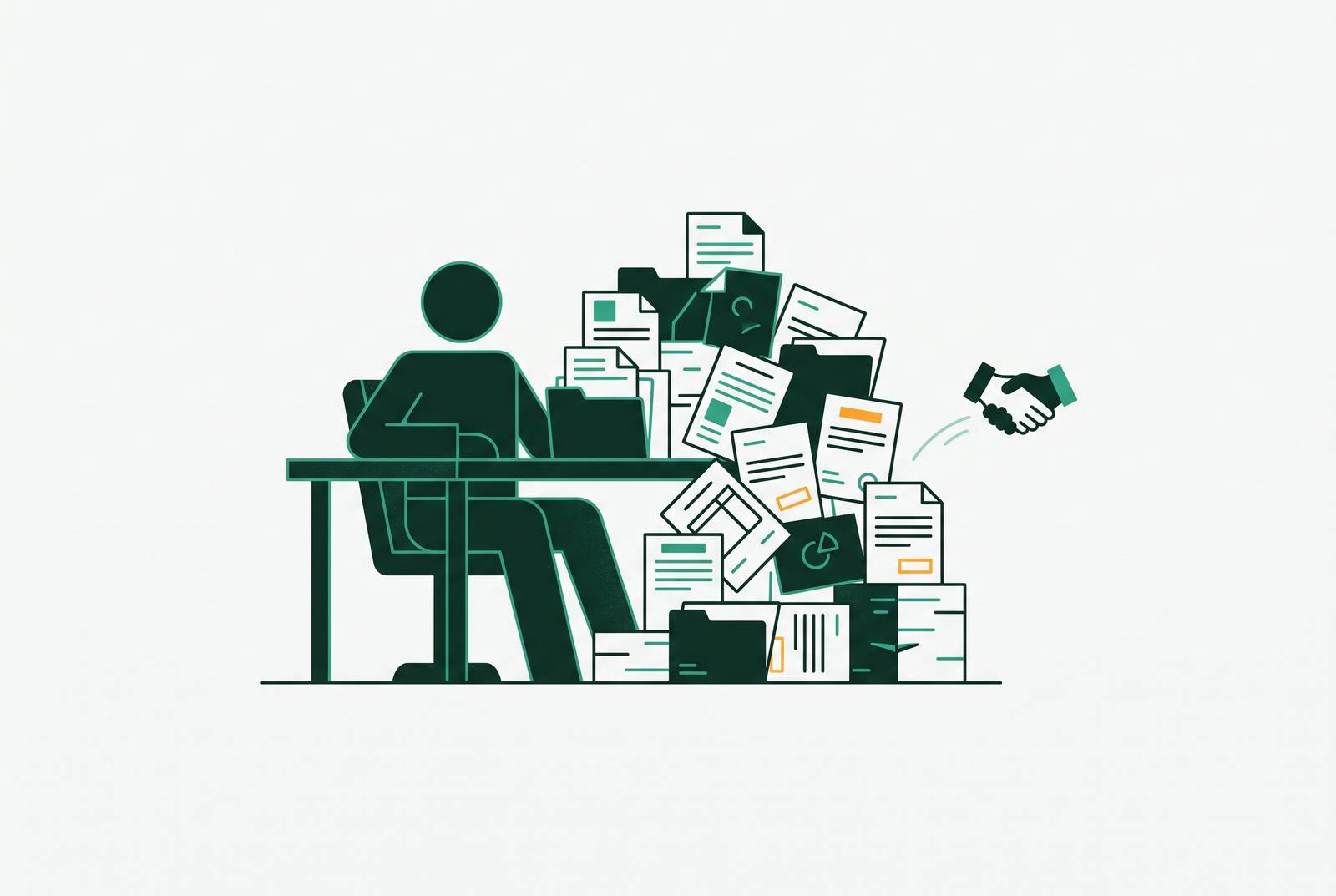
Sales reps spend about 30% of their working week actually selling. Some analyses put the figure even lower, with reps devoting only 28% of their time to actual selling and the remaining 72% to non-revenue tasks like data entry, scheduling, and CRM updates. The other 70% goes somewhere else entirely: admin, internal meetings, data entry, research. And this isn't a rough patch that's about to correct itself. Landbase's analysis of the Salesforce data found the split hasn't moved in five years.
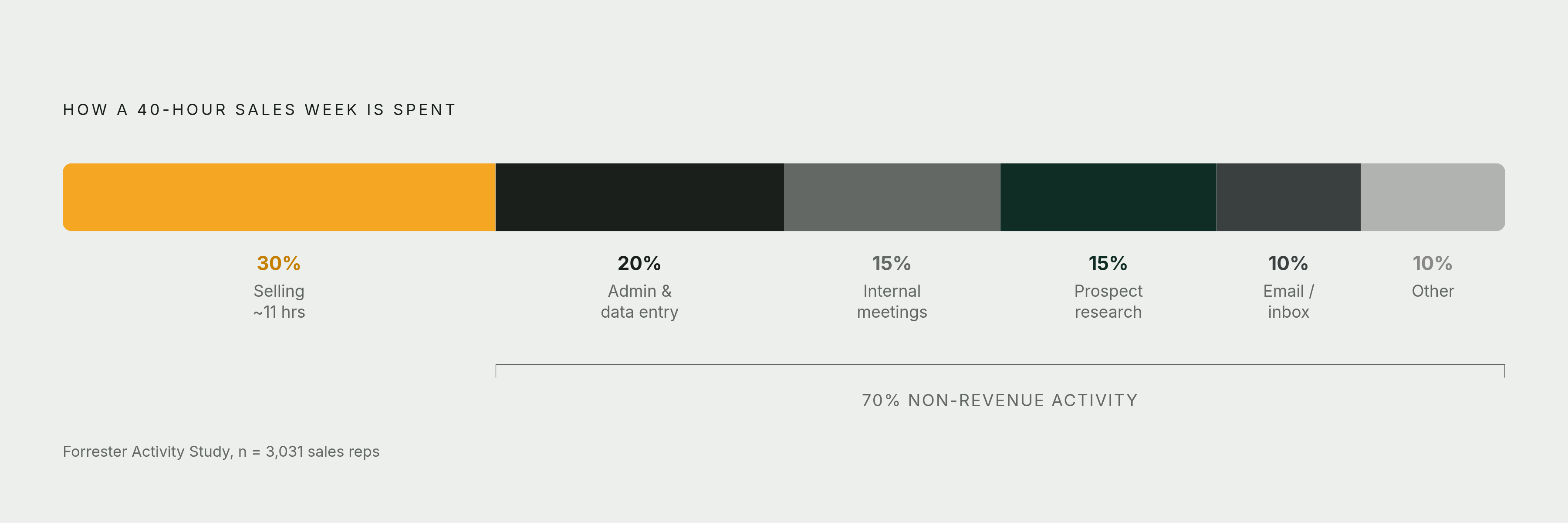
Break the week down further and the picture gets more specific. The Forrester Activity Study, which tracked 3,031 reps across industries, found selling activities take up 30% of the week, admin and data entry take 20%, internal meetings take 15%, prospect research takes 15%, and email or inbox management takes the remaining 10% Salesmotion. Put those numbers in hours instead of percentages, and the picture sharpens even more. The rest scatters across CRM data entry (17%), internal meetings (15%), email and admin (14%), scheduling (12%), and research (14%) Salesmotion.
Eleven hours Salesmotion. That's the ceiling reps are working with before anything backs up Salesmotion. Not the bad week. The normal one. Every problem this piece walks through starts from that number and asks what happens when it shrinks further.
The specific tasks that consume what little selling time remains
CRM data entry is the biggest single drain on that already-thin week. Coffee.ai's sales productivity research finds that reps spend an average of 13 hours a week on manual data entry alone, which works out to about 28% of a standard work week. Add in tool-switching, and it gets worse: reps lose another 3 to 5 hours a week jumping between 5 to 8 disconnected platforms, stacking up to 150 to 250 lost selling hours per rep each year. For field reps specifically, SPOTIO's 2026 State of Field Sales survey found that administrative tasks alone consume 21% of the working week, roughly 8 hours per rep, per week.
Then there's the time spent just looking for things. Salesfully's research found that 71% of reps say they spend too much time entering data instead of selling, and sales teams waste 8 hours a week searching across systems that don't talk to each other. Note-taking and data input appear again as the top complaint: 68% of reps name these as their most time-consuming tasks, and 43% say admin eats between 10 and 20 hours of their week.
Bad data multiplies all of it. Dialing wrong numbers and emailing addresses that bounce, ZoomInfo and Everstage research shows reps lose 27.3% of their working week to this, which comes out to roughly 546 hours a year. Gartner found that 50% of sellers feel overwhelmed by the sheer number of platforms they're expected to use. Each task doesn't just cost minutes, it breaks the rep's train of thought and forces them to rebuild selling momentum from scratch, over and over, all week.
What a backlogged week produces: the quota math
The correlation starts looking hard to ignore. In 2025, 78% of sellers missed quota, up from 69% the year before Salesmotion. Salesforce's State of Sales 2024-25 report puts annual quota attainment at just 28%, the lowest in six years Salesmotion. That share of the week spent selling works out to roughly 11.2 hours, with the other 28.8 hours going to research, CRM updates, internal meetings, and chasing bad data. Quotas were built assuming reps had full selling capacity to work with. They don't, and haven't for years, and the targets never adjusted for that.
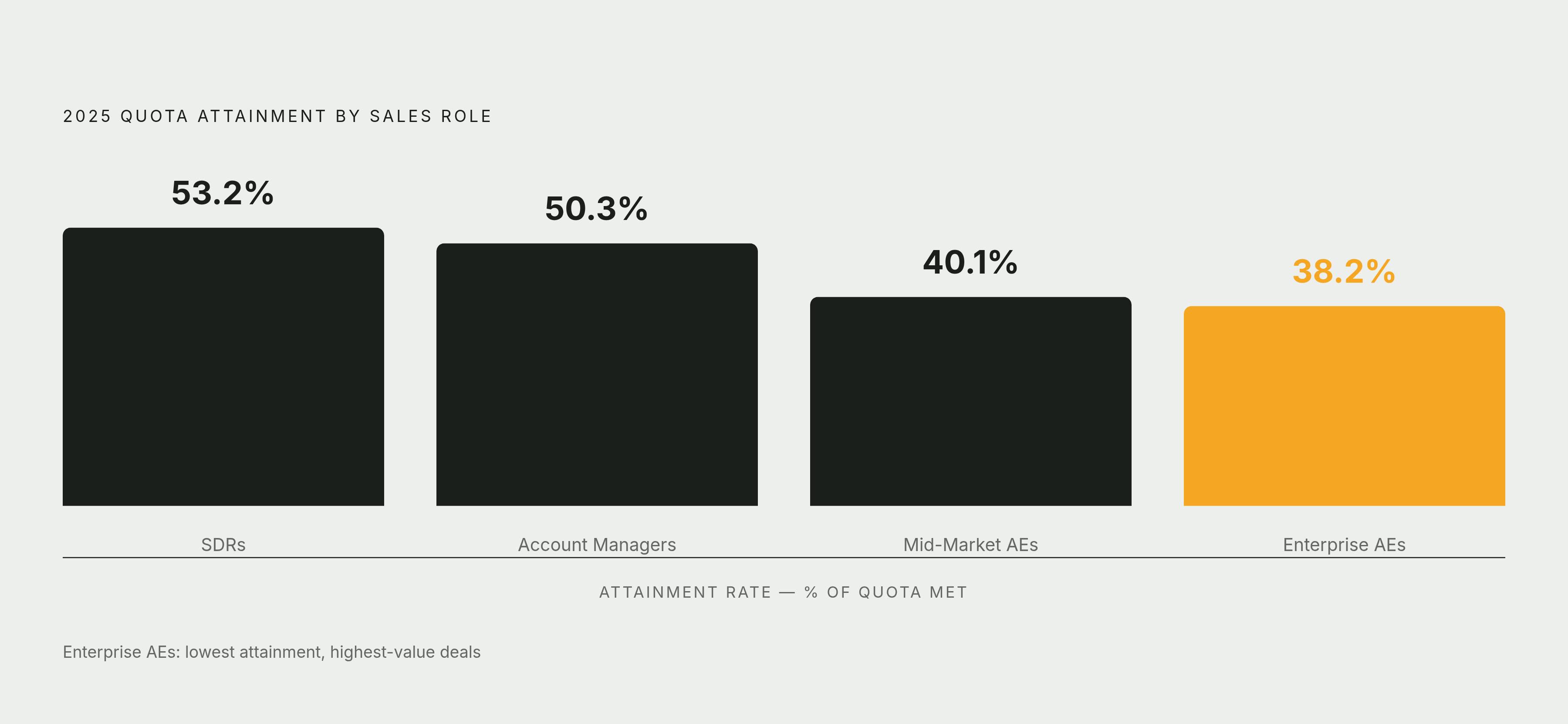
Break attainment down by role and the pattern gets sharper. SDRs hit 53.2% of quota, Account Managers hit 50.3%, Mid-Market AEs hit 40.1%, and Enterprise AEs, who carry the largest and most complex deals, hit just 38.2%. The bigger the deal, the steeper the fall.
Compare top performers to bottom performers and the gap tells its own story. Top performers spend 34% of their time selling Landbase. Bottom performers spend 23% Landbase. That's an 11-point gap, and Landbase's data ties it directly to quota attainment. A separate breakdown of the week finds reps spend 28% of their time selling, with the rest split across CRM data entry (17%), internal meetings (15%), email and admin (14%), scheduling (12%), and research (14%) https://www.salesforge.ai/directory/sales-tools/salesmotion. Is that gap about discipline? Grit? Probably not. Top performers have likely built or adopted systems that protect their selling time from the admin flood Landbase. The gap is structural.
Scale that loss out across a year and it gets almost absurd. Each rep loses the equivalent of 37 selling weeks annually to non-revenue work. Multiply that across a 20-rep team, and the organization is burning through 740 selling weeks of capacity every single year. That's a direct hit on selling capacity itself. That's most of the team's selling capacity, gone before a single quota number gets tallied.
How admin backlog kills deals already in the pipeline
Speed matters more than most reps have time to act on. Ebsta's data shows that deal slippage, meaning delays in response, can cut win rates by 113%. The top 14% of performers act on buying signals the same day they show up Salesmotion. The bottom 86% often take days or weeks, because admin backlog is sitting between them and the buyer.
Follow-up is usually the first casualty. HubSpot data shows 60% of customers say no four times before they say yes, yet 48% of salespeople never make a second contact at all. When CRM upkeep is eating hours, follow-up is the easiest thing to skip, because it's the task with no immediate deadline attached to it Salesmotion. Zapier's survey of 404 managers backs this up directly: 68% say their teams spend between 3 and 10 hours a week just on CRM upkeep, meaning up to a quarter of the working week can vanish before a single follow-up email goes out.
And this is where deals actually die, quietly. Somewhere between 40% and 60% of B2B pipeline gets lost to no-decision every year, and most of that is stalled deals that simply expired without anyone noticing. Admin backlog is the mechanism that lets that happen undetected. Pipeline is also a measure of what's already decaying while it waits. It's also what's already rotting while the rep is buried in CRM entry.
Buyer experience when their rep is buried in admin
Flip the perspective around to the buyer's side of the table, and admin backlog looks like something else entirely: unreliability. Delayed responses, missed follow-ups, inconsistent outreach, these are what a buyer actually experiences when a rep's week is backed up, and Chief Outsiders points out this does long-term damage to customer trust.
Loyalty doesn't just sit there waiting. Buyers expect proactive outreach, fast responses, and steady value, and when a familiar contact goes quiet or slows down, competitors who notice the gap move in. That's a present, ongoing risk. That's what "responsive" and "reliable" actually mean to a buyer evaluating who to trust with a purchase decision.
This risk isn't spread evenly, either. Ebsta's analysis, cited in Everstage, shows that 17% of reps generate 81% of revenue. Everstage's own statistics page attributes the identical figure to Ebsta, describing a skewed performance pattern in which 17% of reps generate 81% of revenue https://www.ebsta.com/ebsta-pavilion-b2b-sales-benchmarks-2024/. When those specific reps are the ones overloaded, the damage is concentrated on the relationships that matter most. It's concentrated on the relationships that matter most.
So admin backlog isn't just a productivity problem. It's a relationship-quality problem wearing a productivity costume. A rep who can't respond fast, can't follow up consistently, or has to re-read old notes to remember where a deal stands, feels unreliable to the person on the other end of it. And the stalled deals from the last section? Those are often lost customers. They're often the buyer's early signal that they've already started looking elsewhere.
How admin overload converts into burnout and turnover
Forbes reporting cited by Chief Outsiders shows two-thirds of sales reps say they feel close to burnout because of excessive workloads. That's not a fringe complaint from a handful of overworked reps. That's the majority experience.
SDRs churn faster than any other sales role, and admin overload and burnout, not compensation, are the leading reason people leave, accounting for 35% of departures. Average tenure in the role is 18 months. Zoom out further and sales rep turnover averages 35% annually across the board, nearly three times the rate seen across other industries. Reps who feel like they have no autonomy over their own time are 34% less likely to hit quota and 44% more likely to start looking for another job.
None of that is cheap to replace. Three departures in a single year costs more than $450,000, and that's before anyone even tallies the quota shortfall those empty seats caused.
And the cycle feeds itself. Every rep who leaves means the reps who stay pick up more accounts, more admin, more backlog, which pushes them closer to leaving too. It's not a coincidence that this concentrates on the small group of reps generating most of the revenue. Given that 17% of reps generate 81% of it, burnout isn't spread evenly across the team. It lands hardest on the people the organization can least afford to lose.
Why the problem compounds quietly
Part of what makes this dangerous is the lag. Quota misses, turnover, stalled pipeline, these appear weeks or quarters after the admin backlog that actually caused them. By the time the signal is visible, the damage has already compounded past the point of an easy fix.
Activity metrics make it worse, because they're measuring the wrong thing. A rep logging a high volume of emails and CRM updates looks busy, looks productive even Salesmotion. But if those emails are admin-driven rather than buyer-facing, the metric is rewarding exactly the behavior that's eating selling time. It's tracking motion, not progress.
Tools get added specifically to fix fragmentation, and instead they often deepen the exact problem they were meant to solve. Gartner found that half of sellers feel overwhelmed by the number of platforms they're required to use. Tools get added specifically to fix fragmentation, and instead they often deepen the exact context-switch fatigue they were meant to solve Gartner. More software isn't automatically less backlog.
Even managers, who are closest to the problem, seem to have made peace with it. The Zapier survey found 68% of managers acknowledge their teams spend 3 to 10 hours a week just on CRM upkeep. That's not managers missing the symptom. That's managers who've normalized it, treating CRM hygiene as an unavoidable cost of doing business rather than what it actually is: a slow, compounding leak of revenue. What would surface the problem earlier? Response lag by deal stage. Follow-up gap rates. Time-to-update in CRM after a buyer interaction Salesmotion. These are visible in the data before quota miss appears on a dashboard.
Automating admin work alongside the rep's existing workflow
McKinsey research, cited in Docusign's analysis, found that automating non-customer-facing work, combined with shifting some tasks to shared services, can free up roughly 20% more sales team capacity. That's the scale of what's actually on the table here. Not a marginal improvement. A meaningful chunk of the week back.
But there's a condition attached, and it matters more than the headline number. Automation only compounds the benefit if it runs inside the tools a rep already uses. A tool that requires a new platform, new manual data entry, or constant prompting adds friction before it removes any. The design principle that actually works is quiet integration with what's already there: Salesforce, HubSpot, the inbox, the calendar.
What does that recovery look like in real numbers? Salesforce's State of Sales report found sellers using AI agents expect a 34% reduction in research time and a 36% reduction in time spent drafting emails Landbase. Salesforce's official State of Sales 2026 announcement confirms sellers expect agents to cut email drafting time by 36% https://www.landbase.com/blog/how-ai-sdr-agents-boost-conversions-by-70-2025. That's a concrete, measurable gain in hours." That's hours coming back into the week, specifically from the tasks named earlier in this piece as the biggest drains.
Concretely, this looks like CRM updates happening on their own after a call or an email, without the rep having to sit down and log it. It looks like follow-up drafts ready to go before the rep even has to remember they're overdue. It looks like deal context that travels with the rep instead of living scattered across notes nobody can find later. Nextstep is one option built around exactly this idea: it runs alongside inbox, calls, and CRM, drafts replies, logs updates, and books next steps for the rep to review and approve, integrates directly with Salesforce and HubSpot, and learns a rep's tone and deal context without needing constant manual prompting.
None of the losses mapped across this piece, the missed follow-ups, the stalled deals, the burned-out reps walking out the door, get solved by telling reps to work harder or manage their time better. They get solved by removing the structural tax that admin backlog places on every single hour a rep has to work with.
Sources
- Why Sales Reps Spend Less Than 30% of Their Time Selling (And What to Do About It) | Landbase
- How to Measure and Improve Sales Productivity in 2026
- Sales Reps Spend 70% of Their Time on Admin
- Sales Time Management: How Top Reps Spend Their Day | Salesmotion
- Why Reps Spend 72% of Their Time NOT Selling (And How to Fix It) | Salesmotion
- Gartner Sales Survey Finds 67% of B2B Buyers Prefer a Rep-Free Experience
- Sales Rep Turnover Statistics 2026: The Real Cost of Rep Churn — Gangly Blog