What Reps Do in the 30 Minutes After a Sales Call
Top reps lock down deals in the half hour after hanging up, not during the call itself.
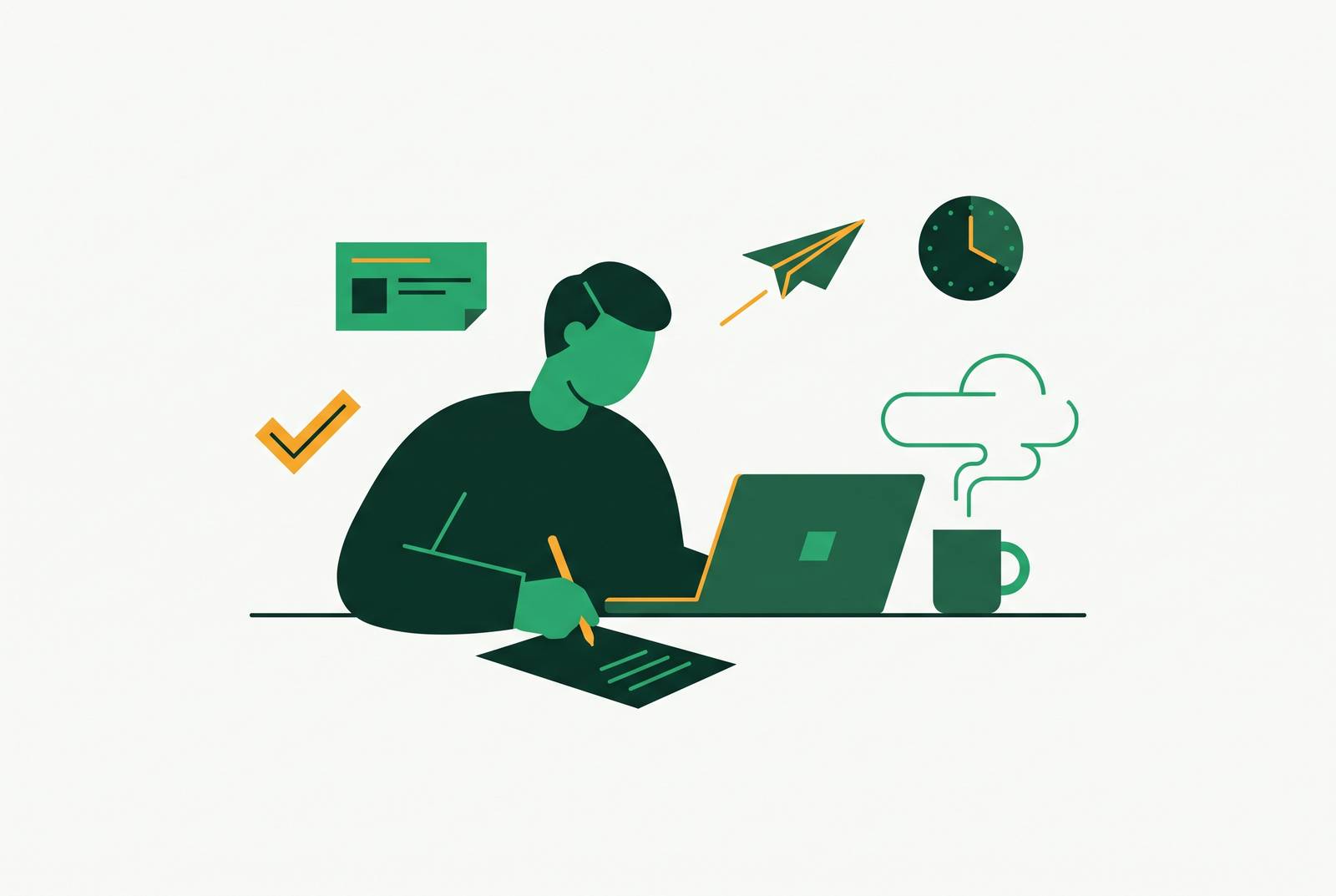
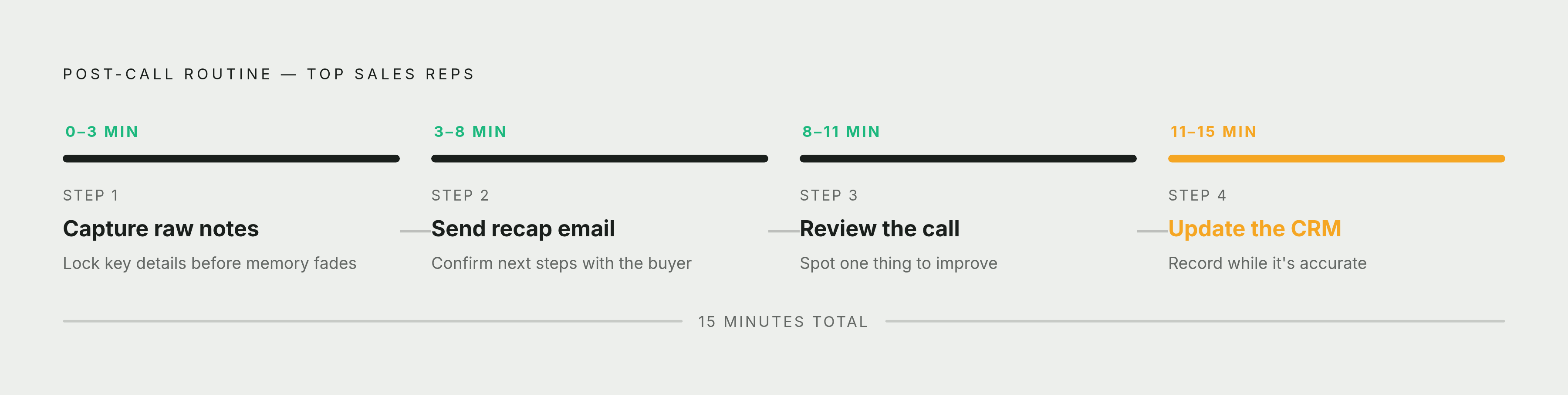
A sales call can go great and the deal can still die in the next three weeks. That isn't a contradiction, it's what happens when a rep treats the hang-up as the finish line instead of the starting gun. Top reps run a structured sequence after a call ends, and that sequence, not the call itself, is where deals actually get won or lost. Everything that follows in this piece breaks that half hour into four steps, each one depending on the step before it.
Step 1 (0–3 min): Capturing raw notes before memory degrades
The first move after hanging up is writing down what actually happened, in detail, before any of it fades.
What goes into those notes matters more than how long they take to write. A useful note covers the prospect's pain points in their own words, who else is involved in the decision and on what timeline, whether the budget numbers given were real or a dodge, what signaled genuine interest, and anything that felt like hesitation or a competing evaluation in progress. Tone counts too. How the prospect sounded carries information that a transcript of their words alone won't capture.
The payoff appears weeks later, in deals where a rep can step back in with full context, not immediately. Specific notes let a rep step back into a deal with full context, while generic notes force a rep to re-ask questions the prospect already answered, which reads as sloppy and makes the prospect wonder if anyone was listening the first time. Sales Gravy's research on top performers found that one hallmark habit is opening every sales presentation with a quick recap of the prospect's own situation, and that's only possible if the notes from the prior call actually exist. No notes, no recap. No recap, no trust that the rep remembers who they're talking to.
Step 2 (3–8 min): Writing a recap email that uses the prospect's own language
With notes in hand, the next five minutes go to a recap email, and it needs to go out while the conversation is still fresh in the prospect's head, not polished and sent the next morning. A weak version reads, "Great talking today, let me know if you have any questions, talk soon." A tight version restates the prospect's problem back to them in the words they used to describe it, lists every action item with a name and a date attached, stays short enough to read in one glance on a phone, and closes with "Anything I missed?" instead of "Let me know if you have questions". The first question invites a reply. The second gives the prospect permission to do nothing.
Language choice is strategy here. A subject line that mirrors the prospect's own phrasing and situation can lift open rates by up to 26% according to industry analysis, and Yesware's research on closing the call names "ending without confirming next steps" as the single most common mistake reps make. Vague sign-offs like "talk soon" hand the prospect zero reason to respond, because there's no specific next step attached to respond to.
Sales Gravy lists following up after the first call as one of the non-negotiable habits separating top performers from everyone else, noting that a rep cannot rely on the prospect to call back.
Some reps push back here. They argue a more thoughtful, better-written email sent a few hours later beats a rushed one sent immediately. The recency window doesn't hold open that long, though. It closes within hours, and a short, timely email built from the prospect's own words consistently beats a polished one that lands the next morning after the conversation has gone cold in the prospect's mind.
Step 3 (8–11 min): Reviewing the call itself, not just the outcome
This step is about the rep, not the deal. It's about the rep. The first two steps and the fourth one all serve a specific prospect and a specific pipeline entry. This one serves the next call, with somebody else on the other end.
Most reps skip it. They log the outcome, hit send on the recap, and move straight to the next thing on the calendar, carrying the exact same blind spots into the next conversation. That's how weak discovery, awkward follow-ups, and prospects going quiet after a strong demo turn into patterns instead of one-off bad luck.
The step itself only takes three minutes, but it's the one place in the whole routine where a rep can pin down a specific moment in the call that caused friction or got missed entirely. Did the prospect give a signal that went unanswered, and if so, how did the rep respond? Did the rep talk more than the prospect, and if so, at what point did that start? What would the first two minutes look like done differently?
Sales Gravy's research on top performers points at the same gap: the best reps clarify instead of assuming, and this window is where a rep notices the moments they guessed at instead of asking directly. Hyperbound frames this reflection loop as the place where self-coaching actually happens, and it's also the piece of development most likely to vanish entirely when a rep jumps straight from sending the email to updating the CRM. Tools like Gong and Chorus from ZoomInfo can pull up the exact moments from a call transcript, but deciding what those moments mean and what to change next time still falls to the rep doing the reflecting.
Step 4 (11–15 min): Updating the CRM while the details are still accurate
The last four minutes go to the CRM, and whether that data is worth anything to anyone later depends on the timing here. A CRM update entered right after the call reflects what actually happened. One entered hours or days later is a reconstruction built from a fading memory, and that gap is where pipeline visibility, forecasting, and coaching all start to break down.
A useful update after a call covers a handful of things. The deal stage, and whether it moved from where it sat before the call. The qualification fields, updated with what the prospect actually said rather than what the rep assumed, whether that's MEDDPICC fields, BANT answers, or simply naming the decision-maker. A short summary of the prospect's stated priorities, again in their own language. Any red flags or mentions of a competitor in the mix.
This step is what makes the first three steps visible to anyone besides the rep who did them. The notes, the recap email, and the three minutes of reflection reach a sales manager, a forecaster, or the teammate who inherits the account later only if they land in the CRM accurately. That's the whole function of this step: it turns private effort into shared, usable information.
It's also the step that collapses first, and for a clear reason. CRM entry is manual work that gives the rep who does it nothing back in the short term. The benefit flows to managers, to forecasters, to whoever handles the account next, not to the person typing it in. Unreliable data doesn't just sit there quietly, either. Sales managers start building parallel tracking systems to compensate, forecasts turn into guesswork, marketing attribution breaks down, and handoffs between account executives and customer success teams lose the context that made them useful in the first place. Research cited from grademyclose.com and industry analysis describes the same pattern across sales organizations in different industries: conversations happen out in the field, CRM updates happen much later if they happen at all, details fade in the gap, and coaching has nothing accurate left to work from.
Why most reps skip or compress these steps (and what it costs them)
None of this breaks down because reps are lazy or undisciplined. It breaks down because the routine runs straight against how reps get rewarded. Time in front of prospects gets measured, praised, and paid for. The fifteen minutes of notes, email, reflection, and CRM entry that make that time count for something later competes with an already full week, and it's easy to see why it loses.
The CRM step in particular collapses first and most reliably, because it's the one piece of the whole routine that gives nothing back to the person doing it in the short term. The data serves the organization.
Skipping the window costs something in three different places. The rep carries the same skill gaps from call to call with no structured moment to even notice them, let alone fix them, and teams that get coached consistently hit quota at dramatically higher rates than teams coached only occasionally. The prospect feels the deal go soft: next steps that were never pinned down, a recap email that never showed up, follow-ups that feel like they're starting from zero because they are. The organization loses pipeline visibility, forecasting turns unreliable, and coaching has to run on self-reported summaries instead of what actually happened on the call.
There's a coaching gap layered on top of all this too. Hyperbound and MySalesCoach's State of Sales Coaching 2026 report found a real disconnect between how often managers believe coaching is happening and how often reps say they're actually receiving it, which suggests that even where a reflection loop exists on paper, it often isn't closing in the way anyone assumes. Klenty's research on follow-up calls found that most sales that close require multiple follow-up touches, yet a large share of reps give up after one conversation. The post-call routine makes that first follow-up informed enough to earn a second one.
Automating the Admin Layer
Automating the administrative pieces of this routine, the note capture, the CRM entry, the first draft of the recap email, removes the friction that causes reps to skip them in the first place. It doesn't replace the reflective discipline that separates good reps from great ones.
Conversation intelligence platforms already join calls automatically, transcribe them in real time, flag action items, and draft a follow-up email for a rep to review before sending. Gong, Chorus from ZoomInfo, Avoma, and Salesforce Einstein Conversation Insights are all in this category. A newer wave of agentic tools pushed further into this territory in late 2025, including Gong's "Action," HubSpot's "Breeze Copilot for Sales," and Salesforce's Agentforce, each treating the post-call workflow as something to automate rather than just something to analyze after the fact. CallJune.AI, launched in November 2025, takes a different angle entirely: a rep calls June right after talking to a customer, June listens, asks questions that push the deal forward, sharpens the next steps, and writes the CRM update automatically in about two minutes.
Crafting and sending the recap email within the critical window is where timing matters most, and that's exactly where automating the operational overhead without losing personalization pays off. Nextstep runs alongside the inbox, the calls, and the CRM to draft replies, log updates, and book next steps automatically, integrating with Salesforce and HubSpot and learning a rep's tone and deal context so what it produces fits without manual prompting.
Step 3 still doesn't automate away, and tools built for practice reflect that. Hyperbound and Second Nature let reps rehearse specific moments pulled from a real call, the objection that got fumbled, the question that never got asked, turning reflection into a structured practice loop instead of a skipped step.
The strongest case against leaning too hard on automation is worth taking seriously: if the CRM fills itself in and the email writes itself, a rep can quietly stop paying close attention during the call in the first place. Automation can clear out the admin work that keeps getting skipped. The attention, the listening, and the three minutes of honest reflection after the call still belong to the rep, and no tool does that part for them.
Sources
- 30 Closing the Call Statements to End Conversations (2025 Guide)
- 17 Best Practices of Top Performing Salespeople
- What to Do in the 15 Minutes After a Sales Call
- Best Follow Up Email After Sales Call Tips
- What to Do After a Sales Call: 8 Steps to Turn Conversations Into Closed Deals
- 7 Essential Practices To Make Follow-up Calls in Sales
- Tips to build a structured post-call routine to improve deal closing rate
- How to Get Your Sales Team to Actually Update the CRM (2026 Guide)